Face Games -When Good Faces Go Bad
by M.A.Tucker January 20th, 2025
Face Games -When Good Faces Go Bad
by M.A.Tucker January 20th, 2025
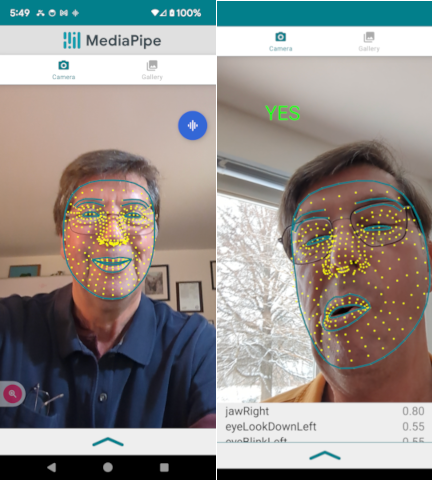
Face Landmarks: the author smilingly symmetric (left); playing face games (right)
Why?
Your face is amazing! The range of expression, from subtle or nuanced cues to obvious or powerful emotions, is one of the hallmarks of human communication. Face games are one of the earliest developmental areas for people. Think about an infant with a gurgling smile when she recognizes her mother or father or the scowls of outraged indignation when he’s being fed something disagreeable.
By the time most of us are adults, we’ve mastered an extensive range of expressions. We often generate expression without even conscious thought — the tender glance toward a loved one, the indifferent dismissal of a suitor, the piercing glare of anger, or the delighted recognition of an old friend. More than any other part of your body, your face is uniquely YOU.
What happens when a good face goes bad?
What?

Facial Palsy aka Bell’s Palsy is the result of an inflammation of a facial nerve bundle. Doodles by the author.
Facial nerve bundles emerging from behind the ears on the left and right sides of the face control the muscles on that side of the face. When these nerves are working well, a full range of expressions is possible and often the expressions are symmetric (e.g. smile or frown).
An inflammation of one of the nerve bundles (Facial Palsy aka Bell’s Palsy) can cause the nerves signals on that side of the face to not reach the muscles. This causes a number of issues: drooping of the affected eye and lip, excessive tearing or dryness in the affected eye, loss of some taste, difficulty eating and possibly enunciating while speaking. In addition, when the signals from the facial nerve are blocked or degraded, the face muscles quickly atrophy.
So What?
Though the physical effects are pronounced, the emotional effects are more difficult to imagine. When you look in a mirror or a camera, YOU don’t look like YOU to YOU (or others). People may jerk their heads around to stare. It’s obvious something is very “off”. On the bright side, most people can recover in over 6 to 12 months. Your body is amazing at healing. The nerve inflammation is no exception. However, the face muscles will need plenty of exercise to return to peak form.
What’s Next?
To assist your body in recovery, Physical Therapy (PT) is recommended. This consists primarily of (you guessed it!) — Face Games. The Oxford University Hospitals (NHS Foundation Trust) have a wealth of information to help with this effort along with a Face Board Game. Collections of playing cards showing an extensive array of facial exercises/expressions are useful for guidance and encouragement. The game board has a track with different types of exercises as you progress through the game. For detailed information and a free downloadable game PDF, please visit https://www.ouh.nhs.uk/services/departments/specialist-surgery/plastics/facial-palsy/documents/facial-palsy-game-board.pdf
Oxford University Hospitals Face Board Game snippet.
Imagine deciding to climb a mountain and scale a rocky spire. You might start by building endurance with long distance street walking, expand to practicing traversing rough terrain, include some free climbing and then put it all together to scale the mountain. This could easily take 3–6 months to build the required muscle and savvy.
Purposely, lifting the lip or eye to achieve symmetry could be as arduous an undertaking.
What About Fun?
The Physical Therapy descriptions note prominently that progress will be imperceptible. How do you motivate and keep the motivation up over a long haul? I’d at least want a “step counter” app tracking the effort and providing visibility into even seemingly imperceptible progress.
With progress in machine learning, apps to stream real-time video, model facial landmarks and evaluate symmetry or expression matching are accessible. Explanations https://ai.google.dev/edge/mediapipe/solutions/vision/face_landmarker and code repositories https://github.com/google-ai-edge/mediapipe-samples/tree/main are well done. The app used in this article can be found here: https://github.com/blu3crab/SamFaceX . It is primarily the Google sample code with a few modifications (yes-no head nod recognition).
You could track your exercises and get a better evaluation than “it looks a bit better”. For example, a “Signal Strength” metaphor might overlay the observed lip position vs the ideal.

Adopt a “Signal Strength” metaphor for visualization overlays? Doodles by the author.
A skeptic might suggest that this is not the time or place for FUN & GAMES. However, I beg to differ. When it’s fun, learning accelerates and there may be more frequent exercising. A Face Game app could provide good visuals on progress but how would you make it FUN?
There are individuals who spend an inordinate amount of time working to learn seemingly inscrutable rules in order to achieve imaginary objectives. They are called Gamers. I am fortunate to know some of those people. What makes a game fun? Is it the challenge, the mastery of a difficult set of interrelated aspects which together lead to unexpected outcomes? How does surprise play into fun? How does status and “winning” figure into game fun.
The answer to these questions (if they exist), Dear Reader, belong in another story. ;}

The author with a skeptically raised eyebrow, whistling past the graveyard?
메타데이터
- post_id
- 3a8fe2afc0bf
- slug
- face-games-when-good-faces-go-bad-3a8fe2afc0bf
- url
- https://medium.com/@matucker/face-games-when-good-faces-go-bad-3a8fe2afc0bf
- canonical_url
- https://medium.com/@matucker/face-games-when-good-faces-go-bad-3a8fe2afc0bf
- author_url
- https://medium.com/@matucker
- status
- ok
- fetched_at
- 2026-06-24 11:06:28