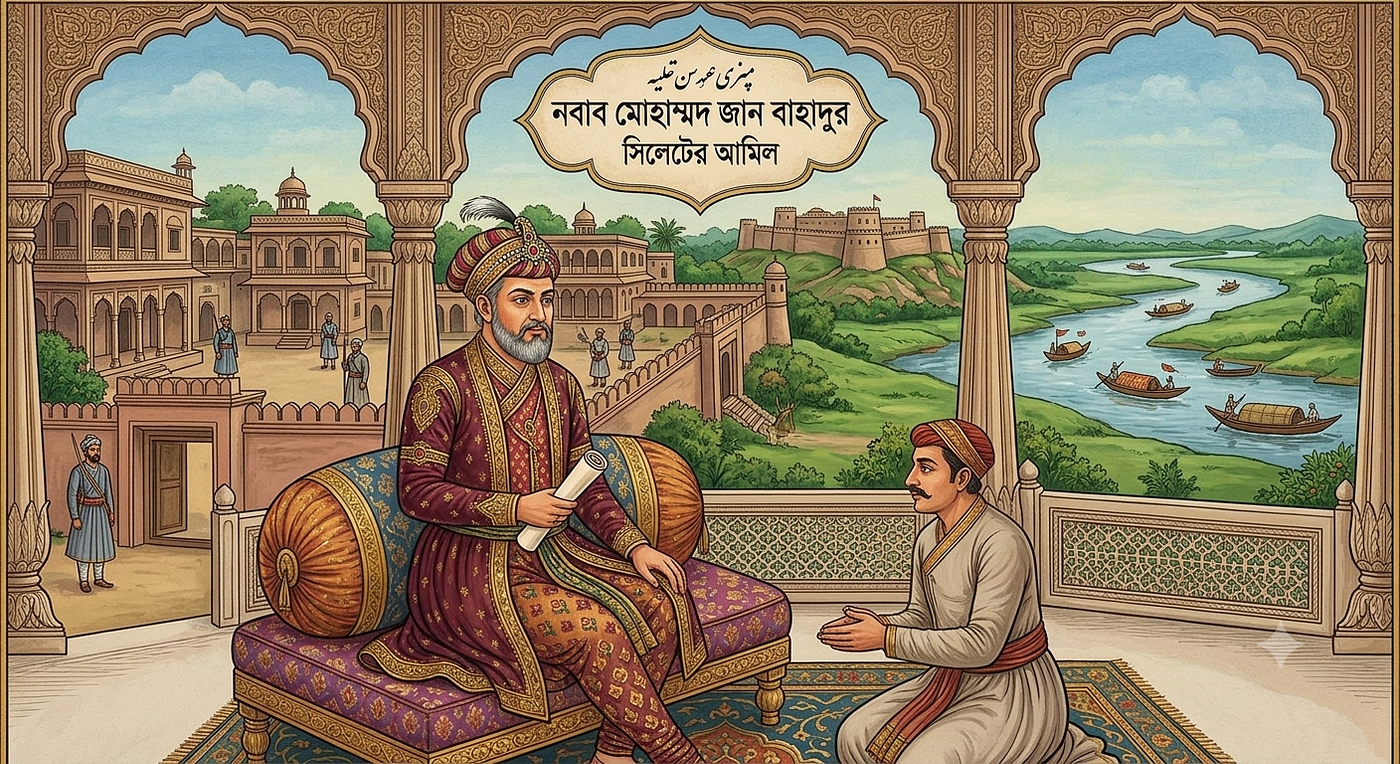
The Fractured Northeast: How the Dreams of a Greater Bengal and Unified Assam Collapsed (1946–1947)
The map of South Asia almost looked radically different. As British colonial rule neared its end, the dominant geopolitical debate was not…
The Fractured Northeast: How the Dreams of a Greater Bengal and Unified Assam Collapsed (1946–1947)
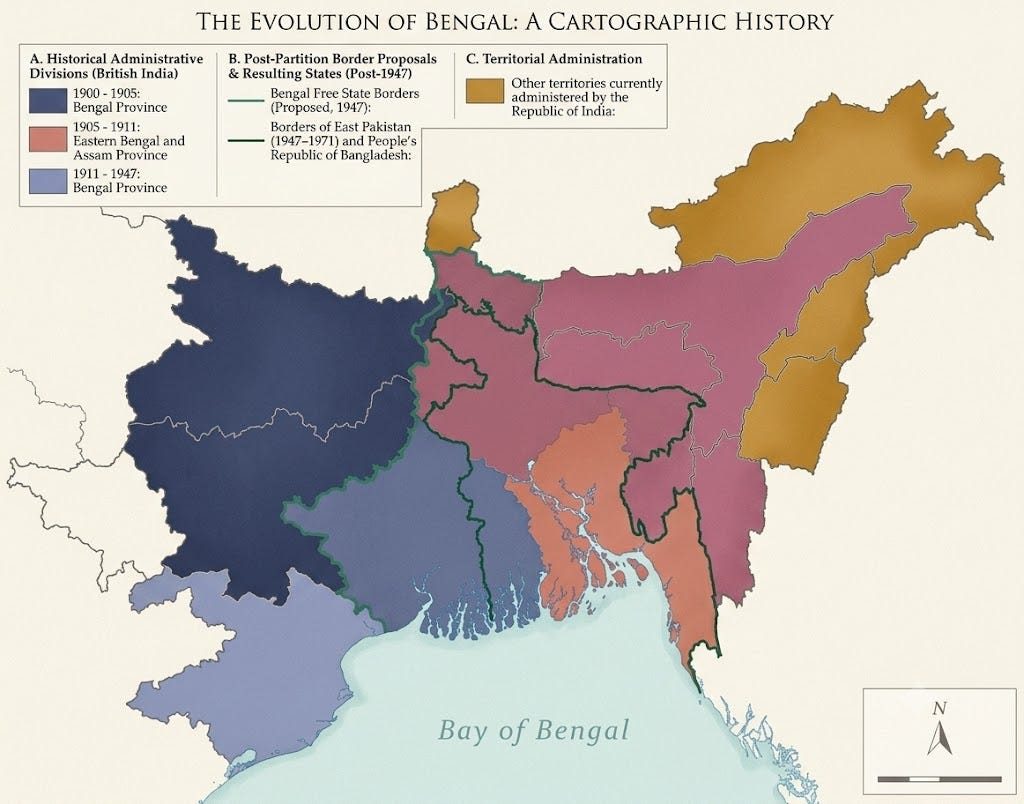
The map of South Asia almost looked radically different. As British colonial rule neared its end, the dominant geopolitical debate was not simply whether India would be bifurcated into two nations, but whether the vast, resource-rich northeastern frontier could form a sovereign, third power bloc. This blueprint evolved through two distinct phases: first, a massive constitutional grouping that bound Bengal and Assam together; and second, a last-ditch effort to build an independent, Sovereign United Bengal.
The plan collapsed under a combination of unyielding high-level political vetoes and explosive street-level communal mobilization. The chronological collapse of this grand northeastern territory reveals how the actions of grassroots organizers, including the macro-politics of leaders like Gopinath Bordoloi and Dr. Syama Prasad Mukherjee, altered history.
1. The Constitutional Blueprint: Group C (May 1946)
The concept of a unified northeastern zone first materialized under the British Cabinet Mission Plan in May 1946. Aiming to preserve India’s structural unity while addressing the Muslim League’s demands for autonomy, the British proposed a three-tier federal structure. The provinces were to be arranged into three compulsory groups:
- Group A: Hindu-majority heartland provinces.
- Group B: Muslim-majority provinces in the Northwest.
- Group C: A dominant eastern bloc comprising the entirety of Bengal and Assam.
Who Was Ready to Accept It?
The Muslim League, led by Muhammad Ali Jinnah, accepted the plan. To Jinnah, Group C represented a highly powerful eastern zone where Muslims held a demographic majority. Crucially, Jinnah viewed Group C as a stepping stone; once the bloc was established, nothing would constitutionally prevent it from seceding later to form a grand Eastern Pakistan. The Indian National Congress also gave tentative, initial assent to the broader framework, believing it preserved a unified central government.
Who Stopped It?
The primary opposition came from Gopinath Bordoloi, the Premier (Chief Minister) of Assam. Bordoloi realized that in a joint Group C assembly, Bengal’s massive population would completely overwhelm Assam. Assam, which had a distinct cultural, linguistic, and non-Muslim majoritarian identity, would effectively be swallowed by a Muslim League-dominated regional constitution.
Bordoloi chose open confrontation over standard party discipline. He bypassed reluctant elements of the Congress high command and directly petitioned Mahatma Gandhi. Gandhi gave him an unequivocal directive:
“Assam must not lose its soul. It must uphold it against the whole world… It is an impertinent suggestion that Bengal should dominate Assam.”
Bolstered by Gandhi, Bordoloi forced the Assam Legislative Assembly to pass a formal resolution in July 1946, refusing to sit in the section with Bengal. Shortly after, Jawaharlal Nehru issued his famous July 1946 press conference, stating Congress would enter the assembly “completely unfettered,” signaling that compulsory groupings like Group C could be rejected. Spooked by this retraction, Jinnah withdrew the League’s acceptance of the Cabinet Mission Plan and called for a direct show of street strength.
2. The Street Catalyst: Direct Action and the Calcutta Riots (August 1946)
With the Cabinet Mission Plan unraveled, the Muslim League declared August 16, 1946, as Direct Action Day to press their demand for a sovereign Pakistan. In Bengal, the provincial Premier, Huseyn Shaheed Suhrawardy, declared the day a public holiday, clearing the streets for a massive political demonstration.

At this crucial juncture, the student leaders worked to maximize crowd turnout. Student cadres spent weeks delivering fiery speeches, distributing leaflets, and mobilizing the Muslim working-class and student demographics of Calcutta to gather at the massive Maidan rally.
While the League’s leadership framed Direct Action as a political strike, assembling a hyper-charged, communally polarized crowd in a volatile city proved catastrophic. On the morning of August 16, the mass mobilization spilled over into localized altercations, which instantly metastasized into the Great Calcutta Killings.
The Domino Effect: The Noakhali Riots (October–November 1946)
The violence in Calcutta acted as a horrific regional accelerator. In October 1946, rumors and highly exaggerated accounts of the Calcutta killings reached the rural, Muslim-majority districts of Noakhali and Tippera in East Bengal.
What followed was a devastating wave of targeted communal violence against the local Hindu minority. Local networks, often organized by local religious leaders and disgruntled elements aligned with the League’s harder factions, launched systematic attacks resulting in massacres, forced conversions, arson, and large-scale displacement.
The Destruction of Political Legitimacy

The Noakhali riots completely crippled the political standing of Premier Suhrawardy’s government. Even though Mahatma Gandhi launched a historic, grueling barefoot peace march through the villages of Noakhali to restore calm, the psychological damage was permanent.
For the regional Hindu population and leadership, Noakhali was absolute proof of a terrifying reality: if a provincial Muslim League administration was in charge, the state would either actively participate in or stand idly by during the destruction of Hindu life and property. Any remaining hope for peaceful coexistence within a unified, undivided provincial boundary died in the fields of Noakhali.
4. The Last-Ditch Effort: Independent United Bengal (Spring 1947)
By April 1947, the British had announced their definitive plan to leave India, and the partition of the subcontinent along religious lines was inevitable. Realizing that a standard partition would slice Bengal in half and strip the eastern portion of its economic anchor, Calcutta, Premier Suhrawardy launched a desperate counter-strategy: the Sovereign United Bengal Proposal.
Suhrawardy joined forces with progressive Congress leader Sarat Chandra Bose (brother of Netaji Subhas Chandra Bose) and Muslim League leader Abul Hashim. On May 20, 1947, they formalized a five-point plan for an independent “Free State of Bengal”.
The Core Features of the Proposal
- Bengal would be a sovereign state entirely separate from both India and Pakistan.
- It abandoned separate electorates in favor of a joint electorate system with proportional representation.
- Power-sharing was mandated: if the Prime Minister was a Muslim, the Home Minister must be a Hindu, and the military and civil services would be split equally between both communities.
Who Was Ready to Accept It?
Surprisingly, Muhammad Ali Jinnah initially sanctioned the plan. Jinnah reasoned that a unified, independent Bengal — even if separate from Pakistan — was far better than a partitioned Bengal that handed West Bengal and Calcutta to India. Sarat Bose also presented the plan to Mahatma Gandhi, who gave it a remarkably sympathetic and attentive hearing.
5. The Final Veto: Why the Proposal Failed
The United Bengal plan did not fail because its constitutional text was flawed; it failed because the ground beneath it had been thoroughly burnt. The ultimate obstacle to a sovereign, unified Bengal was Dr. Syama Prasad Mukherjee, the leader of the Hindu Mahasabha.
Mukherjee launched a relentless, highly successful counter-campaign demanding the partition of Bengal. His primary and most devastating political weapon was the memory of the August 1946 Calcutta Riots.
Mukherjee argued that the Suhrawardy administration had failed to protect citizens during the Great Calcutta Killings and the subsequent Noakhali riots. He successfully convinced the Bengali Hindu middle class (Bhadralok) and the national Congress leaders — Jawaharlal Nehru and Sardar Vallabhbhai Patel — that an independent, United Bengal would quickly become a puppet of Pakistan, leaving the Hindu minority completely vulnerable to communal domination or slaughter.
Failure of United Bengal
The actions of grassroots organizers are directly linked to the structural failure of the United Bengal dream. By successfully mobilizing the aggressive, communally charged street power that triggered the 1946 massacres, the Muslim League activists created the exact environment of terror that their opponents needed.
Dr. Mukherjee used the horrific results of that mobilization as absolute proof that a unified, Muslim-majority state was a lethal proposition for Hindus. Without the mass violence of 1946, Mukherjee’s arguments for partition would not have achieved the overwhelming public backing necessary to force the Congress High Command’s hand. The street-level mobilization effectively provided the political ammunition that destroyed Suhrawardy’s top-level diplomatic maneuvers.

6. The Aftermath: Redrawing the Frontier
The fate of the region was sealed on June 3, 1947, with the announcement of the Mountbatten Plan. On June 20, 1947, the Bengal Legislative Assembly met and formally voted to partition the province along religious lines.
- West Bengal, including Calcutta, was integrated into the Union of India.
- East Bengal became East Pakistan.
- Assam remained a separate state within India, entirely stripped of its compulsory connection to Bengal, save for the Muslim-majority district of Sylhet, which voted to join East Pakistan via a localized referendum.
The failure of these unified territories entirely reconfigured the political destiny of their participants. Dr. Syama Prasad Mukherjee entered India’s first cabinet and later founded the Bharatiya Jana Sangh. Gopinath Bordoloi was celebrated as the savior of Assam’s sovereignty and territorial integrity. At the cost of fractured eastern unity.
Reference:
- Bose, S. C. (1982). The voice of Sarat Chandra Bose: Selected speeches and writings (1927–1947). Netaji Research Bureau.
- Chakrabarty, B. (1990). Subhas Chandra Bose and middle class radicalism in Bengal, 1928–1947. I.B. Tauris.
- Chatterji, J. (1994). Bengal divided: Hindu communalism and partition, 1932–1947. Cambridge University Press. https://doi.org/10.1017/CBO9780511563249
- Das, S. (1991). Communal riots in Bengal, 1905–1947. Oxford University Press.
- De, S. (2020). The Great Calcutta Killings and Noakhali Riots of 1946: A study in communalism and partition politics. Routledge. https://doi.org/10.4324/9780429323713
- Mansergh, N., & Moon, P. (Eds.). (1977). The transfer of power 1942–7: Vol. VII. The Cabinet Mission (23 March–29 June 1946). Her Majesty’s Stationery Office.
- Mansergh, N., & Moon, P. (Eds.). (1981). The transfer of power 1942–7: Vol. X. The Mountbatten Plan: From field marshal to viceroy (22 March–30 May 1947). Her Majesty’s Stationery Office.
- Medhi, S. B. (1978). Gopinath Bordoloi, the Assam Congress, and British policy (1946–1947). Assam Publication Board.
- Mukherjee, S. P. (1993). Leaves from a diary. Ananya Publishers.
- Rahman, S. M. (2012). The unfinished memoirs (F. Kaiser, Trans.). Oxford University Press.
- Seni, S. (1982). The Muslim League in Bengal, 1905–1947. Vikas Publishing House.
- Bandyopadhyay, S. (2009). The ripples of partition: The Great Calcutta Killings and the political restructuring of Bengal. Journal of South Asian Studies, 32(2), 201–222. https://doi.org/10.1080/00856400903049455
- Chakrabarty, B. (1993). The 1947 united Bengal movement: A thesis without a synthesis. The Indian Economic & Social History Review, 30(4), 467–488. https://doi.org/10.1177/001946469303000404
- Harun-or-Rashid. (1984). The Bengal Muslim League and the United Bengal movement, 1947. Journal of the Asiatic Society of Bangladesh, 29(1), 55–79.
- Malkani, K. R. (1996). Dr. Syama Prasad Mookerjee and the partition of Bengal. Journal of Indian History, 74(3), 145–158.
- Phukon, G. (1984). Role of Gopinath Bordoloi in saving Assam from the Cabinet Mission’s grouping scheme. Proceedings of the North East India History Association, 5, 234–245.
- Assam Legislative Assembly. (1946). Official report of the proceedings: Special session on the British Cabinet Mission’s proposals (July 1946) (Resolution No. IV). Assam Government Press.
- Government of Bengal. (1946). Report on the disturbances in Calcutta during August 1946 (Intelligence Branch Dossier №415/46). West Bengal State Archives, Kolkata, India.
- Government of Great Britain. (1946). India (Cabinet Mission): Statement by the Cabinet Mission and His Excellency the Viceroy (Cmd. 6821). His Majesty’s Stationery Office.
메타데이터
- post_id
- 3aa010eac36e
- slug
- the-fractured-northeast-how-the-dreams-of-a-greater-bengal-and-unified-assam-collapsed-1946-1947-3aa010eac36e
- url
- https://medium.com/@Shwachy/the-fractured-northeast-how-the-dreams-of-a-greater-bengal-and-unified-assam-collapsed-1946-1947-3aa010eac36e
- canonical_url
- https://medium.com/@Shwachy/the-fractured-northeast-how-the-dreams-of-a-greater-bengal-and-unified-assam-collapsed-1946-1947-3aa010eac36e
- author_url
- https://medium.com/@Shwachy
- status
- ok
- fetched_at
- 2026-07-12 02:50:36