The Shift from Clicks to Conversations: Why Enterprise Leaders Need Both in 2026
For nearly two decades, the digital success of an enterprise was measured by a familiar set of metrics: page views, bounce rates, and…
The Shift from Clicks to Conversations: Why Enterprise Leaders Need Both in 2026
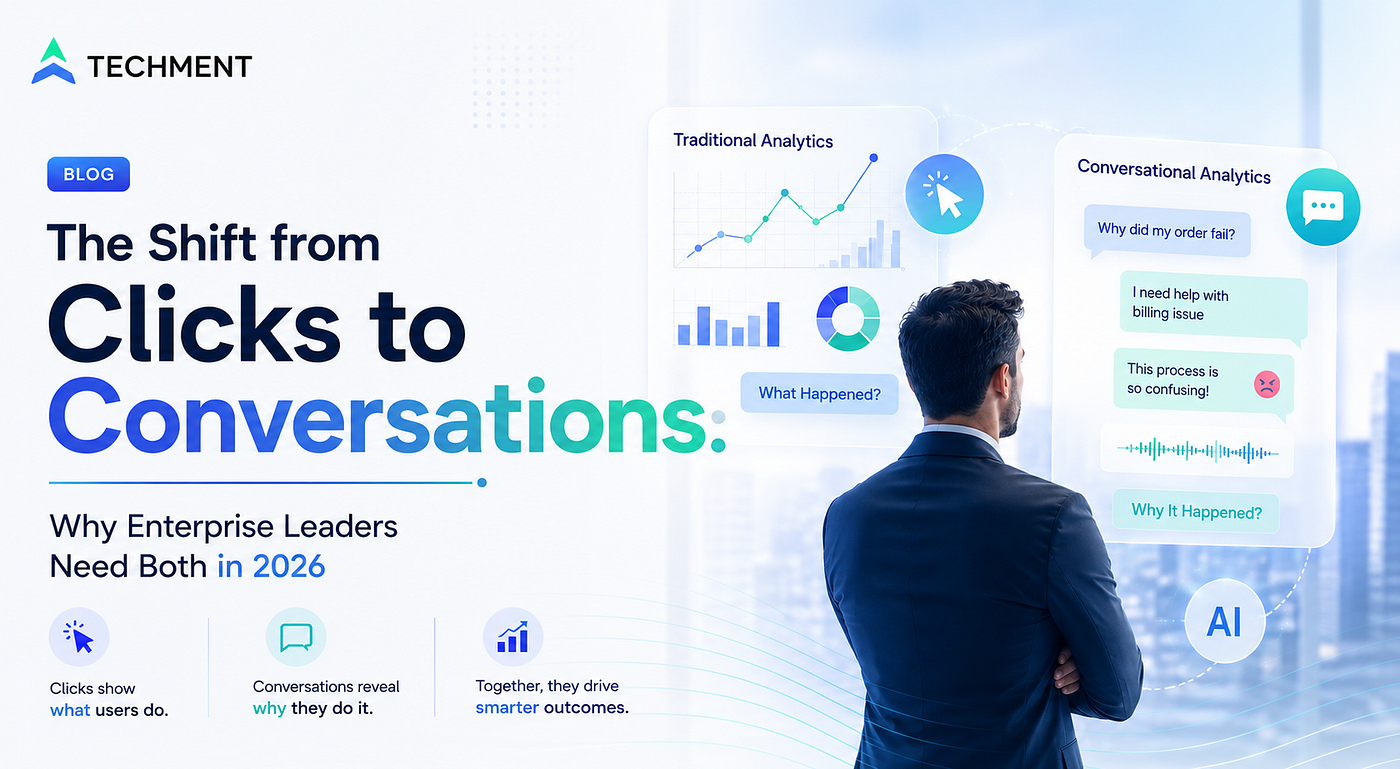
For nearly two decades, the digital success of an enterprise was measured by a familiar set of metrics: page views, bounce rates, and conversion funnels. If the “clickstream” looked healthy, the business was winning. However, as we navigate through 2026, a fundamental shift has occurred. Enterprise leaders are finding that while they have more data than ever, they often lack a clear understanding of customer intent.
Traditional web analytics tells you what a user did — they clicked a button, stayed for two minutes, or abandoned a cart. But it fails to explain why. This is the gap being filled by conversational analytics. The debate is no longer about choosing one over the other; it is about evolving toward a hybrid intelligence model that combines behavioral tracking with deep linguistic understanding.
The Architecture of Understanding: Traditional vs. Conversational
Traditional Web Analytics: The Behavioral Foundation
Traditional web analytics platforms, such as Google Analytics or Adobe Analytics, are built for a web-first era. Their architecture focuses on structured data gathered from browser cookies and tracking scripts. These tools are the gold standard for:
- Marketing Attribution: Understanding which campaigns drive traffic.
- Funnel Optimization: Identifying exactly where users drop off in a checkout process.
- Historical Benchmarking: Comparing year-over-year growth in traffic and sessions.
While indispensable for measuring digital performance, traditional analytics is essentially “silent.” It interprets a “bounce” as a failure, but it cannot tell if the user left because they found their answer instantly or because they were frustrated by a technical glitch.
Conversational Analytics: The Intent Revolution
Conversational analytics represents a move toward “active intent understanding.” By leveraging Natural Language Processing (NLP) and Generative AI, this approach extracts meaning from unstructured data — chat transcripts, voice interactions, and AI copilot sessions.
Instead of tracking a path, conversational analytics tracks:
- Sentiment: Is the customer frustrated, confused, or satisfied?
- Intent Recognition: What was the customer actually trying to achieve in their own words?
- Emotional Intelligence: Identifying urgency or churn risk through linguistic patterns.

11 Critical Differences Enterprise Leaders Must Know
To strategically navigate the modern data landscape, it is vital to understand how these two methodologies diverge across key operational pillars:
- Behavior vs. Intent: Web analytics tracks actions; conversational analytics interprets the motivation behind those actions.
- Structured vs. Unstructured Data: Traditional systems thrive on tidy event data; conversational systems process the “messy” reality of human language.
- Funnels vs. Journeys: While web analytics looks at linear steps, conversational analytics maps the emotional and contextual journey of a user.
- Historical vs. Real-Time: Conversational systems increasingly allow for real-time interventions, such as triggering a human agent when a chatbot detects high frustration.
- Quantitative vs. Qualitative: One measures “how many,” the other explains “how well” the interaction went.
- Clickstream vs. Emotion: Understanding the “vibe” of a customer interaction is only possible through conversational intelligence.
- Campaign vs. Interaction: Web analytics optimizes the “hook”; conversational analytics optimizes the “conversation.”
- Static vs. Adaptive: Traditional dashboards are retrospective, while conversational AI systems can adapt their responses based on the ongoing analysis.
- Channel-Centric vs. Omnichannel: Conversational data spans voice, chat, and messaging, providing a more holistic view than a single website session.
- Manual vs. AI-Assisted Interpretation: AI now automates the discovery of insights within transcripts that would take humans weeks to read.
- Digital Optimization vs. Enterprise Intelligence: The goal has shifted from making a website better to making the entire business more intelligent.
Operationalizing Conversational Insights
How does this translate to business value? In 2026, the use cases are expanding rapidly:

- Customer Support: By analyzing support logs, enterprises can identify recurring “unresolved intents” — questions the current system can’t answer — leading to targeted knowledge base updates.
- AI Copilot Governance: For companies deploying internal or external AI assistants, conversational analytics is the primary tool for monitoring “hallucinations” and ensuring AI accuracy.
- Sales Intelligence: Identifying buying signals or competitive mentions within sales calls allows teams to pivot their strategy in real-time.
The Challenge: Privacy and Integration
Transitioning to a conversational model isn’t without hurdles. Dealing with voice recordings and chat transcripts introduces significant PII (Personally Identifiable Information) risks. Enterprise leaders must ensure their data architectures — like Microsoft Fabric or modern data lakes — are equipped with robust governance frameworks to mask sensitive data while retaining analytical value.
Furthermore, the “hallucination” risk in AI requires constant validation. An analytics system is only as good as the NLP model’s ability to correctly identify a customer’s sarcasm or cultural context.
The Future is Hybrid: A Unified Intelligence Strategy
The most successful enterprises in 2026 are not replacing their web analytics teams. Instead, they are integrating conversational AI with their existing Customer Data Platforms (CDPs).
By combining the What (web analytics) with the Why (conversational analytics), businesses create a 360-degree view of the customer. This hybrid approach allows for hyper-personalization: knowing not just that a user is on your pricing page, but knowing they previously expressed frustration about a specific feature in a chat session three days ago.
Transform Your Data into Dialogue
The era of guessing customer intent based on click patterns is over. To remain competitive, your enterprise must move toward a model that understands the human being behind the screen. Whether you are looking to modernize your data architecture or implement high-performing conversational AI, the time to bridge the gap between “clicks” and “conversations” is now.
Ready to evolve your enterprise analytics strategy? At Techment, we specialize in helping organizations navigate the complexities of AI readiness, data governance, and conversational intelligence. Let us help you turn your unstructured data into your most valuable strategic asset.
Want to dive deeper into the technical architecture and enterprise use cases? **Read the whole blog here**
Have questions about modernizing your analytics stack? **Contact Us**
메타데이터
- post_id
- 3aa1073e902b
- slug
- the-shift-from-clicks-to-conversations-why-enterprise-leaders-need-both-in-2026-3aa1073e902b
- url
- https://medium.com/@techment/the-shift-from-clicks-to-conversations-why-enterprise-leaders-need-both-in-2026-3aa1073e902b
- canonical_url
- https://medium.com/@techment/the-shift-from-clicks-to-conversations-why-enterprise-leaders-need-both-in-2026-3aa1073e902b
- author_url
- https://medium.com/@techment
- status
- ok
- fetched_at
- 2026-07-10 15:36:45