Self-reflexive on The Platform : A Deep Dive into Social Inequality and Individualism
Right on time, The Platform is here to get us out of boredom by satirizing the economic systems such as capitalism, communism, and…
Self-reflexive on The Platform : A Deep Dive into Social Inequality and Individualism
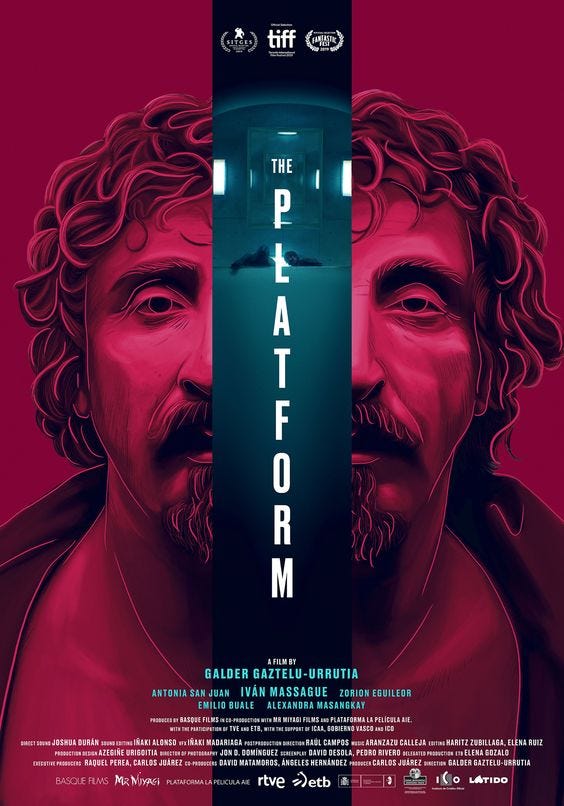
Right on time, The Platform is here to get us out of boredom by satirizing the economic systems such as capitalism, communism, and socialism. It is also here to be a self- reflexive film on the social construct in our society by mirroring the inequality of social classes
The 2019 Spanish film El Hoyo or The Platform( as it’s known in English is about a vertical prison with a food platform and two minutes per day to feed the prisoner from up to down. Which implies that those who are above eat all the food while the people who are bellow don’t get anything more than empty plates. It is a vicious cycle because the prisoners change levels.
One month they could be on the upper floors enjoying the abundance of food or worse ending up on the lowest level lead to starvati on. This could be considered as a metaphor of the towering terror of capitalism. Wealthy individuals enjoying their time at the top while the excluded people at the bottom are eating each other alive. Capitalism brings inequality but resists change that leads individuals to take as much as they can, while it’s there.
The difference between the high and the low level is life or death. The starvation’s situation leads the prisoner to cannibalism and anthropophagy. surviving is what matters so absolute individualism is the ideology these prisoners follow. They think of no one but themselves to save their lives.
In dialogue with Goreng, Imoguiri points out a critical issue within the vertical prison: the lack of food rationing despite ample resources. She emphasizes the absence of “spontaneous solidarity,” a critique that echoes communist principles aimed at challenging systemic flaws.
The platform’s mechanics are managed solely by its prisoners, revealing the anarchy that disrupts its delicate ecosystem. As noted by the LA Times, the criticism shifts towards the chaos generated by individuals, rather than placing blame on a fixed elite like the government or upper classes. This decentralized control highlights the ignorance of those on level 0 and the administration, unaware of the monthly upheavals within the vertical structure.
Driven by moral imperative, Goreng seeks to change the food distribution paradigm to benefit those on the lower levels. His proposal — that those above moderate their consumption to ensure equitable distribution — is swiftly condemned by fellow inmates who label him a communist. This pivotal moment exposes the entrenched selfishness endemic in society, where personal gain often overrides communal welfare.
Goreng’s ridicule and rejection highlight a broader societal trend where individuals, especially the privileged, dismiss the plight of others. This reinforces a cycle of self-justification and neglect, fostering a neoliberal ethos where individualism reigns supreme and collective action is scarce.
The film shows how difficult it is to change a system where those who are already part of it play into the dynamics and end up settling for what they have due to the fear that the situation could get worse. El Hoyo is a metaphor for social classes and an exposition of our reality as a society. It prompts us to ask: Why should those who are above help those below?
The end of the film is open to various interpretations. Goreng (Iván Massagué) and Baharat (Emilio Buale) manage to bring Miharu’s daughter, who is hidden in the last level, up to level 0. The seven-year-old girl becomes a symbol, also serving as a metaphor to convey to the audience that the new generation has the opportunity to change the unequal system.
An interesting scene to analyze the reflexivity of this film is when Goreng reads Don Quixote for the last time upon finding the little girl. “El grande que fuera vicioso, será vicioso grande y el rico liberal será un ávaro mendigo. Que al poseedor de las riquezas no le hace dichoso tenerlas, sino gastarlas. Y no el gastarlas como quiera, sino saberlas bien gastar.” This dialogue provides a clue from Cervantes that Goreng does not read:
“The poor gentleman has no other option but to be virtuous, affable, well-behaved, courteous, restrained, not arrogant, not gossipy, and above all, charitable.”
Goreng embodies the poor gentleman. We cannot change society, but we can change ourselves. It is our responsibility as human beings to be virtuous.
The film chose the thriller genre to explore class division. The platform takes the concept that wealth is finite and uses the thriller genre to illustrate it, along with some humorous dialogues and scenes. The film could have taken the cliché route of criticizing the rich and empowering the poor to fight back. Instead, the director explores how the poor devour each other and the inability to do good without an incentive or threat.
The lighting design serves a meaningful purpose in every scene, creating a sense of atmosphere. As we can see, red and blue colors are consistently used not only to indicate temperature changes but also to intensify drama. The film was impressively produced on a low budget. “El Hoyo” maximizes the potential of a confined space, resulting in a high-quality movie set in a room with two bedrooms, a bathroom sink, and the platform.
The film prompts critical thinking and raises philosophical questions about how we function as a society. What are your thoughts? How do you interpret the ending? If you were in the hole what would you do?

메타데이터
- post_id
- 3aaa0deba526
- slug
- self-reflexive-on-the-platform-a-deep-dive-into-social-inequality-and-individualism-3aaa0deba526
- url
- https://medium.com/@katherinneperalta/self-reflexive-on-the-platform-a-deep-dive-into-social-inequality-and-individualism-3aaa0deba526
- canonical_url
- https://medium.com/@katherinneperalta/self-reflexive-on-the-platform-a-deep-dive-into-social-inequality-and-individualism-3aaa0deba526
- author_url
- https://medium.com/@katherinneperalta
- status
- ok
- fetched_at
- 2026-07-17 07:14:13

