Understanding Load Balancers: Concepts, Types, and Algorithms
Modern applications are expected to handle thousands or even millions of users simultaneously. If all users send requests to a single…
Understanding Load Balancers: Concepts, Types, and Algorithms
Modern applications are expected to handle thousands or even millions of users simultaneously. If all users send requests to a single server, that server will quickly become overloaded, leading to slow performance or system crashes.
This is where Load Balancers come into play.
In this blog, we’ll explore:
- What a Load Balancer is
- Why it is important
- Types of Load Balancers
- Common Load Balancing Algorithms
- Real-world examples
What is a Load Balancer?
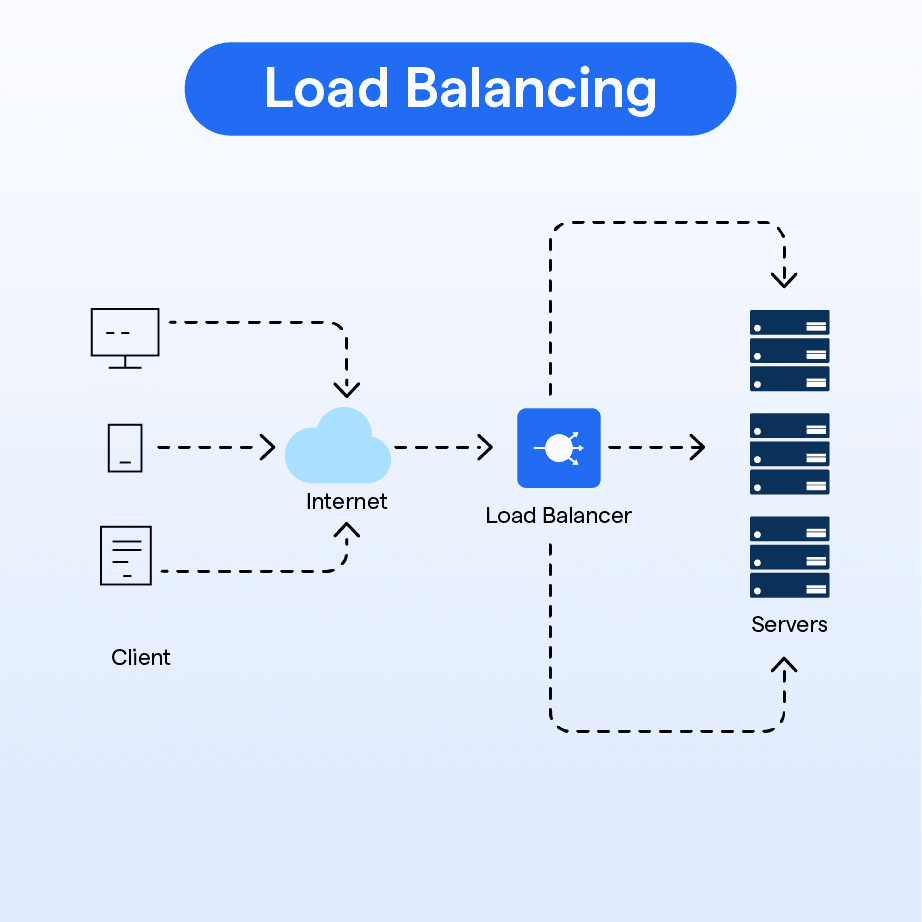
A Load Balancer is a system that distributes incoming network traffic across multiple backend servers. Its main purpose is to ensure that no single server becomes overwhelmed, improving the overall performance, reliability, and scalability of an application.
Instead of sending all requests to one server, a load balancer intelligently distributes requests among a group of servers.
Basic Flow
Users → Load Balancer → Multiple ServersExample:
Load Balancer
        /       |        \
   Server 1   Server 2   Server 3
The load balancer decides which server should handle each request.
Why Load Balancers Are Important
Load balancers are a critical component in modern distributed systems.
1. Improved Performance
By distributing traffic across multiple servers, applications can handle more requests simultaneously without slowing down.
2. High Availability
If one server fails, the load balancer redirects traffic to other healthy servers, ensuring the application remains accessible.
3. Scalability
Load balancers allow systems to scale horizontally by adding more servers when traffic increases.
4. Fault Tolerance
Applications continue running even when one or more servers fail.
Load Balancer Layers
Load balancers can operate at different layers of the OSI Model.
Layer 4 Load Balancer (Transport Layer)
Layer 4 load balancers route traffic based on network information such as:
- IP Address
- TCP Port
- UDP Port
They do not inspect the content of the request.
Example decision:
If request arrives on port 443 → forward to server group AAdvantages
- Faster performance
- Lower overhead
- Suitable for high-throughput applications
Example Tools
- AWS Network Load Balancer
- HAProxy
Layer 7 Load Balancer (Application Layer)
Layer 7 load balancers make routing decisions based on application-level data.
They can analyze:
- HTTP headers
- URLs
- Cookies
- Request paths
Example routing rules:
/api → Server Group A
/images → Server Group B
Advantages
- More intelligent routing
- Content-based distribution
- Better control over traffic
Example Tools
- Nginx
- AWS Application Load Balancer
- Cloudflare
Types of Load Balancers
Load balancers can be categorized based on how they are implemented.
1. Hardware Load Balancers
These are physical devices specifically designed for load balancing.
Characteristics
- High performance
- Dedicated hardware
- Used in large data renters
Examples
- F5 BIG-IP
- Citrix ADC
Disadvantages
- Expensive
- Limited flexibility
- Harder to scale compared to cloud solutions
2. Software Load Balancers
These are applications installed on servers that perform load balancing.
Characteristics
- Highly flexible
- Easy to configure
- Open-source options available
Popular Software Load Balancers
- Nginx
- HAProxy
- Traefik
Most modern startups use software load balancers due to their flexibility and cost efficiency.
3. Cloud Load Balancers
Cloud providers offer managed load balancing services, eliminating the need to manage infrastructure.
Examples
- AWS Elastic Load Balancer (ELB)
- Google Cloud Load Balancer
- Azure Load Balancer
Benefits
- Automatic scaling
- Built-in health monitoring
- High availability
These are widely used in cloud-native architectures.
Health Checks in Load Balancers
A key feature of load balancers is health monitoring.
The load balancer periodically checks whether backend servers are functioning correctly.
Example health check:
GET /healthIf a server responds successfully, it remains in the pool.
If a server fails the health check:
Server marked as unhealthy
Traffic redirected to other servers
This ensures users never get routed to a broken server.
Load Balancing Algorithms
Load balancers use different algorithms to determine how requests should be distributed among servers.
Round Robin Algorithm
Definition
Round Robin is one of the simplest and most widely used load balancing algorithms.
It distributes requests sequentially across all available servers.
How It Works
Assume we have three servers:
Server A
Server B
Server C
Incoming requests are distributed like this:
Request 1 → Server A
Request 2 → Server B
Request 3 → Server C
Request 4 → Server A
Request 5 → Server B
Once the last server receives a request, the cycle starts again.
Advantages
- Very simple to implement
- No complex calculations required
- Works well when all servers have equal capacity
Disadvantages
- Does not consider server performance
- Slow servers may receive the same number of requests as fast ones
- Can lead to uneven load distribution
Weighted Round Robin
Definition
Weighted Round Robin improves the basic Round Robin algorithm by assigning weights to servers.
Servers with higher capacity receive more requests.
Example
Assume we have three servers:
Server A → Weight = 3
Server B → Weight = 1
Server C → Weight = 1
For every 5 requests:
Server A → 3 requests
Server B → 1 request
Server C → 1 request
This allows stronger servers to handle more traffic.
Advantages
- Better resource utilization
- Works well with servers of different capacities
- Easy to configure
Least Connections Algorithm
This algorithm routes traffic to the server with the fewest active connections.
Example:
Server A → 100 connections
Server B → 30 connections
New requests will be sent to Server B.
Benefits
- Dynamically balances load
- Ideal for long-lived connections
- Adapts to real-time traffic
Geo-Based Load Balancing
Geo-based load balancing routes users to servers based on their geographical location.
Example:
User in India → Mumbai server
User in Europe → Frankfurt server
User in USA → Virginia server
Benefits
- Reduced latency
- Faster response time
- Better user experience
This approach is commonly used by CDNs and global applications.
Real World Examples
Many large-scale systems rely heavily on load balancing.
Examples:
- Netflix distributes traffic across thousands of servers.
- Amazon uses load balancers to handle millions of requests per second.
- Google routes global traffic using geo-based load balancing.
Without load balancers, these systems would not be able to scale reliably.
Conclusion
Load balancers are a fundamental component of modern distributed systems.
They help ensure applications remain fast, scalable, and reliable, even under heavy traffic.
Key takeaways:
- Load balancers distribute traffic across multiple servers.
- They improve performance, reliability, and availability.
- They can operate at Layer 4 or Layer 7.
- Different algorithms like Round Robin, Weighted Round Robin, Least Connections, and Geo-Based routing determine how traffic is distributed.
메타데이터
- post_id
- 3aaa858fa5c8
- slug
- understanding-load-balancers-concepts-types-and-algorithms-3aaa858fa5c8
- url
- https://medium.com/@shilpecsaxena9098/understanding-load-balancers-concepts-types-and-algorithms-3aaa858fa5c8
- canonical_url
- https://medium.com/@shilpecsaxena9098/understanding-load-balancers-concepts-types-and-algorithms-3aaa858fa5c8
- author_url
- https://medium.com/@shilpecsaxena9098
- status
- ok
- fetched_at
- 2026-07-13 06:23:13