Three Men Named Christ
On Delusion, the Mind’s Defense of Itself, and an Experiment We Never Should Have Run
Three Men Named Christ
On Delusion, the Mind’s Defense of Itself, and an Experiment We Never Should Have Run
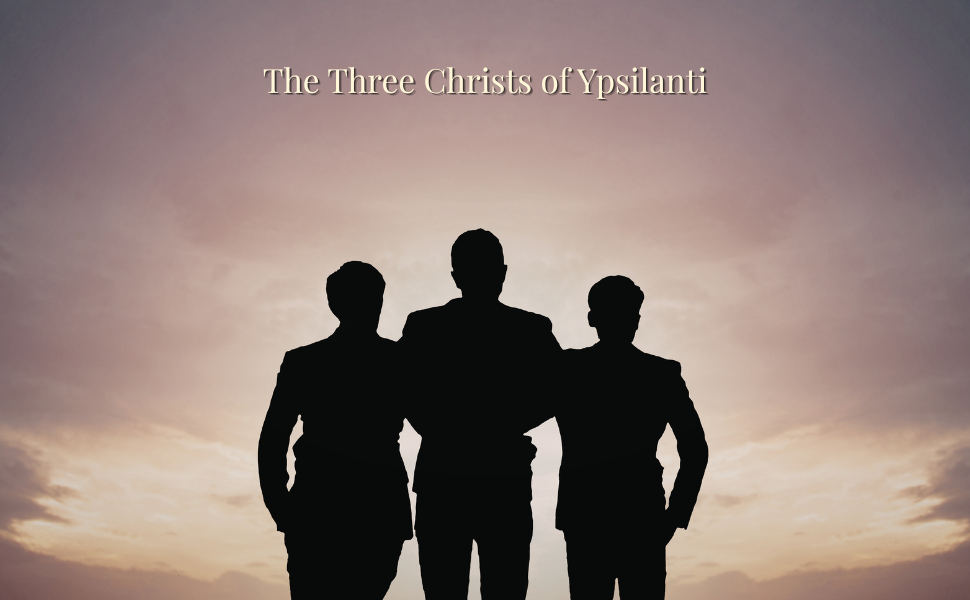
In 1959, three men met for the first time in a day room at Ypsilanti State Hospital in southeastern Michigan. Each of them was absolutely certain he was Jesus Christ.
Joseph Cassel was a 58-year-old Canadian, although he claimed to be English. Joseph had a traumatic childhood and, despite 20 years of psychiatric hospitalization, was described as a skilled writer. He tended to react aggressively toward the other two Christs, who he argued were delusional since he was the true messiah.
Clyde Benson was closer to 70 and plainspoken. Similar to Joseph, he had been institutionalized for 17 years. While initially getting into shouting matches with the other Christs, Clyde eventually fell into the quiet acceptance of a Midwestern farmer who had weathered his share of turmoil.
Leon Gabor was 38 and the most talkative of the three — a former Catholic seminarian whose schizophrenia had organized itself around an elaborate theology of his own design. At one point, he preferred the title Dr. Righteous Idealed Dung, sometimes shortened to Dr. R. I. Dung. Other times he created equally unusual titles, like Dr. Domino Dominorum et Rex Rexarum, Simplis Christianus Pueris Mentalis Doktor.
The man who had brought the three of them together was a social psychologist named Milton Rokeach. His hypothesis was simple, if audacious. If a man’s most foundational belief about himself — I am the messiah — were placed in direct, daily, unavoidable contact with two other men holding the same foundational belief, surely something would have to give. One or more of them would be forced to consider a different reality. The competing claims couldn’t all be true.
For two years, Rokeach watched to see which of them would change his mind.
What gave instead
The short answer is: none of them.
What gave, instead, was the surrounding scaffolding of the delusion. The men did not surrender their claims to Christhood. They preserved their claims by reorganizing the people around them.
Clyde, the oldest, took the simplest route. He determined that the other two were already dead. Dead men’s claims were of no consequence.
Joseph offered a more diplomatic theory. The hospital was a kind of school, and the other two were patients merely learning to be Christ. Their progress was nothing to do with him, the actual one.
Leon’s framework was the most intricate. He explained that Joseph was a duped man — his uncle was operating him from a distance, like a machine. Leon made similar accommodations for Clyde, for Rokeach, for the orderlies, for the world at large.
What Rokeach watched, day after day, wasn’t a contest between three claims that should have collapsed under the weight of contradiction. It was three men quickly rebuilding the edges of their reality so the center could hold. The center being, in each case, the self.
The brain’s defense of itself
This is the part that, decades later, I find harder to look away from than the experiment itself.
The men were not unintelligent. Joseph and Leon were both highly verbal and capable of extended argument. Clyde was less articulate but no less sure. Confronted with two other men telling them, every day, to their faces, that they were the real Christ — they did not waver. They created entire imaginary worlds to explain away these contradictions. All to preserve a created identity.
What we now know about the neuroscience of delusion makes this less surprising than it looks at first. A delusion is rarely a single false belief sitting alone in the mind, ready to be argued out with logic. It is typically embedded in a thicket of supporting cognition — perceptual experience, emotional weighting, a constructed personal history, and a system of secondary beliefs that explain away contradiction. Updating the central claim would require updating most of the surrounding structure too. The brain’s reality-monitoring system, anchored in the prefrontal cortex and its connections to medial temporal regions, is configured for stability. It is much better at integrating new evidence into existing models than at tearing existing models down.
Add to this a phenomenon called anosognosia — the unawareness of one’s own deficit, observed in stroke, dementia, and many psychotic conditions — and the puzzle of the Three Christs becomes less puzzling. The men were not only unable to update; they were unable to perceive that they had anything to update. From inside the delusion, they were the stable point of reality, and everyone else was the data that needed to be reconciled.
This is, in a quieter way, what all of our brains do. Most of us are not claiming to be Christ. But each of us is operating from a model of ourselves we are deeply invested in maintaining, and most of us perform small versions of the moves Leon made — adjusting the people around us slightly to keep the picture coherent. The Three Christs case sat at the edge of that pattern, where the model and the world had drifted too far apart to be quietly bridged.
What Rokeach was doing
It would be one thing if Rokeach had simply observed.
He didn’t. Over the course of the study, he moved from observation to manipulation. He fabricated letters from imagined figures the men had mentioned in their delusions and delivered them as if they were real. Leon believed he had a wife named Madame Yeti Woman. Rokeach wrote letters in her name, instructing Leon to behave in particular ways, to see what would happen to the delusional system when it received “evidence” from inside its own logic. He did similar things for Joseph and Clyde.
He was, in effect, becoming an actor in their delusions, with their supposed delusional figures as his hand puppets.
The men changed their behavior in response. Their inner architectures, mostly, did not.
In a 1984 afterword to a later edition of his book, Rokeach wrote a sentence that stays with anyone who reads it: I had no right, even in the name of science, to play God and interfere round the clock with their daily lives. He apologized — to the men he could no longer apologize to in person, having waited too long, and to the field he had hoped to advance.
What we kept and what we didn’t
Modern psychology has institutional protections that didn’t exist in 1959. Institutional review boards. Informed consent procedures that ask whether a participant has the cognitive capacity to give it. Ethics committees that would, today, decline Rokeach’s design before he set foot on the ward.
We have those protections partly because of cases like this.
What we do with the data is harder. Rokeach’s findings are still cited. The case is still taught — in clinical psychology programs, in the philosophy of mind, in the history of social psychology. The book has not gone out of print.
Since that experiment in 1959, The Three Christs of Ypsilanti has been adapted into a stage play, two operas, and a 2017 film starring Peter Dinklage as Joseph Cassel.
When I sit with my own clients now, half a century later and 2,400 miles away, I sometimes find myself thinking about the men in that day room. Not because anything in my work resembles what Rokeach was doing — it doesn’t — but because the lesson of Ypsilanti is one that can teach us something about ourselves.
To some extent, we all hold beliefs about ourselves, our identity, and our interactions with the world. We have our own perceptions about how a conversation went or how we treated another person. Our brain’s defense system is likely to protect our own worldview… perhaps not to the extent that we believe we are Christ, but maybe we aren’t open to hearing another person’s point of view.
Becoming aware of our own tendency to protect that self-image could be the first step in seeing what really is.
[embed]
메타데이터
- post_id
- 3ac0cb7e6c66
- slug
- three-men-named-christ-3ac0cb7e6c66
- url
- https://medium.com/the-neurowellness-review/three-men-named-christ-3ac0cb7e6c66
- canonical_url
- https://medium.com/the-neurowellness-review/three-men-named-christ-3ac0cb7e6c66
- author_url
- https://medium.com/@rcoop801
- status
- ok
- fetched_at
- 2026-06-26 12:24:55