The Age of AI and the Intelligence of Hara-What Ancient Japanese Wisdom Has Taught Us
Prologue: April 18, 2026, from Kumano Hongū to Tamaki Shrine
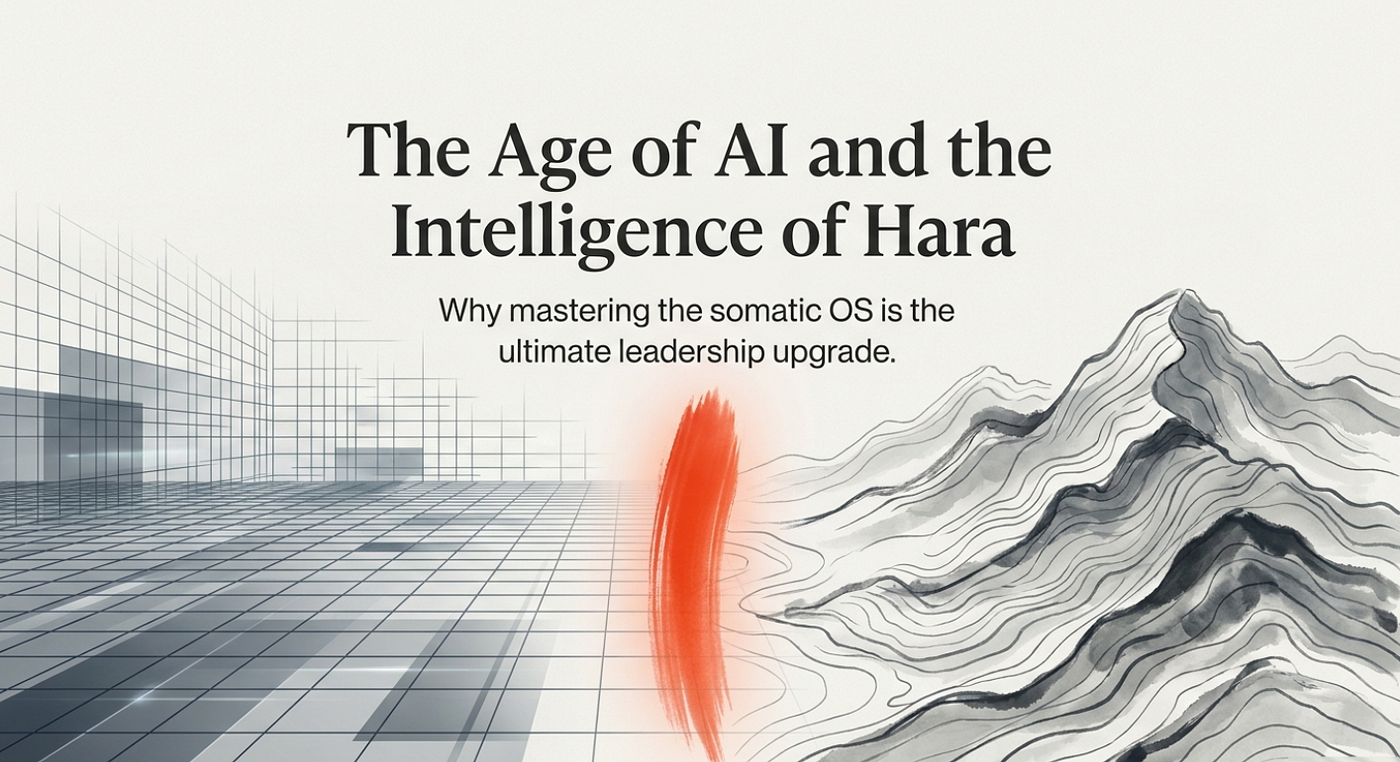
The Age of AI and the Intelligence of Hara-What Ancient Japanese Wisdom Has Taught Us
Prologue: April 18, 2026, from Kumano Hongū to Tamaki Shrine
On April 18, 2026, I was in the mountains of Wakayama Prefecture.
The distance from Kumano Hongu Taisha to Tamaki Shrine is approximately 20 kilometers. I was participating in a one-day ascetic practice, walking a section of the Ōmine Okugake Trail — a UNESCO World Heritage site — alongside a group of Shugendō practitioners. Early in the morning, in the dim light, we donned our robes and set off into the mountains at the sound of a conch shell.

Omine Mountain Range
To be honest, at the time of departure, I felt somewhat like a “reporter.” As someone writing a book on the importance of “gut feeling” in the age of AI, I expected this Shugendo experience to serve as material to back up my theories.
However, the mountains effortlessly shattered those expectations.
Shortly after we began walking, at the signal of the guide — known as the sendatsu — everyone began chanting “Sange Sange, Rokkon Shōjō.” This was the gateway to an experience that far exceeded my imagination.
What surprised me was that once I got into the rhythm of the chanting, my feet began moving forward on their own. Even on quite steep mountain trails, or on uneven terrain where rocks and tree roots were intricately intertwined, my body naturally chose the optimal step before my mind could even think, “Next is that rock, then that root.” I wasn’t walking consciously. When my voice, breath, and rhythm became one, my body began to move autonomously.

Yamabushi ascetics marching in formation
It was the moment I understood — not with my head, but with my gut — that this was the manifestation of “bodily intelligence.”
At every rest stop, the ascetics would blow their conch shells in unison. The sound of a dozen or so conch shells resonating simultaneously was not something to be heard, but something to be “bathed in.” The low-frequency vibrations traveled through my bones, shook my internal organs, and made my skin tremble. Before I knew it, the boundary between myself and the sound had become blurred. My vision, hearing, and touch — all my senses — were simultaneously sharpened, and I was enveloped in a sensation as if the world’s resolution had been heightened. This, I suppose, is what it means for the “five senses to awaken.”
And then, there was the absolute concentration on my footing. In places where there was a risk of slipping, I couldn’t let my guard down for even an instant. On sections with chains or steep descents, my life was literally on the line. “Ah, if I slip here, it’s over,” I thought, feeling the terror of death time and again. Yet strangely, in the midst of that terror, all distracting thoughts vanished completely. Work emails, next week’s meeting, a project six months down the line — every thought that had filled my head during city life was rendered powerless in the face of the overwhelming reality focused on a single point at my feet.
As I walked, I realized something else important: the physicality of the Japanese people and its rationality. Feeling the earth directly through tabi socks, moving with a Namba-style body posture that avoids twisting the core, and crossing rocks with a low center of gravity. This physical technique is an extremely refined method of movement, honed over more than a thousand years in the extreme environment of the mountains. There lay a system of living bodily knowledge that could never be acquired in a fitness gym.
What struck me was the composition of the participants. Many female Yamabushi were walking alongside us. While Shugendo is often perceived as a traditionally male-dominated ascetic practice, modern Shugendo is undoubtedly changing. I sensed that a sincere longing to reclaim the innate life force inherent in all humans — regardless of gender — is what draws so many people to this ancient yet new path.

The author taking a break along a rugged mountain trail
At each rest stop, local residents offered us “hospitality.” Cold drinks, homemade sweets, and warm rice. But they didn’t simply hand these over. They bowed to the ascetics, pressed their palms together in prayer, and offered them with a deep bow. I couldn’t help but feel a lump in my throat at the depth of faith that has been passed down in this region for over a thousand years. The ascetics are walking through the mountains carrying the prayers of the community on their backs.
At each gyoba (prayer site), everyone chants the Heart Sutra, esoteric mantras, and unique sutras passed down among the Yamabushi in unison. When I let my voice rise from the depths of my belly, the vibrations affirm my own body from within. At the same time, my voice blends with those of my companions and resonates with them. There was a mysterious sense of unity there, where the “individual” and the “whole” arise simultaneously.
And then, nature itself. The chirping of birds, the sound of the wind rustling through the trees, the scent of damp earth, the faint fragrance of mountain cherry blossoms, and the dazzling fresh greenery. This analog “raw data” ceaselessly stimulated my sharpened senses. I felt my senses — which had been constantly fragmented by smartphone notifications — finally beginning to regain their original function.
When I arrived at Tamaki Shrine after walking 20 kilometers, my body was deeply fatigued, but I felt an even greater sense of quiet fulfillment. I hadn’t gained any special abilities. Yet I could clearly feel that my “belly” possessed a depth and stillness unlike anything I had experienced before.

The final destination of this Shugendo pilgrimage: Tamaki Shrine
Through this experience, I was reaffirmed in my conviction that the concept of “the gut” discussed in this book is neither a metaphor nor an abstract idea. It is a highly practical form of intelligence that truly exists within the body and can be honed through training.
[embed]
Introduction: Who Will Write the One Line That AI Cannot?
If you ask ChatGPT to “write a business plan,” a well-organized proposal will be returned in a matter of seconds. If you ask Claude to “analyze organizational challenges,” a structured analysis covering multiple points emerges instantly. We are witnessing an era — the first in human history — where we can outsource “thinking.”
However, this raises a fundamental question.
Among the options neatly laid out by AI, who is it that ultimately decides, “Let’s go with this”? And what is it that imbues that decision with such weight that one would stake one’s life on it?
Over the past few years, through my work with ZenSchool and the Zen2.0 Association, I have engaged in dialogue with business leaders, researchers, and spiritual practitioners from around the world — at Kencho-ji Temple in Kamakura, in Silicon Valley offices, along the mountain trails of the Kumano Kodo, and in conference halls in Switzerland. A particular keyword has repeatedly emerged from these conversations.
That keyword is “hara” (gut).
Surprisingly, even among Silicon Valley executives leading cutting-edge AI development, this ancient Japanese concept is quietly but surely gaining attention. Sam Altman of OpenAI and executive coaches in the West are beginning to speak of “Hara” as a third intelligence — neither Head (logic) nor Heart (emotion).
Why “hara” in the age of AI? And why should Shugendo — Japan’s unique mountain ascetic practice, which has continued for over a thousand years — be reevaluated now as the most sophisticated system for cultivating this “hara”?
In this article, taking the experience of the Ōmine Okugake pilgrimage described at the beginning as a starting point, I will delve deeper into this question by intersecting cognitive science, neurophysiology, and management theory.

Chapter 1: The Arrival of the “U-Shaped Society” and the Two Remaining Domains of Human Sovereignty
The Disappearance of Intermediate Processes in Intellectual Labor
With the spread of generative AI, the very structure of society is undergoing a major transformation. Much of the intellectual labor previously performed by humans consisted of intermediate processes: “information gathering → analysis → structuring → verbalization.” Whether consultants, editors, lawyers, or engineers, the majority of their work has generated value within this intermediate domain.
However, AI is replacing precisely these intermediate processes at an astonishing speed. Only the two ends remain.
One is “determining direction (will).” The foundational questions of what we aim for and why we do it. The other is “accepting the results (responsibility).” The resolve at the end — who will take the fall when things go wrong.
I call this structure the “U-shaped society.” It is a society where the center has fallen away, and human roles have been compressed to the two ends.
Don’t Become a “Terminal of Responsibility”
There is a terrifying pitfall here.
Leaders who continue to rely on the optimal solutions presented by AI will eventually find themselves unable to make any decisions on their own. The basis for their decisions becomes “because the AI said so.” Their excuse for failure is also “it was the AI’s judgment error.”
At this point, humans are no longer the agents of their own decisions. They have become mere “terminals of responsibility” (proxies) who exist solely to sign off on decisions.
I consider this state to be the most dangerous form of regression. This is because AI feels no “pain.” AI does not lie awake at night after a failure. Even if its misjudgment hurts someone, it feels no emotional anguish. It does not sweat, tremble, or feel a knot in its stomach.

In other words, AI is a structural entity incapable of “weight” to its decisions.
If so, the role humans must fulfill is clear. We must be “samurai” who master the overwhelmingly intelligent ‘racehorse’ that is AI, and at the very last moment, settle on a decision in our gut — saying, “This is the way to go.” This is the essence of leadership in the AI era.
And this very act of “settling on a decision in one’s gut” is the manifestation of bodily intelligence, the central theme of this article.
Chapter 2: The Intelligence of the “Gut” Proven by Science — The Somatic Marker Hypothesis
The gut is the second brain
The phrase “deciding with your gut” has long been dismissed as mere mental toughness or sheer willpower. However, recent cognitive science is revealing that this bodily sensation is an extremely rational decision-making system.
According to the “Somatic Marker Hypothesis” proposed by neurobiologist Antonio Damasio, when humans make complex decisions, they utilize visceral sensations linked to past experiences as signals. This reaction, known as a “gut feeling” (intuition), detects “danger” or “opportunity” even before logical calculations begin.

In other words, our intestines and abdominal cavity contain an information-processing system that interprets the world through pathways distinct from those of the brain. Academically, this is referred to as “embodied cognition.” Intelligence is not something that exists solely within the brain; it is inextricably linked to the physiological state of the entire body.
Intelligence That AI Can Never Possess
Here lies the decisive point of divergence between AI and humans.
No matter how advanced the models implemented in AI may be, it possesses neither “physical pain” nor “physiological pleasure or discomfort.” Therefore, it cannot understand the true weight of a situation within its context.
How heavily a decision weighs on the lives of those involved. How a product affects the user’s body. How a word resonates with the listener’s heart. These are things only those with bodies can understand.

Physical training, as exemplified by Shugendo, holds profound rational significance as a process for sharpening sensitivity to these subtle bodily signals — what is known as “internal sensory perception.”
When we find ourselves going in circles within a labyrinth of logic, a quiet voice from deep within says, “No, that’s not right.” Even when the optimal solution is presented, our gut tells us, “That won’t work.” The sensitivity to discern this voice will become the rarest of abilities in the age of AI.
Chapter 3: Why “Shugendo”? — The Mountain as the Ultimate Training Ground
The Path of Practical Experimentation
Shugendo is a mountain asceticism system unique to Japan. Rather than understanding doctrine, it values “proof” gained through the body; it is truly the path of “practical experimentation.”
When I myself undertook a Shugendo-style experience of walking the Kumano Kodo for several days, I felt for the first time that many things I had understood intellectually had finally “sunk in.” The mountains are the ultimate training ground.
Why? Because placing oneself in the unpredictable, extreme environment of the mountains forcibly awakens the life-sustaining systems that have been dormant during urban life.

Walking on Uneven Terrain and the “Automated Body”
When walking on paved roads, we don’t think about anything. However, on mountain trails where stones, roots, mud, and rocks are intricately intertwined, the footing changes with every step.
This is when something interesting happens. Conscious, logical thinking — the so-called functions of the left brain — simply can’t keep up. If you’re thinking, “I’ll place my next step there, and the reason is…,” you’ll fall over immediately.
That’s when the instinctive perceptual system kicks in. Through tabi socks or straw sandals, we directly sense the ground’s unevenness, the hardness of the soil, and its moisture through touch. The brain unconsciously decides “where to place the foot next.”
This is the very embodiment of the “RPD (Recognition-Primed Decision) model,” through which skilled experts instantly arrive at the correct answer. Constant feedback from the soles of the feet activates sensory nerves and rapidly updates the brain’s pattern recognition library.
It is precisely this accumulation of training that constitutes the intuition that allows one to “see the correct answer” even in uncertain situations.
Namba Walking — Placing the Center of Gravity in the Abdomen
The walking techniques of Shugendo are deeply rooted in “Namba” (same-side movement), a physical method that avoids twisting the body. Moving the right foot and right shoulder simultaneously minimizes energy loss from trunk rotation and dramatically reduces fatigue during long walks.
However, what is even more important is that this walking style allows you to constantly keep your center of gravity in the center of your body — that is, in your “belly.”

When climbing steep rocky terrain, a low-center-of-gravity posture is required, achieved by deeply bending the knees to harness gravity. This “grounded” posture not only creates physical stability but also stabilizes the autonomic nervous system, fostering the mental fortitude — or “resolve” — needed to overcome fear.
I have been trail running for many years, and whenever my knees shake on steep descents, I focus my awareness on my hara. Then, strangely enough, my footing becomes steady. This is not a metaphor; my center of gravity physically stabilizes. The body’s intelligence is experienced directly in this way.
Chapter 4: What the Conch Shell Trains — The Science of Hara-Koshi Breathing
An Ultimate Physical Training Device Beyond a Simple Signal Tool
The conch shell, a symbol of Shugendo practitioners, is not merely a signaling tool. It is the ultimate device, refined over more than a thousand years as an advanced apparatus for breathing and physical training.
To sound the conch shell, one requires not just lung capacity, but powerful and stable “intra-abdominal pressure.” It involves deeply lowering the diaphragm while simultaneously mobilizing deep muscles such as the transverse abdominis and pelvic floor muscles. This is an ancient breathing technique known as “belly-waist breathing.
A Shugendo practitioner blowing a conch shell

https://www.instagram.com/reels/DK0RRzGKBXu/
The effects of this process on the body are wide-ranging.
First, core stability. High intra-abdominal pressure supports the spine from within, dramatically improving physical performance during mountain hiking. Second, the activation of internal organs. The changes in abdominal pressure caused by deep breathing provide a massaging effect on the internal organs, contributing to mental stability through the gut-brain axis. Third, the condensation of energy. The focus on the “tanden” (lower abdomen), which is emphasized in Japanese martial arts and performing arts, is physically experienced through the concrete act of blowing the conch shell.
Sound Vibrations and the Dissolution of Boundaries Between Self and Other
The conch shell’s rich, resonant tone causes the performer’s entire body to vibrate in unison. These “sound vibrations” have the effect of calming or stimulating the nervous system through bone conduction and direct stimulation of the tissues.
What left a particularly strong impression on me was the experience of blowing the conch shell in a deep valley. The sound emitted from my center — that is, from my abdomen — echoed off the mountains and returned to me. In that moment, the boundary between whether “I am producing the sound” or “the sound is passing through me” became blurred.
This experience dissolves the boundary between the self and nature, serving as a trigger that evokes the sense of “oneness with all things,” which I will discuss in a later chapter.
Chapter 5: “Purity of the Six Senses, Repentance, Repentance” — Mantras and the Default Mode Network
Synchronization of Rhythm, Vocalization, and Walking
During their training, Yamabushi repeatedly chant “Sange, Sange, Rokkon Shōjō” at a steady rhythm. This is not merely a religious ritual, but an extremely advanced form of mental training.
The synchronization of vocalization and walking at a steady rhythm guides the brain into a kind of trance state, or “the zone” (flow). The repeatedly chanted mantra suppresses the activity of the brain’s default mode network (DMN), which generates distracting thoughts, and allows consciousness to become completely immersed in the present physical movements and sensations.

Excessive DMN activity is the breeding ground for the “regrets about the past” and “anxieties about the future” that plague modern people. The moment we put down our smartphones, we automatically start worrying about something. Synchronizing chanting with walking forcibly stops this autopilot.
This “cessation of thought” is the gateway to “pure experience” — something AI can never achieve.
Purification of the Six Senses — Increasing the Resolution of Incoming Information
The declaration to “purify the six senses (eyes, ears, nose, tongue, body, and mind)” functions as a form of psychological priming that filters out noise from the sensory organs and enhances the precision of incoming information.
Purifying the eye root (vision) expands peripheral vision and cultivates the ability to gaze intently at the essence. The “eye of the distant mountain” — that is, the ability to grasp the whole while looking far away — directly corresponds to the ability to see the big picture in management.
Purifying the ear root (hearing) allows one to detect subtle sounds of nature and accept silence itself. In modern organizations, this corresponds to the ability to hear the unspoken voices of subordinates and customers.
The sense of smell, the sense of taste, the sense of touch, and the sense of mind. The concept of sharpening these six senses one by one is, even from the perspective of modern cognitive science, an extremely sophisticated sensory training program.
Modern people, dominated by smartphones and PCs, live with a distorted sensory balance that is skewed toward vision and thought. Shugendo’s purification of the six senses is a prescription for correcting this distortion and restoring humanity’s original perceptual balance.
Chapter 6: The Symbolism of “Death and Rebirth” and the Resilience of Leaders
Entering the Mountain is a Return to the Womb
In Shugendo, “entering the mountain” (nyūhō) is a metaphor for a return to the womb and a simulated death and rebirth. Entering the mountain is a symbolic ritual of dying once and being reborn anew.
Training on sheer cliffs, such as at the particularly famous “Nishi no Nozoki,” literally forces one to face the fear of death and keenly realize one’s own insignificance. In this extreme state, one is compelled to abandon the “rational self” and retreat to the “gut (instinctive life)” in order to survive.

While walking along a rugged section of the Kumano Kodo, I was suddenly overcome by a strange sensation. There are moments when the worries about work, concerns about relationships, and anxieties about the future that I carried in my daily life all seem “irrelevant.” They haven’t disappeared. Rather, enveloped by the vast presence of the mountains, they have become relatively small.
As an unshakable sense of stability “A Steady Gut”
By navigating this process, one cultivates robust “resilience” against modern stress and anxiety.
The unshakable sense of stability possessed by those who have experienced ‘death’ — that is, a “steady gut” — becomes the greatest weapon in leadership within an uncertain business environment.
The leader most trusted in times of crisis is not the one with the quickest mind. Nor are they the ones who present the most accurate analysis. Rather, they are the ones who, even when imagining the worst-case scenario, can say from the depths of their being, “It’ll be all right.” That sense of stability can never be acquired through classroom study or training. It is a rare asset that can only be attained by those who have pushed their bodies to the absolute limit and experienced the boundary between life and death, even if only symbolically.
Chapter 7: “Raw Data” from the Natural World — The Restoration of Analog Intelligence
Digital Signals and Fluid Analog Information
In Shugendo, the natural environment is not merely a backdrop. It is a “torrent of information” that actively stimulates the senses.
The flickering of light, the temperature of the wind, the humidity of the air, and the sound of birds echoing in the silence — these are not fixed digital signals, but “raw analog data” that constantly flows and intertwines in complex ways.
The “intuition” and “inspiration” that Shugendo practitioners experience in the mountains are not mystical phenomena. Rather, they are the result of vast amounts of nonverbal information being processed holistically in the “hara” (the center of the body) and surfacing into conscious awareness without passing through logic.

Training in this environment dramatically enhances the “ability to sense subtle cues” — a skill that modern people are in danger of losing due to their dependence on digital devices.
The ability to read subtle changes in a subordinate’s expression in a conference room. The ability to sense the true intentions behind a business partner’s words. The ability to foresee major trends from small signs in the market. All of these depend on the ability to process analog information. Training in the mountains directly hones these abilities.
Chapter 8: Yoshida Shoin and “Sincerity” — The Source of Samurai Leadership
Not the Amount of Knowledge, but Aspiration and Action
In Japanese history, Yoshida Shoin stands out as a figure who placed “inner resolve” at the center of his educational philosophy. At Shoin’s Shoka Sonjuku, “resolve” (the establishment of will) and “execution” were rigorously valued above the mere quantity of knowledge.

Shoin Yoshida
This can be described as the pinnacle of what we today call “purpose-driven management” or “ownership.” In just a few short years, the Shōka Sonjuku produced a succession of individuals who would become the core leaders of the Meiji Restoration. The secret lay not in academic instruction, but in the education of one’s “gut.”

The “sincerity” (makoto) that Shōin preached refers to the true voice that wells up from one’s own gut. Even if it contradicted external evaluations or conventional wisdom, the “resolve” to see through a decision made from the gut was considered the true quality of a leader.
What Sets Leaders Apart in the AI Era
In an era where AI continuously produces “logically optimal solutions,” what will distinguish leaders?
It is the aesthetic sense, the ethical compass, and the strength of conviction required to “dare to go beyond” those optimal solutions. It is the person who, when AI declares, “Option A is optimal,” can respond from the heart, “No, we’ll go with Option B. Because…” The leaders we need in the coming era are precisely these kinds of people.
The words that follow “because” do not necessarily have to be logical. They can be a sense of aesthetics. They can be a sense of ethics. They can be intuition. What matters is whether that judgment carries a physical weight.
Chapter 9: “Emptiness (Ma)” — Acceptance as the Strongest Form of Leadership
Eliminating the Noise of Prejudice
Designer Kenya Hara defined “Emptiness (Ma),” which lies at the core of Japanese aesthetics, as a vessel of possibility that accepts everything.
Emptying oneself through Shugendo practice means eliminating the noise of one’s own biases and past successes. This is a critically important ability in an era of rapid change.
Leaders bound by past successes cannot see the new reality. “In our industry,” “Based on past experience,” “Common sense dictates” — phrases like these cause organizations to become rigid.
A leader with “a settled mind” possesses a “vast inner space” that allows them to accept suggestions from subordinates and complex AI predictions without preconceptions. It is this “receptivity” that serves as the “human gravitational pull” uniting an organization in today’s world, where diverse values collide.
Strength is the power to accept
Here, I would like to state one paradoxical truth.
Having a settled mind does not mean becoming stubborn. Rather, it means acquiring the flexibility to accept everything. Truly strong people remain unshaken even when criticized. They do not reject proposals. They do not break even when they fail.
This is because their core does not depend on external evaluations or circumstances. Their core lies within their settled mind. That is precisely why they can accept everything that happens on the outside.
This is the essence of leadership most sought after in the AI era.
Chapter 10: Translating into Daily Life — Practical Ways to Live the Shugendo Way
For Those of Us Who Cannot Go to the Mountains
“That said, we can’t climb a mountain every day” — a perfectly reasonable response.
However, the essence of Shugendo lies not in a specific environment, but in the training of the mind through the body. There are many ways to practice this in daily life.
For physical training, activities that engage the body in unpredictable natural environments — such as trail running or surfing — are effective. Through trail running myself, I have experienced a sharpening of my senses that desk work cannot provide.
In the realm of breathing and physiology, a few minutes of daily practice focusing on abdominal breathing brings stability to the autonomic nervous system and improves proprioception. Meditation and improving gut health also fall into this same category.

In the realm of perception and cognition, nature walks that consciously engage the five senses — so-called forest therapy — enhance the clarity of your intuition. Even just walking in a park once a week without your smartphone will definitely change your senses.
In the realm of decision-making, I encourage you to try Konosuke Matsushita’s “two-step decision-making method” — decide with your gut first, then verify with logic — as practiced by Konosuke Matsushita. Entrust the analysis to AI, but ask your gut for the final judgment. This distinction between the two becomes the most powerful decision-making process in the AI era.
In the realm of spirit and philosophy, consciously cultivating your own “view of life and death” and exploring what “sincerity” means to you leads to the clarification of your long-term purpose.
Conclusion: Toward an Era of Symbiosis Between AI and the “Gut”
No matter how much artificial intelligence evolves or how precisely it mimics human cognitive processes, AI will never feel “pain,” break a “sweat,” or feel “awe” at the harshness of nature.
These are privileged forms of intelligence granted only to living beings that have endured the grueling process of sustaining life for four billion years. And the focal point of all this is the “belly.”

Shugendo, Japan’s unique system for cultivating bodily intelligence, is by no means a relic of the past. Rather, it can be described as the most cutting-edge update program for liberating humans from being “slaves to logical thinking” and enabling them to manifest a higher-order “intelligence as life.”
Walking along rugged mountain trails, step by step, with your center of gravity in your belly. Voicing from your own center, accompanied by the sound of the conch shell. And immersing oneself in the vast torrent of information from the natural world.
It is precisely this sense of the “belly” — rediscovered through these experiences — that becomes the most powerful weapon for mastering the potent tool of AI and carving out an uncertain future.
What is required in the AI era is not merely the development of superior algorithms. It is the strengthening of the “physical OS” of the humans who use them.
“Training the gut” through Shugendo experiences will lead us back to our inherent human radiance and serve as the key to opening the door to a new era where technology and life harmonize.
I would like to call this era the “Age of Symbiosis.” An era in which AI and humans coexist, maximizing each other’s strengths and compensating for each other’s weaknesses. The protagonists of this era will be people who, while mastering cutting-edge AI, possess a “samurai-like intelligence” deeply rooted in their own gut.
Come, let’s go to the mountains. To listen to the sound of the conch shell, to reclaim the voice of our gut.
For that is the most rational choice for surviving the AI era.

Written by Kouji MIki with Gemini Deep reserach and NotebookLM and Claude Opus 4.7.
A Workshop on Discovering Your Ikigai in the Age of AI
More information about the author, Koji Miki
References
- Survival Strategies in the AI Era: The “Ko” Shape Society and “Hara” — Samurai-like … — note, accessed April 19, 2026, https://note.com/zenschool/n/n5e8803b19480
- “Ghosts in the Machine: Reclaiming Sovereignty in the Age of AI” — Michael Sindhelm, accessed April 19, 2026, https://michaelschindhelm.com/en/the-ghost-in-the-machine-reclaiming-sovereignty-in-the-age-of-ai/
- AI Did Not Answer. It Reflected. | Zen and Innovation: Koji Miki — Medium, accessed April 19, 2026, https://zenschool.medium.com/the-ai-didnt-answer-it-reflected-c510e1d9b629
- Welcome to the Age of Symbiosis: Why We Must Cultivate “Hara” in an Era of Living with AI | zenschool — note, accessed April 19, 2026, https://note.com/zenschool/n/n4e3ab9e34659
- The Importance of “Hara” in the AI Era: Insights from Panasonic and OpenAI | Author: Koji Miki, accessed April 19, 2026, https://mikikouj.medium.com/the-importance-of-hara-in-the-ai-era-insights-from-panasonic-and-openai-7fe6c1615345
- How to Cultivate “Hara” to Survive the AI Era: The Source of Leadership Seen in the New Prime Minister | zenschool, accessed April 19, 2026, https://note.com/zenschool/n/n4769157b658b
- Yamabushi: Japan’s Mountain Ascetics — History, Rituals, and How to Experience Shugendo, accessed April 19, 2026, https://blog.bespoke-discovery.com/japanese-yamabushi-a-journey-into-the-mystical-world-of-shugendo
- Gaining Magical Power Through Seclusion: Shugendo and Japanese Religion — Deeper Japan, accessed April 19, 2026, https://www.deeperjapan.com/deeper-views/shugendo-and-japanese-religion
- The Revival of “Samurai Leadership”: Why Silicon Valley Is Now Focusing on Japan’s “Hara,” accessed April 19, 2026, https://zenschool.medium.com/the-return-of-samurai-leadership-why-silicon-valley-is-now-focusing-on-japans-hara-f22507025989
- Focus on the Gut: Extending Embodied Cognition and Perception to the Gut Complex — Frontiers, accessed April 19, 2026, https://www.frontiersin.org/journals/neuroscience/articles/10.3389/fnins.2023.1172783/full
- (PDF) Focus on the Gut: Extending Embodied Cognition and Perception to the Gut Complex, accessed April 19, 2026, https://www.researchgate.net/publication/377223490_Minding_the_gut_extending_embodied_cognition_and_perception_to_the_gut_complex
- Promoting Self-Explanation in STEM: A Comparison of Metacognitive Accuracy Between Humans and AI, accessed April 19, 2026, https://sciencepublishinggroup.com/article/10.11648/j.ajcst.20260901.13
- Shugendo — Wikipedia, accessed April 19, 2026, https://en.wikipedia.org/wiki/Shugend%C5%8D
- Shugendo: Origins and Practices | PDF | Deities | Shrines — Scribd, accessed April 19, 2026, https://www.scribd.com/document/94947812/Shugendo-Lore
- Hara and Reiki — International House of Reiki, accessed April 19, 2026, https://ihreiki.com/blog/hara-and-reiki/
- [Quick Training] Abdominal and Lower Back Breathing: Focus on the Torso… Ancient Martial Arts Training Part 2 — YouTube, accessed April 19, 2026, https://www.youtube.com/watch?v=m1V8wfPuMd8
- Hidden in Plain Sight — Indeed! [Archive] — AikiWeb Aikido Forum, accessed April 19, 2026, http://www.aikiweb.com/forums/archive/index.php/t-20103.html
- “The Purity of the Six Senses” is a Buddhist teaching | Introducing places with deep connections, accessed April 19, 2026, https://www.famille-kazokusou.com/magazine/manner/328
- Tottori — Experience the Past and Future | Chugoku + Shikoku × Tokyo (Japan), accessed April 19, 2026, https://www.chushikokuandtokyo.org/route_20/
- “The Experience of Zen” — Project Gutenberg, accessed April 19, 2026, https://www.gutenberg.org/ebooks/34325.epub3.images
- “Songs to Make the Dust Dance” — UC Press E-Books Collection, accessed April 19, 2026, https://publishing.cdlib.org/ucpressebooks/view?docId=ft2f59n7x0;chunk.id=0;doc.view=print
- Surrendering to the Sea: The Scientific Reason Why We Modern People “Draw Energy” from Nature | zenschool — note, accessed April 19, 2026, https://note.com/zenschool/n/n8010e79e8877
- The “Wisdom of the Body” We Were Forgetting, Reflected by AI | zenschool — note, accessed April 19, 2026, https://note.com/zenschool/n/n8cb528636cca
- Forest Therapy — Sharpening the Five Senses in the Great Outdoors — Google Arts & Culture, accessed April 19, 2026, https://artsandculture.google.com/story/pAWBRre_Z0VJLg?hl=ja
- From City to Mountain, and Back to City: Contemporary Shugenshi in Japan’s Social and Religious Context — Concordia’s Spectrum, accessed April 19, 2026, https://spectrum.library.concordia.ca/977162/1/McGuire_Phd_S2013.pdf
- “Designing Design” by Kenya Hara, accessed April 19, 2026, https://lan-portal.uob.edu.ly/niche/EPDF/67T59319Q1/designing-designkenyahara.pdf
메타데이터
- post_id
- 3ac2152afd50
- slug
- the-age-of-ai-and-the-intelligence-of-hara-what-ancient-japanese-wisdom-has-taught-us-3ac2152afd50
- url
- https://medium.com/@zenschool/the-age-of-ai-and-the-intelligence-of-hara-what-ancient-japanese-wisdom-has-taught-us-3ac2152afd50
- canonical_url
- https://medium.com/@zenschool/the-age-of-ai-and-the-intelligence-of-hara-what-ancient-japanese-wisdom-has-taught-us-3ac2152afd50
- author_url
- https://medium.com/@zenschool
- status
- ok
- fetched_at
- 2026-06-17 08:20:12






