Your AI Product Doesn’t Need Another Copilot. It Needs Trust.
As AI products move from helping users to acting for them, the real UX problem is no longer intelligence. It’s whether people can trust…
Your AI Product Doesn’t Need Another Copilot. It Needs Trust.
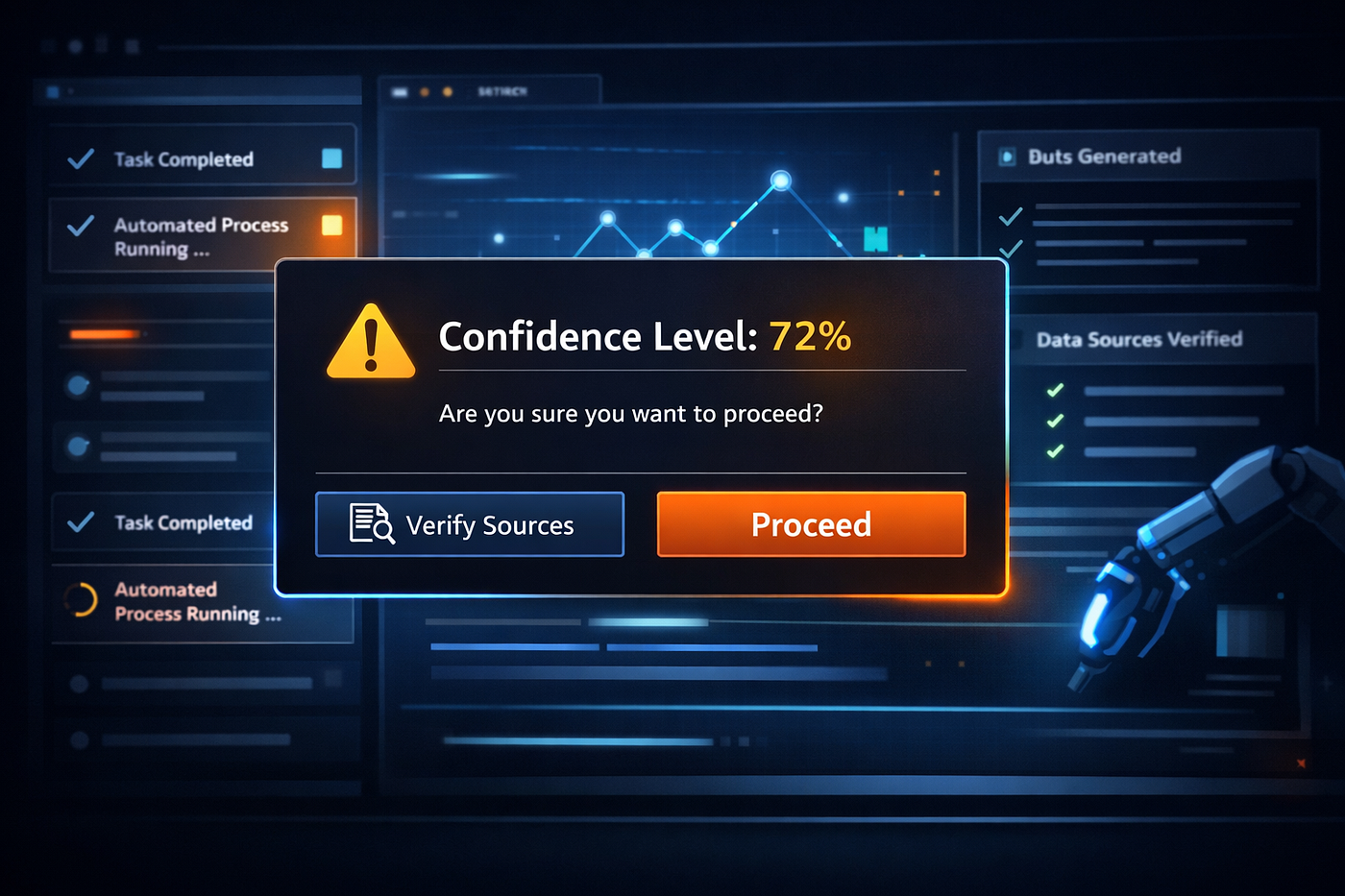
As AI products move from helping users to acting for them, the real UX problem is no longer intelligence. It’s whether people can trust what the system just did.
Let’s be honest.
Every product team and their neighbour seems to be adding AI to something right now.
A copilot here. A smart assistant there. A magic button somewhere in the corner. At this point, if an app doesn’t have some AI feature baked into it, it almost feels like it missed the memo.
But here’s the thing: your AI product probably does not need another copilot.
It needs trust.
Because the real issue with most AI products right now is not that they are not smart enough. It’s that people are not sure they can rely on them.
And that is a much bigger problem.

AI hype is maturing into AI fatigue, and that changes what users need from products
We’ve spent too much time chasing capability
For a while, the tech space was obsessed with capability.
What can the AI do? How fast can it do it? How many things can it automate? How magical can we make it feel?
Cool. Great. Love that for us.
But now that AI is moving beyond just helping users and is starting to act for them, the question is changing. It’s no longer just “Can this thing do the task?” It’s “Can I trust what it just did?”
And if I’m being honest, that is where a lot of products start falling apart.
Because many of them are designed to look impressive before they are designed to feel dependable.
They generate. They summarize. They recommend. They automate. They send. They route. They decide. They do all these things that sound exciting in product demos. But the minute a user starts wondering, Wait, why did it do that? Can I check that? Can I undo it? Should I even believe this? …the product suddenly becomes very quiet.
That quietness? That’s the problem.
The next generation of AI products will not win because they feel the smartest. They will win because they feel the safest to rely on.
The real UX issue is not intelligence. It’s confidence.
Nielsen Norman Group says trust is becoming a major design problem for AI experiences, especially as users grow more tired of lazy AI features and AI clutter that doesn’t actually improve their experience
And honestly, I get it.
Because somewhere along the line, the industry started confusing “frictionless” with “good.”
So now a lot of AI experiences are built to feel smooth, fast, and effortless. But smooth does not automatically mean trustworthy. Fast does not automatically mean safe. And effortless definitely does not always mean better.
Sometimes, when a system moves too quickly, the user just feels left behind.
If an AI tool writes an email for me, fine. If it sends one on my behalf, now we need to talk.
If it suggests a change, okay. If it makes the change without clearly showing me what happened, that’s a different story.
If it summarizes a report, nice. If it makes a decision based on that report and I cannot trace the logic, then no, we have a problem.
What most AI products actually need is a trust model
In the next wave of AI products, trust is not a feature. It’s the strategy
This is exactly why I think so many teams are building AI features when what they really need to be building is a trust model.
And no, I don’t mean a fluffy “we care about responsible AI” statement hidden in a help centre article somewhere.
I mean actual product mechanics.
Things like showing what the system did. Explaining why it did it. Being honest about uncertainty. Letting users review actions before they go through. Making it easy to reverse mistakes. Setting visible boundaries around what the AI can and cannot do.
You know, the things that make people feel like they are still in a relationship with the product, not being managed by it.
Because once software starts acting on behalf of users, trust is no longer a nice-to-have.
It is the experience.
John Maeda talks about this shift as moving from UX to AX, from user experience to agentic experience. In his framing, the old design challenge was helping users do things. The new one is helping users evaluate whether the agent did the right thing
That shift matters a lot more than people realize.
Good AI UX is not just about reducing effort
The companies getting AI into production are investing in governance and evaluation, not just more capability
In the old world, good UX often meant reducing clicks, simplifying flows, and removing blockers. And yes, that still matters.
But in AI products, especially agentic ones, that can’t be the whole story anymore.
Because if the system is making moves on my behalf, I do not just need convenience.
I need clarity.
I need context.
I need control.
And most importantly, I need confidence.
Right now, the companies that are actually getting AI into production are not just the ones building flashy features. They are the ones investing in evaluation, governance, and oversight.
Databricks reports that organizations using AI governance tools get over 12 times more AI projects into production, and organizations using evaluation tools move nearly 6 times more AI systems into production
That says a lot.
Because it means the real bottleneck is not just intelligence.
It is accountability.
Adoption is rising faster than trust infrastructure
Deloitte points in the same direction. Worker access to AI rose by 50% in 2025, but only one in five companies has a mature governance model for autonomous AI agents
So basically, adoption is moving fast, but trust infrastructure is still playing catch-up.
And if we’re being real, users can feel that gap.
That’s why so many AI products feel clever but slightly unsettling.
They can do a lot, but they don’t always help users understand what is happening well enough to feel comfortable. And once that discomfort sets in, all the intelligence in the world won’t save the experience.
Because users do not want to feel impressed for two minutes and anxious for the rest of the workflow.
They want to know:
What is this thing doing? What is it allowed to touch? How sure is it? Can I double-check it? Can I fix it if it gets weird?
That is trust.
And if your product cannot answer those questions clearly, then adding another copilot feature is really just adding another layer of doubt.
“Show your work” should be the bare minimum
IBM says organizations will need agents that can “show their work,” and honestly, that should be the bare minimum
Because if an AI system is going to act, it should also be able to explain itself.
Not in some long-winded technical way that nobody asked for, by the way.
Just enough for the user to understand what happened and decide whether to go with it.
That could mean source visibility.
It could mean confidence indicators.
It could mean approval checkpoints.
It could mean audit trails.
It could mean clearer permissioning.
Anyhoo, you get the point.
Trust is not one feature.
It is a system.
The best AI products will know when to slow down
And I think that is where the next wave of good AI products will really separate themselves.
Not by being the loudest.
Not by stuffing AI into every corner of the interface.
Not by trying to automate absolutely everything just because they can.
But by being the products that know when to slow down, when to explain, when to ask first, and when to leave the human in control.
Because contrary to what a lot of product marketing seems to believe, people are not just looking for AI that feels powerful.
They are looking for AI that feels safe to use.
AI that feels legible.
AI that feels accountable.
AI that does not make them wonder if they are one click away from a very avoidable mess.
So no, your AI product probably does not need another copilot.
It needs a better answer to a much simpler question:
Why should anyone trust this?
And until that answer is clear, the smartest feature in the room may still be the weakest part of the experience.
Thanks for reading.
If you’re designing AI products right now, this is probably the question worth sitting with a little longer: not what else can this system do? but what makes people believe it did the right thing?
메타데이터
- post_id
- 3afc162efbe0
- slug
- your-ai-product-doesnt-need-another-copilot-it-needs-trust-3afc162efbe0
- url
- https://medium.com/@ololade.adesuyi/your-ai-product-doesnt-need-another-copilot-it-needs-trust-3afc162efbe0
- canonical_url
- https://medium.com/@ololade.adesuyi/your-ai-product-doesnt-need-another-copilot-it-needs-trust-3afc162efbe0
- author_url
- https://medium.com/@ololade.adesuyi
- status
- ok
- fetched_at
- 2026-08-01 21:54:48




