State Management Isn’t About State: It’s About Ownership
Most Angular State Discussions Start In The Wrong Place
State Management Isn’t About State: It’s About Ownership
Most Angular State Discussions Start In The Wrong Place

Ask Angular developers about state management and you’ll hear:
- Signals
- RxJS
- NgRx
- Signal Store
- Component Store
- BehaviorSubject
The conversation immediately becomes technical.
People compare tools.
People compare APIs.
People compare syntax.
But here’s the interesting part.
Most state management problems have nothing to do with technology.
They are ownership problems disguised as technical problems.
The Question Nobody Asks
Imagine a customer dashboard.
Several components display customer information.
Customer Profile
Customer Orders
Customer Activity
Customer Permissions
Everyone asks:
Where should we store the customer state?
A more important question is:
Who owns the customer state?
Those are very different questions.
State Is Easy
Storing data is trivial.
customers = signal([]);Done.
State management solved.
Except it isn’t.
Because storing data was never the difficult part.
The Real Problem
Consider this situation.
Component A updates the customer.
Component B updates permissions.
Component C updates preferences.
Component D updates account status.
Now ask:
Which version is correct?
Suddenly the problem becomes more interesting.
Every State Problem Eventually Becomes An Ownership Problem
Imagine four components.
Profile Component
Orders Component
Settings Component
Admin Component
All modify the same customer object.
Who wins?
Who decides?
Who validates changes?
Who guarantees consistency?
These are ownership questions.
Not state questions.
Why Local State Feels Easy
Component state is simple.
isOpen = signal(false);Ownership is obvious.
The component owns it.
The component changes it.
The component reads it.
Everything is clear.
No architecture discussion required.
Shared State Changes Everything
Now imagine:
Customer Stateis used by:
- Dashboard
- Orders
- Reports
- Administration
Suddenly ownership matters.
Because multiple consumers depend on the same information.
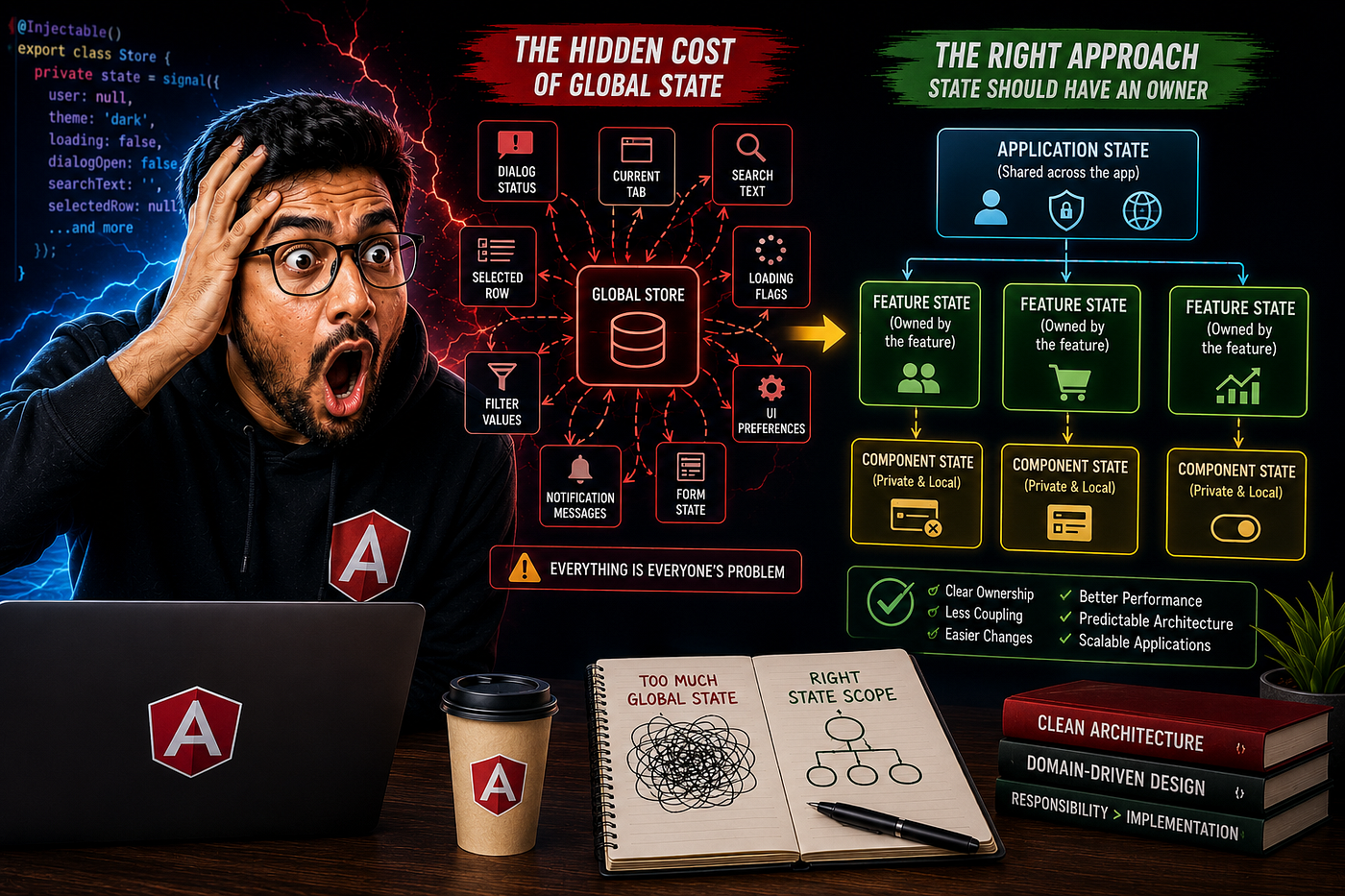
The Common Anti-Pattern
Many applications eventually reach:
Component A
      │
      ▼
Shared Service
      ▲
      │
Component B
Then:
Component Cjoins.
Then:
Component Djoins.
Soon every feature touches the same state.
Nobody truly owns it.
The architecture becomes fragile.
What Good State Management Actually Does
Most developers think state management tools exist to store data.
Not really.
They exist to establish ownership.
A good store answers:
Who owns the data?
Who changes it?
Who observes it?
The store becomes the source of truth.
Why NgRx Became Popular
NgRx wasn’t popular because developers enjoy writing reducers.
It became popular because ownership became explicit.
Action
     │
     ▼
Reducer
     │
     ▼
Store
Every state change follows the same path.
The architecture becomes predictable.
Why Signals Are Changing The Conversation
Signals make state easier.
Example:
customer =
 signal<Customer | null>(null);
Simple.
Elegant.
Reactive.
But Signals don’t automatically solve ownership.
You can still create chaos with Signals.
You can still create multiple competing sources of truth.
The ownership problem remains.
State Ownership In Modern Angular
Modern Angular increasingly encourages:
Feature
    │
    ▼
Feature Store
Example:
Customer Feature
      │
      ▼
Customer Store
Ownership becomes obvious.
Customer data belongs to the Customer domain.
Not every component in the application.
The Hidden Cost Of Multiple Sources Of Truth
Imagine:
Customer Stateexists in:
- Component
- Service
- Signal
- Cache
- Store
Which one is correct?
Nobody knows.
Eventually synchronization bugs appear.
Developers lose confidence.
The application becomes difficult to reason about.
State Management Is Really Consistency Management
The real goal isn’t:
Store DataThe real goal is:
Maintain ConsistencyThat’s why ownership matters so much.
Ownership reduces ambiguity.
How Senior Engineers Think About State
Junior developers ask:
Where should I put this state?
Senior engineers ask:
Who should own this state?
The second question usually leads to better architecture.
Because ownership naturally creates boundaries.
And boundaries create maintainability.
A Practical Rule
Before introducing:
- Signals
- RxJS
- NgRx
- Signal Store
Ask:
Who owns this data?
If you can’t answer that question clearly, the technology choice won’t save you.
The architectural problem still exists.
Final Thoughts
State management discussions often focus on tools.
Signals versus NgRx.
RxJS versus Stores.
Libraries versus Framework APIs.
But the most important question is much simpler.
Who owns the data?
Because state management isn’t fundamentally about storing information.
It’s about creating a single source of truth.
It’s about establishing responsibility.
And responsibility is what keeps large Angular applications maintainable as they grow.
The best state management solution isn’t the one with the fewest lines of code.
It’s the one that makes ownership obvious.
Connect with Me
If you enjoyed this post and would like to stay updated with more content like this, feel free to connect with me on social media:
- Twitter : Follow me on Twitter for quick tips and updates.
- LinkedIn : Connect with me on LinkedIn
- YouTube : Subscribe to my YouTube Channel for video tutorials and live coding sessions.
- Dev.to : Follow me on Dev.to where I share more technical articles and insights.
- WhatsApp : Join my WhatsApp group to get instant notifications and chat about the latest in tech
Email: Email me on dipaksahirav@gmail.com for any questions, collaborations, or just to say hi!
I appreciate your support and look forward to connecting with you!
메타데이터
- post_id
- 3b000a5e4c23
- slug
- state-management-isnt-about-state-it-s-about-ownership-3b000a5e4c23
- url
- https://medium.com/angular-engineering/state-management-isnt-about-state-it-s-about-ownership-3b000a5e4c23
- canonical_url
- https://medium.com/angular-engineering/state-management-isnt-about-state-it-s-about-ownership-3b000a5e4c23
- author_url
- https://medium.com/@dipaksahirav
- status
- ok
- fetched_at
- 2026-06-16 19:09:56