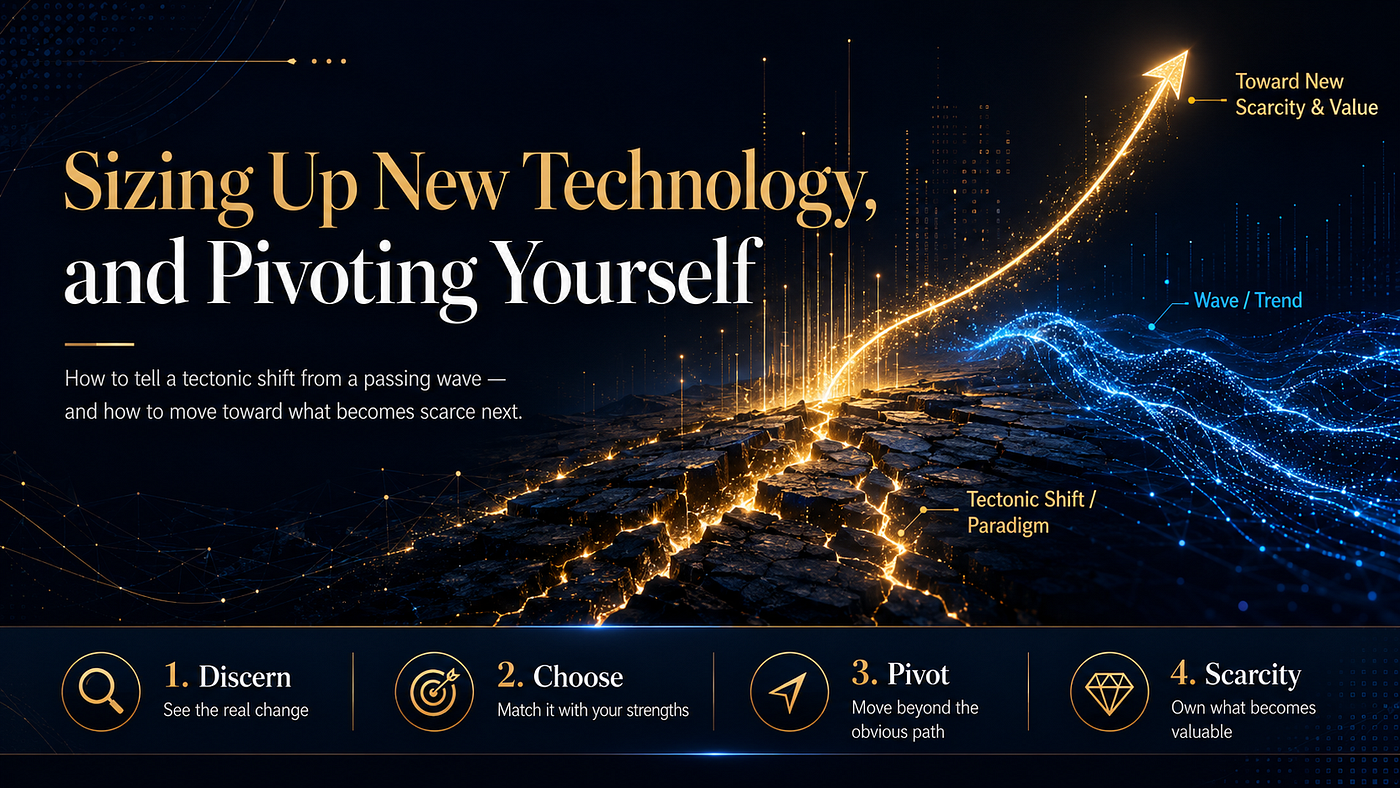
Sizing Up New Technology, and Pivoting Yourself
Every time a new technology arrives, we engineers are faced with two questions.
Sizing Up New Technology, and Pivoting Yourself
Every time a new technology arrives, we engineers are faced with two questions.
The first is, “Is this the real thing?” Is it a paradigm that will fundamentally reshape how society and business work, or is it a passing fad — something that looks big from a distance but quietly recedes before long?
The second is, “If it is the real thing, then what should I do about it?” Do I need to chase it? Is it fine to chase it the same way everyone else does? Or is there a completely different approach?
I have spent my career, ever since I was a new graduate, turning new technology into value for the world. I worked with the cloud around 2010, began putting machine learning into practice around 2015, worked with MLOps and unstructured data around 2020, and since 2023 I have been deeply involved in the world of generative AI and AI agents. Drawing on that experience, let me offer my own answers to these two questions.
In Part 1, I’ll share the tools I use to tell a “tectonic shift (paradigm)” from a “wave (fad).” In Part 2, I’ll give my personal take on where to plant yourself once you’ve recognized the real thing.
To state the conclusion up front: when something becomes free, go and claim what has newly become scarce right next to it.
Part 1: Tectonic Shift, or Wave?
Don’t be dazzled by the spectacle
I like to think about new technology through the metaphor of a “tectonic shift” versus a “wave.”
A tectonic shift advances quietly but surely, deep beneath the sea. It redraws the shape of continents, moves coastlines, and reshapes the very ground people stand on. Once the terrain has moved, it never returns to what it was. The cloud, the smartphone, and AI/LLMs were tectonic shifts of this kind.
A wave, by contrast, looks big from a distance, and its spray — the hype, the money, the sheer volume of news — is spectacular. But a wave recedes quickly. Looking back, there have been many technological waves that were heralded as world-changing yet quietly slipped away: 3D television, the great voice-based social media boom, the early frenzy around wearables, the metaverse, 5G, blockchain, NFTs… Most of these, I think, were waves.
The tricky part is that, early on, a tectonic shift and a large wave look very much alike. Both are said to “change the world,” and both pull in enormous money and talent. That is precisely why we need to keep a cool head and tell tectonic shifts from waves using reliable indicators.
“Can a single person feel the value right away?”
When I encounter a new technology, the first measure I apply is: “Can a single person feel its value right away?”
In the world of software, I believe a technology that becomes a tectonic shift requires no cumbersome permission, does not depend on others joining in at the same time, and lets a single, self-directed user experience its value on their own within minutes.
By “user” I mean to include both consumers and developers — essentially, the broad, unspecified public.
In the beginning, the cloud let a developer with nothing more than a single credit card spin up a server in minutes, without anyone’s permission, and feel its value on the spot. The smartphone, alongside Steve Jobs’ keynote, made you understand “this is different” the moment you touched it in a store. And LLMs, when ChatGPT appeared in November 2022, drew in countless people within the first few seconds of typing a question into the chat box.
https://www.youtube.com/watch?v=x7qPAY9JqE4
What all three share is this: the proof of value was completed in the user’s own hands, without waiting for anyone else to join or to grant permission.
On the other hand, some technologies stumble right here. The metaverse and many blockchain-based services, for example, fell into this trap. Even if you join alone, almost nothing happens if no one else is around. Value materializes only on the condition that “everyone uses it.” This is a chicken-and-egg problem; by nature such technologies are slow to take off, and often never take off at all. I call this property single-player viability. A technology that delivers value from the very first user is fast and strong, whereas a value proposition that means nothing until others join takes a long time, or never gets off the ground.
Let’s analyze a bit further
Of course, single-player viability alone can’t explain everything. But between the paradigms that became tectonic shifts and the fads that ended as waves, the same kind of large gap shows itself along other dimensions too.
Beyond single-player viability, another important indicator is whether the technology resolves or eases an essential constraint by an order of magnitude. The essence of technology is to solve some problem (whether or not humanity is even aware of it). One caveat: this value tends to be framed as a question of scale — “a 10x improvement or a 10% improvement?” — but what really matters is whether it’s 10x against the right constraint. Take 5G: it certainly improved bandwidth significantly, but 5G isn’t available everywhere in Japan, and for most use cases that bandwidth wasn’t the real bottleneck. We are, surprisingly, quite satisfied with the widely available Wi-Fi and 4G. Genuine paradigms have always eased — by orders of magnitude — a broad constraint that people were truly struggling with.
Another important lens is whether a technology becomes a foundation on which users can easily build businesses — in other words, whether it can nurture an ecosystem. In the wake of a tectonic shift, new business ecosystems spring up one after another. On top of the smartphone, Uber and Instagram grew; on top of the cloud, countless SaaS products; and on top of LLMs, a diverse array of AI agents is now sprouting. By contrast, when I think back on NFTs and the metaverse, I can’t shake the impression that what got built on top of them was mostly just more, similar NFTs and metaverses. Ecosystems in nature always carry diversity. The same holds for technology.
Finally, there’s the indicator of whether no belief is required to use the technology — that is, whether it “just works” without you having to subscribe to a particular worldview. A paradigm-defining technology simply works, no matter what its users happen to believe. You don’t need to resonate with any particular ideology to use the cloud (though you may need to trust your cloud provider). Within the waves, however, some demand agreement with a certain worldview as a precondition for feeling their value. Some blockchain use cases presuppose the idea that “centralization must be overcome,” and the metaverse presupposes empathy with the vision that “life’s center of gravity will shift into virtual space.” Technologies that demand belief in the very experience of their value may build a passionate circle of believers, but they tend not to become tectonic shifts that work for everyone.
Four questions
As a result of this analysis, I pose the following four questions as indicators for telling a tectonic shift from a wave.
Does the solution come first, or the problem? A paradigm solves a problem that already plainly exists. A fad tends to begin in the reverse order: “We’ve built a wonderful hammer — now let’s go find a nail to hit.” If the search for use cases for a given technology has been going on for years, that itself may be the answer.
Is permission required? Both the cloud and LLMs can be started with “just a sign-up” (subscriptions are an amazing business model). 5G required a great deal of “permission” and “staging” — carrier capital investment, device upgrades, and waiting for coverage. Technologies whose adoption needs someone else’s permission have a hard time.
Is it destined to become boring? A genuine paradigm ultimately becomes something boring. The automobile, TCP/IP, the cloud — all are now invisible infrastructure that no one even thinks about. A fad, by contrast, has to keep selling itself, so it stays loud forever.
Who is the one getting excited? With a paradigm, practitioners on the ground quietly but surely capture enormous value. With a fad, it’s investors and tech enthusiasts who need to spread the word about “future value.” People who actually have a problem of their own are the most honest. Pay attention to the places where people are “paying their own money and time for real results” to solve their own problems.
Dividing “real thing or fad” into three
I’ve been framing this as a binary so far, but reality is a bit more nuanced. In practice, I sort technologies into three categories.
- (A) Paradigm shift — It changes the very terrain of the world. The cloud, the smartphone, and LLMs belong here.
- (B) Real, but merely an incremental “feature” — Useful, but it doesn’t change the terrain. I’d put 5G here. It did not, in itself, give rise to a broad new form of expression or a business ecosystem.
- © Hollow hype — Lots of spectacle, but little left behind. NFTs and parts of the metaverse seem close to this (though there are, of course, successful cases built on them).
What I especially want to handle with care is separating a technology’s “essence” from its “periphery.” Blockchain, for instance: the maximalist part — “put everything on the chain” — ended as a fad, yet a narrow but solid real demand, such as stablecoins, also remained. Once you can see the essence apart from the periphery, the resolution of your judgment improves dramatically. Both “total rejection” and “total endorsement” are forms of switching off your brain.
Amara’s Law and hindsight bias
Finally, let me leave a note of caution to myself.
One is what’s known as Amara’s Law. People overestimate the impact of a technology in the short term and underestimate it in the long term. Even genuine paradigms must pass once through the trough of disillusionment in the hype cycle. So judgment isn’t only about pinning down “is this real?” — it’s also a judgment of timing: “which phase are we in right now?”
The other is hindsight bias. After you’ve won, you can say anything you like. What I want to discuss here is not a prophecy that infallibly predicts the future. What I’m writing is, at best, my own view that nudges the odds of being right just a little higher. The future is uncertain, and having my own methodology miss the mark is itself an interesting lesson.
Homework
Now that I’ve gone to the trouble of laying out a methodology, let’s try using it. As of 2026, there are several technologies where the verdict — tectonic shift or wave — is split: AI agents, humanoid robots, AR glasses, quantum computers. All of them are hard to score.
Try judging each of them — tectonic shift, or wave?
- Can a single person feel the value within minutes, without permission?
- Does it ease the right constraint by an order of magnitude?
- What is starting to get built on top of it?
- Does feeling its value require some kind of belief?
Part 2: Where Something Becomes Free, Scarcity Is Born Next to It
Within a new technology, where should you position yourself?
In every paradigm, something suddenly becomes “free (abundant),” and right next to it, something else newly becomes “scarce.” Value flows either to those who build the paradigm, or to those who seize what has newly become scarce.
A technological paradigm in software is, in essence, “an event in which something once expensive (i.e., a problem that previously had to be solved at high cost) becomes virtually free.” The cloud made computing resources, the smartphone made distribution, and LLMs made natural language almost free.
Engineers take that paradigm as a given and create value on top of it — but you need to consciously choose where to place your own value position.
One option is to become the one who builds the paradigm. As a builder of the paradigm, you can generate enormous value by providing the thing that becomes free.
Another option is to become the one who grows a new business ecosystem on top of the paradigm. Here too, taking the paradigm as a given, you create vast value by seizing what has newly become scarce right next to the thing that became free.
The key in this choice is not to rush toward the thing that became free. The thing that became free is a commodity. Crowd around it, and it commands no price. Value always flows to its “neighbor.” When something becomes virtually free, something else that had been inconspicuous suddenly surfaces as the bottleneck for the whole. When the smartphone spread and an ecosystem of apps and social media formed, holding on to users’ attention became the bottleneck. Beside the paradigm lies what has newly become scarce, and that is where the new sources of value and competition are.
The iron rule of pivoting within a new paradigm is this: figure out what has just become free, and either become the one who makes it free, or go claim what it has made scarce.
My case study: betting on data
As a case study, let me describe — as one example — how I myself have bet across various paradigms. In recent years, especially in the age of AI, I have stood beside “data.” In other words, in the AI era, I bet on data.
Of course, this is merely one way to choose, and the object of your bet need not be data. What matters is the “how” of betting.
I didn’t set out from the start intending to bet on the importance of data, either. Through various paradigms — sometimes from inside them, sometimes watching from a distance — I came to realize that every time a paradigm changes, the very “shape” of data’s scarcity changes too.
In the cloud era, the scarcity was “scale and distribution.” The moment servers and storage became cheap, the challenge shifted from “how do we run and store things?” to “how do we keep large-scale systems stably running in a distributed environment?” My own interest at the time was mostly on that side — scalability and distributed-system design. Looking back, this is the period when the data engineer emerged as a profession, and people who could handle data warehouses and data pipeline platforms came to hold the value. Beside the now-abundant computing resources, “the ability to integrate data” was already beginning to become scarce.
In the mobile era, the scarcity was “the individual and the real-time.” During this period, I worked on machine learning at a company building smartphone e-commerce. What I came to appreciate, hands on, was that the data behind a machine-learning model matters far more than the model itself. How you design behavioral logs, how you clean them up, and how you turn them into usable features — this engineering of data and features was what decided the outcomes. And right around then, apps like TikTok appeared. What kind of data makes possible the recommendations that so accurately guess your taste as videos stream by, and the methods that automatically generate those videos? I was strongly drawn to what lay behind it.
In the AI/LLM era, the scarcity was “the quality of unstructured data” and “evaluation.” Now that generating text and images has become virtually free, what has become scarce is shaping a company’s proprietary knowledge into a form that generative AI can use accurately. What’s required is the ability to build retrieval systems, to curate data by meaning and attribute, and to make it usable. And there is one more newly scarce value: the importance of evaluation (evals) — building datasets that measure the quality of outputs — has become firmly recognized. Foundation models can be used by anyone, identically, through OpenAI or Anthropic, but the discipline around data is not the same for everyone.
Lining these up, a line comes into view: structured × large-scale → behavioral × real-time → unstructured × evaluation. The tools and the targets changed every time, and my own position changed too. And yet, the one challenge that has persisted across the eras seems to be “the difficulty of turning the data specific to each paradigm into value.” Precisely because it is a challenge that runs beneath every tectonic shift, betting on data in the age of generative AI was, for me, a natural choice.
Generalizing the pivot
Now, here is the heart of it. I happen to be betting on data, but what I want to convey in this article is not “bet on data.” It’s the way of moving — “go claim the scarcity next to the thing that became free.”
For example, in the age of LLMs, beside the content generation that became free, what became scarce is not data alone.
- Aesthetic judgment: Precisely because you can generate infinitely, the discernment to choose what is good has value.
- Verification and trust: Precisely because plausible falsehoods get mass-produced, the ability to verify outputs and responsibly guarantee trust has become scarce.
- Distribution and attention: Precisely because anyone can create content, the skill of capturing consumers’ attention and delivering to them matters.
- The last mile into operations: A demo is easy, but the ability to embed LLMs and AI agents into the gritty work on the ground in a way that creates value is what’s in demand.
Data wasn’t the only thing that became scarce in the cloud era, either. The SRE who safeguards reliability, the cost management (FinOps) that optimizes ever-swelling bills, the security that ensures safety — all are scarce specialties that arose “beside the servers and storage that became free.”
The methodology of pivoting can be generalized like this. The “neighbor” you should stand beside might be data, or evaluation, or trust, or the operations of a specific industry — but you only need to pick one “scarcity” that fits the cards in your own hand.
I’ll sum up how to choose in five questions. Try asking them of yourself.
Question 1: Am I standing at one of the “two ends,” or in the “middle”? In any gold rush, the ones who profit over the long run are at the two ends. One end is “picks and shovels” — the side that builds infrastructure and foundations. The other end is “the last mile” — the side that digs deep into a specific field or domain. And the middle — the generic application layer — is usually a red ocean. That’s because commodification is fiercest in the middle. Place yourself at one of the two ends.
Question 2: Will the time I’m investing now still travel with me three years from now? Learning time is finite. Specific APIs and frameworks are consumables that may become useless in the next paradigm. What you should bet on are meta-skills and domain judgment that carry across paradigms. In my case, it was “the ability to tame complex data with diverse techniques.” For you it may be something else. Ask yourself, “Will this still travel with me three years from now?”
Question 3: Am I combining my own domain with the new paradigm? The most valuable pivot is not “becoming a generic new-tech engineer.” That commoditizes fastest. What’s truly strong is combining the valuable domain knowledge you already hold with the new paradigm. If someone who knows logistics well grasps “logistics × LLM,” they won’t lose to a generic prompt jockey. Your existing expertise is capital to be used as leverage. This is also a pivot that’s psychologically easier to execute.
Question 4: Am I exhausting myself trying to be “first”? Am I getting into the “lasting layer” early? Remember Amara’s Law. The first wave — the flashy infrastructure race and the frenzy — often takes losses. To get into the lasting layer “early,” you don’t need to be “first.” In fact, a contrarian move is fine too: while everyone chases the spectacle of the app layer, you quietly stake out the plain, boring “neighbor” (data in generative AI is fundamentally unglamorous). The boring layer has thin competition, and compounding works in your favor.
Question 5: Am I selling my time by the hour, or accumulating assets that compound? Selling labor by the hour only adds up. What you should aim for is a position where the more it’s used, the more data accumulates, the better the product gets, and the more it’s used — a multiplying loop (a flywheel). Aim for the position where you accumulate assets that compound.
In closing
Finally, ask yourself this.
What has this tectonic shift just made free? And right next to it, what has it newly made scarce? Should I become the expert in that scarce thing?
메타데이터
- post_id
- 3b0ccface136
- slug
- sizing-up-new-technology-and-pivoting-yourself-3b0ccface136
- url
- https://medium.com/@shibuiyusuke/sizing-up-new-technology-and-pivoting-yourself-3b0ccface136
- canonical_url
- https://medium.com/@shibuiyusuke/sizing-up-new-technology-and-pivoting-yourself-3b0ccface136
- author_url
- https://medium.com/@shibuiyusuke
- status
- ok
- fetched_at
- 2026-07-11 07:02:50