Half a Basketball Court of Farmland — A Calculation That Made My Head Spin 12 Years Ago, and Its…
Twelve years ago, I was running a large-scale cassava cultivation business in Cambodia. The hypothesis was simple: if we brought Japanese…
Half a Basketball Court of Farmland — A Calculation That Made My Head Spin 12 Years Ago, and Its Answer Sheet Today
Twelve years ago, I was running a large-scale cassava cultivation business in Cambodia. The hypothesis was simple: if we brought Japanese agricultural know-how to a developing country and operated at scale, we could win. While testing that hypothesis on the ground, I was simultaneously chasing the numbers behind the bigger picture.
One day, a calculation made my head spin.
I was working out how much grain cultivation area was needed to support the annual meat consumption of the average European. It takes about 4 kilograms of grain to produce 1 kilogram of pork, and about 7 kilograms for beef. Convert EU citizens’ average meat consumption into grain, divide by the grain yield per hectare at the time, and you get the cultivation area required per person.
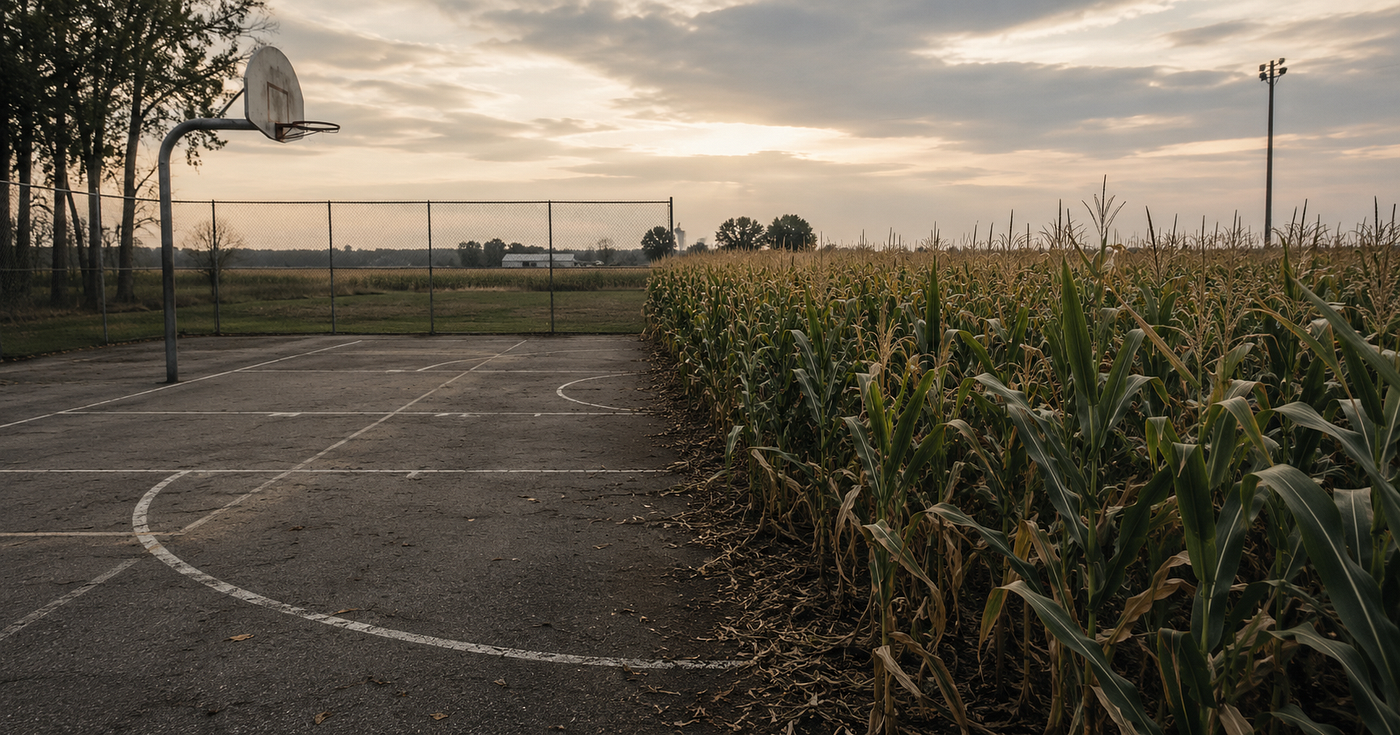
Half a basketball court.
Every single person living in Europe “virtually” owns a cornfield the size of half a basketball court, just to support their meat consumption. They’ve never seen this field. They don’t know it exists. But someone, somewhere, is growing that grain. Behind every virtual farm, there are virtual economic laborers. Nobody thinks about this when picking up a pack of meat at the supermarket.
Human dietary habits have a tipping point.
When per capita GDP reaches the range of $5,000 to $10,000, what people eat changes dramatically. People who had been slaughtering backyard chickens, eating fish caught in the river, and living off vegetables from their own plots start going to supermarkets. They buy packaged beef. They buy condiments they’ve never purchased before.
This isn’t a matter of culture or religion. I lived in Cambodia for 14 years and watched it happen with my own eyes. Cambodians didn’t eat less meat because of Buddhism — they ate less meat because they were poor. When they got richer, they ate more. You can’t stop it. It’s a fundamental human drive.
But stomachs have limits. Beyond a certain income level, the amount people eat plateaus. Cheap Australian beef might get upgraded to Kobe beef, but the actual quantity doesn’t change much. Recent research shows that meat consumption actually begins declining in some countries when per capita GDP hits $32,000 to $55,000 — Canada, Switzerland, and New Zealand are leading that trend.
In other words, meat consumption follows an S-curve: too poor to eat it, then explosive growth past a threshold, then a plateau when affluence peaks. The problem was that at the time of my calculation, billions of people were right in the middle of that explosive growth zone.
Twelve years ago, I ran the numbers for Asia alone. And I excluded India.
I left India’s 1.4 billion people out of the calculation. Unlike Cambodia, India’s low meat consumption really is driven by culture and religion. Hindu vegetarianism holds regardless of income. Thankfully, that segment won’t grow.
But even with just Asia minus India — China, Southeast Asia, Central Asia — the additional grain cultivation area needed to support projected meat consumption growth came out to roughly the same size as the entire territory of France.
An entire France’s worth of new cornfields, just for Asia. I didn’t include Africa. The numbers would have been too chaotic to even attempt.
And at the time, 5 million hectares of forest were being lost to agricultural conversion every year. Yet the same amount of farmland was simultaneously being lost to desertification. We were cutting forests to make farms while farms were turning into desert at the same pace. Net zero at best — probably negative.
Twelve years have passed. Time for an answer sheet.
World population grew from 7 billion in 2011 to over 8 billion by 2024. Right on pace with projections, if not ahead.
Per capita arable land dropped from 0.24 hectares in 2001 to 0.17 hectares in 2023 — a 20% decline. Total arable area grew slightly, but population grew much faster. The FAO’s 2025 report states that 1.7 billion people are already experiencing declining yields due to land degradation.
Forest loss has accelerated from the 5 million hectares per year I cited back then to 10 million hectares per year in the latest data.
Yield improvement rates have slowed: maize at 1.6% per year, rice at 1.0%, wheat at 0.9%. Doubling production by 2050 would require 2.4% annual improvement. We’re nowhere close.
And China turned out worse than anyone expected.
Twelve years ago, mainland China wasn’t yet wealthy enough for meat consumption to be a major factor. Hong Kong was the outlier. The mainland was still in the “about to arrive” phase. It arrived. As of 2023, the Chinese consume about 45 kilograms of meat per person per year, and despite being less than 20% of the world’s population, they account for over 40% of global pork consumption.
A 2024 research paper from China reported that the cultivated land needed to support Chinese diets expanded from 99.44 million hectares in 1987 to 159.66 million hectares in 2021 — exceeding China’s actual cultivated land area. One country ate through its own farmland.
The calculation that made my head spin 12 years ago had come true. And reality turned out worse than my projections.
The next act belongs to Africa — the continent I left out of my calculations because the numbers were too chaotic. It now holds over a billion people with the world’s highest population growth rate. When they begin crossing the $5,000 threshold, what happens next?
My head is spinning even more than it was 12 years ago.
— Kengo Kitaura
메타데이터
- post_id
- 3b0db04c5acf
- slug
- half-a-basketball-court-of-farmland-a-calculation-that-made-my-head-spin-12-years-ago-and-its-3b0db04c5acf
- url
- https://medium.com/@kengo/half-a-basketball-court-of-farmland-a-calculation-that-made-my-head-spin-12-years-ago-and-its-3b0db04c5acf
- canonical_url
- https://medium.com/@kengo/half-a-basketball-court-of-farmland-a-calculation-that-made-my-head-spin-12-years-ago-and-its-3b0db04c5acf
- author_url
- https://medium.com/@kengo
- status
- ok
- fetched_at
- 2026-07-13 23:34:01