HyperExecute vs Selenium Grid: Speed That Actually Scales | TestMu AI(Formerly LambdaTest)
Selenium Grid built the foundation of modern test automation infrastructure. HyperExecute was built for what comes next. Understanding the…
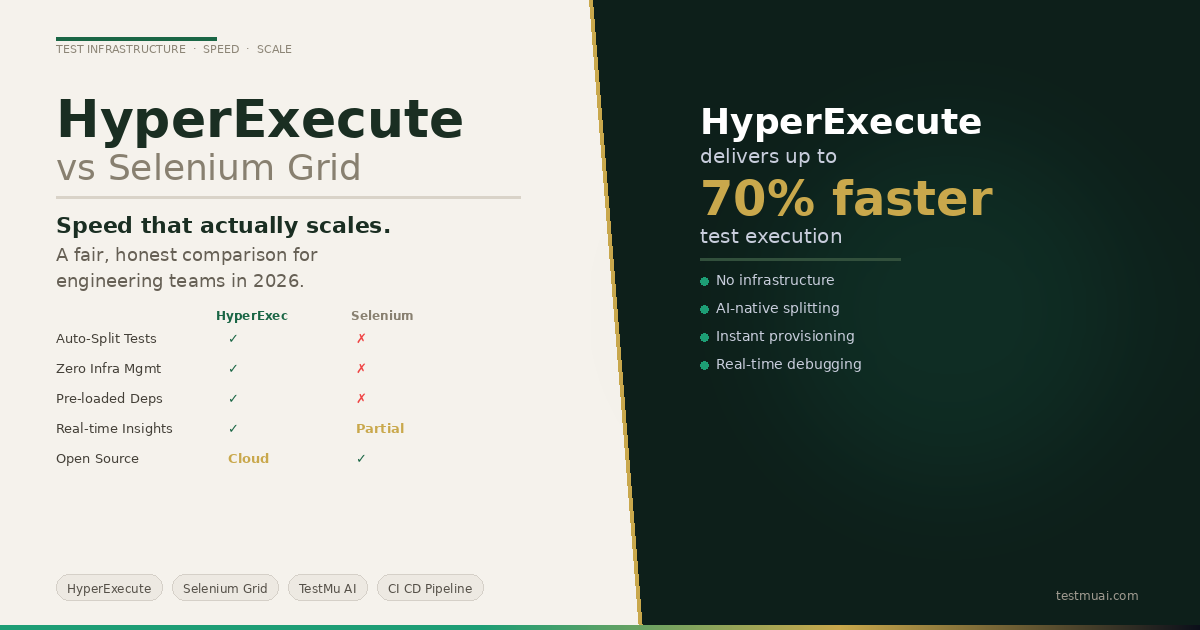
HyperExecute vs Selenium Grid: Speed That Actually Scales | TestMu AI(Formerly LambdaTest)
Selenium Grid built the foundation of modern test automation infrastructure. HyperExecute was built for what comes next. Understanding the difference helps you make the right choice for your team today.
Selenium Grid has been the backbone of parallel test execution for well over a decade. It solved a real problem at a time when running tests across multiple browsers and environments meant maintaining a rack of physical machines, and it did so in a way that was open, extensible, and widely adopted.
But the engineering world has changed significantly since Selenium Grid was conceived. Release cycles are shorter. Test suites are larger. Teams are distributed. CI pipelines run dozens of times a day rather than once overnight. The infrastructure that worked well in 2012 is showing its age in ways that are difficult to paper over with configuration tweaks.
HyperExecute, TestMu AI (Formerly LambdaTest) AI-native test orchestration platform, was not built as a replacement for Selenium Grid in the sense of doing the same thing faster. It was built around a different set of assumptions about what test execution infrastructure needs to do in 2026. Understanding those differences helps engineering teams make the right decision about where to invest.
What Selenium Grid does well
To be fair about this comparison, Selenium Grid’s strengths are real and worth acknowledging.
It is open source, which means no licensing cost and full control over the infrastructure. For organisations with the engineering capacity to manage and maintain their own grid, this is a genuine advantage. It integrates natively with every major Selenium-compatible framework and has years of community documentation, tooling, and troubleshooting knowledge behind it.
For teams that have already invested heavily in a self-managed grid setup and have the operational capacity to keep it running well, the case for staying put is not unreasonable. The problems tend to appear when the grid has to scale, when teams do not have dedicated infrastructure engineers, or when the overhead of maintaining the grid starts eating into time that should be spent on test quality.
Where Selenium Grid creates friction
Infrastructure management overhead
Running a Selenium Grid at meaningful scale is not a set-it-and-forget-it operation. Nodes go down. Browser versions drift out of sync with what the tests expect. Driver configurations break with framework updates. Capacity planning becomes a guessing game as test suites grow. For many teams, one or more engineers end up spending a disproportionate amount of time keeping the grid healthy rather than improving test coverage.
Static test distribution
Selenium Grid distributes tests to available nodes without intelligence about test duration or resource requirements. A test suite where individual tests vary significantly in execution time will routinely create situations where some nodes finish early and sit idle while others are still running the slow tests. The total run time is determined by the slowest node, not by the average, which means the inefficiency compounds as the suite grows.
No built-in observability
When tests fail on a Selenium Grid, diagnosing what happened typically involves digging through logs, screenshots, and video recordings after the fact. There is no native intelligence that classifies failures, groups related issues, or separates environmental problems from genuine product regressions. Every failure gets the same manual investigation treatment regardless of its actual cause.
Scaling requires upfront provisioning
Adding capacity to a Selenium Grid means provisioning and configuring new nodes in advance. If you need ten times the capacity for a release crunch, you either have that infrastructure sitting idle most of the time or you scramble to provision it when you need it. Cloud-based grids improve on this somewhat, but the provisioning overhead and cold-start times remain real costs.
How HyperExecute approaches the same problems
Zero infrastructure management
HyperExecute is fully managed infrastructure. There are no nodes to maintain, no browser versions to synchronise, no drivers to update, and no capacity to plan. TestMu AI handles all of that at the platform level. Engineering teams interact with HyperExecute through a YAML configuration file in their repository and a CI integration. The infrastructure layer is invisible.
Teams that previously had engineers dedicated to grid maintenance redirect that capacity toward test quality work. This is often where the most significant time savings happen, not in the test run itself but in everything that was going into keeping the execution infrastructure running.
AI-native test distribution
HyperExecute’s auto-split capability distributes tests based on historical execution data rather than simple numerical division. Tests are grouped to balance load across available concurrency slots, which means slow tests and fast tests are distributed in a way that minimises the idle time that conventional grids create. The result is a more efficient use of parallel capacity and a shorter total run time even at the same level of concurrency.
Instant provisioning through pre-downloaded dependencies
HyperExecute pre-downloads dependencies at the infrastructure level, which eliminates the setup time that sits at the start of most grid-based runs. Tests begin executing almost immediately after a run is triggered rather than waiting for environments to reach a ready state. For teams running multiple pipelines throughout the day, this compounds into meaningful time savings across a week of CI activity.
Real-time failure intelligence
TestMu AI’s Test Insights layer is integrated directly into HyperExecute, which means failures are classified and surfaced in real time during the run rather than as raw log output after it completes. Engineers can begin investigating a genuine product regression while the rest of the suite is still running, rather than waiting for the entire run to finish before any diagnostic work starts.
The practical performance difference
TestMu AI benchmarks HyperExecute at up to seventy percent faster execution compared to traditional Selenium Grid setups. That figure reflects the combined effect of AI-native distribution, instant provisioning, and efficient parallel execution rather than a single optimisation.
For context, a test suite that currently runs in sixty minutes on a self-managed grid would typically finish in under twenty minutes on HyperExecute. A three-hour overnight suite would finish in under an hour. The absolute gains scale with suite size, which means the value proposition grows as the product grows rather than flattening out.
Framework compatibility
A common concern when evaluating any grid alternative is framework lock-in. HyperExecute supports Selenium, Playwright, Cypress, Appium, TestNG, JUnit, PyTest, Mocha, Jest, and every major language-framework combination that works with these tools. Teams do not need to rewrite tests or change their automation approach to move to HyperExecute. The configuration sits in a YAML file and the tests themselves remain unchanged.
Teams that built their automation stack when LambdaTest was the platform name will find the same compatibility guarantees in TestMu AI. LambdaTest is now TestMu AI, and HyperExecute has been part of the platform since before the rebrand. The execution infrastructure is the same. The intelligence layer on top of it has grown.
When to stick with Selenium Grid
There are scenarios where self-managed Selenium Grid still makes sense. Organisations with strict data sovereignty requirements that prevent cloud-based execution. Teams with existing grid infrastructure that is running well and genuinely costing nothing in maintenance overhead. Small test suites where execution time is not yet a limiting factor for release velocity.
For everyone else, the operational overhead of managing grid infrastructure, combined with the performance ceiling that static test distribution creates, typically makes a managed platform with intelligent orchestration the more economical choice once the full cost is accounted for, including engineer time.
The bottom line
Selenium Grid built the infrastructure model that made parallel browser testing accessible. HyperExecute is the answer to what that model needs to become when the teams using it are shipping faster, the suites are larger, and the tolerance for feedback loop latency has shrunk to near zero.
The speed gains are real. The management overhead reduction is real. And the integration with the broader TestMu AI platform means that faster execution is not an isolated optimisation but part of a connected quality workflow that scales alongside the product.
메타데이터
- post_id
- 3b0f13e5f5fd
- slug
- hyperexecute-vs-selenium-grid-speed-that-actually-scales-testmu-ai-formerly-lambdatest-3b0f13e5f5fd
- url
- https://medium.com/@jain_sahab/hyperexecute-vs-selenium-grid-speed-that-actually-scales-testmu-ai-formerly-lambdatest-3b0f13e5f5fd
- canonical_url
- https://medium.com/@jain_sahab/hyperexecute-vs-selenium-grid-speed-that-actually-scales-testmu-ai-formerly-lambdatest-3b0f13e5f5fd
- author_url
- https://medium.com/@jain_sahab
- status
- ok
- fetched_at
- 2026-06-09 15:37:30