Zero-Latency Voice Agents: A Review of Hugging Face, Cerebras & Gemma 4
The paradigm of conversational AI is shifting. While end-to-end monolithic models have dominated recent headlines, the engineering reality…
Zero-Latency Voice Agents: A Review of Hugging Face, Cerebras & Gemma 4
The paradigm of conversational AI is shifting. While end-to-end monolithic models have dominated recent headlines, the engineering reality of deploying low-latency, scalable Voice AI often favours modular, cascaded architectures.
The recent announcement from Hugging Face and Cerebras regarding their real-time voice AI stack powered by the Gemma 4 31B model presents a fascinating case study in optimising the Time-to-First-Audio (TTFA) metric. By combining an open-source pipeline with extreme-scale inference hardware, they are tackling the most persistent bottleneck in multi-turn voice agents: P95 latency tails.
Here is a technical teardown of their proposed architecture, an analysis of its latency characteristics, and a look at the empirical results from its deployment in embodied AI.
The Cascaded Architecture: A Modular Pipeline
Unlike joint-embedding models that process audio in and audio out directly, the Hugging Face/Cerebras stack relies on a classic cascaded architecture. This provides immense observability and allows researchers to swap discrete components for domain-specific fine-tuning.

Architecture: HF Realtime Voice — Speech2Speech
- Automatic Speech Recognition (ASR): Nvidia Parakeet: The pipeline ingests raw speech input and processes it through Nvidia’s Parakeet. Parakeet models (typically based on RNN-T or Conformer architectures) are highly optimized for streaming transcription, ensuring minimal algorithmic delay before passing text to the LLM.
- VLM Inference engine: Gemma 4 31B on Cerebras: The transcribed text is fed into Google DeepMind’s Gemma 4 (31 Billion parameters). This is where Cerebras’ hardware becomes critical. By bypassing traditional GPU memory bandwidth limitations with their Wafer-Scale Engine, they drastically reduce time-to-first-token (TTFT) and overall token generation time.
- Text-to-Speech (TTS): Alibaba Qwen3TTS: The generated text tokens are streamed into Alibaba’s Qwen3TTS. As a neural speech synthesiser, Qwen3TTS prioritises natural prosody and low-latency chunking, thereby converting LLM output back into a continuous spoken response.
Analytical Review: Latency, P95 Tails, and the Memory Wall
In production, the user experience is not governed by the median response time, but by the P95 latency, the worst 5% of delays.


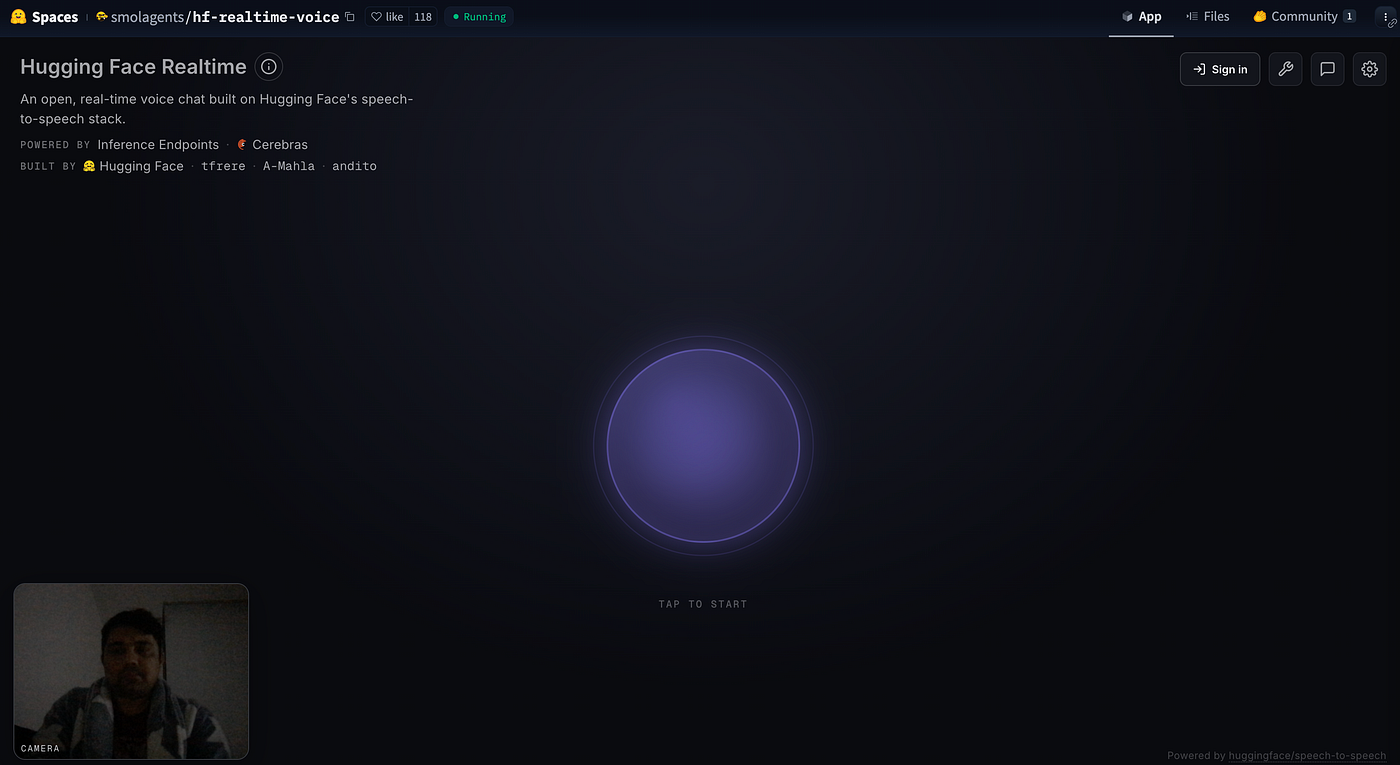
Demo: Snapshot of HF Realtime Voice
When humans converse, the typical gap between turns is roughly 200 to 500 milliseconds. Traditional GPU-based LLM inference, especially for a dense 31B parameter model like Gemma 4, often suffers from multi-second delays under concurrent load. These delays compound heavily when the agent must execute function calls or multimodal reasoning steps before responding.
The Cerebras Advantage: LLM inference is fundamentally memory-bandwidth bound, not compute-bound. Traditional GPUs hit a “memory wall” when fetching weights for every token generated. Cerebras solves this by keeping the entire model weights on-chip across its massive Wafer-Scale Engine.
By eliminating off-chip memory access, the time-to-first-token drops to near zero, and the generation speed outpaces human reading speed by orders of magnitude. This compresses the middle layer of the cascaded pipeline so aggressively that the total TTFA is dictated almost entirely by the ASR and TTS chunking overhead.
Modularity vs. Monolithic Trade-offs

Modularity vs. Monolithic Tradeoff
Experimental Deployment: Embodied AI in the Wild
The most compelling validation of this architecture isn’t found in sterile benchmarking, but in its physical deployment. Hugging Face confirmed that this exact pipeline is currently powering Reachy Mini robots, with over 10,000 units deployed in the wild.
For embodied AI, conversational latency isn’t just a UI metric; it dictates whether the robot feels “alive” or broken. The sheer volume of these deployments acts as a massive experimental proving ground. A P95 latency spike in a robot interaction breaks the illusion of presence instantly. The fact that a 31B parameter model can be reliably served to 10k+ physical endpoints in real-time is a testament to the stability of the Cerebras inference backend.
Conclusion
The Hugging Face and Cerebras collaboration is a powerful reminder that open-source, modular systems can compete with — and in terms of predictability, potentially outperform — closed monolithic models when paired with the right silicon.
For researchers and engineers building scalable voice applications, this architecture proves that you do not need to sacrifice the debuggability of a cascaded pipeline to achieve conversational latency. By systematically crushing the LLM inference bottleneck, developers can refocus their efforts on what matters: the quality of the data, the expressiveness of the TTS, and the accuracy of the ASR.
This platform’s architectural leap is particularly exciting in the context of our project on speech synthesis. The modularity of the Hugging Face pipeline perfectly aligns with our recent work developing a privacy-centric TTS architecture. We developed our model to prioritize professional-grade voice cloning that runs entirely on consumer hardware, ensuring that output quality is maintained while keeping user data fully private. The ability to plug a highly optimized, localized TTS model into a low-latency LLM pipeline opens up entirely new avenues for secure, real-time voice agents.
For those interested in how localized, privacy-focused speech synthesis can complement and integrate with these broader conversational frameworks, you can review the full academic paper in the ACM Digital Library, or explore the practical implementation details in our recent technical breakdown: A Privacy-Centric Architecture for Professional Voice Cloning on Consumer Hardware.
Don’t forget to test the HF Realtime Voice Demo to see the latency improvements in action.
References
- Mahla, A., Marafioti, A., von Werra, L., Vyas, S., & Cerebras. (2026, July 1). Hugging Face and Cerebras bring Gemma 4 to real-time voice AI. Hugging Face Blog. Retrieved from https://huggingface.co/blog/cerebras-gemma4-voice-ai
- Hugging Face Open-Source Repository. (2026). speech-to-speech. GitHub. https://github.com/huggingface/speech-to-speech
- Hugging Face Spaces Demo. (2026). HF Realtime Voice. Retrieved from https://huggingface.co/spaces/smolagents/hf-realtime-voice
- Nvidia. (n.d.). Parakeet: ASR Models. Nvidia NeMo Framework.
- Alibaba Cloud. (n.d.). Qwen3TTS Architecture and Technical Specifications.
- DeepMind. (2026). Gemma 4: Open Models Based on Gemini Technology. Google.
- Pokhrel, K., et al. (n.d.). A Privacy-Centric Architecture for Professional Voice Cloning on Consumer Hardware. ACM Digital Library. https://dl.acm.org/doi/10.1145/3774905.3795605
- Pokhrel, K. (n.d.). A Privacy-Centric Architecture for Professional Voice Cloning on Consumer Hardware. GOpenAI Blog. https://blog.gopenai.com/voicy-a-privacy-centric-architecture-for-professional-voice-cloning-on-consumer-hardware-75fd1c1a0f0a
메타데이터
- post_id
- 3b23b0f74dde
- slug
- zero-latency-voice-agents-a-review-of-hugging-face-cerebras-gemma-4-3b23b0f74dde
- url
- https://blog.gopenai.com/zero-latency-voice-agents-a-review-of-hugging-face-cerebras-gemma-4-3b23b0f74dde
- canonical_url
- https://blog.gopenai.com/zero-latency-voice-agents-a-review-of-hugging-face-cerebras-gemma-4-3b23b0f74dde
- author_url
- https://medium.com/@kushalpokhrel
- status
- ok
- fetched_at
- 2026-07-08 18:29:56