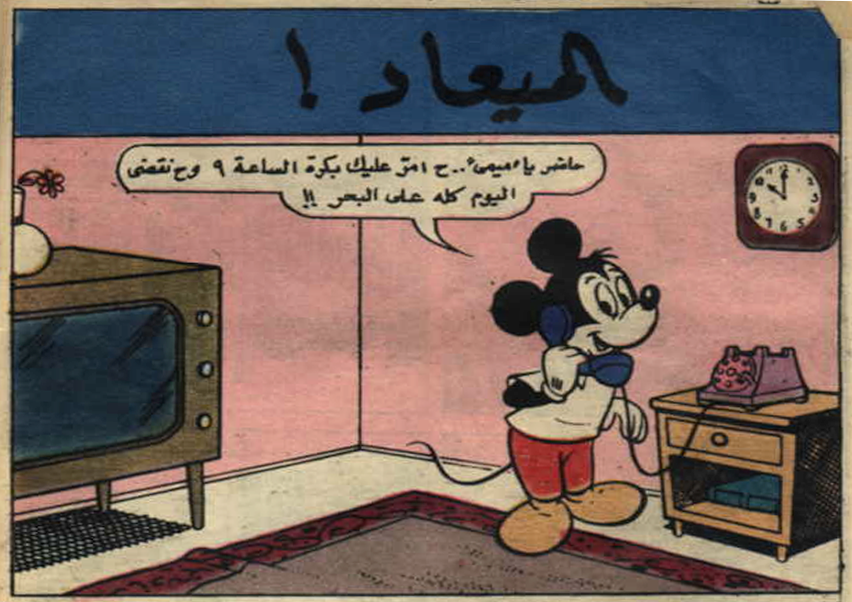
“Translating” Tintin in Six Strips
Tintin becomes Arab again and again and again.
“Translating” Tintin in Six Strips
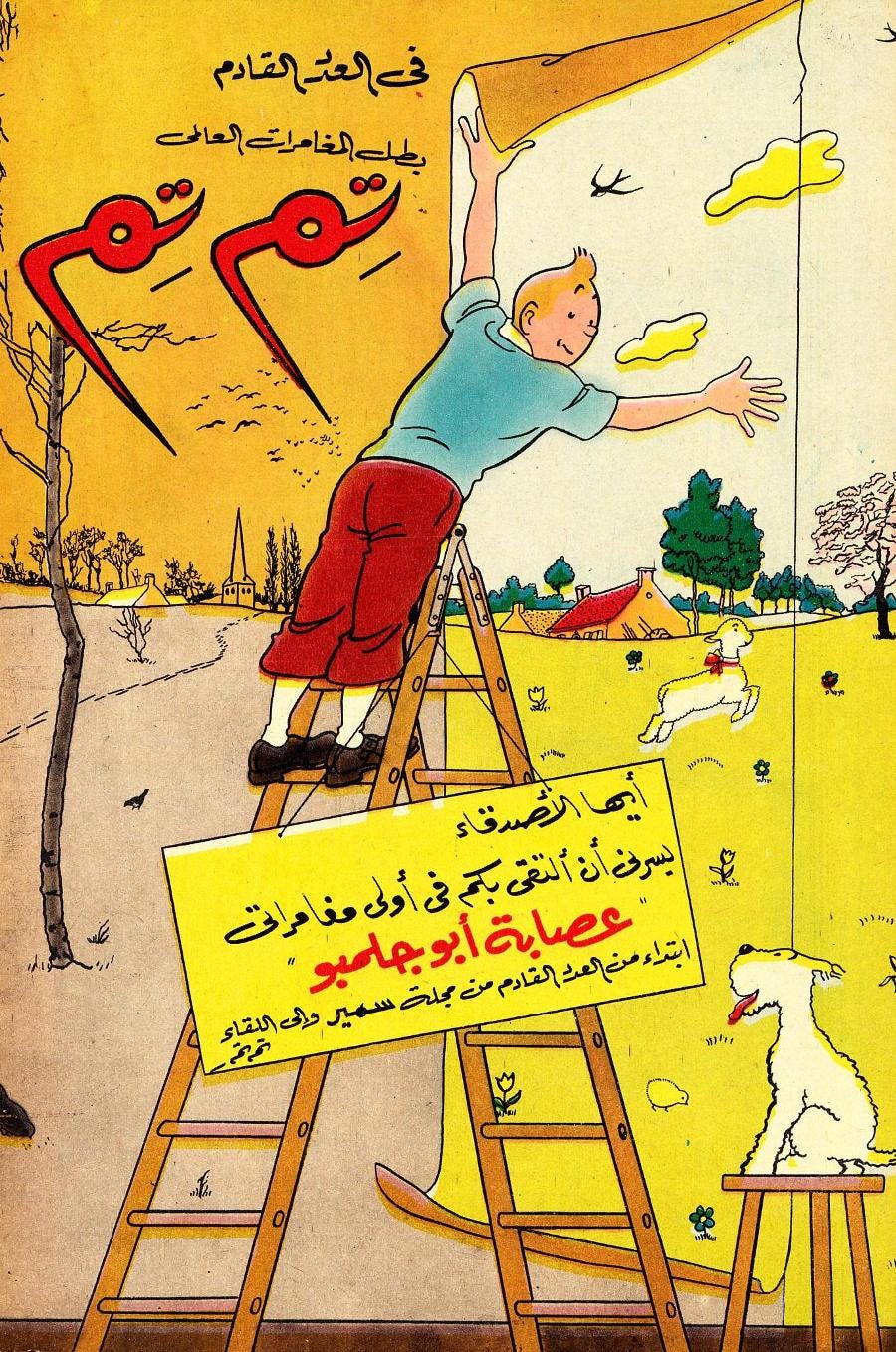
Cover of Samir Magazine (Issue 277), 1961, announcing that Timtim will join the magazine’s cast in the next issue
A boy stands on a ladder. He is doing two things.
First, he is wheat pasting a scene of a vibrant springtime pasture over a bleak winter background. In the winter image, the trees are barren, it is grey, and life is dormant. In the new image, trees are lush, flowers are blooming, and a lamb is jumping mid-air. This boy, whose hair crests into a quiff, is changing the same vista from dark to light in front of our eyes. As with all season changes, this feels inevitable. There was a before and an after.
Second, he is looking back at us with his eyebrows raised and a wry smile. His name is “Timtim.” The year is 1961. It is issue 277 of the beloved Egyptian children’s magazine Samir, published by Dar Al-Hilal. The text prompts that “the International Hero” Timtim will be joining the cast of regular Samir characters in the next issue with his first adventure “The Abu Galambu Gand.” He is the springtime on our winter pages. There was a before and an after.
A history of Arab comics contains within it a history of translation. Arab artists started creating original comics as early as 1920 with children’s magazines such as “Al-Awlad” in Egypt. As early as the 1940s, publication houses began translating Western comic book icons like Mickey Mouse, Superman and Lou Lou for Arab readers. A common feature of Arab children’s magazines is that original comic creations are often depicted side by side with iconic Western characters speaking Arabic. Arguably, no Western character has been more ubiquitous in the over 100 years of Arab comics than Tintin (aka Timtim, Tantan, or Hammam, depending on the decade and country).
Tintin the boy reporter is the original creation of the artist Hergé (né Georges Remi). Originally written in French and illustrated in the artist’s studio in Belgium from the 1930s onward, The Adventures of Tintin has been republished in 70 languages over the world. Even before those translations, Tintin had travelled to the ‘Middle East’ more than any other geography over the course of 24 books: first to Egypt in the Cigars of the Pharoah (1934), second to Morocco in the Crab with the Golden Claws (1941), and then twice to the fictional country of Khemed in Land of Black Gold (1950) and The Red Sea Sharks (1956).
Many, including myself, have documented Hergé’s problematic depiction of non-white characters throughout the Adventures of Tintin. Hergé’s conception of Arabs throughout Tintin’s many Middle East adventures is textbook Orientalism (short tempers, hooked noses and lots of sand). That said, the Tintin that speaks Arabic is not the same Tintin created by Hergé. To use a turn of phrase from the critical theorist Homi K. Bhabha, through the art of colonial mimicry the Tintin of Arab Comics is “almost the same, but not White.”
In six comic strips we can distill how Tintin was not only repeatedly translated into Arabic, but how he tried to become Arab. Tintin’s ubiquity provides insight into cultural translation, transformation, and violence. To use another of Bhabha’s descriptions for the space that happens when two or more cultures interact, each Arabic panel in which Tintin appears is a “site of collaboration, and contestation” of identity.
Strip 1: Tintin in America (1934)

Hergé, Belgium (1907–1983) Tintin en Amérique Page 32, 1934, Pub. Casterman, Belgium
Tintin en Amerique was Tintin’s third adventure. The comic was originally serialized in black and white from 1931–1932. The adventure follows Tintin’s exploration of the United States, requisite with Chicago gangsters and western Cowboys. The story is a classic example of how race operates in Tintin and more broadly in the 1930s European psyche. The Native Americans that Tintin encounters in “Redskincity” are not given any speaking roles. They are scenery. In one panel, Tintin points his camera directly at a stereotypically dressed Native American man begging on the street; Tintin’s dog Milou exclaims, “A Redskin!” As they walk on, Tintin remarks about how his European-chic clothes are getting a lot of attention from the cowboys.
Strip 2: Hammam in Amreeka (1947)

Artist Unidentified, “The Adventure of Hero Hammam in the Land of Uncle Sam”, Al-Katkout Page 9, Issue # 8, 1947, Pub. Bint al-Nîl, Egypt, Based on the art of Hergé in Tintin en Amérique, 1934
Launched in 1946, Al‐Katkout (Nestling) was a pioneering children’s magazine published in Egypt by the government-owned publishing house Daughter of the Nile Press for two years. Like many Egyptian magazines from the time, most of Al-Katkout’s pages were filled with text-heavy fairytales, science experiments, and word games created for children. Unlike many magazines of the time globally, Al-Katkout was one of the first magazines in the Middle East to feature the fledgling artform of comics. From the premiere issue, the star of Al‐Katkout serialized comics strips was a boy reporter named Hammam who traveled the world solving crimes with his fox terrier, Antar. Tintin’s translation from French into Arabic (from Tintin into Hammam) in 1946 is significant because it means that he was translated for readers of Al-Katkout 12 years before he was first translated into English.
This first instance of Tintin’s transformation reveals the subversive art of translation: in both form and substance. In form, the editors of Al-Katkout reversed the original layout to read from right to left and erased all speech bubbles. This was a very literal “flip the script” moment, as the editors created new captions in Arabic underneath each panel similar to conventions of the time. In substance, Tintin en Amerique becomes “The Adventure of Hero Hammam in the Land of Uncle Sam.” Tintin’s cap is re-rendered as a tarboush, and his identity re-rendered as ‘Arab.’
Coming only a decade after Hergé’s original drawings, the comic now tells the tale of an Arab boy in America. When Hammam encounters a cowboy, the caption reads: “The clothes Hammam wore were strange to the inhabitants of the village.” Here, Tintin’s speculation that his Europeanness is “getting a lot of attention” is replaced with text stating explicitly that Hammam’s Arabness is strange and otherizing in this land.
Strip 3 and 4: King Ottokar’s Sceptre (1947) / The Secret of the Scepter (1960)

Artist Unidentified, “Secret of the Sceptre”, Sindibâd Page 9, Issue #27, 1960 Pub. Dar al-Marouf, Egypt, Based on the art of Hergé in King Ottokar’s Sceptre, 1947, Page 1
Hussein Bicar, an Egyptian artist renowned for his modernist paintings, founded Sindibâd Magazine in 1952. Before it stopped publishing in 1960, Sindibâd was filled with original comics penned by Bicar, the writer Mohammed Said al‐Aryan, and other artists like Mario Morelli. Each magazine featured an illustrated adventure of the titular Sindibâd the Sailor, recasting the centuries old folkloric hero from One Thousand and One Nights as a uniquely Arab globe-trotting hero in the mode of Tintin (complete with a dog named “Nimrod”). Sindibâd championed Bicar’s broader artistic philosophy of putting Egypt in conversation with the global art world, but not bending to greater art trends for forms sake alone.
Under the umbrella of the state‐owned publishing house Dar Al‐Marouf, Bicar and team aimed to create comics shaped by subject matter and perspectives rooted in the Arab experience and embodying the ideology of Pan-Arabism under Nasser. To point, six months after Sindibâd’s premiere, King Farouk was overthrown. As part of the sweeping nationalization of the presses, Sindbad’s circulation was increased to 27,000 copies a week directly to schools. [SG1] In short, the new Nasser-led government recognized the symbolic and educational importance of locally produced art for children and actively guaranteed its success.
While the magazine stayed true to its pan-Arab ethos for most of its run, in the very last issue, readers were greeted with another cultural contestation of Tintin’s identity. Likely tracing from the 1947 colorized version of the album King Ottokar’s Sceptre, here Tintin’s hair is unquiffed, his pants shortened, the color of his wardrobe undrabbed. The streets are given Arabic names, and Milou is erased. Much like Hammam in Al‐Katkout, Tintin is not translated but transformed into a new identity.
Strip 5: Tantan in Amreeka (1977)

Hergé, Belgium (1907–1983), “Tantan and the Chicago Gangs” Page 16, 1977, Pub. Dar al-Marouf, Egypt, Arabic translation of Hergé Tintin en Amérique, 1946
In the late 1970s, Tintin was once again introduced to Arabic readers: this time as a Belgian named Tantan who just so happened to speak great Arabic. Egyptian publisher Dar Al‐Marouf began to translate the Tintin albums in their canonized format of 24 distinct hardcover books. No longer nestled between other stories in Arabic language children’s magazines, these books largely adopted Hergé’s colorized Casterman version of the stories and replaced the original French with Arabic text. In the same three panels, now retitled as “Tantan and the Chicago Gangs,” Tantan is back to his original wardrobe. A more literal translation of Tintin is possible now because, by this point, Tintin means something to Arab readers as a fixed culture object. The site of cultural contestation is narrowed from the whole panel, as in Al-Katkout and Sindibad, to the speech bubbles.
Strip 6: Translating Gibberish in Crab (1941) (1961)

Left: Hergé, Belgium (1907–1983), “The Crab with the Golden Claws” Page 36, 1943, Pub. Casterman, Belgium | Right: Pub. Dar al-Marouf, Egypt, Arabic translation of “The Crab with the Golden Claws”
In a 1961 issue of Samir referenced at the start of this article, readers were teased with Timtim’s “first” adventure, “The Abu Galambu Gand.” The Galambu Gand was a translation of original Tintin’s ninth adventure, The Crab with The Golden Claws, which was set in Morocco. In the comic, Tintin meets, is repeatedly almost killed by, and ultimately befriends the perpetually drunk Captain Haddock. Just as in the previous panel, Tintin was traveling to readers of Samir as a culturally fixed signifier (aka the teased “the International Hero”). Re-presenting (and, on some level, reclaiming) Tintin’s Morocco adventure for Arab readers illustrates that even if a site of translation is limited to a speech bubble, there is still room for resistance.
Throughout Tintin’s adventures in the Middle East, Hergé often used nonsensical squiggly lines to signify Arabic, instead of, well, Arabic. The problem does not arise in too many panels; just as with Native Americans in Tintin in America, Arabs in Tintin comics are rarely given the agency to speak. Instead, they are scenery or punchlines — sometimes both.
In a scene from Crab that depicts a shootout between Haddock and an unnamed Arab, a translation dilemma becomes a moment of invention. Hergé’s squiggle “Arabic” invites the translator to become a writer. The Arabic editors created actual Arabic text (“This will be the last shot”) to replace the fury squiggles. Instead of accepting Hergé’s stereotyped language decisions for an Arab character, the translator took it upon herself to create and add language — to fill in the blank with (real) voice.
This article was originally published in Journal Safar, Issue 8 “Tongues” (2025)
메타데이터
- post_id
- 3b3d9e7b0657
- slug
- translating-tintin-in-six-strips-3b3d9e7b0657
- url
- https://medium.com/@ndamluji/translating-tintin-in-six-strips-3b3d9e7b0657
- canonical_url
- https://medium.com/@ndamluji/translating-tintin-in-six-strips-3b3d9e7b0657
- author_url
- https://medium.com/@ndamluji
- status
- ok
- fetched_at
- 2026-06-29 22:44:20