Putting Black Life Center Stage
For more than 30 years, New Horizon Theater has put the spotlight on African American stories.
Putting Black Life Center Stage
For more than 30 years, New Horizon Theater has put the spotlight on African American stories.
By LaMont Jones Jr.

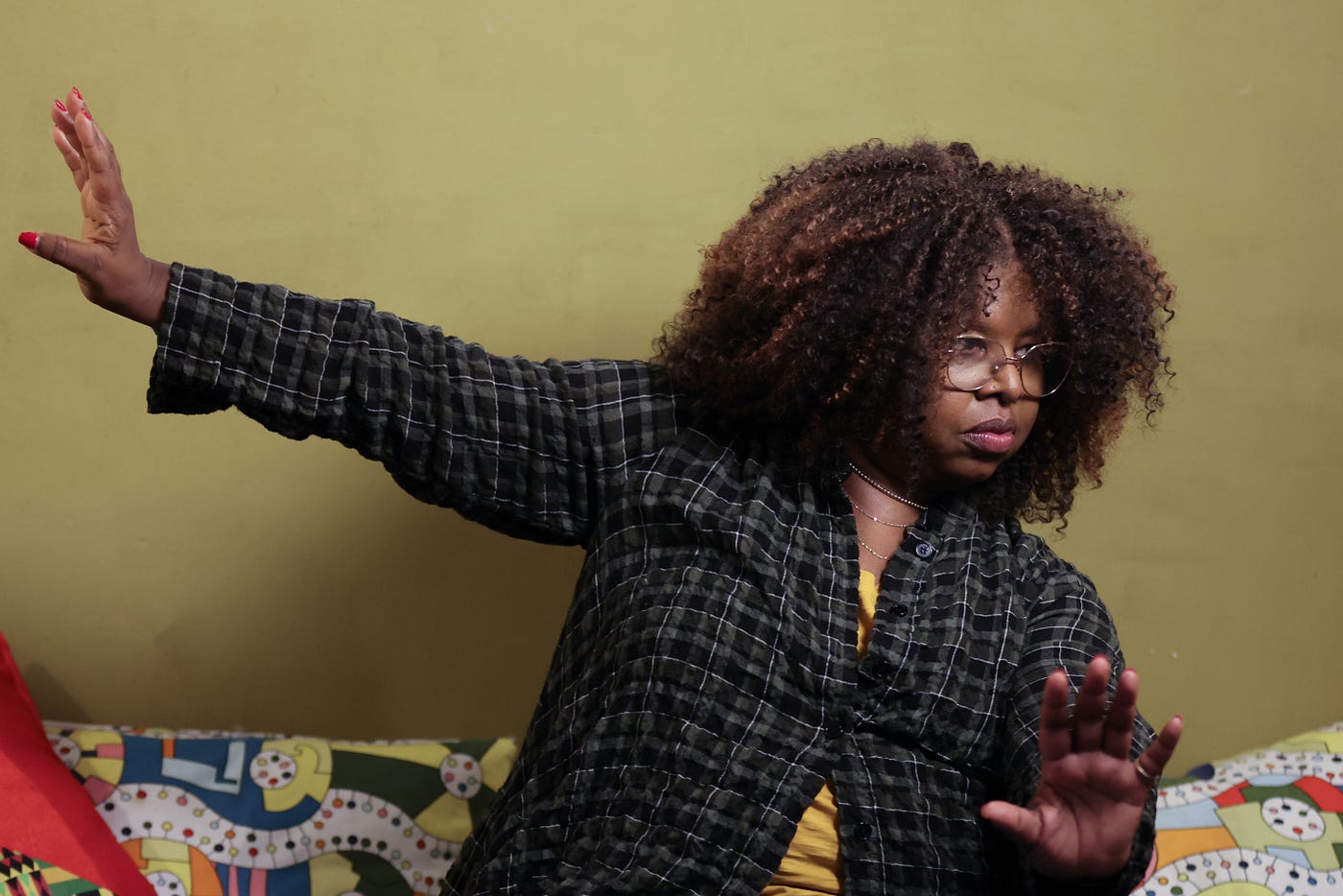
Joyce Meggerson-Moore, chair of New Horizon’s board of directors | Image by Brian Cook/Golden Sky Media
The seven Black men rule the basketball court, showing off their mesmerizing team hoop skills while bonding through conversation. They seem as oblivious to onlookers as they are to the sun beating down on them this scorching summer day outside a public school in Pittsburgh’s Stanton Heights neighborhood.
Soon, they bow and receive applause — as actors in New Horizon Theater’s production of “Kings of Harlem.” The play, written and directed by Layon Gray, was inspired by the Harlem Rens professional basketball team that was hugely successful in the 1930s despite the adversity and social rejection that segregation visited upon them.
“Kings of Harlem” was New Horizon’s 30th anniversary season opener in August 2021 and the theater company’s first live performance since the COVID-19 pandemic struck in early 2020. Guests wore masks and sat in socially distanced folding chairs arranged on the court. Among them was Carolyn Callahan, who was so impressed with the production that she saw it twice.
“I had never been to a play where the stage was actually a basketball court,” says Ms. Callahan. “Imagine that you go to see a play and you’re actually there, in the setting where it generally would occur. It was an excellent way to introduce the new season out of a pandemic, and I enjoyed it.”
More than 800 people attended four productions of the play, says Joyce Meggerson-Moore, chair of New Horizon’s board of directors. Attendance was higher than expected given the pandemic, she says, fueled partly by a comprehensive marketing campaign that included outreach in the neighborhood surrounding the school.
“People often tell us that our productions are as good and as professional as any play you see on Broadway or anywhere else,” says Dr. Meggerson-Moore, who has led the board for more than 25 years and was a volunteer at New Horizon’s inception. “It’s gratifying when people express that. We like people to know about us and keep coming back.”
With a $250,000 grant from The Heinz Endowments and the Ford Foundation through the Pittsburgh’s Cultural Treasures Initiative, Dr. Meggerson-Moore and New Horizon’s leaders — all volunteers — are planning to ramp up community engagement and artist support while continuing to offer the types of dramatic presentations that have won them a loyal following over the last three decades.
They’re also seeking a permanent space that they can call home, hoping to end a nomadic existence that has seen them hopscotch across the city, presenting plays and musicals in auditoriums and make-do spaces such as libraries, churches, community centers and even a few theaters.
Since its inception, New Horizon has been the little theater company that could. The unapologetically Black-centric performing arts organization has wrestled with and ultimately triumphed over the existential challenges that face local, minority-run nonprofit arts groups.
New Horizon emerged in the early 1990s, when Pittsburgh native Elva Branson assembled a group of local artists to create a theater company dedicated to providing a venue for Black performers, plays and audiences. Among those helping her lay the groundwork were Rob Penny — a playwright, poet, social activist and University of Pittsburgh professor — and renowned playwright August Wilson.
The first play, “Home,” was staged in 1992 and was written by Samm-Art Williams and directed by Ernest McCarty, who later served as New Horizon’s artistic director for 14 years. Seasons gradually grew from one production to as many as five, with typically 12 productions per play. The chosen genres run the gamut of the theater experience, from one-person historical dramas to small-cast comedies to full-ensemble musicals.
There’s also New Horizon’s signature event each spring, an annual glitz-and-glamour fundraising performance headlined by legendary Black entertainers that have included Ossie Davis and Ruby Dee, Ashford & Simpson, The Temptations featuring Dennis Edwards, and Melba Moore.

Joyce Meggerson-Moore with Melba Moore | Image by Richena Brockinson
Dr. Meggerson-Moore says New Horizon endeavors to advance Black arts, provide a vehicle for the artistic development of Black actors and playwrights, and consistently present excellent plays and other cultural events that reflect Black historical experiences and contemporary perspectives. Along the way, that has meant paid work for more than 500 cast and crew members ranging from light technicians, sound engineers and stagehands to set designers and actors, as well as directors like Mr. Gray, Mr. McCarty, Herb Newsome and Eileen J. Morris.
“Definitely, the art that New Horizon has been presenting gives the community a sense of its history,” says Ms. Morris, who originally acted in New Horizon plays and for more than 20 years has directed one play each season. The Chicago native, now artistic director at The Ensemble Theatre in Houston, Texas, moved away from Pittsburgh in 2006 but returns every year to direct the spring production.
“That’s how strongly I believe in what New Horizon is doing,” she says. “It’s a wonderful opportunity for me to grow as a human and as an artist.”
Ms. Morris, who directed “One Monkey Don’t Stop No Show,” the season-ending comedy in 2022, says New Horizon has made a huge cultural impact on the region largely because of its longevity and collaborative, community-oriented ethos.
“I believe in the vision and mission of the organization,” she says. “It’s stood the test of time. It has been consistent with its leadership, which speaks to its dedication and contribution to the community. It has contributed a variety of plays and art that speak to the African American experience, work that is indicative of the world in which we live.”
New Horizon’s origins and mission are similar to Harlem’s famed American Negro Theatre, which became prominent from 1940 into the 1950s and held its first performances in a public library and the basement of a Baptist church. Founded by a Black playwright and a Black actor, its mission was to present plays showing the breadth of Black life while providing exposure and training for Black creatives who shared their interests. That theater company boosted the acting careers of numerous future luminaries, including Sidney Poitier, Alice Childress and Harry Belafonte.
Black theater companies across America, including New Horizon, have continued the tradition.
Ms. Callahan, who has attended New Horizon productions since the first play, says she keeps coming back because “the productions are entertaining and they’re a venue for writers who probably wouldn’t have the opportunity to showcase their individual work.”
“I think it’s awesome that someone can take a thought from their head and put it on paper and have different characters to speak and tell a story,” Ms. Callahan says. “I’m mesmerized by someone’s ability to do that and for it to come alive on stage. I keep coming back so I can support their efforts.”
Despite the manifold challenges of keeping New Horizon viable as a nonprofit, Dr. Meggerson-Moore remains upbeat and optimistic.
“It’s been a labor of love,” she says. “And it’s ongoing work. People don’t understand how much it costs to produce just one play. New Horizon has been fair with our performers over the years — we’ve always paid them, even before some other larger local theater companies were paying their actors. We were just happy to be named a Pittsburgh Cultural Treasure, because that gave us some leeway to do something for the company.”
Having its own space would allow New Horizon to extend the run of popular productions based on demand, which often isn’t possible under the short-term contracts with leased venues, she says. The flexibility would mean more opportunities for student groups, seniors, individuals with disabilities and other key New Horizon audiences to experience productions like “Black Angels Over Tuskegee” and “The Ballad of Emmett Till.”
Jean Bryant, a longtime auxiliary board member, says Ms. Meggerson-Moore “does a good job making sure those communities are not forgotten.”
“That’s pretty important,” says Ms. Bryant. “Often, those groups are forgotten and don’t have access.”
Ms. Bryant notes that New Horizon plays attract culturally diverse audiences, and has observed that neighborhood venues are more accessible for people unable to attend theater events farther from home.

Joyce Meggerson-Moore with Layon Gray
“I think it’s very important the community has a chance to stay in the community and get this kind of programming without having to go downtown or to New York to see plays that reflect the Black experience,” she says.
Kevin Brown, who acted in New Horizon’s debut play 30 years ago and has performed in at least one production nearly every year since, says the company has become a respected cultural institution in the community.
“It means a lot to Black folks,” he says. “There are some folks who lack the theater experience, and New Horizon makes it available and makes it affordable. And a lot of the plays that they touch on … they show Black people’s diversity, that we can be and are achievers.”
New Horizon “has been a mainstay for a lot of people, and it’s given a lot of actors an opportunity to show what they can do where they ordinarily would not have a stage to present themselves,” adds Mr. Brown, a former board member. “It’s been a good shot in the arm for Black people, in particular, to flex their artistic muscles.”
Some of those artists have shown up with a lot of muscles. Aside from directing and acting in a number of New Horizon productions, Mr. Newsome has designed and built sets and done graphic design work for marketing and promotion efforts. The New York native, who collaborates with Dr. Meggerson-Moore and Ms. Morris to plan each season’s schedule, says New Horizon’s effect on local culture is significant.
“Part of the impact they have links up with their mission, who they exist for,” Mr. Newsome says. “They provide an opportunity for Black performers and Black writers to basically have a say, and for historical stories to get out that have to do with Black experience and Black culture — stories that might not be told normally by the general American theater as a whole.”
As the 2022–2023 season approaches, New Horizon hopes to expand its board and audience, re-engage more longtime supporters and become better known to potential funders, says Dr. Meggerson-Moore, who draws on her education — a bachelor’s degree in theater arts, a master’s in rehab counseling and a Ph.D. in counseling education — to further the theater’s objectives.
Efforts will also focus on reaching younger audiences and recruiting promising local stage talent, adds Mr. Newsome. New Horizon is “a Pittsburgh institution,” he says, “so it has the responsibility to promote the city and give back to the city and develop the artists in the city.”
Securing a permanent space, Dr. Meggerson-Moore says, is a major goal. Until then, New Horizon will continue to entertain audiences in its current regular venues: the Kelly Strayhorn Theater, the University of Pittsburgh/Falk School and the Carnegie Library of Homewood auditorium.
In addition, she adds, there will be some performances at the newly dedicated Dr. Vernell
Audrey Watson Lillie Theatre on Pittsburgh’s South Side. Dr. Lillie, who died in 2020, was founder and artistic director of Kuntu Repertory Theatre, an acclaimed predominantly Black company that was based at Pitt and entertained audiences for 39 years. Dr. Lillie, who was active in the Black Theater Movement in Houston in the 1960s, was intentional about developing student talent there and later in Pittsburgh as a director, producer, actress and Pitt faculty member of 34 years.
Like Kuntu was through its final production in 2013, New Horizon has been a training ground
and a launching pad for many of the actors and actresses who grace its stage.
“It gave me my footing. I gained my acting wings there,” says Mr. Brown, who has gone on to act in numerous productions, including the “Fences” motion picture starring Denzel Washington and a Netflix gig for Higher Ground Productions, the company founded in 2018 by former President Barack Obama and First Lady Michelle Obama. He has performed across the United States and in foreign countries ranging from Scotland to South Africa.
“I learned what it meant to be a stage actor, to touch people without using your hands, to help people feel something they wouldn’t feel elsewhere,” he says of his New Horizon experiences. “It’s life-altering, and it has changed my life. And it’s all because of what I was given at New Horizon. New Horizon has provided so much for the Black arts community in Pittsburgh, I just want to see it get its just due. We need to tell our stories, and this is one outlet for us to do that.”
LaMont Jones Jr., Ed.D., is an editor and writer in Northern Virginia. Twitter: @DrLaMontJones
New Horizon Theater: www.NewHorizonTheater.org; https://www.facebook.com/NewHorizonTheaterPGH; https://twitter.com/TheaterWHeart
메타데이터
- post_id
- 3b44a5778155
- slug
- putting-black-life-center-stage-3b44a5778155
- url
- https://medium.com/@pcti/putting-black-life-center-stage-3b44a5778155
- canonical_url
- https://medium.com/@pcti/putting-black-life-center-stage-3b44a5778155
- author_url
- https://medium.com/@pcti
- status
- ok
- fetched_at
- 2026-07-26 09:46:03