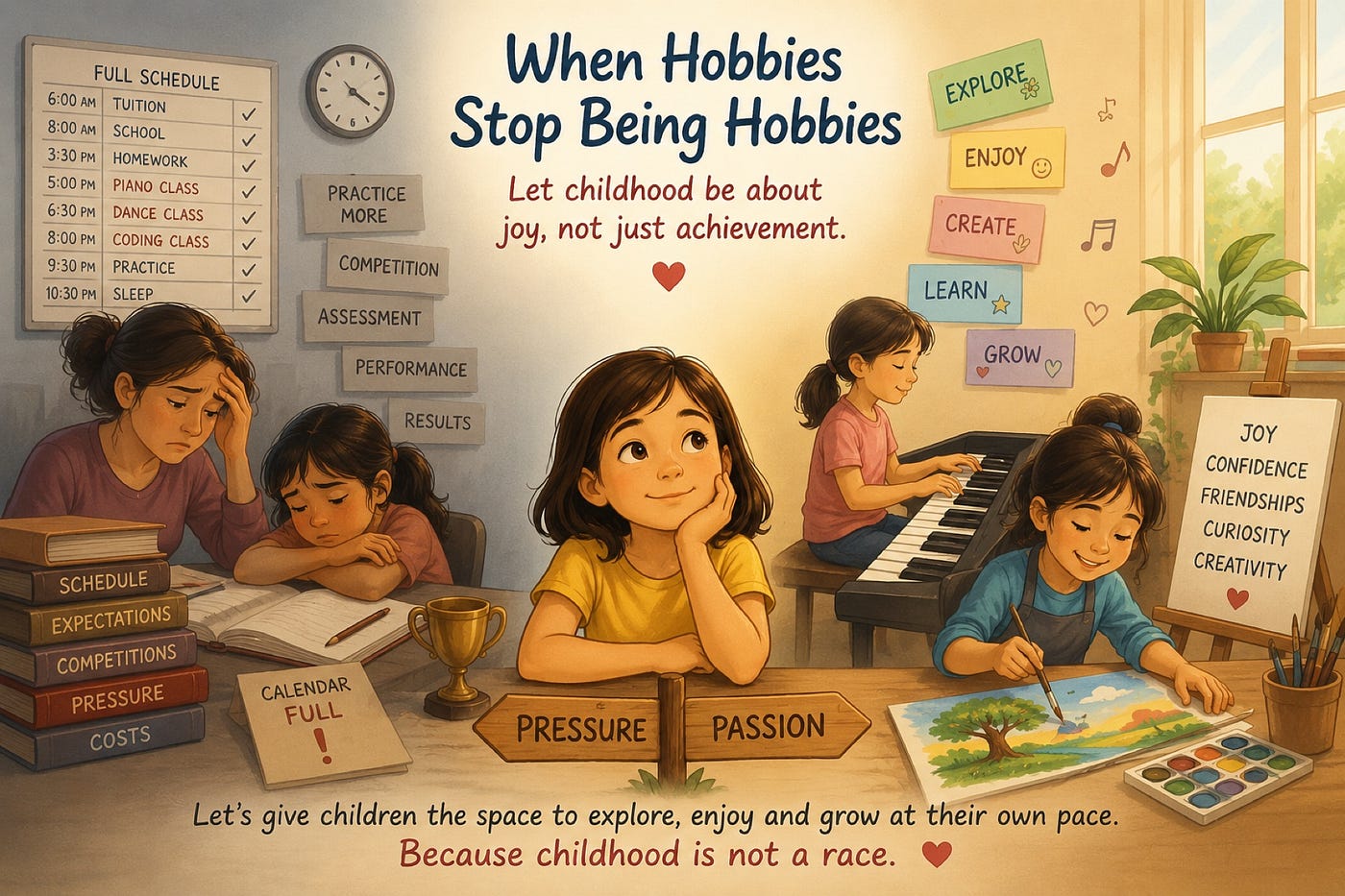
When Hobbies Stop Being Hobbies
When Hobbies Stop Being Hobbies
Escaping the Extracurricular Race
Why we need to stop treating childhood passions like academic subjects and let kids experience the joy of unhurried learning.
There was a time when childhood had room for aimless afternoons, scraped knees, and hobbies that existed for one simple reason. They brought joy.
Many of us grew up attending a vocal/dance class once or twice a week, practicing the keyboard and learning new notes without worrying about grades, or joining a neighborhood drawing class where the biggest reward was a smile from the teacher. These activities were called “hobbies” because they gave us a break from academics. They helped us discover who we were beyond report cards.
Fast forward to today, and the meaning of a hobby has changed dramatically.
Parents Are Trying Their Best
Working parents today are under constant pressure to provide their children with a safe, engaging, and meaningful environment while they focus on their professional responsibilities. Even stay-at-home parents, especially homemakers, have demanding days filled with countless household responsibilities. In many families, enrolling children in extracurricular activities has become less of a choice and more of a necessity.
The intention is genuine. Parents hope their children are spending time with a responsible adult, learning a new skill, and interacting meaningfully with peers, especially in mixed-age groups where younger children can learn from older ones and friendships grow naturally. These classes also offer parents the reassurance that their children are spending their time constructively.
However, what begins with the best of intentions often turns into another source of stress. Many extracurricular activities now come with expectations that extend far beyond the classroom. Parents are expected to ensure regular practice at home, prepare children for assessments, performances, competitions, and examinations, and stay committed to an ever-growing schedule. Before long, they find themselves running yet another race, one they never intended to enter.
What was meant to be an enriching break from academic pressure often starts mirroring it, leaving both parents and children feeling overwhelmed instead of inspired.
When Parents Are Pulled in Different Directions
Another challenge is that parenting itself is rarely uniform. Every parent brings a different perspective. One may believe the child should take every class seriously and practise diligently, while the other may feel the child should be allowed to enjoy it at their own pace. These differing approaches can create confusion for the child, leaving them unsure of what is actually expected.
The irony is that we understand the true purpose of many of these activities. Whether it is learning a musical instrument, drawing, dance, or even abacus, the larger goal is to stimulate different areas of the brain, nurture creativity, improve concentration, and support holistic development. These benefits cannot be rushed. They are meant to unfold gradually, at a pace that suits each child. Yet somewhere along the way, the focus shifts from the child’s journey to maintaining discipline, meeting practice targets, and achieving visible outcomes.
The responsibility of enforcing this discipline often falls on parents. Those who invest enormous amounts of time ensuring regular practice, attending every session, and preparing their children for competitions are frequently seen as “committed” parents, and their children are perceived as exceptional. Naturally, other parents feel compelled to follow the same path, not necessarily because they believe in it, but because they fear their child may otherwise miss out.
Should Every Hobby Demand Discipline Like Academics?
Another aspect that deserves attention is the expectation around practice. Some extracurricular centres intentionally limit classes to two or three sessions a week, believing that children should spend the remaining days practising at home.
While the intention may be to reinforce learning, this expectation often shifts a significant part of the teaching responsibility onto parents.
Young children, especially, do not naturally possess the discipline to practise consistently on their own. They need an adult to guide them, motivate them, and gently build that habit over time. For many families, this becomes yet another responsibility added to an already packed day.
In today’s fast-paced world, academics already demand regular homework, projects, and revision. Do extracurricular activities also need to mirror the same level of commitment?
Perhaps the goal should be different. Instead of expecting children to master a skill quickly, these classes could focus on nurturing genuine interest. When a child falls in love with music, art, dance, or sport, practice follows naturally.
Curiosity is a far stronger motivator than pressure.
Parents certainly have an important role to play in encouraging their children. But when every hobby requires constant supervision, reminders, and structured practice at home, what was meant to be a joyful learning experience can become another source of stress for the entire family.
Sometimes, going a little slower may actually help children stay with a hobby for much longer.
The Disconnect in Volunteering
Another dynamic that frequently adds to this pressure is the reliance on volunteers to prepare children for upcoming competitions. Often, well-meaning individuals step up to teach. However, they frequently teach at a pace suited to their own comfort, completely overlooking the individual needs of the child.
This situation becomes exponentially worse when the classes are held online. The sessions often become purely transactional. The volunteer logs on, teaches the material, and leaves. In this virtual void, it is impossible to gauge the mindset of the child. When a child inevitably struggles to keep up with this rigid pace, unfair assumptions quickly surface. Volunteers might conclude that the child is unfocused, that the parents are not taking it seriously, or that their time is simply being wasted.
My request to anyone stepping up to teach is simple. Volunteering inherently means accepting and adapting to these varying situations. Building a genuine rapport with a child is an absolute must before trying to march through a syllabus. When that emotional connection and understanding are missing, the very intention of volunteering is completely defeated.
The Hidden Cost of Childhood
Then comes the financial aspect.
Many parents openly question the rising cost of school education, but in my experience, extracurricular activities often cost even more. Music, dance, sports, coding, art, and specialised learning programmes can add up to a significant monthly expense. Some institutes collect fees quarterly or for long-term programmes, making the financial commitment even heavier.
And yet, parents continue to enrol their children. Not because they are convinced every class is essential, but because there are very few meaningful alternatives. In today’s urban lifestyle, there are limited safe spaces where children can simply play, explore, and engage under the guidance of caring adults. Classes become the default option.
At times, it feels as though this reality is being taken advantage of. Parents’ desire to give their children the best and their need for a safe, constructive environment is a genuine vulnerability. When programmes become increasingly expensive while also demanding greater commitment from both the child and the parent, it is worth asking whether we are still nurturing childhood or inadvertently commercialising it.
When Every Hobby Needs a Stage
Another trend worth reflecting on is the growing emphasis on annual day performances. Almost every extracurricular programme now culminates in a grand event, often with the belief that performing on stage is essential for building confidence and overcoming stage fear.
While performing can certainly be a valuable experience for some children, it need not become the ultimate goal of every hobby.
In many centres, preparations for the annual day begin months in advance. Parents are asked to pay separately for costumes, photography, venue arrangements, and other event-related expenses. More importantly, for two or three months, regular learning often takes a back seat as classes focus almost entirely on rehearsals. Instead of exploring new skills or deepening their understanding, children spend weeks perfecting a single performance.
This raises an important question. Is every child attending a class to perform on stage, or are they there because they genuinely enjoy the activity?
Let Hobbies Be Hobbies Again
Perhaps, as parents, we also need to reflect on our expectations. We don’t have to look for visible results from every class our child attends. Not every hobby needs to produce a medal, a certificate, or a performance. Some experiences quietly shape a child’s personality over time. They build patience, creativity, discipline, and confidence in ways that are not immediately visible.
Likewise, extracurricular centres could consider giving children the space to simply learn, explore, and enjoy without every activity culminating in a showcase or competition. There is immense value in learning that is unhurried and free from constant evaluation.
Parents today are doing their best in a world that expects them to excel at everything including career, parenting, academics, and now extracurricular development too. The intention behind enrolling children is rarely to create pressure. It is to provide opportunities, meaningful engagement, and a safe environment.
Perhaps it is time to redefine what success in a hobby looks like. Instead of measuring it through certificates, competitions, annual day performances, or hours of practice, we could measure it by something much simpler.
Did the child enjoy going to class?
Did they come home excited to share what they learnt?
Did they develop curiosity, confidence, friendships, and a love for learning?
Because those are the outcomes that truly last.
When hobbies stop becoming a race and return to being spaces of exploration, creativity, and joy, we don’t just give children a skill. We give them back a piece of their childhood.
메타데이터
- post_id
- 3b4e85e064b1
- slug
- when-hobbies-stop-being-hobbies-3b4e85e064b1
- url
- https://medium.com/@aarthishankar/when-hobbies-stop-being-hobbies-3b4e85e064b1
- canonical_url
- https://medium.com/@aarthishankar/when-hobbies-stop-being-hobbies-3b4e85e064b1
- author_url
- https://medium.com/@aarthishankar
- status
- ok
- fetched_at
- 2026-08-08 13:11:19