Landing Page vs Website for Google Ads: Which Converts Better?
A simple guide for businesses that want to stop wasting ad clicks and turn Google Ads traffic into real leads.
Landing Page vs Website for Google Ads: Which Converts Better?
A simple guide for businesses that want to stop wasting ad clicks and turn Google Ads traffic into real leads.
When you run Google Ads, every click costs money.
That is why one question matters a lot:
Should you send people to your website or to a dedicated landing page?
The simple answer is this:
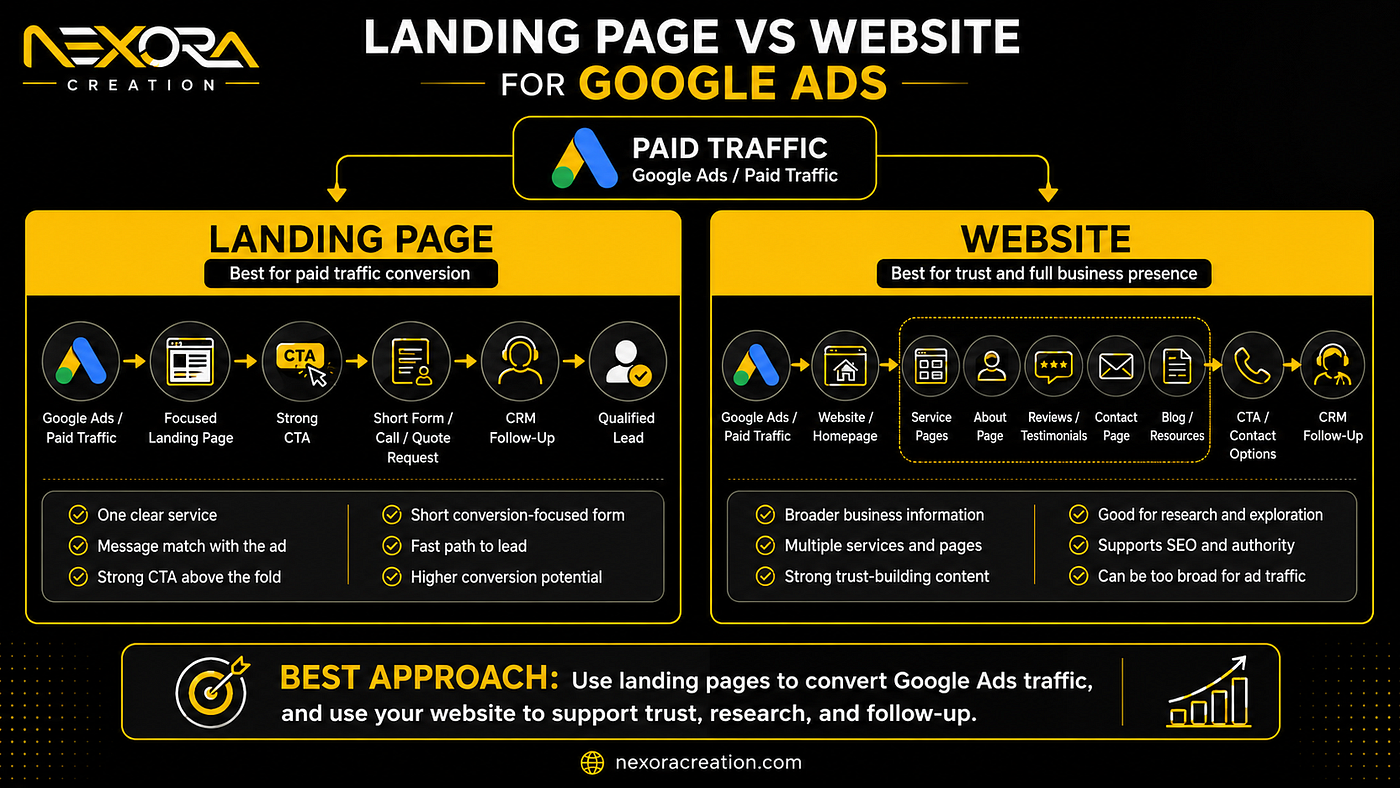
A dedicated landing page usually converts better than a general website page because it is focused on one offer, one audience, one service, and one clear action.
But that does not mean your website is useless.
Your website builds trust, supports SEO, explains your services, shows proof, and helps people understand your business. A landing page, on the other hand, is built to convert paid traffic quickly.
The best strategy is not always landing page or website.
The best strategy is knowing when to use each one.
What is the difference between a landing page and a website?
A website is a full online presence for your business.
It may include:
- Homepage
- About page
- Service pages
- Portfolio
- Blog
- Testimonials
- Contact page
A website helps people explore your business, understand your services, and build trust over time.
A landing page is different.
A landing page is usually built for one campaign, one offer, and one conversion goal.
For example, if your Google Ad says:
“Emergency Plumbing Repair in Dallas”
the landing page should focus only on emergency plumbing repair in Dallas.
It should not send visitors to a homepage where they have to search through different services.
A landing page has one job:
Turn the visitor into a lead.
That lead could be:
- A phone call
- A form submission
- A quote request
- A booking
- A consultation
- A WhatsApp message
Which converts better for Google Ads?

For most Google Ads campaigns, a dedicated landing page converts better.
The reason is focus.
When someone clicks a Google Ad, they are usually searching for something specific.
They may need:
- Roof repair
- AC service
- Dental appointment
- Legal consultation
- Website design
- Cleaning service
- Local clinic booking
If they land on a broad homepage, they may feel confused.
They may ask:
- Is this the service I searched for?
- Do they serve my area?
- Where do I request a quote?
- Can I call now?
- Is this the right page?
Every extra question creates friction.
A landing page removes that friction by matching the ad, keyword, offer, and visitor intent.
That is why landing pages often perform better for paid traffic.
Why does message match matter?
Message match means your ad and landing page say the same thing.
For example:
Keyword: Emergency dentist in Austin Ad headline: Emergency Dentist in Austin Landing page headline: Emergency Dentist in Austin CTA: Book an Emergency Appointment
This creates a smooth experience.
The visitor feels like they landed in the right place.
Now compare that with a weak journey:
Keyword: Emergency dentist in Austin Ad headline: Emergency Dentist in Austin Landing page headline: Welcome to Our Family Dental Clinic CTA: Learn More
The second page is related, but it does not match the urgency clearly.
That small mismatch can reduce conversions.
With a dedicated landing page, you can control the headline, offer, CTA, content, and form around one exact campaign.
When should you use a landing page?
You should use a landing page when your Google Ads campaign has a specific goal.
Landing pages work best when you want:
- Calls
- Bookings
- Quote requests
- Form submissions
- Consultation requests
- Service enquiries
- Demo requests
You should especially use a landing page when:
- Your ad promotes one service.
- Your ad targets one location.
- Your homepage is too broad.
- Your campaign has one clear offer.
- Your budget is limited.
- You want better conversion tracking.
- You want to test different headlines or CTAs.
For example, a roofing company should not send “roof repair near me” traffic to a general homepage.
A better page would be:
“Roof Repair Services in Tampa”
That page can include the service, city, trust proof, quote form, phone number, and FAQs.
This gives the visitor a clearer path to action.
When can a website page work for Google Ads?
A website page can work if it is already highly relevant and conversion-focused.
For example, a strong service page can work well if it includes:
- A clear service headline
- Strong CTA
- Trust signals
- Fast loading speed
- Mobile-friendly layout
- Service details
- Simple form
- Click-to-call button
- FAQs
- Conversion tracking
In that case, the service page is almost working like a landing page.
But a general homepage is usually weaker for Google Ads because it has too many paths.
A homepage may talk about:
- Your brand
- Multiple services
- About information
- Blog links
- Portfolio
- General company details
All of that can be useful, but it may distract paid visitors who came for one specific service.
What should a high-converting landing page include?
A strong Google Ads landing page should be simple, focused, and easy to act on.
It should include:
- A clear headline that matches the ad
- A short benefit-driven subheading
- One main CTA
- Phone number or click-to-call button
- Trust signals
- Service details
- Local relevance if needed
- Simple form
- FAQs
- Final CTA
The page should quickly answer:
- What do you offer?
- Where do you offer it?
- Why should I trust you?
- What happens after I contact you?
- What should I do next?
For local service businesses, this structure works well:
- Service + location headline
- Short benefit statement
- Call or quote CTA
- Reviews or trust proof
- Service benefits
- Simple process
- Service area
- Short form
- FAQs
- Final CTA
This layout helps visitors understand the offer without feeling lost.
Does your website still matter?
Yes, your website still matters.
A landing page may convert the ad click, but your website supports the trust behind that conversion.
Many visitors will still check your:
- Homepage
- About page
- Reviews
- Portfolio
- Service pages
- Blog
- Contact details
Your website helps people decide whether your business is real, professional, and trustworthy.
That is why the best approach is usually not to choose only one.
Use landing pages for focused Google Ads campaigns.
Use your website for trust, SEO, authority, education, and long-term growth.
Both should work together.
How can CRM and automation improve conversions?
A landing page can generate the lead, but your follow-up system decides whether that lead becomes a real opportunity.
Many businesses lose Google Ads leads because they respond too slowly.
A visitor fills out a form, but the business replies hours later. By that time, the visitor may already have contacted a competitor.
A CRM system can help you:
- Capture leads instantly
- Store the lead source
- Notify your team
- Send confirmation messages
- Assign leads to the right person
- Track follow-up status
- Send reminders
- Measure lead quality
Automation can also help with:
- Email follow-ups
- SMS reminders
- Booking confirmations
- Missed call follow-up
- Pipeline updates
A landing page creates the enquiry.
A CRM helps protect and manage that enquiry.
What is the best strategy?
The best strategy is usually to use both.
Use a landing page when you are running a focused Google Ads campaign.
Use your website to support brand trust, SEO, service education, and long-term credibility.
A good paid traffic system looks like this:
- Google Ad brings the visitor.
- Landing page matches the ad intent.
- CTA makes the next step clear.
- Form or phone call captures the lead.
- CRM stores and tracks the lead.
- Follow-up system turns the lead into a conversation.
- Website supports trust if the visitor wants to explore more.
This is how you turn clicks into real business opportunities.
At Nexora Creation, we help businesses build conversion-focused websites and landing pages that connect paid traffic, service pages, CTAs, and follow-up systems into one clear lead generation journey.
If your Google Ads are getting clicks but not enough leads, your landing page or website page may need a conversion-focused review.
You can explore our website development services here:
https://nexoracreation.com/services/website-development/
Conclusion
A landing page usually converts better than a general website page for Google Ads because it is focused, relevant, and built around one clear action.
But your website still matters.
Your website builds trust, supports SEO, explains your services, and gives visitors confidence before they contact you.
Use a landing page when your campaign targets one service, one location, one offer, or one specific audience.
Use a website page only when it already matches the ad intent and is built to convert.
If you are paying for traffic, do not make visitors work hard.
Match the ad. Match the intent. Show proof. Make the CTA clear. Track every lead. Follow up quickly.
That is how Google Ads clicks become real leads.
FAQs
Is a landing page better than a website for Google Ads?
A landing page is usually better for Google Ads because it focuses on one offer, one service, and one CTA. A website page can still work if it is highly relevant and conversion-focused.
Should I send Google Ads traffic to my homepage?
In most cases, no. A homepage is usually too broad for paid traffic. A dedicated landing page or service page usually gives visitors a clearer path to action.
Can a service page work as a landing page?
Yes. A service page can work if it has a clear headline, strong CTA, trust proof, mobile-friendly design, fast speed, and content that matches the ad.
Why do landing pages convert better?
Landing pages convert better because they reduce distractions, match the ad message, focus on one user intent, and make the next step clear.
Does my business still need a website?
Yes. Your website supports trust, SEO, brand credibility, service information, blogs, case studies, and long-term visibility.
메타데이터
- post_id
- 3b61e3dd2ef4
- slug
- landing-page-vs-website-for-google-ads-which-converts-better-3b61e3dd2ef4
- url
- https://medium.com/@nexoracreation/landing-page-vs-website-for-google-ads-which-converts-better-3b61e3dd2ef4
- canonical_url
- https://medium.com/@nexoracreation/landing-page-vs-website-for-google-ads-which-converts-better-3b61e3dd2ef4
- author_url
- https://medium.com/@nexoracreation
- status
- ok
- fetched_at
- 2026-06-20 20:29:01