The Gold Consensus Trade: What Could Go Wrong?
Disclaimer: This article represents a contrarian market analysis and should not be interpreted as investment advice or a prediction of…
The Gold Consensus Trade: What Could Go Wrong?
Gold Crash
Disclaimer: This article represents a contrarian market analysis and should not be interpreted as investment advice or a prediction of future prices. The objective is to examine risks that may currently be underappreciated by the market and explore scenarios that investors should consider alongside the prevailing bullish narrative.
For centuries, gold has been viewed as the ultimate safe-haven asset. When economies weaken, wars erupt, currencies depreciate, or financial systems appear fragile, investors instinctively turn toward gold.
Over the last few years, that instinct has been rewarded.
Gold prices have surged to record highs, central banks across the world have increased their gold allocations, geopolitical tensions have intensified, and investors have increasingly embraced the narrative that gold represents the only true form of money in an uncertain world.
The consensus view today is remarkably simple:
“Gold can only go higher.”
But history teaches us a different lesson.
The most dangerous market environments often emerge when everyone agrees on the same story.
This raises an uncomfortable question:
What if the biggest risk to gold today is not a lack of buyers, but too many buyers?
What if the very factors that drove gold to record highs are now creating the conditions for a significant correction?
While the long-term role of gold as a reserve asset remains intact, there is growing evidence that the market may be entering a phase where a 20–30% correction becomes increasingly plausible.
The Rally That Everyone Understands
The reasons behind gold’s spectacular rise are well known.
Central banks have accumulated gold at one of the fastest paces in modern history. Countries such as China, India, Turkey and Poland have diversified reserves away from excessive dependence on the U.S. dollar.
The Russia-Ukraine conflict, tensions in the Middle East, trade disputes, concerns regarding sovereign debt and fears surrounding global financial stability have all contributed to a powerful safe-haven bid.
At the same time, investors have become increasingly concerned about long-term fiscal deficits, currency debasement and the sustainability of government debt.
The result has been a near-perfect environment for gold.
However, markets are forward-looking.
Once a narrative becomes universally accepted, future returns become dependent on new positive surprises rather than existing information.
That is where the risks begin to emerge.
Gold Is No Longer Being Driven by Jewellery Demand
Historically, gold demand was largely supported by jewellery consumption, particularly in countries such as India and China.
Today, the structure of demand is changing.
As prices continue rising, jewellery demand is showing signs of stress. Consumers are reducing purchase quantities, opting for lighter products and postponing discretionary purchases.
Meanwhile, investment demand through ETFs, bullion products and institutional channels has become increasingly dominant.
This shift is important.
When an asset is purchased primarily because investors expect future price appreciation rather than because of underlying consumption demand, price movements become more dependent on sentiment.
In simple terms, gold is becoming less of a consumption asset and more of a financial asset.
And financial assets can experience sharp corrections when sentiment changes.
The Market May Be Overestimating Central Bank Demand
One of the strongest bullish arguments for gold has been central bank buying.
However, many investors may be misunderstanding what is actually happening.
India’s RBI, for example, has maintained gold holdings around historical highs. Yet much of the recent discussion has focused on the movement of gold reserves back into domestic vaults rather than aggressive new purchases.
The market appears to have interpreted reserve management decisions as confirmation of a permanently bullish gold outlook.
That assumption may be dangerous.
Central banks are not emotional buyers. They are strategic allocators.
If gold becomes an increasingly large portion of reserves due to rising prices, future purchases naturally slow. Markets respond not to total demand but to changes in marginal demand.
A slowdown in purchases can have a disproportionate impact on prices.
RBI Gold Reserve Position: What Has Actually Changed?
Much of the market narrative suggests that RBI has been aggressively accumulating gold in anticipation of a major monetary shift. The actual data paints a more nuanced picture.
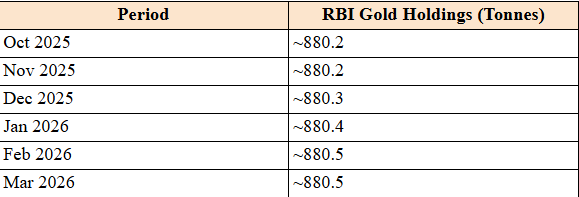
RBI Gold Reserve Position
The more significant development has not been fresh buying but the repatriation of over 100 tonnes of gold from overseas vaults back into India.
This distinction matters.
Repatriation is a reserve-management decision.
Aggressive accumulation is a directional bet.
Investors should be careful not to confuse the two.
The Hidden Warning Sign Nobody Is Discussing
Over recent weeks, several mutual fund houses have imposed restrictions or caps on certain gold-related investment products.
The official explanation involves regulatory and operational considerations.
However, from a market psychology perspective, the development is noteworthy.
Restrictions generally emerge when demand becomes unusually strong.
This does not automatically indicate a market top.
But it does suggest that investor participation has become increasingly concentrated in a single narrative.
Historically, major corrections are rarely preceded by investor pessimism.
They are preceded by investor enthusiasm.
When everyone wants exposure to the same asset at the same time, future returns often become less attractive.
Gold ETF Flows Reveal A Potential Sentiment Extreme
One of the strongest indicators of investor enthusiasm is ETF demand.
Over the past year, gold ETFs have witnessed significant inflows as investors sought protection from geopolitical uncertainty and concerns around fiat currencies.
Indian gold ETFs also recorded strong inflows, reflecting growing investor appetite despite already elevated prices.
At the same time, several mutual fund houses including HDFC, SBI and Nippon have imposed restrictions or limits on certain gold-related investment products.
While regulatory explanations remain valid, the timing deserves attention.
Markets rarely peak when investors are fearful.
They often peak when investors become convinced that prices can only move higher.
That does not guarantee a correction.
But it does suggest sentiment may be approaching an extreme.
Gold Has Become One of the Most Crowded Trades Globally
Consider the current market narrative.
Central banks are buying gold.
The world is de-dollarizing.
Governments are repatriating reserves.
Geopolitical tensions remain elevated.
Debt levels continue to rise.
Fort Knox audits are making headlines.
Gold has overtaken U.S. Treasuries as a reserve asset.
Every major bullish argument is already widely known.
This does not mean the arguments are wrong.
But it does mean much of the optimism may already be reflected in prices.
Markets do not move based on what investors know.
Markets move based on what investors discover next.
And at present, the list of undiscovered bullish catalysts appears to be shrinking.
The Fort Knox Debate and Trump’s Gold Narrative
A fascinating development in recent months has been renewed discussion regarding verification and transparency of U.S. gold reserves.
Supporters of Donald Trump and several market commentators have called for greater visibility and verification of gold holdings stored at Fort Knox.
Whether symbolic or substantive, the discussion reinforces an important theme.
Governments themselves are increasingly treating gold as a strategic monetary asset rather than simply another commodity.
Ironically, however, when every headline reinforces the same bullish narrative, investors should ask whether the market has already priced in much of that optimism.
The Real Threat: Interest Rates
Among all potential risks, rising real interest rates remain the most important.
Unlike stocks, bonds or real estate, gold generates no cash flow.
It pays no dividend.
It pays no coupon.
Its attractiveness therefore depends heavily on opportunity cost.
When inflation falls while interest rates remain elevated, real yields rise.
Historically, this has been one of the most challenging environments for gold.
If global inflation moderates faster than expected while central banks maintain tighter monetary conditions, investors could begin rotating back toward interest-bearing assets.
Such a shift would directly challenge one of the core pillars supporting the gold rally.
Import Duty Changes and Their Impact on Indian Demand
India remains one of the world’s largest importers of gold.
As a result, import duty policy plays a critical role in shaping demand.
Historically, governments have frequently adjusted import duties to manage:
- Current account deficits
- Foreign exchange reserves
- Currency stability
Higher duties generally suppress official demand and encourage recycling, while lower duties stimulate purchases but increase import dependence.
At today’s price levels, even modest policy adjustments can significantly influence investor behaviour and physical demand.
Why Indian Investors Face a Unique Risk
Indian investors face an additional challenge that receives very little attention.
Unlike large global institutions, most Indian investors have limited access to sophisticated hedging tools.
Physical gold holders, gold ETF investors and bullion buyers are largely directional participants.
If gold experiences a sharp decline, many investors have only two practical choices:
Hold.
Or sell.
The inability to efficiently hedge downside exposure increases the risk of panic-driven exits during periods of market stress.
This dynamic can accelerate corrections once key support levels are broken.
PM Modi’s Remarks and the Economic Perspective
Prime Minister Narendra Modi’s remarks encouraging reduced dependence on non-essential imports, including gold purchases, highlight a broader economic reality.
For an individual investor, gold may serve as a store of value.
For the economy, however, large-scale gold imports represent capital flowing out of the country.
Governments generally prefer household savings to be channelled into productive assets such as businesses, infrastructure, manufacturing and financial markets.
This creates an interesting divergence between what may be beneficial for individual investors and what may be preferable from a national economic perspective.
The Technical Picture Is Beginning to Change
While fundamentals remain important, technical analysis often provides the earliest indication that market psychology is shifting.
On the weekly time frame, gold appears to be developing characteristics consistent with a potential descending triangle formation.
At the same time, momentum indicators are showing signs of weakening participation despite prices remaining near historic highs.
This type of divergence is often observed during late-stage advances.
Technical Evidence Supporting The Correction Thesis
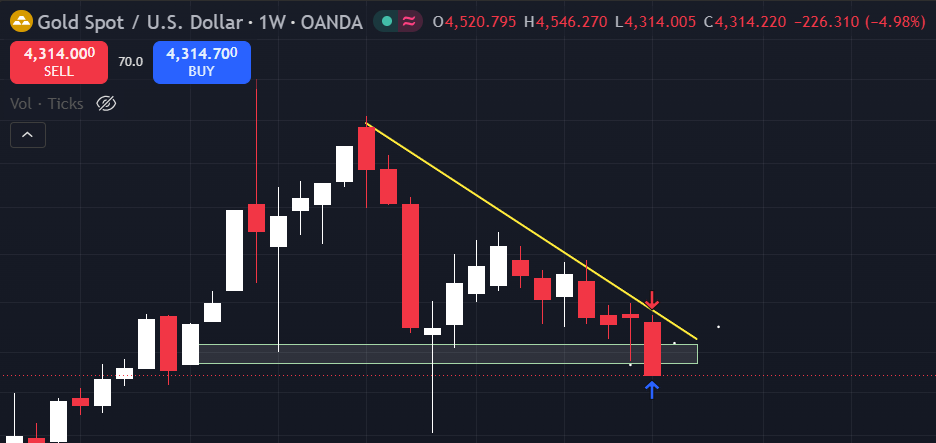
1. Descending Triangle Formation
The weekly chart appears to be forming a descending triangle, a pattern often associated with weakening buying pressure and repeated tests of support.
2. Momentum Divergence
Despite prices remaining near record highs, momentum indicators are failing to confirm the strength of the advance.
This divergence often indicates narrowing participation beneath the surface.
3. RSI Weakness
The Relative Strength Index (RSI) has started showing signs of exhaustion compared to previous highs, suggesting momentum is not keeping pace with price.
4. MACD Deterioration
MACD momentum appears to be flattening, indicating that bullish momentum may be losing strength even as prices remain elevated.
Individually, none of these indicators guarantee a decline.
Collectively, however, they suggest investors should remain cautious.
Price continues making headlines.
Momentum begins losing conviction.
If support levels eventually break, technical selling could combine with weakening ETF flows, slower central bank demand and changing macroeconomic conditions.
Such combinations have historically produced corrections far larger than investors expect.
Can Gold Really Fall 30%?
Many investors instinctively dismiss the possibility.
History suggests they should not.
Gold has experienced multiple major corrections throughout modern financial history.
Following the 1980 peak, gold entered a prolonged decline.
Following the 2011 peak, gold corrected by roughly 45%.
Even after the 2020 pandemic rally, meaningful corrections followed.
A 30% decline would not be unprecedented.
It would simply require a combination of catalysts:
- Geopolitical tensions easing
- Central bank demand moderating
- ETF inflows slowing
- Real interest rates rising
- Investor sentiment becoming less optimistic
None of these factors individually are sufficient.
Together, they could create the conditions for a substantial repricing.
Scenario Analysis: What Happens Next?
Rather than predicting a single outcome, investors should consider multiple possibilities.

Scenario Analysis
Under the bear-case scenario, a downside target near the 3900 zone becomes increasingly relevant.
Importantly, this would not necessarily signal the end of gold’s long-term bull market.
Rather, it would represent a significant repricing of expectations after a period of extraordinary optimism.
Final Thoughts
This is not an argument that gold is worthless.
Nor is it an argument against holding gold as part of a diversified portfolio.
Gold remains one of the most important monetary assets in the world.
However, investors should distinguish between long-term value and short-term price.
The long-term case for gold may remain intact.
The short-term risk-reward equation appears far less attractive.
Today, the market is overwhelmingly focused on why gold should continue rising.
Very few investors are asking what could cause it to fall.
History suggests that asking uncomfortable questions is often where the best investment insights originate.
The consensus believes gold is entering a new era of permanent strength.
Markets rarely reward consensus forever.
And that is precisely why a 30% correction in gold may no longer be unthinkable.
메타데이터
- post_id
- 3b7eea2ec4e5
- slug
- gold-at-record-highs-why-a-30-correction-may-no-longer-be-unthinkable-3b7eea2ec4e5
- url
- https://medium.com/@aashishlalwani/gold-at-record-highs-why-a-30-correction-may-no-longer-be-unthinkable-3b7eea2ec4e5
- canonical_url
- https://medium.com/@aashishlalwani/gold-at-record-highs-why-a-30-correction-may-no-longer-be-unthinkable-3b7eea2ec4e5
- author_url
- https://medium.com/@aashishlalwani
- status
- ok
- fetched_at
- 2026-06-09 15:37:30



