If AI Can Do Everything, Why Learn Anything?
On judgment, friction, and the only thing AI can’t do for you.
If AI Can Do Everything, Why Learn Anything?
On judgment, friction, and the only thing AI can’t do for you.
Photo by Google DeepMind on Unsplash
In the fall of 2023, researchers from the University of Pennsylvania ran an experiment in a Turkish high school. Nearly a thousand students, grades nine through eleven, were split into three groups. One group did their math practice the old-fashioned way, another had access to ChatGPT, and a third had access to a version of ChatGPT fine-tuned to work like a tutor, nudging students toward answers rather than just handing them over.
The group with ChatGPT solved 48 percent more practice problems correctly. The tutored group solved 127 percent more. By every visible measure, AI was working. Students were getting through more problems, getting more right, and moving faster.
Then they took the test.
The ChatGPT group scored 17 percent worse than the students who had no help at all. The tutored group, the ones who solved 127 percent more problems, did no better than the group that used nothing. The students who struggled alone, who got stuck and worked through it, who got things wrong before they got them right, they won.
Now consider this. That study was conducted in 2023, when AI was, by today’s standards, relatively primitive. And we’re not even on the endgame yet.
In his recent essay, Anthropic CEO Dario Amodei describes his vision of powerful AI as a system smarter than a Nobel Prize winner across most relevant fields — biology, math, engineering, writing, and capable of absorbing information and generating actions at roughly ten to a hundred times human speed.
So the question worth asking is, if AI is going to be so good, does it eliminate the need for learning?
Getting the answer is not the same as learning it
There is a concept in cognitive science called desirable difficulty. The idea is counterintuitive: learning sticks better when it is harder. Getting something wrong, and then correcting it, is one of the most powerful learning mechanisms we have. In other words, the struggle is the process of learning itself.
This is where AI creates a problem it was never designed to create. AI is built to be helpful, to be fast, and to remove friction wherever it finds it. And it is extraordinarily good at that. But friction is the mechanism of learning. When AI removes it, it is doing what it was built to do, in a way that quietly costs you something you did not know you were spending.
The Turkish students who used ChatGPT got more problems right during practice. But they never actually learned the math. They performed without understanding. And when the tool was taken away, there was nothing underneath.
That distinction, between performing and learning, is the thing worth sitting with. Because it does not just apply to high school students doing math problems. It applies to anyone who reaches for AI before doing the work of understanding.
You can’t evaluate what you don’t understand
Here is another part of the study that should make you pause. ChatGPT answered the math problems correctly only half of the time. It was wrong 42 percent of the time.
They had never built the internal model that would let them look at a solution and feel that something was off. So they took what the machine gave them. Moved on. Walked into the test carrying the wrong foundations and had no idea.
That is the real cost of skipping the struggle. You lose the ability to know when the tool is failing you. And that is an entirely different problem. You can work around not knowing something, but you cannot work around not knowing that you don’t know.
Before writing this, I spent time mapping my research on IR, the studies, the debates, where the evidence is solid and where it gets contested. Not to have AI summarize it for me. To know what I was looking at before I started.
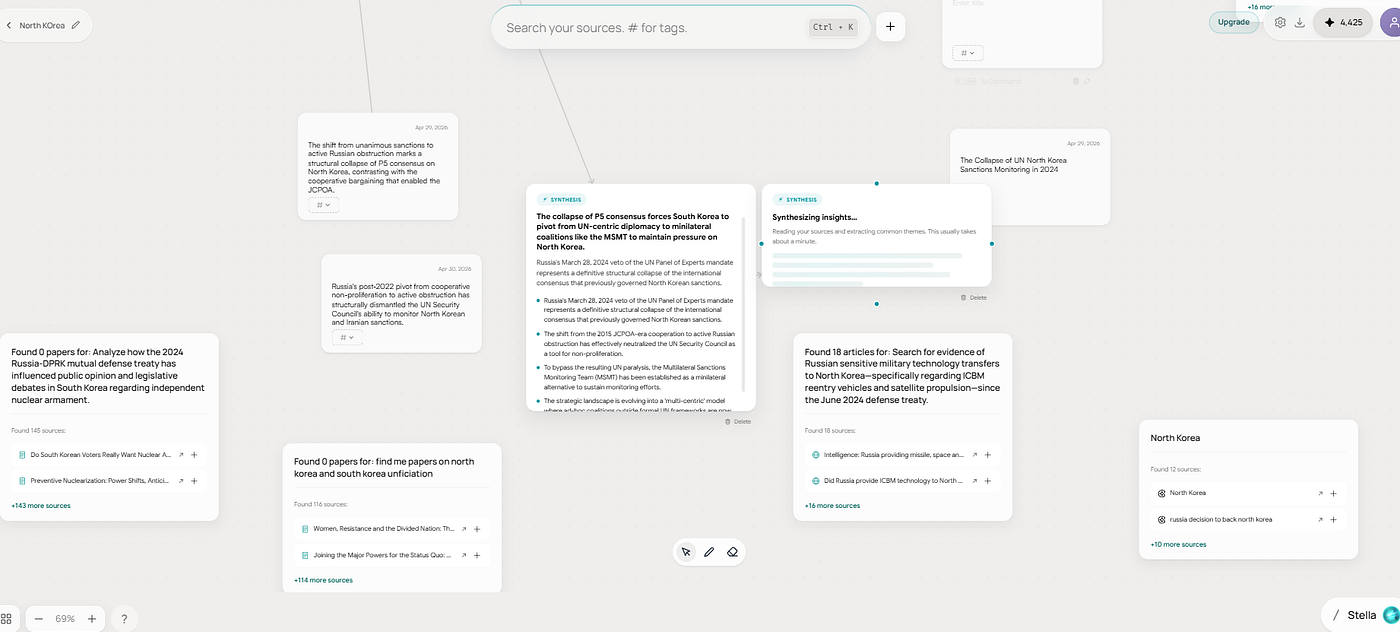
My research canvas in Constella.
In a world where AI is increasingly doing the work, the person who cannot evaluate what the machine produces is just the hand that hits send.
Because there are two things AI genuinely cannot do for you.
The first is knowing when something is wrong. That requires an internal model, the kind that only comes from having worked through the material yourself, making mistakes, and correcting them. The Turkish students who accepted the wrong methods had none of that. The machine failed them, and they never knew.
The second is knowing what question to ask. AI will answer anything you put in front of it, faster than any human alive. But it has no idea what matters to you. What problem is worth solving, what direction is worth going. That judgment lives entirely with the human.
Both atrophy when you stop exercising them. And they are built through exactly the struggle that AI removes.
So, no, AI doesn’t eliminate the need for learning. It clarifies what learning was always for.
Here is the thing, though.
Learning was never really about storing information. We just thought it was, because for most of human history, storing information and building judgment came bundled together. You could not have one without going through the other. If you wanted to know something, you had to sit with it, wrestle with it, make sense of it yourself. The understanding and the information arrived together.
AI unbundles them for the first time.
It can give you the information instantly. The understanding is still yours to build. And that separation, which feels like a shortcut, is actually the thing that clarifies what learning was always for. It was about what working through the information did to your mind rather than the output of the information itself.
Dario Amodei expects powerful AI to operate at ten to a hundred times human speed. That is an extraordinary thing. But speed in the wrong direction is just a faster way to get lost. The person who decides the direction, who evaluates what comes back, who knows what to do with the output — that person still needs to understand something. Deeply. As a prerequisite.
So no, AI does not eliminate the need for learning. In a world where everyone has access to the same powerful machine, judgment is the only thing that is not evenly distributed. And judgment is built through exactly the struggle that AI is so good at removing.
The question was never whether AI is smart enough to replace learning. The question is whether you are building the thing that makes AI useful rather than dangerous.
That part has always been yours.
메타데이터
- post_id
- 3b7fdb86ecca
- slug
- if-ai-can-do-everything-why-learn-anything-3b7fdb86ecca
- url
- https://medium.com/ai-ai-oh/if-ai-can-do-everything-why-learn-anything-3b7fdb86ecca
- canonical_url
- https://medium.com/ai-ai-oh/if-ai-can-do-everything-why-learn-anything-3b7fdb86ecca
- author_url
- https://medium.com/@rfbryan
- status
- ok
- fetched_at
- 2026-06-15 20:49:13