Did you know that Vincent van Gogh’s “Self-Portrait with Bandaged Ear” is one of the most…
It was in January 1889 that this masterpiece was created during one of the most tumultuous periods in the life of the Dutch…
Did you know that Vincent van Gogh’s “Self-Portrait with Bandaged Ear” is one of the most psychologically engaging and historically significant works in Western art?

Image Source Wikipedia
It was in January 1889 that this masterpiece was created during one of the most tumultuous periods in the life of the Dutch Post-Impressionist artist. It translates a personal trauma into a profound reflection on artistic identity and human suffering.
Historical Background
The collaboration between the two artists proved volatile. On that fateful December evening, following Gauguin’s threat to leave, Van Gogh approached him with a razor. Later that night, in a moment of psychological crisis, Van Gogh sliced off his own left ear. He brought it to a prostitute in Arles. This act of self-mutilation marked a turning point in the artist’s mental health struggles. It became one of the most notorious episodes in the history of art.
In a letter dated January 17, 1889, to his brother Theo, Van Gogh mentioned that he had completed a new self-portrait, which art historians believe to be this work. The painting thus serves as both a document of recovery and a testament to the artist’s unwavering commitment to his craft despite personal adversity.
Visual Description and Artistic Elements
The self-portrait presents Van Gogh wearing a blue cap with black fur and a green overcoat, with a white bandage covering his ear and extending under his chin. Interestingly, due to the mirror Van Gogh used. At the same time, in the painting, the bandaged ear appears to be on the right side of the composition, though it was actually his left ear that was injured.
Behind the artist, the composition includes several significant elements: an open window, a canvas on an easel with indistinguishable marks, and most notably, a Japanese woodblock print titled “Geishas in a Landscape” by Satō Torakiyo from the 1870s. The fur cap, recently purchased to keep his heavy bandage in place and protect him from the winter cold, serves as a poignant reminder of the difficult circumstances he faced in January 1889.
Van Gogh employed his characteristic impasto technique throughout the work, applying paint thickly to create visible brushstrokes and textural effects. This method, inspired by Adolphe Monticelli’s use of impasto, gives the composition remarkable energy and passion, transforming what could have been a simple documentary record into a dynamic artistic statement.
Cultural Influences
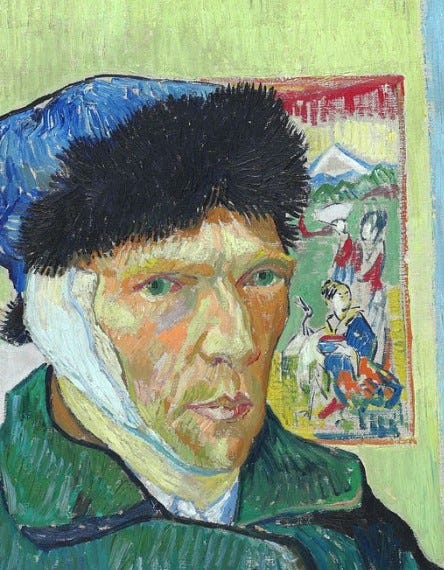
The inclusion of a Japanese print in the background reflects Van Gogh’s profound fascination with Japanese art, which significantly influenced his artistic development. Throughout his lifetime, Van Gogh collected hundreds of Japanese prints, drawn to their bold colors and innovative spatial effects. This interest in Japanese aesthetics was part of the broader Japonisme movement that swept through European art in the late 19th century.
Van Gogh’s engagement with Japanese art extended beyond mere collecting; it profoundly influenced his approach to modernizing Western painting. The bold colors and flattened spatial relationships characteristic of Japanese woodblock prints are evident throughout his mature work, including this self-portrait. The specific print visible in the painting, “Geishas in a Landscape,” was part of his personal collection and demonstrates how he integrated Eastern artistic elements into his Western self-portraiture tradition.
Compositional Structure
Van Gogh employs a traditional three-quarter view self-portrait format. Still, he subverts classical expectations through the careful use of asymmetrical elements. The bandaged ear creates a powerful focal point that disrupts conventional balance. At the same time, the Japanese print serves as both a decorative element and a cultural signifier. The tightly cropped composition creates a sense of intimacy and psychological intensity, drawing viewers into direct confrontation with the artist’s gaze.
Color Palette and Symbolism
The painting’s color scheme demonstrates Van Gogh’s sophisticated understanding of color theory. The dominant green overcoat contrasts sharply with the blue cap and warm flesh tones, creating visual tension that mirrors the artist’s psychological state. His strategic use of complementary colors — green against red, blue against orange — generates vibrant optical effects that energize the entire composition.
The pale green background suggests themes of sickness and convalescence, while the vibrant colors of the Japanese print provide a counterpoint of exotic vitality. This juxtaposition may reflect Van Gogh’s complex relationship with his own mental state: acknowledging his fragility while maintaining a connection to the broader world of artistic inspiration.
Brushwork and Technique
The heavy impasto technique serves both aesthetic and expressive functions throughout the work. The thick, directional brushstrokes in the overcoat create rich texture and visual movement. At the same time, the more controlled application of paint to the facial features suggests careful self-examination and psychological introspection. This varied handling of paint demonstrates Van Gogh’s technical mastery and his ability to modulate his approach according to the expressive needs of the subject.
The visible brushwork explicitly rejects the smooth illusionism favored by academic painting traditions, instead embracing a modernist emphasis on the materiality of paint itself. This approach aligns Van Gogh with broader Post-Impressionist movements that prioritized artistic expression over literal representation.
Psychological Dimension
Perhaps most significantly, the direct gaze confronts viewers with unflinching honesty about mental suffering and artistic dedication. The bandage becomes a complex symbol of both physical trauma and artistic martyrdom. At the same time, Van Gogh’s steady gaze suggests resilience rather than defeat. Crucially, he presents himself not as a romantic figure of the “tortured artist” but as a working professional — evidenced by the easel visible in the background — who continues to create despite a personal crisis.
This psychological complexity elevates the work beyond mere autobiography into a universal meditation on the relationship between suffering and creativity, between personal trauma and artistic expression.
Legacy and Current Status
Following Van Gogh’s death in 1890, the painting came into the possession of Julien (Père) Tanguy, though the exact circumstances remain unclear. Tanguy, who had posed twice for Van Gogh in 1887, likely acquired it through his role as an art dealer and supporter of avant-garde artists. The work was exhibited in major Van Gogh retrospectives in Paris in 1901 and 1905, helping to establish the artist’s posthumous reputation.
In 1928, the British industrialist and art collector Samuel Courtauld purchased the painting, which subsequently became part of the Courtauld Institute of Art’s collection. Today, it remains on permanent display in the Courtauld Gallery at Somerset House in London, where it continues to attract scholars and visitors from around the world.
Critical Assessment
While “Self-Portrait with Bandaged Ear” undeniably functions as a powerful document of personal trauma, its most significant achievement lies in its synthesis of Post-Impressionist technique with psychological realism. Van Gogh transforms a moment of crisis into a sophisticated exploration of artistic identity, cultural exchange, and human resilience.
The painting’s enduring impact stems not merely from its biographical drama but from its formal innovations: the bold color relationships, the expressive brushwork, the integration of Eastern and Western artistic traditions, and the psychological intensity of the direct gaze. These elements combine to create a work that transcends its historical moment, speaking to universal themes of creativity, suffering, and perseverance.
However, the work’s fame presents specific interpretive challenges. Its status as one of the most recognizable images in art history risks reducing it to a curiosity about the “mad artist” rather than allowing appreciation of its sophisticated handling of color, form, and space. Contemporary viewers must look beyond the sensational biographical details to recognize the painting’s significant contribution to the development of modern portraiture and its role in bridging 19th-century Post-Impressionism with 20th-century modernist movements.
Conclusion
“Self-Portrait with Bandaged Ear” represents a pivotal moment in both Van Gogh’s personal journey and the broader trajectory of Western art. Created during a period of intense personal crisis, the painting demonstrates how great artists can transform suffering into profound artistic statements. Through its innovative technique, cross-cultural references, and psychological depth, the work continues to offer new insights into the complex relationships between art, identity, and human experience.
The painting stands as a testament to Van Gogh’s conviction that art can serve as both a personal expression and a universal communication — a bridge between the artist’s inner world and the broader human community. In our contemporary moment, as discussions of mental health, artistic practice, and cultural exchange continue to evolve, Van Gogh’s self-portrait remains remarkably relevant, offering both historical perspective and ongoing inspiration for understanding the transformative power of creative expression.
메타데이터
- post_id
- 3bc16dfd2864
- slug
- did-you-know-that-vincent-van-goghs-self-portrait-with-bandaged-ear-is-one-of-the-most-3bc16dfd2864
- url
- https://medium.com/@angelo.jusay/did-you-know-that-vincent-van-goghs-self-portrait-with-bandaged-ear-is-one-of-the-most-3bc16dfd2864
- canonical_url
- https://medium.com/@angelo.jusay/did-you-know-that-vincent-van-goghs-self-portrait-with-bandaged-ear-is-one-of-the-most-3bc16dfd2864
- author_url
- https://medium.com/@angelo.jusay
- status
- ok
- fetched_at
- 2026-07-11 15:42:37