Polygenicity in simple terms
Why Most Traits Are Influenced by Thousands of Genes
Polygenicity in simple terms
Why Most Traits Are Influenced by Thousands of Genes
When we first learn genetics, the relationship between genes and traits very often appears very simple and direct. A single gene mutation leads to a specific disease, or a gene determines a particular characteristic. This classical view comes largely from studying Mendelian traits, where one gene has a strong and clearly observable effect.
However, most traits we observe in humans do not follow this pattern. Characteristics such as height, body mass index, cognitive abilities, and many psychiatric conditions are not controlled by a single gene. Instead, they arise from the combined influence of many genetic variants acting together.
This is where the concept of polygenicity becomes essential. Understanding polygenicity shifts our perspective from “one gene–one trait” to a much richer and more realistic view of how biology works.
What is Polygenicity?
Polygenicity tells that a trait is influenced by a large number of genetic variants, each contributing a small effect. Rather than one dominant gene determining the outcome, the trait emerges from the cumulative influence of many variants spread across the genome.
The term itself comes from “poly,” meaning many, and “genic,” referring to genes. A polygenic trait, therefore, is one that depends on many genes working together.
What is important to understand is not just the number of genes involved, but also the size of their effects. In polygenic traits, each individual genetic variant typically has a very small impact. Individually, it may not be noticeable at all. However, when thousands of such small effects are combined, they can produce substantial variation in the trait.
An Example: Height

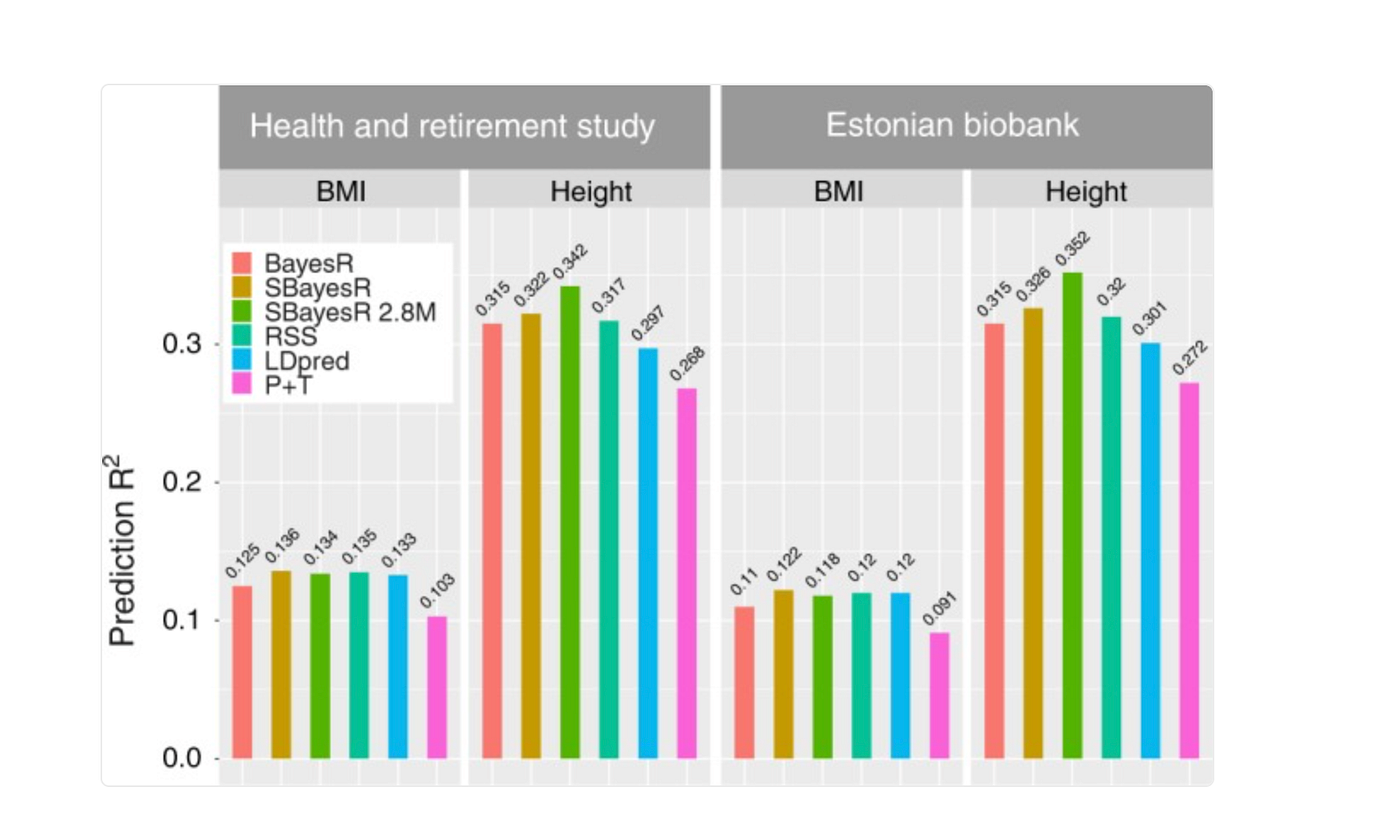
Image source

Image source
Human height is a popular example of a polygenic trait. It provides a clear illustration of how polygenicity works in practice.
There is no single gene that determines whether a person will be tall or short. Instead, thousands of genetic variants across the genome contribute to height. Some variants slightly increase height, while others slightly decrease it. Each effect is small, often so small that it cannot be detected easily on its own.
When all these effects are added together, they produce the wide range of heights observed in the population. This is why height follows a continuous distribution rather than falling into distinct categories.
How does Polygenicity Work?
Imagine that each genetic variant acts like a small “push” on a trait. Some pushes move the trait in one direction, while others move it in the opposite direction. No single push is strong enough to determine the outcome, but the total sum of all pushes determines where an individual ends up.
This perspective explains why individuals with similar genetic backgrounds can still show variation, and why predicting traits based on genetics alone is often probabilistic rather than deterministic.
From a mathematical perspective, a polygenic trait can be thought of as the sum of contributions from many genetic variants, along with environmental influences.
Trait = SNP₁ + SNP₂ + SNP₃ + ... + SNPₙ + EnvironmentEach SNP contributes a small effect size, and these effects are typically assumed to combine in an additive way. In reality, there can also be interactions between genes and between genes and the environment, but the additive model provides a useful and widely used approximation.
This framework is fundamental to many statistical genetics methods, including GWAS and polygenic risk scoring.
Effect Sizes: Many Small Contributions
One of the defining features of polygenic traits is the distribution of effect sizes across genetic variants.
Most variants have extremely small effects, often close to zero. A smaller number of variants may have slightly larger effects, but truly large-effect variants are rare in polygenic traits. This creates a characteristic distribution where many variants contribute a little, and only a few contribute more noticeably.
This structure is sometimes referred to as the genetic architecture of a trait. Understanding this architecture is important because it determines how easy it is to detect genetic associations and how well we can predict traits.
Polygenicity in GWAS
Genome-Wide Association Studies (GWAS) identify associations between genetic variants and traits. However, polygenicity introduces important challenges for GWAS.
Because individual SNP effects are small, very large sample sizes are required to detect them reliably. Even in large studies, only a subset of the contributing variants reach statistical significance. This means that GWAS results capture only part of the underlying genetic architecture.
An important implication is that the absence of a significant association does not mean a variant has no effect. It may simply mean that the effect is too small to detect with the available data.
Polygenicity vs Mendelian Traits
The difference between polygenic and Mendelian traits highlights how genetic architecture can vary across traits.
In Mendelian traits, a single gene or a small number of genes has a large effect, leading to clear and predictable patterns of inheritance. In contrast, polygenic traits involve many genes with small effects, resulting in continuous variation and more complex inheritance patterns.
This distinction is important because it influences how we design studies, interpret results, and think about prediction and causality.
Connection to Heritability
Polygenicity is closely related to the concept of heritability, which computes the proportion of variation in a trait that can be attributed to genetic differences.
High heritability does not imply that only a few genes are involved. In fact, many highly heritable traits are also highly polygenic. This means that a large portion of the variation is genetic, but that variation is distributed across many variants rather than concentrated in a few.
This helps explain why identifying all contributing variants is difficult, even for traits with high heritability.
The Missing Heritability Problem
One of the central challenges in genetics is the so-called “missing heritability” problem. This refers to the gap between heritability estimates from family studies and the proportion of variance explained by GWAS findings.
Polygenicity plays a major role in this gap. Because many variants have very small effects, they may not be detected individually in GWAS. As a result, a substantial portion of the genetic contribution remains hidden when considering only significant associations.
Other factors, such as rare variants and gene–environment interactions, also contribute, but polygenicity is one of the important explanations.
Polygenicity and Polygenic Risk Scores (PRS)
Polygenicity provides the foundation for polygenic risk scores (PRS), which aim to summarize an individual’s genetic predisposition to a trait.
A PRS is constructed by combining the effects of many genetic variants, typically weighted by their effect sizes estimated from GWAS.
PRS = Σ (effect size × genotype)Instead of focusing on a few significant variants, PRS leverages the cumulative effect of many variants, including those with small effects. This approach aligns directly with the polygenic nature of most traits.
As a result, PRS can capture more of the genetic signal than analyses based solely on individual variants.
Why Polygenicity Matters
Understanding polygenicity has practical implications for how we conduct and interpret genetic research.
It changes how we think about causality, highlighting that traits often arise from distributed effects rather than single causes. It influences study design, emphasizing the need for large sample sizes and careful statistical modeling. It also underpins modern predictive approaches such as PRS.
More broadly, polygenicity reflects the complexity of biological systems, where many components interact to produce observable outcomes.
Summary
Polygenicity reveals a fundamental principle of genetics: Most traits are shaped not by a single gene, but by the combined effect of many small genetic contributions. Recognizing this helps us move beyond overly simplistic models and toward a more realistic understanding of how genetic variation influences complex traits.
References
- Visscher et al., 2017–10 Years of GWAS Discovery
- Boyle et al., 2017 — An Expanded View of Complex Traits: From Polygenic to Omnigenic
- GWAS Catalog: https://www.ebi.ac.uk/gwas/
About me:
Thank you for reading the article! If you find this article useful, check out my other articles relevant to data science. Also, like, clap, comment, and follow me on Medium, LinkedIn, and GitHub.
메타데이터
- post_id
- 3bcf07a5be98
- slug
- polygenicity-in-simple-terms-3bcf07a5be98
- url
- https://medium.com/@nivedita.home/polygenicity-in-simple-terms-3bcf07a5be98
- canonical_url
- https://medium.com/@nivedita.home/polygenicity-in-simple-terms-3bcf07a5be98
- author_url
- https://medium.com/@nivedita.home
- status
- ok
- fetched_at
- 2026-06-09 15:37:30