Eight Practical Scenarios Where Generative AI Transforms Engineering Workflows
Today, generative AI (Gen AI) is being widely adopted across different industries, primarily due to its numerous benefits and advantages…
Eight Practical Scenarios Where Generative AI Transforms Engineering Workflows
Today, generative AI (Gen AI) is being widely adopted across different industries, primarily due to its numerous benefits and advantages. In engineering design workflows, Gen AI helps improve efficiency by rapidly exploring design alternatives, optimizing solutions to meet performance criteria, allowing customization of products, and promoting collaboration among engineers. Additionally, Gen AI reduces costs by streamlining processes and minimizing the need for physical prototypes through virtual testing. In this blog, we will explore eight scenarios defined by a conceptual workflow of design optimization using Gen AI, which integrates generative, predictive, and optimization models.
Three Models for Gen AI Design Optimization
The design optimization workflow using generative AI can be carried out by mapping the relationships between design, engineering performance, and a low-dimensional latent space and by employing three key models: a generative model that creates designs from the latent space, a predictive model that estimates engineering performance, and an optimization model.
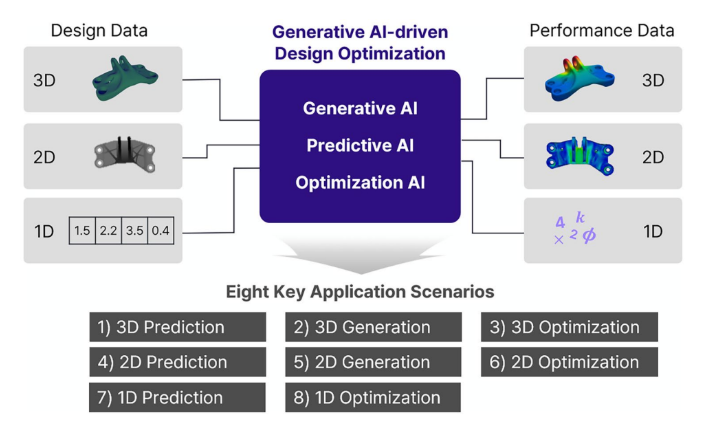
Figure 1. Generative AI-driven design optimization process
Moreover, two methods for design optimization are feasible. The first approach is iterative optimization, which connects the generative and predictive models in series, utilizing a traditional optimization algorithm to search for the one that minimizes the difference from a target performance, ultimately leading to the best design. The second method is generative optimization, which directly generates the optimal design using the predictive model during training, with the target performance as input. This approach effectively transforms the high-dimensional design space into a low-dimensional latent space, addressing the challenges of high-dimensional optimization
Gen AI‐Driven Design Optimization Application Scenarios
Design optimization driven by generative AI is established based on the types of data used and the nature of the analysis being performed. Essential to AI-driven design optimization are generative, predictive, and optimization models, with approaches varying according to the design and the type of analysis data, whether it’s 1D, 2D, or 3D.
From the perspectives of CAD and CAE, data can be classified into three categories: 3D data, which includes 3D CAD models (such as STEP and STL files) and 3D CAE analysis results; 2D data, encompassing cross-sectional design data, depth map data, specific view images, and 2D CAE analysis results; and 1D data, which involves material properties, boundary conditions, manufacturing-related parameters, and 1D CAE analysis outcomes. Together, these elements define a comprehensive framework for eight design optimization scenarios.
Scenario 1: 3D Prediction
This scenario utilizes 3D CAD data to forecast performance. It requires a 3D CAD dataset, conditions for CAE analysis, and corresponding results data. The model can conduct both static and dynamic predictions, meaning it can estimate values in a specific context or at a given moment. 3D prediction is applicable in various fields, including structural, thermal, fluid, and electromagnetic analysis.

Figure 2. Static and dynamic predictions from 3D CAD data using predictive AI
Scenario 2: 3D Generation
Here, generative models create new 3D geometries that adhere to specified conditions. This scenario requires a 3D CAD dataset and optionally includes condition-related information specific to CAD. It’s beneficial for engineers in the conceptual design phase, allowing them to explore diverse design options. It can also generate synthetic data to supplement the lack of existing 3D CAD data, and conditions such as weight or performance metrics can guide the generation of optimal shapes.

Figure 3. New 3D shapes from a 3D CAD dataset with conditional information using Generative AI
Scenario 3: 3D Optimization
This scenario focuses on efficiently optimizing complex 3D geometries. It requires training datasets for both predictive and generative models. 3D optimization is particularly advantageous for engineers looking to refine their designs without needing to parameterize them. In some situations, optimization can be directly linked to a CAE solver, bypassing the need for predictive AI.

Figure 4. Optimal 3D design from datasets using predictive AI and Gen AI
Scenario 4: 2D Prediction
This scenario type processes 2D data to predict performance outcomes. The required datasets include 3D CAD files, 2D images, and relevant CAE analysis conditions and results. Utilizing 2D representations can be particularly effective in scenarios where cross-sectional design is crucial, necessitating a 3D-to-2D conversion pipeline for input.

Figure 5. 2D static and dynamic performance outcomes from 2D data with conditions using predictive AI
Scenario 5: 2D Generation
In this scenario, generative models produce 2D data that meet specified conditions, drawing from either 3D CAD or 2D image datasets. This approach can be especially useful when working with designs that are better represented in 2D (for instance, thin, wide objects). It may also require conversion processes between 3D and 2D forms.

Figure 6. 2D image generation from 3D CAD or 2D image datasets using Gen AI
Scenario 6: 2D Optimization
This involves optimizing 2D design outputs. Similar to the previous scenarios, it requires datasets to train both predictive and generative models. It may be advantageous to first conduct 2D optimization before translating the results into a 3D form, particularly in-depth map optimizations.

Figure 7. 2D optimal design from datasets trained on both Gen AI and predictive AI
Scenario 7: 1D Prediction
This scenario employs 1D data to anticipate performance. When high-fidelity data are scarce, low-fidelity data can also be used in a multi-fidelity approach. The primary focus here is on optimizing predictions based on 1D parameters, but the model can be expanded to work with 2D and 3D data as well.

Figure 8. Static and dynamic 1D predictions from 1D data using high/low fidelity predictive AI
Scenario 8: 1D Optimization
In this model, 1D design variables are optimized. As with the other scenarios, a dataset is needed to train the predictive AI. This method proves particularly effective when converting data into 1D variables is more practical than optimizing in 3D directly. Generative optimization techniques are often employed in this case to facilitate inverse design.

Figure 9. Optimal 1D parameter to Optimal 3D design from dataset using predictive AI+ optimizer
These eight scenarios illustrate how generative AI can deliver comprehensive solutions across various dimensions of data in design optimization tasks, enabling engineers to leverage predictive models, generative capacities, and optimization techniques tailored to their specific needs.
By incorporating generative AI into design optimization workflows, engineers can dedicate their energy and time to tasks that require their specific expertise. The eight scenarios outlined, ranging from 3D to 1D design applications, demonstrate the power of Gen AI in enhancing product development processes. As industries continue to embrace this technology, the potential to innovate, reduce costs, and improve overall performance becomes increasingly attainable. By adopting advanced AI-driven methodologies, engineers can streamline their workflows and unlock new dimensions of creativity and functionality in their designs.
Reference
Kang, N. (2025). Generative AI-driven design optimization: eight key application scenarios. JMST Advances. https://doi.org/10.1007/s42791-025-00097-1
Read this whitepaper to learn how Gen AI can improve your existing engineering design optimization workflow.
메타데이터
- post_id
- 3bcf0c24dc0c
- slug
- eight-practical-scenarios-where-generative-ai-transforms-engineering-workflows-3bcf0c24dc0c
- url
- https://medium.com/narnialabs/eight-practical-scenarios-where-generative-ai-transforms-engineering-workflows-3bcf0c24dc0c
- canonical_url
- https://medium.com/narnialabs/eight-practical-scenarios-where-generative-ai-transforms-engineering-workflows-3bcf0c24dc0c
- author_url
- https://medium.com/@joanna.lee_narnialabs
- status
- ok
- fetched_at
- 2026-06-10 22:22:12






