CBDC vs Stablecoin vs Crypto: Key Differences & Best Choice (2026 Guide)
The financial system is being rebuilt in real time. Governments are rolling out CBDCs. Enterprises are integrating stablecoins for faster…
CBDC vs Stablecoin vs Crypto: Key Differences & Best Choice (2026 Guide)

The financial system is being rebuilt in real time. Governments are rolling out CBDCs. Enterprises are integrating stablecoins for faster payments. And crypto-native platforms are continuing to push the boundaries of decentralization. But for fintech founders, banking leaders, payment companies, and Web3 product teams, this shift brings a critical question:
What should you actually build in 2026?
Should you align with the regulatory strength of CBDCs, leverage the speed and scalability of stablecoins, or innovate with decentralized cryptocurrencies?
The answer is not as straightforward as it seems. Choosing the wrong model can lead to regulatory roadblocks, scalability issues, and delayed go-to-market. Choosing the right one can unlock new revenue streams, global reach, and long-term competitive advantage.
This is where most businesses get stuck. Not because of a lack of information, but because of too much fragmented insight without clear direction.
In this guide, we go beyond surface-level definitions. You will get a clear, strategic breakdown of CBDC vs stablecoin vs cryptocurrency, along with real-world use cases, decision frameworks, and expert insights to help you choose the right path. Whether you are exploring **stablecoin development **for payments, evaluating CBDC integration, or building a crypto-powered ecosystem, this guide is designed to help you move from confusion to clarity and from planning to execution.
Understanding the Core Concepts
This section breaks down each model in a clear, business-focused way so you can quickly grasp where each fits in your strategy.
What is a CBDC?
A Central Bank Digital Currency is a government-issued digital form of fiat currency. It is centralized, regulated, and controlled by a country’s monetary authority.
Key characteristics:
CBDCs are primarily being explored by governments and large financial institutions.
What is a stablecoin?
A stablecoin is a blockchain-based digital asset pegged to a stable reserve like fiat currency or commodities.
Key characteristics:
Businesses exploring stablecoin development are typically focused on creating scalable, low-cost financial systems with global reach.
What is cryptocurrency?
Cryptocurrencies like Bitcoin and Ethereum are decentralized digital assets that operate without a central authority.
Key characteristics:
Organizations investing in crypto development often aim to build ecosystems, tokens, or decentralized platforms.
A Clear Comparison to Guide Your Strategic Decision
By now, you understand that CBDCs, stablecoins, and cryptocurrencies are not competing technologies in isolation. They represent three distinct financial architectures, each designed for a specific purpose.
However, for fintech founders, banks, payment companies, and crypto product leaders, the real challenge lies in choosing the right model based on business goals, regulatory exposure, and scalability requirements.
CBDC vs Stablecoin vs Cryptocurrency: Detailed Comparison Table (2026)
To simplify this decision, here is a comprehensive, side-by-side comparison that breaks down the core differences across key parameters that matter in 2026.
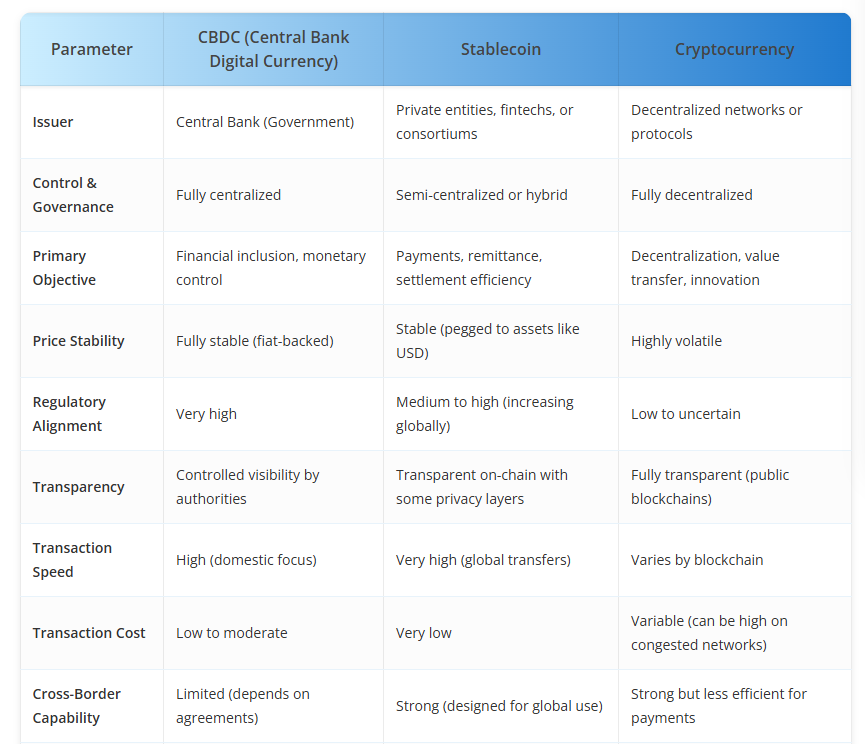
What This Comparison Means for Your Business?
At a surface level, this table highlights differences. But for decision-makers, it reveals something more important: where the real opportunity lies.
- If your priority is regulatory control and national-scale infrastructure, CBDCs are the logical path
- If your goal is building scalable, revenue-generating financial products, stablecoins clearly lead
- If you are focused on innovation, decentralization, and ecosystem growth, cryptocurrencies remain essential
This is exactly why businesses are increasingly investing in stablecoin development as a middle ground that balances compliance, scalability, and usability.
Which One Should You Choose Based on Your ICP?
Now that the differences are clear, the next step is aligning them with your business model, risk appetite, and growth strategy.
- For Fintech Founders
If you are building a payment app, remittance platform, or digital wallet, stablecoins offer the fastest path to execution.
Instead of focusing on definitions, the real advantage is:
- Faster go-to-market without regulatory bottlenecks
- Built-in global payment capability
- Cost-efficient transaction infrastructure
This is where working with a **cryptocurrency development company** helps you move from idea to deployment with compliance-ready systems.
- For Banks and Financial Institutions
For traditional institutions, the decision is less about choosing one and more about balancing control with innovation.
- CBDCs provide regulatory alignment and trust
- Stablecoins unlock speed and cross-border efficiency
This is why most institutions are moving toward a hybrid architecture rather than a single-system approach.
- For Payment and Remittance Companies
Here, the decision is straightforward.
Your business depends on:
- Speed
- Cost efficiency
- Liquidity movement
Stablecoins directly solve these operational bottlenecks, making them the most practical choice for scaling payment infrastructure. Leveraging specialized stablecoin development services ensures these systems are optimized for real-world transaction volume and compliance.
- For Crypto Product Teams and CTOs
If your goal is to build platforms, ecosystems, or token-driven models, cryptocurrencies remain foundational to these efforts.
However, the real shift in 2026 is this:
- Crypto for innovation
- Stablecoins for usability
This combination reduces friction for users while maintaining decentralization at the core, something that requires deep crypto development expertise to execute effectively.
Emerging Market Trends in 2026
- Hybrid Financial Models
We are seeing a convergence of CBDCs, stablecoins, and cryptocurrencies.
- CBDCs for compliance
- Stablecoins for payments
- Crypto for innovation
This creates new opportunities for businesses that can integrate all three effectively.
2. Institutional Adoption of Stablecoins
Major financial institutions are increasingly adopting stablecoins for:
- Treasury management
- Cross-border settlements
- Liquidity optimization
This is driving demand for enterprise-grade stablecoin development solutions.
3. Rise of Regulatory-First Architecture
Compliance is no longer optional. Businesses now require:
- KYC and AML integration
- Audit-ready smart contracts
- Transparent reporting systems
A reliable development partner ensures that these elements are built into the foundation.
4. Interoperability as a Competitive Advantage
Future-ready platforms must operate across:
- Multiple blockchains
- Financial systems
- Regulatory environments
This is where advanced crypto development services play a crucial role in building scalable infrastructure.
Decision Framework: How to Choose the Right Model
Choosing between CBDCs, stablecoins, and cryptocurrencies becomes much easier when you break it down into clear business-driven factors, not just technical differences.

This structured approach simplifies complex decisions and helps you align your technology choice with real business priorities. Instead of getting stuck in theory, you can move forward with clarity and execute with confidence using the right mix of infrastructure and expert-led development services.
Where Most Businesses Go Wrong
Many organizations stumble not because the technology is flawed, but because the approach is.
They often:
- Choose technology based on hype instead of real use case
- Overlook regulatory implications until it becomes a blocker
- Underestimate the complexity of infrastructure and scalability
- Move forward without a clear go-to-market strategy
The reality is, these are not small missteps. They can delay launches, increase costs, and even derail entire projects. That is why working with an experienced **digital currency development company** is not just helpful, it becomes a strategic advantage.
Note: Do not repeat these mistakes. Learn from them, make informed decisions early, and build with clarity from day one!
Conclusion: Strategy Is Clear. Execution Is Everything.
By now, you are not just comparing CBDCs, stablecoins, and cryptocurrencies. You are looking at three powerful building blocks that can shape your entire financial product. The real question is no longer what they are. It is how you use them to create speed, compliance, and long-term scalability in your business.
- CBDCs bring regulatory strength and institutional trust
- Stablecoins unlock real-world utility and global transactions
- Cryptocurrencies drive innovation and ecosystem growth
But here is the truth: most businesses realize too late. Understanding is not an advantage. Execution is. This is where working with an experienced crypto development company like Antier makes a measurable difference.
With deep expertise across blockchain architectures, enterprise-grade crypto dev services, and specialized stablecoin development services, we help you move from concept to a fully functional, market-ready product without friction. Whether you are building a payment platform, launching a stablecoin, or designing a scalable Web3 ecosystem, the focus is always the same. Build it right, build it fast, and build it for the future.
Frequently Asked Questions
Originally published at https://www.antiersolutions.com on April 2, 2026.
메타데이터
- post_id
- 3befeaf67207
- slug
- cbdc-vs-stablecoin-vs-crypto-key-differences-best-choice-2026-guide-3befeaf67207
- url
- https://medium.com/@ryleetaylor222/cbdc-vs-stablecoin-vs-crypto-key-differences-best-choice-2026-guide-3befeaf67207
- canonical_url
- https://medium.com/@ryleetaylor222/cbdc-vs-stablecoin-vs-crypto-key-differences-best-choice-2026-guide-3befeaf67207
- author_url
- https://medium.com/@ryleetaylor222
- status
- ok
- fetched_at
- 2026-07-13 11:03:25