When Your Baby Finally Sleeps and You Realize You Want the Room to Yourself
The first quiet moment arrives like a wave you’ve been waiting for.
When Your Baby Finally Sleeps and You Realize You Want the Room to Yourself
The first quiet moment arrives like a wave you’ve been waiting for.
The baby settles — not that fluttery half-sleep where you’re still tense and listening with your whole body, but a deeper stretch where the house finally stops holding its breath. For a second, you can feel your shoulders unclench. Relief comes, real and immediate.
And then, right behind it, another feeling slips in — soft, startling, and almost forbidden.
I want to be alone.
Not as a rejection. Not as a dramatic fantasy of leaving. Just as a small pocket of air where nobody needs your arms, your milk, your eyes, your attention, your nervous system.
A shower with the door latched.
A few minutes where you’re not “on.”
Ten minutes of silence that isn’t interrupted by a cry you can hear even when you’re not hearing it.
Then the guilt surges fast, like it was waiting for you to admit the truth.
How can I want space from my baby? What kind of mother thinks this? Does this mean I’m selfish? Does this mean I’m cold?
You look at your baby and feel love — actual love, the kind that would make you protect them with your entire life.
And still, your body feels crowded.
So you swallow the need. You keep moving. You try to be endlessly generous with yourself erased from the picture.
But guilt doesn’t make you more loving. It usually just makes you lonelier inside your love.
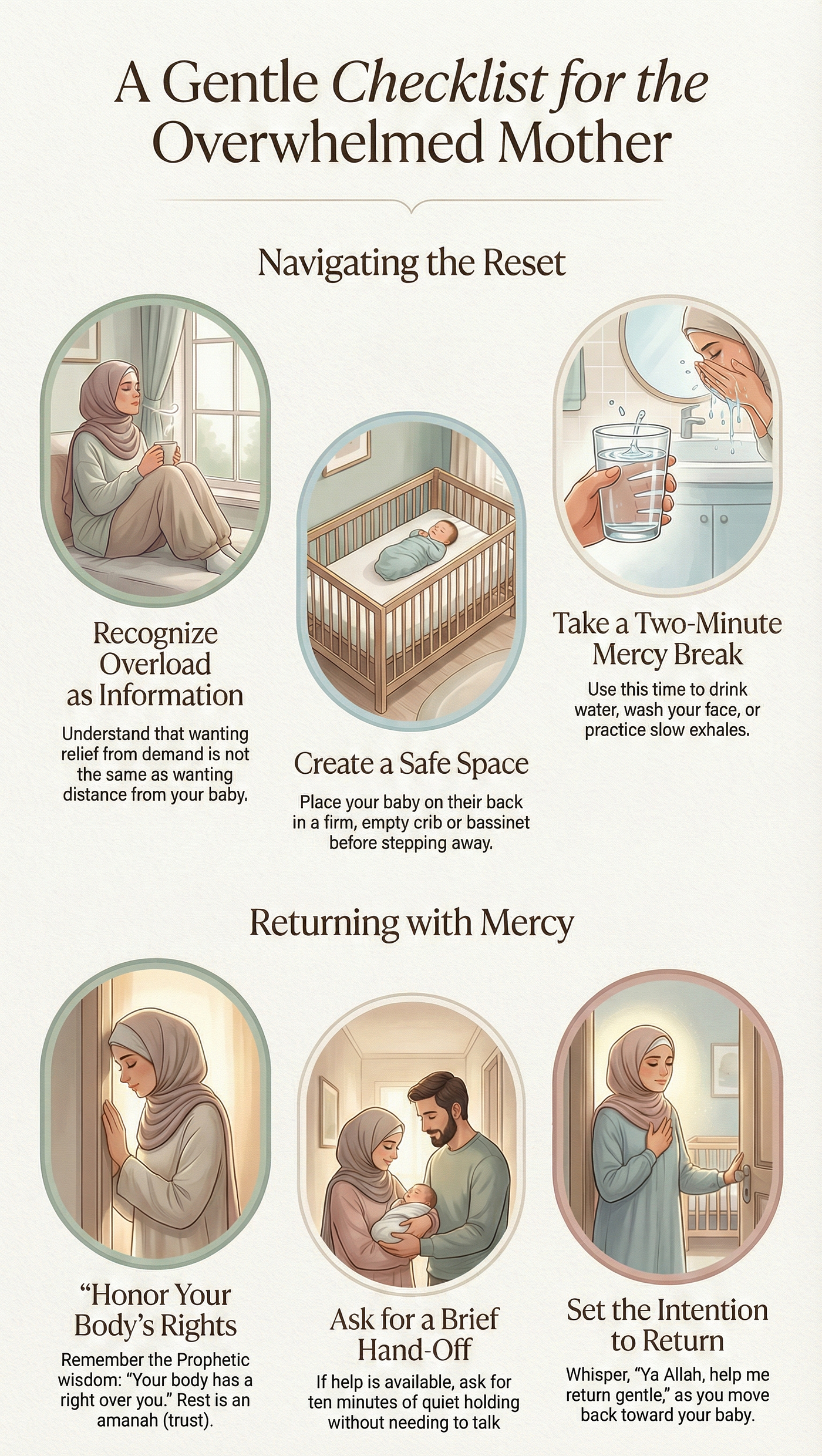
The thing you’re asking for isn’t distance — it’s relief
It helps to name this correctly, because the wrong name turns it into shame.
Most mothers who secretly want a moment alone are not trying to get away from their baby. What they’re craving is a pause from constant demand — the ongoing requirement that your body be available, your senses be alert, your mind be tracking everything.
When you’ve been the always-on system — feeding, soothing, lifting, monitoring, planning — your brain doesn’t fully power down just because the baby finally sleeps. Your body stays in “ready mode.” Your attention remains stretched.
So wanting space for a few minutes is often not a statement about your love.
It’s a signal about overload.
And overload isn’t a moral defect. It’s information.
The American Psychological Association discusses parental burnout and notes how even small breaks can help a parent regulate and recover. [1] Public health guidance on postpartum wellbeing also normalizes taking breaks and asking for help as part of caring for your emotional health after birth. [2]
So when your heart whispers, I need a moment, it may not be betrayal at all.
It may be your nervous system trying to protect your gentleness.
Why postpartum guilt sounds so authoritative
Postpartum guilt rarely feels like a suggestion. It speaks like a judge.
It takes a normal human need and turns it into a verdict:
If I need a break, I’m failing. If I step away, I’m not maternal enough. A good mother wouldn’t want this.
But guilt is not always a compass. Sometimes it’s just a byproduct of impossible standards meeting real-life intensity.
And when you’re undersupported, the guilt often gets louder, because your brain tries to regain control by demanding you become superhuman:
No rest.
No needs.
No “weakness.”
It becomes a loop:
You deny yourself a pause → irritability rises → you feel guilty for being irritable → you deny yourself a pause even harder.
Or you have the thought I want to be alone, and your mind translates it into I must be a bad mother. That translation creates shame. Shame creates silence. Silence makes the feeling swell.
And if postpartum anxiety or depression is present, that inner pressure can deepen.
Perinatal depression and anxiety are real, medical, treatable conditions — not character flaws. [3] ACOG emphasizes that postpartum care should be understood as an ongoing process, tailored to a woman’s needs, including mental health support. [4]
You don’t need to diagnose yourself to benefit from that truth. You only need permission to take your inner world seriously.
The smallest safe break can change the tone of an entire day
You don’t need a grand solution right now. You need a first step that is safe and merciful.
Here is the truth guilt tries to hide from you:
A brief break can make you more present, not less.
If you’re alone, the baby is crying, and you feel yourself climbing toward panic or anger, one of the safest choices is often not to keep holding the baby while you’re dysregulated.
It can be safer to place your baby down in a safe sleep space and take a short reset.
Safe sleep guidance emphasizes placing babies on their backs on a firm, flat surface — such as a crib, bassinet, or play yard — without soft objects in the sleep area. [5] [6]
That reset can look like this:
- Place baby down safely (on their back, firm surface, clear sleep space). [5] [6]
- Step into the bathroom or hallway for two minutes.
- Breathe slowly.
- Drink water.
- Splash your face.
- Come back.
That is not abandonment.
That is prevention.
That is you protecting the amanah of gentleness before the moment escalates.
And if someone is available — a spouse, a relative, a trusted friend — handoff can be simple and specific:
“I need ten minutes. Please take the baby. No fixing, no talking — just hold them while I reset.”
You’re not asking to disappear. You’re asking to return.
A re-frame that removes the sting
Some sentences change everything because they tell the truth without cruelty.
Try this one:
This isn’t me leaving my baby. This is me returning in a better state.
Bonding is not something you must “feel” perfectly, every minute of the day. Bonding is built over time through repeated returns — feeding, soothing, eye contact, safety, consistency.
A mother who steps away briefly to regulate is not weakening attachment. She’s protecting the quality of her presence.
Your baby does not need a mother who never has needs.
Your baby needs a mother who can come back — again and again — with mercy.
When “I need space” is actually a sign to reach for help
Sometimes the guilt is just guilt.
And sometimes it comes with warning signs that deserve professional care.
If your need for space comes alongside any of the following, please treat it as important:
- persistent sadness or emptiness
- constant anxiety or panic
- inability to sleep even when the baby sleeps
- intrusive scary thoughts
- thoughts of harming yourself or your baby
Perinatal mood and anxiety disorders are treatable, and emergencies warrant immediate help. [3] Postpartum Support International also offers pathways to support and resources. [7]
Seeking help is not weakness.
It is amanah — protecting life, heart, and home.
Where Allah is in the moment you feel “too human”
Postpartum whispers often try to make your limits sound like spiritual failure.
If you were better, you wouldn’t need a break.
But Allah did not design motherhood to erase your human capacity.
Allah tells us plainly: “Allah does not burden any soul beyond what it can bear.” (Qur’an 2:286). [8]
If you feel at the edge of what you can carry, that isn’t proof of Allah’s displeasure.
It is proof that you reached a limit Allah already knows.
And the Prophet ﷺ taught a boundary that mothers deserve to hear as mercy, not as a modern slogan:
“Your body has a right over you.” (Sahih al-Bukhari 5199). [9]
Your body is an amanah. Protecting it with water, food, rest, and small resets is not selfishness. It is stewardship.
And Allah sees what you intend — especially when your intention is to return gentle.
“Actions are judged by intentions.” (Sahih al-Bukhari 1). [10]
So if your intention is: Ya Allah, I’m stepping away for a moment so I don’t snap, so I can come back with mercy — that can be worship.
Even fatigue is not spiritually invisible.
The Prophet ﷺ taught that fatigue and hardship can be a means of expiation. (Sahih al-Bukhari 5641). [11]
The Islamic frame is not “feel nothing.”
It is: don’t punish yourself for being human. Take the merciful means Allah allowed. Return with gentleness.
A two-minute mercy break you can try today
If you do nothing else, do this.
- Put your baby in a safe sleep space — on their back, on a firm surface, with an empty sleep area. [5] [6]
- Set a two-minute timer.
- In those two minutes, do three things:
- Drink water.
- Exhale longer than you inhale.
- Whisper: “Ya Allah, help me return gentle.”
Then go back.
If two minutes is all you can manage today, it still counts. Because it breaks the lie that a good mother never needs space.
You are a good mother not because you never feel crowded — but because you care how you show up, and you’re willing to take steps that protect your mercy.
Du’a: Ya Allah, lift shame from my heart. Grant me halal rest and barakah in small breaks. Help me return to my baby with gentleness, and protect me from overwhelm and despair. Ameen.
References
[1] American Psychological Association. Parental burnout — https://www.apa.org/topics/stress/parental-burnout [2] Government of Canada. Your Guide to Postpartum Health and Caring for Your Baby — https://www.canada.ca/en/public-health/services/child-infant-health/postpartum-health-guide.html [3] National Institute of Mental Health. Perinatal Depression — https://www.nimh.nih.gov/health/publications/perinatal-depression [4] ACOG. Optimizing Postpartum Care — https://pubmed.ncbi.nlm.nih.gov/29683911/ [5] American Academy of Pediatrics. Safe Sleep — https://www.aap.org/en/patient-care/safe-sleep/ [6] Health Canada. Sleep Time — https://www.canada.ca/en/health-canada/services/consumer-product-safety/reports-publications/consumer-education/your-child-safe/sleep-time.html [7] Postpartum Support International. Get Help — https://postpartum.net/get-help/ [8] Qur’an 2:286 — https://quran.com/2/286 [9] Sahih al-Bukhari 5199 — https://sunnah.com/bukhari:5199 [10] Sahih al-Bukhari 1 — https://sunnah.com/bukhari:1 [11] Sahih al-Bukhari 5641 — https://sunnah.com/bukhari:5641
메타데이터
- post_id
- 3c062e4a5330
- slug
- when-your-baby-finally-sleeps-and-you-realize-you-want-the-room-to-yourself-3c062e4a5330
- url
- https://medium.com/@growdeeneducation/when-your-baby-finally-sleeps-and-you-realize-you-want-the-room-to-yourself-3c062e4a5330
- canonical_url
- https://medium.com/@growdeeneducation/when-your-baby-finally-sleeps-and-you-realize-you-want-the-room-to-yourself-3c062e4a5330
- author_url
- https://medium.com/@growdeeneducation
- status
- ok
- fetched_at
- 2026-07-19 19:20:35






