What Happens When Every Investor Has the Same Information?
Private markets have spent decades improving almost every part of the acquisition process. Firms have built stronger sourcing networks…
What Happens When Every Investor Has the Same Information?

When every investor has the same information, the advantage belongs to those who understand what changes the decision.
Private markets have spent decades improving almost every part of the acquisition process. Firms have built stronger sourcing networks, more sophisticated underwriting models, deeper due diligence frameworks and increasingly advanced systems for market research, valuation and portfolio monitoring. Artificial intelligence has now accelerated that evolution, making it possible to analyse businesses, financial statements and market information at a speed that would have been unthinkable only a few years ago.
Yet the most consequential moment in any acquisition remains remarkably unchanged.
After the financial model has been built, the diligence completed, the lenders consulted and the risks debated, someone still has to decide whether the opportunity deserves capital.
That decision is where the vision behind VREXO™ begins.
The company was not built around a feature, a workflow or a belief that private markets simply needed better software. It was built around a much larger question: what should private market decision-making look like when information is no longer the constraint?
The Vision Did Not Begin With Software
Most technology companies begin by identifying a process that can be made faster or easier. The original thinking behind VREXO™ came from a different place.
Years spent evaluating business acquisitions and commercial real estate transactions revealed an uncomfortable reality: an acquisition can be analysed thoroughly and still be understood poorly.
Modern transactions rarely suffer from a complete lack of information. By the time a serious opportunity reaches an investment committee, the team may have reviewed years of financial performance, built detailed forecasts, tested valuation assumptions, spoken with lenders, studied the market, completed operational diligence and consulted multiple advisors.
The problem is that each discipline often sees a different version of the same investment.
The financial model explains historical performance and projected returns. The lender sees debt serviceability, downside protection and financing risk. Market intelligence provides external context. Due diligence identifies operational and legal exposure. Valuation establishes what the business may be worth. Experienced operators notice patterns and contradictions that may never appear in a formal report.
Every perspective can be individually correct and still fail to produce a complete understanding of the acquisition.
The industry has become extremely good at producing each piece of intelligence. What it has not built to the same degree is infrastructure for understanding how those pieces change one another.
That gap became the starting point for VREXO™.
An Acquisition Is Not a Collection of Reports
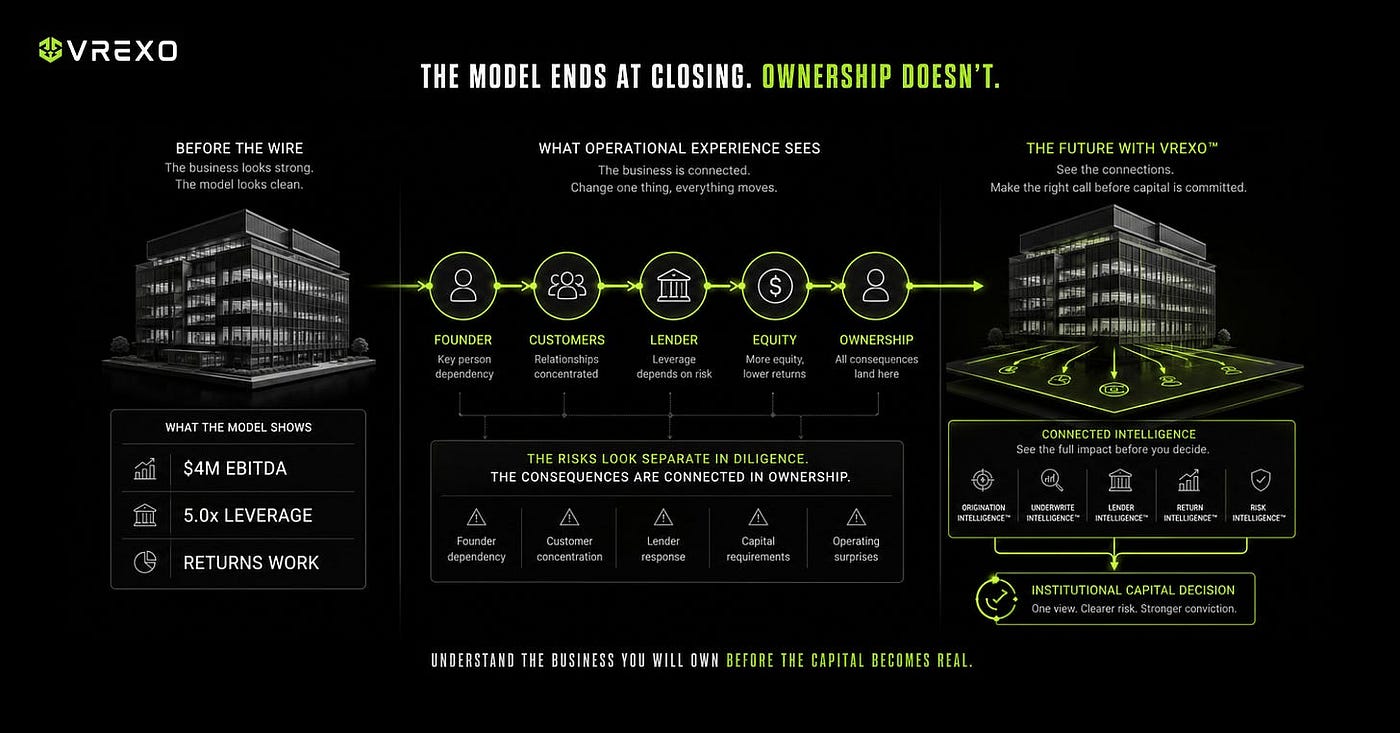
A spreadsheet can show what happens to returns if revenue declines by 10 percent. What it cannot determine on its own is whether the reason revenue might decline also changes lender appetite, working capital requirements, exit assumptions and the original investment thesis.
That distinction is where many acquisition decisions become far more complicated than the model suggests.
A customer concentration issue may initially appear to be an operational concern. If a lender views that concentration differently, it can become a financing constraint. A financing constraint can change the capital structure. A different capital structure can alter returns and, ultimately, the price an investor can responsibly pay.
Nothing important stays in one category for long.
The same is true in commercial real estate. A change in market conditions may affect tenant demand, refinancing assumptions, lender behaviour, valuation and exit timing simultaneously. Looking at each variable independently may produce five reasonable analyses. The investment decision, however, depends on understanding what happens when all five begin interacting.
Traditional deal analysis is often very good at capturing variables.
Experienced investors are good at understanding consequences.
The vision behind VREXO™ is based on the belief that private markets need infrastructure for that second problem.
What Experienced Operators See Differently
The best acquisition professionals develop an ability that is difficult to document and even harder to transfer.
After years inside transactions, they begin to recognise patterns earlier. They know when attractive EBITDA deserves more scrutiny. They understand when lender enthusiasm is meaningful and when it may disappear as market conditions change. They recognise that two risks which appear manageable independently can become unacceptable when combined.
This is often called experience or instinct, but those words do not fully explain what is happening.
Experienced operators are continuously connecting signals.
They are comparing the current opportunity with prior transactions, financing environments, market cycles and investment outcomes. They are asking how one change affects the rest of the deal. Much of that reasoning takes place across spreadsheets, lender calls, investment committee discussions, documents and accumulated memory.
For decades, that capability has largely lived inside the heads of experienced investors.
The larger question behind VREXO™ was whether the acquisition process itself could be built to support that way of thinking.
That is the idea behind Institutional Intelligence for Private Markets.
Institutional Intelligence is not an automated investment committee. It is not artificial intelligence deciding whether a business or commercial property should be acquired, and it is not a replacement for experienced investors. Its purpose is to strengthen the environment in which judgment operates by connecting intelligence that has historically been evaluated in separate places.
That is a fundamentally different ambition from making acquisition software more efficient.
Why This Vision Matters Now
For much of private market history, information itself created competitive advantage. Proprietary sourcing, specialist research, broker relationships, internal databases and larger analytical teams gave sophisticated firms access to opportunities and insights their competitors did not possess.
That advantage is changing.
Artificial intelligence is rapidly reducing the cost of analysis. Financial models will become easier to build and challenge. Market research will become faster. Institutional-quality information will become increasingly accessible across the lower middle market.
This will make acquisition teams more productive, but it will also create a new competitive reality.
When every serious investor has powerful analytical tools, having powerful analytical tools is no longer enough to differentiate a firm.
The advantage moves somewhere else.
It moves to the quality of the questions asked before analysis begins and the quality of the judgment applied after the answers arrive. It moves to recognising which signal genuinely changes an investment and which one merely creates more noise.
The next generation of private market infrastructure cannot be designed only to produce more output. It must help investors understand which output actually changes the decision.
VREXO™ is being built for that future.
One Acquisition Should Not Exist in Ten Different Worlds
A single opportunity can currently exist as a sourcing record, an underwriting model, a lender conversation, a valuation exercise, a market research file, a diligence report and an investment committee presentation.
Technically, all of them describe the same acquisition.
Operationally, they can behave like entirely different versions of it.
An underwriting team may identify a risk that has not yet affected valuation. A lender may react strongly to something the acquisition team considers minor. New market intelligence may challenge an assumption that remains unchanged in the financial model. By the time everything reaches the investment committee, the hardest task is often no longer finding information. It is reconstructing the true state of the decision.
The long-term vision for VREXO™ is to change that.
Origination Intelligence™, Acquisition Signal Intelligence™, Institutional Bid Guidance™, institutional underwriting, lender intelligence, market intelligence and portfolio surveillance are not intended to operate as a collection of separate features. They are parts of one connected institutional decision environment.
The objective is not to place more information on one screen.
It is to help every meaningful signal inform the same investment decision.
The Vision Does Not End at Closing
One of the largest losses of intelligence in private markets happens after a transaction closes.
The assumptions that justified the acquisition often remain inside old underwriting files. Risks identified during diligence become separated from portfolio performance. The original investment thesis is rarely tested continuously against what actually happens. Valuable lessons remain inside individual memory rather than improving how the next opportunity is evaluated.
That breaks the institutional learning cycle.
The larger vision behind VREXO™ extends beyond the acquisition itself. Origination should inform underwriting. Underwriting should inform ownership. Portfolio performance should test the assumptions made before closing. Those outcomes should then improve the next capital allocation decision.
That is how institutional knowledge compounds.
And in a future where data becomes abundant, the ability to compound judgment may prove far more valuable than the ability to accumulate more information.
What VREXO™ Is Ultimately Building
The vision behind VREXO™ is not based on the belief that private markets need more technology. It is based on the belief that the industry is approaching a new operating model.
Investors will still make the decisions. Experience will still matter. Investment committees will still challenge assumptions, and judgment will remain human. What should change is the fragmented environment surrounding those decisions.
The firms that lead the next generation of private markets will not simply be those that analyse the most opportunities or adopt new technology first. They will be the firms that build the strongest institutional understanding of where capital should go, why it should go there and what could make the original decision wrong.
That is the vision behind VREXO™.
To build Institutional Intelligence for Private Markets so that experience and judgment can operate with a more complete, connected understanding of the investment before capital is committed.
Because the future of private markets will not be decided by who has the most information.
It will be decided by who understands what that information means.
Private access to VREXO™ is available for selected investors, lenders, acquisition groups, family offices and strategic partners across North America.
If you don’t understand the risk, don’t bid.
Website: **VREXO.ai**
Media Contact
Jessica Paul Media & Marketing Manager, VREXO™ jessica@vrexo.ai (888) 831–2313 401 Bay Street Toronto, Ontario M5H 2Y4 Canada
메타데이터
- post_id
- 3c0635810fc9
- slug
- what-happens-when-every-investor-has-the-same-information-3c0635810fc9
- url
- https://medium.com/@vrexo_ai/what-happens-when-every-investor-has-the-same-information-3c0635810fc9
- canonical_url
- https://medium.com/@vrexo_ai/what-happens-when-every-investor-has-the-same-information-3c0635810fc9
- author_url
- https://medium.com/@vrexo_ai
- status
- ok
- fetched_at
- 2026-07-10 21:29:00