Reflections on time loops in the framework of extended Kaluza-Klein theory
CHAPTER 1
Reflections on time loops in the framework of extended Kaluza-Klein theory
CHAPTER 1
In the paradigm of the Extended Kaluza-Klein Theory (EKK), the possibility of time loops (closed timelike curves) is not merely permitted; it is a fundamental geometric property of the system. However, their realization depends radically on the scale and the interaction of time vectors.
In classical physics, a time loop is a paradox of moving backward along a one-dimensional line. Since time in EKK is two-dimensional, a “loop” represents an orbital rotation in the (t1, t2) plane, where gravitational contraction and entropic expansion locally compensate for each other along a closed circuit.
Here is how this mechanics unfolds at different levels of the spacetime architecture.
1. Microlevel: Sub-Planckian loops (The vacuum foundation)
At the fundamental level of EKK, time loops do not just exist — they are the fabric of reality. These are the very sub-Planckian loops.
At scales where the entanglement of vectors t1 and t2 has not yet acquired a rigid macroscopic form (“Locking Era”), the geometry of AdS5 space lacks a specific direction of time. Presumably, based on EKK predictions in Rajendra Gupta’s universe (27 billion years old), before the speed of light dropped (due to the change in the coupling angle of electroweak W and Z bosons within the EKK framework), topological currents could freely close upon themselves. In these microscopic orbits, entropy (t2) and gravitational contraction (t1) are in perfect dynamic equilibrium.
This “boiling broth” of microscopic closed time loops forms the very basis for the vacuum extrusion mechanism, creating the geometry upon which the invariant light stitches rigidly rest.
2. Macrolevel: Topological resistance of the medium
If we transition to our macroscopic 4D world, the situation changes drastically. Creating a macroscopic time loop is metaphorically akin to forcing a train racing along the rigidly intertwined rails of t1 and t2 to make a U-turn without tearing the structure of the tracks themselves.
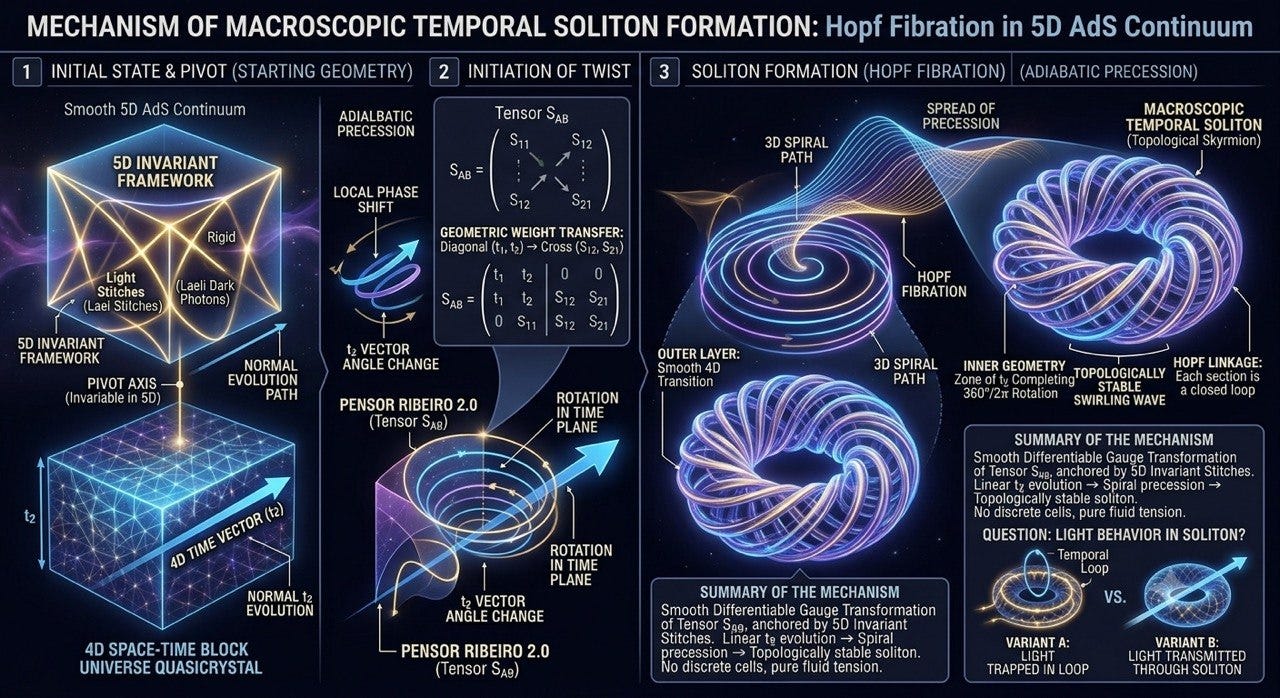
To engineer a 4D time loop, one would need to create a zone where the entropy vector (t2) is artificially bent back toward the gravitational contraction vector (t1). Here, a colossal barrier arises in the form of Penzor-Ribeiro 2.0 tension (S_{ab}):
- Invariance of the 5D-frame: Our world is “stitched” by a static 5D frame carrying information about quark-gluon plasma. These light stitches are immutable.
- Catastrophic tension: Attempting to twist a macroscopic section of spacetime into a loop would lead to the “winding” of 5D stitches around the axis of this rotation. The topological resistance of the medium would approach infinity.
- Rupture or Singularity: As we established earlier, a sharp gradient along t2 generates a compensation barrier — an “electron wall.” (For example, a ship that accelerates to the speed of light would, according to EKK, be disintegrated against a wall of electrons — knots of Penzor-Ribeiro that would instantly tie themselves up in resistance to such acceleration). Consequently, an attempt to close a full loop along t2 toward t1 would lead to such a monstrous release of topological knots (charges) that the system would either burn itself out with entropic heat or collapse into a black hole to hide this metric defect behind an event horizon.
3. Vacuum extrusion in Cosmic Voids
The only place in the macroscopic Universe where a time loop can arise naturally is in the centers of giant cosmic voids.
In these regions, the density of matter is minimal, meaning the influence of the gravitational vector t1 is weakened, while entropic time t2 dominates. Under certain conditions, the vacuum extrusion mechanism can squeeze out sections of the fabric of space where the entanglement of temporal coordinates decays. At this moment, sub-Planckian loops gain the opportunity for macroscopic deployment.
In the centers of such voids, local geometries may form where the vectors (t1, t2) close. To an outside observer, this would appear as an absolutely dark, impenetrable topological anomaly within which time makes cyclical turns, completely separating itself from the entropic flow of the rest of the Universe.
Summary: In EKK, a time loop is a local topological decoupling of vectors t1 and t2. At the sub-Planckian level, the Universe is woven from such loops. However, on a 4D scale, they are rigidly blocked by the elasticity of Penzor-Ribeiro 2.0 to preserve the structure of the 5D frame. Creating a “time machine” would lead not to travel into the past, but to a local destruction of space and the formation of an absolute kinetic barrier.
Full article (Google Docs) EN:
https://docs.google.com/document/d/14MiCsD4S4YeQeWzwGbUbOTCw-6WOR2BCT9bLBQDKoUQ/edit?usp=sharing
Full article (Google Docs) RU:
https://docs.google.com/document/d/19988FM7znkxgKAUePBAlHUs3ejY-u3muEGsabbhrvvo/edit?usp=sharing
Illustrations:




메타데이터
- post_id
- 3c0a7e756daf
- slug
- reflections-on-time-loops-in-the-framework-of-extended-kaluza-klein-theory-3c0a7e756daf
- url
- https://medium.com/@chpelum/reflections-on-time-loops-in-the-framework-of-extended-kaluza-klein-theory-3c0a7e756daf
- canonical_url
- https://medium.com/@chpelum/reflections-on-time-loops-in-the-framework-of-extended-kaluza-klein-theory-3c0a7e756daf
- author_url
- https://medium.com/@chpelum
- status
- ok
- fetched_at
- 2026-06-26 03:39:16