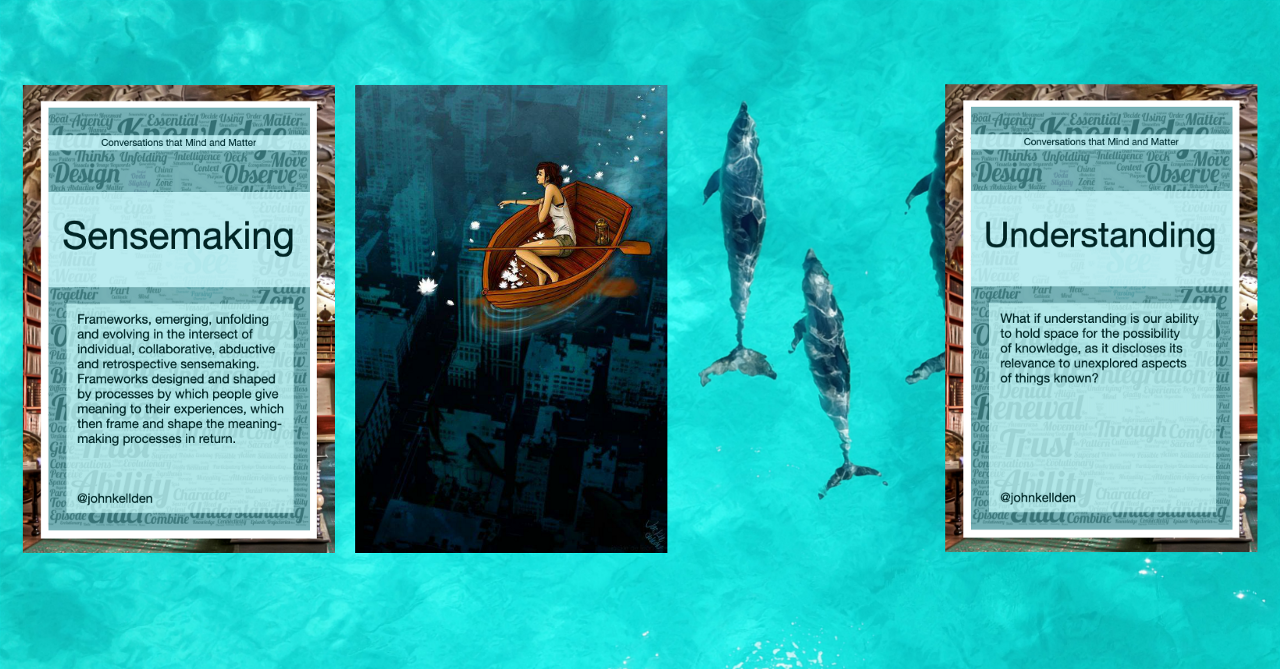
Playⁿ: Mechanism Design
The architecture of meaningful cooperation
Playⁿ: Mechanism Design
The architecture of meaningful cooperation
Playⁿ is not only a way to have better conversations. It is a way to make the conditions of conversation, participation, memory, AI assistance, measurement, and cooperation more visible and revisable.
Mechanism design asks a reverse question. Instead of asking how people will behave inside existing rules, it asks:
What rules, signals, boundaries, incentives, feedback loops, symbolic forms, and return paths would help people cooperate more intelligently?
For Playⁿ, this is not only a question related to media, information or (platform) economics. It is a question of governance, culture, cognition, design, conversation, fields, coherence, memory, knowledge, options, paths, preferable outcomes, understanding, and shared becoming.
Playⁿ: Mechanism Design asks:
What Playⁿ, systemic, semiotic, symbolic, relational and social conditions would help a field turn difference into knowledge and understanding, and shared understanding into purposeful paths of action, and enaction into learning, narratives and meaning-making experiences?
meaning-making as governance
The answer is meaning-making as governance, not as a single framework or rule, nor as a top-down given, but as modular building blocks forming a living mechanism:
- a worthwhile dilemma,
- a GCQ,
- cards,
- conversation,
- notes,
- shards,
- dotted lines,
- shared memory,
- feedback,
- rules and guidelines,
- small moves, rehearsal and return.
A mechanism is not good merely because it helps people adapt, consume, connect, comply, or cope.
“There are two kinds of light — the glow that illuminates, and the glare that obscures.” — James Thurber
Mechanisms have a similar double possibility. They can function as modular building blocks that make relations visible, widen agency, preserve memory, and support meaningful cooperation.
Or they can function as extractive platform designs: capturing attention, hiding their rules, narrowing participation, and converting human activity into data, compliance, or noise.
A good mechanism does not make people easier to manage.
It helps them become more capable of seeing, discussing, revising, remembering, and acting together. The postscripts below explore and illuminate the above from several perspectives.
Read the main essay for the argument. Use Postscripts III–IV for practice. Use Postscripts V–XIV as the deeper architecture.
Card Session: A Glimpse of Mechanism Design
Lena, a service designer, begins. She reads the Mechanism Design card and says: “We keep talking about making participation easier. But easier for whom? The platform is already deciding which categories people can choose, what the AI considers relevant, and what gets summarized before anyone has had a chance to question it.”
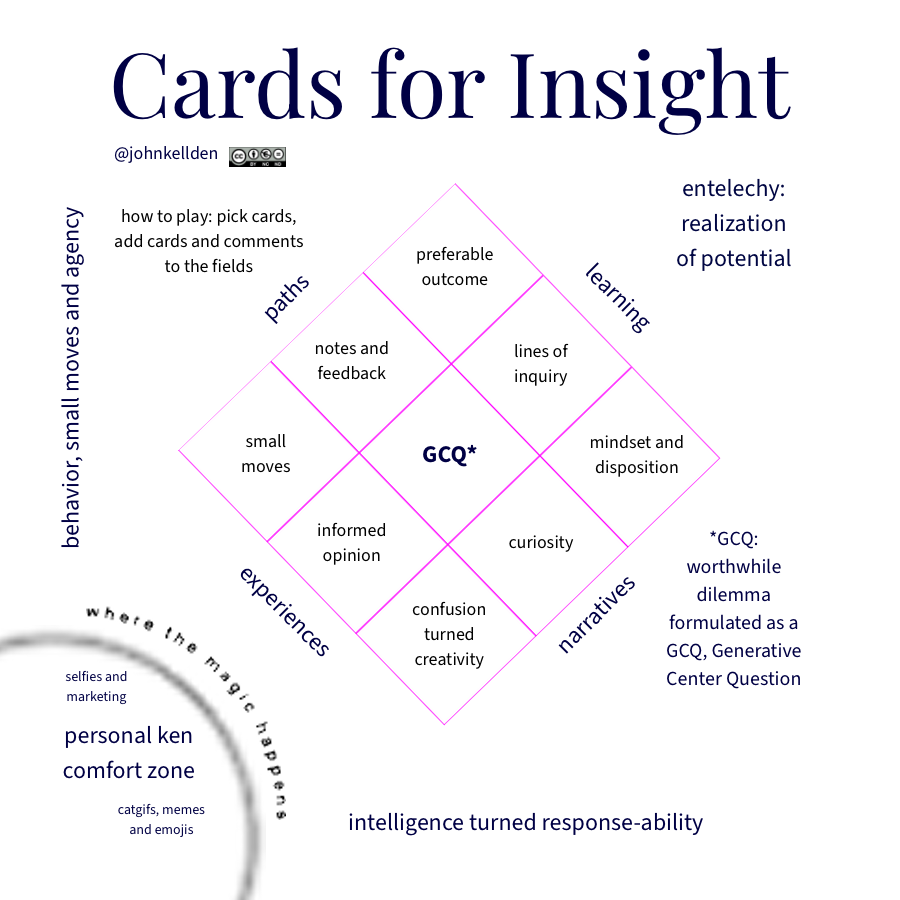
GCQ: One of the Playⁿ diagrams
She places Mechanism Design on the field of lines of inquiry.
Her comment: “What would change if every category in the platform had to show its reason, its history, its likely exclusion, and its revision path?”
Her small move: Create a visible rules layer that participants can inspect, question, and help revise.
Her shard: A rule becomes more trustworthy when the people living inside it can see how it was made.
This is at the heart of Playⁿ: Mechanism Design
Not mechanisms as hidden behavior control. Not incentives as substitutes for care. Not metrics as tools for compliance. Not governance as a layer added after the product is built.
Not AI as an invisible decision-maker.
Playⁿ: Mechanism Design makes the conditions of participation visible enough to become discussable, meaningful enough to be shared, and revisable enough to remain alive.
It asks:
What is this rule doing to the field?
What kind of participation is this interface inviting?
What does this metric reward?
What does this category exclude?
What does the AI make easy to see?
What does it make easier to ignore?
What dotted line is carrying meaning?
What dotted line has broken?
What would help the field repair itself?
This is mechanism design as a practice of collective intelligence.
Not designing people. Not turning them into eyeballs, or like button clicking minions.
Designing better conditions for people to think, play, learn, and act together.
Golden Thread
Playⁿ: Mechanism Design turns rules, flows, measures, and feedback into visible, discussable, and actionable conditions for shared understanding and meaningful cooperation.
A field gathers around a question.
A card reveals a hidden mechanism.
A conversation makes the mechanism discussable.
A rule is revised.
A move is rehearsed.
A consequence becomes visible.
A shard captures what the field learned.
A return tests whether the mechanism still serves the field.
This is not governance after meaning-making.
It is meaning-making as governance.
Throughline
This post follows a simple arc. First, it treats mechanism design as the architecture of cooperation. Then it introduces three cards:
Mechanism Design Commons Good Measure
Together, these cards form a triangle.
Mechanism Design asks:
What rules, incentives, boundaries, and feedback loops shape the field?
Commons asks:
What shared resources, capacities, meanings, and relationships must be protected and cultivated?
Good Measure asks:
What traces of transformation can be made visible without reducing the field to what is easiest to count?
The heart of the post is a card session.
The participants discover that their preferable outcome is not only a better participation platform.
It is a field that becomes capable of revising the conditions of its own participation.
That processual preferable outcome is coherence gain.
The post then turns to the deeper infrastructure:
the commons, the Dotted Lines, the Playⁿ leverage points, Emme as a mechanism-aware companion, and the ongoing work of fine-tuning, harnessing, leveraging, augmenting, orchestrating, and field-tuning.
Three Cards at the Center

Mechanism Design, one of the 504 cards in the Playⁿ Source Deck.
Card: Mechanism Design Mechanism design is our ability to make the rules, incentives, boundaries, feedback loops, and consequences shaping a field visible enough to discuss, meaningful enough to share, and revisable enough to serve evolutionary agency and collective flourishing.
A mechanism is not neutral. It shapes what becomes possible.
Card: Commons Commons are the shared conditions that no participant can create alone, yet all depend upon.
Attention. Trust. Memory. Context. Language. Care. The right to be heard before being summarized.
A commons remains alive when participants can help steward what they share.
Card: Good Measure Good measure is our ability to make change visible without reducing life to what can be counted, ranked, optimized, or controlled.
It preserves enough trace for learning and return, while protecting the living, unfinished quality of the field.
The Triangle
These three cards form a working triangle.
Mechanism Design asks: What conditions are shaping participation?
Commons asks: What shared capacity is at risk, and what must be cultivated?
Good Measure asks: What difference should become visible without becoming flattened?
Together they create a path:
rule → participation → feedback → interpretation → revision → return.
This is how governance becomes playable. This is how play becomes more conscious of the mechanisms shaping it. This is how small moves become purposeful paths of action.
The GCQ 3×3 Gameboard
A playable field for turning a wicked problem (with tacit, hidden or taken for granted mechanism designs) into a worthwhile dilemma, a worthwhile dilemma into a GCQ, and a GCQ into visible rules, shared understanding, revisable practice, and next coherent action.
GCQ: One of the Playⁿ diagrams
Before the card session begins, the group places the GCQ at the center of the 3×3 board. The board is not a static grid. It is a semi-bounded field where questions, cards, comments, tensions, stories, rules, notes, and small moves can become playable.
Around the center, the eight fields give participants places to locate what is emerging:
curiosity, confusion turned creativity, informed opinion, small moves, mindset and disposition, notes and feedback, lines of inquiry, and preferable outcome.
For this session, the board helps the group triangulate between three core cards:
Mechanism Design Commons Good Measure
Together, they help the field move from hidden rule to visible condition, from visible condition to shared understanding, and from shared understanding to revisable practice.
The center holds the GCQ.
The cards act as symbolic handles.
The comments make interpretation social.
The small moves turn understanding toward action.
The notes and shards preserve what the field learns.
The preferable outcome is not only a better product or policy.
It is also processual:
a field more capable of governing the conditions of its own participation.
A Card Session: The Visible Rules Layer
Four participants gather around a 3×3 board. They are working on an AI-assisted participation platform for a municipality.
The platform is intended to make public participation easier.
- Residents can submit concerns.
- They can comment on proposals.
- They can suggest priorities.
- The AI can summarize patterns.
- The municipality can see what is emerging.
At least, that is the promise. But a tension has become visible. The prototype already contains pre-selected issue categories. Its default prompts direct attention toward some kinds of contribution rather than others.
Its AI summaries group comments into familiar administrative language. The platform may be collecting participation while quietly narrowing what people can imagine, say, contest, or create.
The group names the wicked problem: Participatory systems promise openness while quietly narrowing the field through categories, defaults, summaries, and invisible rules of relevance.
They name the worthwhile dilemma: How can we provide enough structure for collective sensemaking without using structure to predetermine, conceal, or over-control the available possibilities?
The GCQ becomes: What would help us design participatory fields in which the rules shaping choice become visible, discussable, and revisable, while the field remains usable enough to support purposeful action?
The GCQ is placed at the center.
The three cards are placed around it:
Mechanism Design Commons Good Measure
The group agrees that these three cards will govern the session.
First Move: Mechanism Design
Lena, the service designer, reads the Mechanism Design card.
She says:
“Our categories are functioning like invisible legislation. We call them helpful prompts, but they are deciding what kind of public reality can appear.”
She places Mechanism Design on the field of lines of inquiry.
Her comment:
“Categories are not neutral because someone chose them before the participant arrived.”
Her small move:
Every category in the participation interface must include:
its purpose, its history, one likely exclusion, and one visible revision path.
Her shard:
A category becomes less controlling when it carries its own explanation and revision path.
Second Move: Commons
Ravi, a community organizer, reads the Commons card.
He pauses. “The shared resource here is not only the platform. It is people’s ability to recognize themselves in what happens after they contribute.”
He places Commons on the field of experiences.
His comment: “When people tell a story, they are not submitting raw material for a dashboard. They are trying to keep part of their world from disappearing.”
His small move: Before a contribution enters a formal category or AI summary, preserve its original wording, its source context, and its participant-approved interpretation.
His shard: Do not summarize people out of their own world.
Third Move: Good Measure
Mira, a municipal innovation lead, reads Good Measure.
She says: “We have been measuring participation as activity: submissions, comments, reactions, response times. But that tells us almost nothing about whether people can influence the frame.”
She places Good Measure on notes and feedback.
Her comment: “The platform should measure not only how many people participate, but whether they can see, question, and revise the conditions of participation.”
Her small move:
Add three field signals:
Can participants see the categories shaping their choices?
Can they challenge or revise those categories?
Can they trace how their contribution was interpreted?
Her shard: Good measure traces agency, not only activity.
Fourth Move: Contrived Contingency
Theo, an AI researcher, looks at the three cards together.
He says: “We need a rule that creates a learning consequence. Something that makes hidden framing visible before it becomes institutional fact.”
The group adds a fourth card:
Contrived Contingency
They create one rule for the platform:
If an AI summary becomes a candidate for formal use, participants affected by its categories must be able to inspect the source material, name what was omitted, and propose a revision before the summary is finalized.
The rule is contrived.
The consequence is real.
AI summaries stop appearing as neutral outputs.
They become provisional field artifacts.
The participants can inspect, challenge, and improve them.
Theo’s shard: A summary becomes more trustworthy when the people summarized can revise the frame.
The Processual Preferable Outcome
At first, the group thought its preferable outcome was a better interface.
- A clearer dashboard.
- A more accountable AI-summary feature.
- A visible rules layer.
Those are real outcomes. But then the group notices a deeper processual preferable outcome:
a participatory field capable of revising the mechanisms through which it participates.
That means:
participants can see rules, participants can question rules, participants can revise rules, the platform can preserve context, the AI can reveal rather than conceal its framing, the municipality can measure agency as well as activity, and the field can learn from the outcomes it produces.
This is coherence gain. The group does not merely design a product feature. It becomes more capable of governing its own conditions of cooperation.
The Seed Story
By the end of the session, the group drafts a seed story.
The Visible Rules Layer
A municipality built a participation platform to make civic engagement easier. At first, it seemed open. Residents could submit concerns. They could comment on proposals. They could choose from issue categories.
AI summaries helped officials identify patterns. But the community noticed something important. The platform was not only gathering participation. It was shaping participation.
Its categories made some experiences easy to express and others difficult to name. Its defaults made some forms of contribution appear relevant and others invisible. Its summaries made some patterns legible while flattening the stories from which those patterns emerged.
So the municipality changed the mechanism. Categories became visible, explainable, and revisable. Residents could inspect the framing of AI summaries before those summaries became official. Original voices remained linked to their interpretations.
The dashboard measured whether people could influence the rules, not only whether they had clicked, commented, or submitted.
The platform did not become frictionless. It became more truthful. The municipality did not eliminate disagreement. It made disagreement more informative. The emergent, evolving field did not solve democracy.
It became more capable of governing the conditions through which democratic participation happens.
What the Participants Bring Back Home
Lena brings back a design principle:
Every category should have a purpose, a history, an exclusion, and a revision path.
Ravi brings back a facilitation rule:
Do not summarize people out of their own world.
Mira brings back a governance metric:
Can participants see, question, and influence the conditions shaping their choices?
Theo brings back an AI design requirement:
Human beings affected by a summary must be able to inspect and revise the frame before it becomes formal.
The group brings back one shared shard:
A mechanism becomes trustworthy when the people living inside it can help revise it.
Mechanism Design Is More Than Incentives
Mechanism design is often described as the architecture of incentives.
That is useful, but incomplete. It asks: How can cooperation become rational? How can a system make productive participation more sensible than obstruction, fragmentation, or free-riding? How can a zero-sum conflict become a situation where several parties have reason to cooperate?
Playⁿ widens the question. People are not only incentive-maximizers. They are situated beings. They enter from Umwelten. They bring memories, fears, identities, social roles, stories, aspirations, injuries, loyalties, and incomplete interpretations. They do not arrive as abstract preference curves. They arrive as human beings inside a field.
A Playⁿ mechanism must therefore be more than an incentive machine. It must become a meaning-making mechanism.
It must help the field:
notice what matters, recognize what is being assumed, make hidden structures discussable, hold difference without flattening it, rehearse consequences, capture what shifts, make a small move, learn from feedback, and return.
A mechanism can make cooperation rational.
Playⁿ asks that it also make cooperation meaningful, visible, revisable, actionable, and worth carrying forward.
The Commons of Playⁿ
Playⁿ has several commons.
Some are visible:
the cards, the diagrams, the CKR, the pattern language, the seed stories, the accumulated shards.
Some are less visible:
attention, trust, context, interpretive generosity, shared language, the right to be understood before being summarized, and the willingness to return.
These are fragile resources. Cards can be copied. But shared attention can be depleted. A note can be stored. But trust can be lost.
A CKR can preserve memory. But it can also become an archive too large, too abstract, or too detached from the field that created it.
AI can retrieve fragments. But it can also synthesize people out of their own world.
So Playⁿ needs commons governance. Not after the product is built. Inside the mechanism. The governance question is not only:
Who owns the data?
It is also:
Who can shape the categories?
Who can challenge the summary?
Who can decide what becomes a shard?
Who can revise a metric?
Who can withdraw an experience from shared memory?
Who can create a new Gameⁿ format?
Who can decide what the field should remember?
Ostrom, Transposed to Playⁿ
Elinor Ostrom showed that shared resources need not be governed only through private ownership or central command.
Communities can create durable arrangements when the rules fit local conditions, those affected can help shape the rules, monitoring is accountable, conflict can be resolved, and governance can operate across nested levels.

Fieldcraft, one of the 504 cards in the Playⁿ Source Deck.
For Playⁿ, these principles become a fieldcraft of shared meaning.
Boundaries
A field needs a boundary. What is the GCQ? Who is participating? What belongs in this session? What remains private? What can become a shard? What may enter CKR(Curated Knowledge Repository)?
Without a boundary, there is noise. With a rigid boundary, there is sterility.
The task is a semi-permeable boundary: strong enough to hold attention, open enough to let reality enter.
Local fittingness
No single session format will fit every field.
A civic group, a school, a startup, a research community, and a neighborhood network may all use cards, Gameⁿ, shards, and AI differently.

Field, one of the 504 cards in the Playⁿ Source Deck.
The grammar can remain shared. The local form should remain adaptive.
Collective choice
Those affected by the rules should be able to help revise them.
Participants should be able to question:
- the card-selection logic,
- the visibility of notes,
- the role of Emme,
- the categories in the app,
- the metrics used to describe the field, and
- the conditions under which a session is closed.
This is the difference between a platform that hosts people and a field that includes them.
Accountable field signals
Monitoring should not become surveillance. It should become field awareness. The app may make visible:
whether the GCQ is active or drifting, whether chat is becoming mimetic, whether notes are becoming shards, whether shards are returning, whether participation is concentrated, whether a decision is being rushed, or whether a dotted line is broken.
But the field should be able to understand how those signals are formed. Opaque monitoring erodes trust. Transparent signals can cultivate it.
Graduated repair
Not every breakdown needs correction or punishment. A poor shard may need revision. A category may need a better explanation. A conversation may need a context request. An AI summary may need care and provenance.
A participant who repeatedly responds without reading may need a gentle invitation back into relation before more formal intervention becomes necessary.
“Intelligence is quickness to apprehend as distinct from ability, which is capacity to act wisely on the thing apprehended.” ― Alfred North Whitehead
The point is not compliance. The point is restoring the field’s capacity to think together. Collective intelligence, evolving with individual ability and small group genius (card-play) response-ability.
Nested governance
A card belongs in a session. A session belongs in a circle. A circle belongs in a community. A community belongs in a knowledge ecology. A knowledge ecology belongs in a wider institutional and cultural field.
Playⁿ already has the beginnings of this nesting:
card → session → shard → CKR → pattern → format → platform → wider field.
The architecture should support this movement without forcing every local field to become globally exposed.
The Playⁿ Leverage Points
Donella Meadows taught that systems often resist intervention at the obvious level.
- Changing a number may matter.
- Changing the flow of information often matters more.
- Changing the rules matters more still.
- Changing goals, paradigms, and the capacity to rethink a paradigm reaches deeper.
Playⁿ needs its own leverage ladder. Not as a fixed hierarchy. As a practical guide for asking where the next small move may have the greatest effect.
1. Fine-tuning
Fine-tuning changes the visible settings. Prompt wording. Card order. Notification timing. Shard length. Default views. Session templates.
These changes matter. But they are rarely enough to transform the field. Fine-tuning improves the surface. It does not, by itself, create coherence.
2. Buffers and timing
A field needs room. Time to read. Space to hesitate. A pause before synthesis. A note buffer before a shard is finalized.
A return date before a decision is treated as complete. Silence as data. The app should not treat delay as failure.
It should help distinguish procrastination from ripening.
3. Harnessing flows
The Coherence Engine is a stock-and-flow structure.

Coherence Engine Schematic: One of the Playⁿ diagrams
Experience enters. Cards and chat activate. Notes accumulate. Shards compress. CKR stores returnable knowledge. Emme retrieves and recombines. Outcomes produce feedback.
Harnessing means designing the pathways through which meaning moves.
The Dotted Lines are the harness.

Dotted Lines: One of the Playⁿ tables
4. Contrived contingency
Rules create the play-world. They decide what counts as a turn, a move a contribution, a shard, a return, a boundary, a consequence, and a repair.
A good Gameⁿ rule might say:
- If a card is placed, add one sentence about what it changes.
- If a participant makes a claim, name the experience, pattern, or evidence that grounds it.
- If a shard is proposed, ask whether it is portable, contextual, and worth returning to.
- If an AI synthesis is offered, invite human correction before formalization.
These are not bureaucratic burdens. They are designed consequences that make learning more likely.
5. Leveraging self-organization
A community should be able to invent.
- New card combinations.
- New Gameⁿ formats.
- New diagram uses.
- New shard practices.
- New metalogue rituals.
- New ways of governing AI participation.
The point is not standardization alone. It is bounded infinity:
finite enough to be shared, open enough to remain alive.
6. Augmenting understanding
Emme can help participants remember prior sessions, compare patterns, retrieve relevant shards, notice recurring dilemmas, and see the Coherence Engine as a dynamic field.
But augmentation must not replace judgment. The human field remains responsible for meaning, value, and action.
7. Orchestrating purpose
The deepest product question is not:
What feature should we build next?
It is:
What kind of field are we helping people become?
Purpose gives the Coherence Engine direction. Preferable outcomes translate purpose into orientation. Endgame scenarios make consequences visible.
Emme should not optimize for engagement. She should help the field remain aligned with its living purpose.
8. Field-tuning
The deepest leverage point is not to make Playⁿ into a new orthodoxy. It is to retain the capacity to revise Playⁿ itself.
- When has the deck become doctrine?
- When has the app become more central than the field?
- When has Emme become over-authoritative?
- When has a useful metric become a compliance instrument?
- When has coherence become conformity?
Field-tuning is the ability of the whole system to learn from its own use.
The Dotted Lines as Mechanism Architecture
The Dotted Lines are not decorative connectors.
Dotted Lines: One of the Playⁿ tables
They are the mechanisms through which Playⁿ either becomes alive or fails. They can be read in four families.
Entry and representation
The Umwelt Entry Line asks how situated experience enters shared inquiry.
The Mimetic Chat Line asks whether conversation has become inquiry or echo.
The Experience Encoding Line asks how lived experience becomes card, pattern, or symbol without losing its meaning.
These lines govern participation. They protect against generic abstraction, performance, and extraction.
Inquiry and agency
The Agency Activation Line asks how chat becomes a card, a move, or a decision threshold.
The Recursive Inquiry Line asks how cards return to the GCQ and deepen it rather than merely decorate it.
These lines govern movement. They protect against endless talk and stagnant reflection.
Memory and intelligence
The Formalization Line asks how notes become usable forms.
The Distillation Line asks how complexity becomes a shard without becoming simplistic.
The Scaling Line asks how a shard becomes a pattern, protocol, post, workshop, feature, or seed story.
The Knowledge-to-AI Line asks how CKR memory grounds Emme without turning the repository into synthetic authority.
These lines govern continuity. They protect against lost insight, dead archives, and ungrounded AI.
Strategy and governance
The Strategic Projection Line asks how present signals relate to future scenarios.
The Alignment Line asks how outcomes remain connected to purpose.
The Evaluation Loop asks how action becomes learning rather than blind execution.
These lines govern direction. They protect against drift, misalignment, and consequence without reflection.
Emme as a Mechanism-Aware Companion
Emme should not merely know the boxes. She should understand the flows. Her operational question is not:
“What is the most fluent answer?”
It is:
“What is the field trying to move through, and where is the flow breaking?”
She can ask:
- Has situated experience been invited into the field?
- Is the chat repeating a narrative without examining it?
- Has the conversation generated a move?
- Is this a real shard, or only a polished summary?
- Does the proposed outcome still serve the purpose?
- Has the group learned from what happened?
Emme should be mechanism-aware. But never mechanism-sovereign. She can suggest, mirror, retrieve, compare. She can make a hidden flow visible. But she should not decide what the field means.
A useful Emme intervention is one that augments intelligence while returning ability and interpretive authority to the people in the field.
Good Measure
Mechanism design becomes dangerous when it measures only what is easy to count. When it only caters to more:
More messages. More sessions. More card draws. More users. More AI summaries. More dashboard activity.
These are not meaningless. But they are not the measure of Playⁿ.
winⁿ as coherence gain; coherence gain as winⁿ
Good measure asks:
- Did intelligence become ability?
- Did behavior become agency?
- Did information become knowledge?
- Did knowledge become shared understanding?
- Did understanding become a small move?
- Did a small move become a purposeful path?
- Did a shard become returnable memory?
- Did the field become more capable of holding difference?
- Did a rule become more visible and revisable?
- Did the community become more trustworthy to itself?
- Did the AI improve human judgment rather than merely accelerate output?
This is coherence gain. Coherence gain is not one number. It is a family of traces.
- A clearer GCQ.
- A more resonant card placement.
- A repaired relationship.
- A shard that returns.
- A new field practice.
- A meaningful category.
- A decision delayed wisely.
- A joint enaction made with more context.
A requisite variety of small moves that changes the conversation.
Why Mechanism Design Matters
Mechanisms age. A rule can become a loophole. A metric can become a target. A dashboard can become theater. A shard can become a slogan. A platform can reward what it was meant to prevent. A card can become a ritual object rather than a symbolic prompt. An AI assistant can become a convenient authority.
This is why Playⁿ needs metalogue. The field must be able to talk about its own mechanisms.
What is this rule now producing?
What behavior is this metric rewarding?
What does this feature make easy?
What does it make difficult?
Whose experience is entering?
Whose experience is being filtered out?
What should be preserved?
What should be revised?
What should be retired?
A mechanism that cannot be discussed is not governance. It becomes algorithm from above: fate, or worse, meaningless procedures, empty mimesis.
Generative Closure
Mechanism design is often understood as the architecture of incentives.

Playⁿ Knowledge Spiral: One of the Playⁿ diagrams
Playⁿ widens it. Mechanism design becomes the architecture of meaningful cooperation.
It asks how cards, questions, rules, diagrams, artifacts, memories, metrics, feedback, AI, and governance can help a field become more capable of understanding together.
It does not promise a world without conflict. It offers a way to make conflict more playable.
It does not promise perfect agreement. It offers a way to make differences more visible, meaningful, and revisable.
It does not promise that AI will solve collective intelligence. It asks how AI can become answerable to the field from which collective intelligence must emerge.
The deepest mechanism is not the rule. It is the field’s growing capacity to notice, revise, remember, and return.
The deepest leverage is not the parameter. It is the purpose.
The deepest commons is not only the repository. It is the shared capacity to keep meaning alive.
- A card can change the conversation.
- A shard can change the next session.
- A dotted line can reveal a broken flow.
- A visible rule can restore agency.
- A well-harnessed Emme can help the field return to itself.
And a field that can return to itself with more understanding, more memory, more agency, and more possibility is already understanding Playⁿ, participating in Gameⁿ and practicing Winⁿ.
Postscript I: John Kellden
Participate well. Sing out for yourself. Hold still for three seconds — long enough for the noospheric transception to land (and remain perfectly yourself if it does not), and let the rest unfold.
I am less interested in being right than in remaining responsive to what feels meaningful and true, building further on what is already there, while occasionally adding something new.
My work, centered on cards, large finite sets, and bounded infinity, explores conscious evolution, cultural sensemaking, and human-AI metalogue as practices of becoming rather than systems of certainty.
I do not assume understanding will be immediate or universal. I assume only that careful attention, small moves, and shared inquiry can make a difference over time.
If there is a through-line, it is this:
to participate, as best I can, in the ongoing experiment of human becoming.
What remains will remain.
The work is simply to participate well — guided by living into our own questions, and leaving concerns about lasting meaning and purpose to those who follow. In the end, we add our own unique touch to the larger canvas, meeting ourselves, others, the world, and the universe halfway.
We made it? What happened? We happened.
John Kellden is a Swedish facilitator, storyteller, and creator of Playⁿ, a card-based practice for navigating complexity through playful and structured inquiry. For more than two decades he has developed and field-tested a 504-card source deck designed to spark perspective shifts, generative dialogue, and new patterns of understanding in individuals and small groups.
At the core of his work is a simple practice:
- pick a card,
- make a move,
- notice what shifts,
- sing out for yourselves,
- and follow where the inquiry leads.
John lives in Sweden with his family and continues to explore how play, storytelling, and human-AI collaboration can support conscious evolution and meaningful cultural change.
Postscript II: The Playⁿ Posts
The first nine Playⁿ posts form a companion ecology: a 3×3 field of perspectives, capacities, risks, and next coherent moves.
The Fieldcraft posts then brought Playⁿ into live complexity: machines, inference ladders, knowledge flow, platform behavior, AI, and shared fields.
The third set, Playⁿ Primitives, gives these earlier posts a deeper scaffold: 24 orientation patterns that help play in general, and Playⁿ in particular, become more conscious.
Playⁿ: The Coherence Engine gives the map. Playⁿ: Chat + Cards; Cards + Chat gives the ignition. Playⁿ: Currencies shows what flows, what is valued, and what can become regenerative. Playⁿ: Gameⁿ gives the field a playable arena where understanding meets consequence and becomes purposeful action. Playⁿ: Mechanism Design makes the conditions of play, governance, participation, measurement, and return visible enough to become shared design material.
This post maps primarily to Primitive 23: Metalogue Codex; UPOODDEAU; Design Cybernetics; Rehearsal; Remembering Forward.
It also resonates with:
Primitive 2: Dynamic Boundaries Primitive 11: Participatory Inquiry; Gameⁿ Primitive 17: Playⁿ Grammar Primitive 18: Knowledge Artifacts Primitive 24: Coherence Engine Schematic
Together, the first five Primitive posts establish a larger movement:
The Coherence Engine gives the map. Chat + Cards gives the ignition. Currencies show what flows and what is valued. Gameⁿ gives the field playable consequence. Mechanism Design makes the conditions of cooperation visible, discussable, and revisable.
A primitive is not a rule. It is an orientation pattern. It helps the field ask:
What are we really doing here?
What kind of intelligence is needed?
What kind of play are we practicing?
What mechanism is shaping this field?
What commons are we drawing upon?
What is being measured?
What is being rewarded?
What would make the rules more visible, more meaningful, more revisable, and more response-able?
Postscript III: Deep Dive — Mechanisms, Commons, and Leverage
Mechanism design begins with the recognition that the rules of cooperation are designed. They may appear inherited, technical, inevitable, or neutral.
But categories, incentives, defaults, language use, communication, media constraints, property rights, voting systems, recommendation engines, AI summaries, dashboards, and participation rules all shape what people can see, value, say, do and create.
The question is not whether mechanisms exist. The question is whether they are visible, accountable, revisable, and capable of supporting plurality.
The central warning is equally important:
A mechanism can become efficient while remaining unjust.
It can align incentives while deepening exclusion. It can optimize a goal whose legitimacy was never adequately discussed.
This is why Playⁿ joins mechanism design to fieldcraft.
The mechanism must be situated inside a living field of experience, context, story, correction, and return.
The rule must remain connected to the people who live inside it.
The metric must remain connected to the purpose it claims to measure.
The AI must remain connected to the source material and human judgment it is meant to augment.
A mechanism should not become a hidden machine.
It should become a field artifact:
visible enough to question, strong enough to hold, open enough to revise, and humble enough to remain in service to life.
Postscript IV: A Three-Card Mechanism Design Practice
Use this when a group senses that the problem is not only what is happening, but how the conditions of participation are shaping what can happen.
Place three cards at the center:
Mechanism Design Commons Good Measure
Ask: What rule, incentive, boundary, category, metric, or feedback loop is shaping this field?
What shared resource or capacity does the field depend upon?
What should become visible without being reduced to a score?
Then name:
one wicked problem, one worthwhile dilemma, one GCQ, one visible mechanism, one small rule revision, one field signal, one shard, and one return.
This is a minimal Playⁿ mechanism-design session, three cards:
Rules. Commons. Measure.
When the triangle holds, card-play becomes a triangulation between rules, commons, and measure; cooperation can begin to become more conscious, meaningful, and purposeful
Postscript V: Coherence
Alignment through difference Coherence is not uniformity. It is not control. It is not the successful removal of disagreement, ambiguity, friction, or surprise.

Playⁿ Coherence Engine — Core Play Field: One of the Playⁿ diagrams
Coherence is alignment through difference: enough meaningful relation among the parts of a field for participants to see what matters, understand how their perspectives connect, and make a next move without pretending the whole situation has been solved.
A coherent field can contain conflict. It can contain incompatible experiences. It can contain uncertainty. It can contain unfinished questions.
What distinguishes it from a fragmented field is not agreement. It is the presence of enough relation, trust, intelligibility, and return for difference to become informative rather than merely divisive.
In Playⁿ, coherence is cultivated through:
a worthwhile dilemma that holds a real tension, a GCQ that gives inquiry a center, cards that externalize possible relations, conversation that lets interpretation become social, notes that catch what begins to matter, shards that make insight portable, knowledge repositories that make memory returnable, and small moves that let understanding meet consequence.
Coherence is therefore not a final state.
It is a living harmony:
emerging, iterating, unfolding.
The question is never simply: Are we coherent?
It is: What relation has become visible enough for this field to move more wisely?
Postscript VI: MPOE
An underlying Modular Process Onto-Epistemology.
Cards as minimal viable vessels of knowing-becoming MPOE — Modular Process Onto-Epistemology — is the philosophical ground beneath Playⁿ. It begins from a simple but profound claim:
Being and knowing are not separate activities.
We do not first inhabit a finished world and then acquire knowledge about it from outside.
We participate in a world that is continually becoming, and our ways of knowing help shape what can become visible, meaningful, memorable, and actionable.
Playⁿ therefore treats each card, conversation, diagram, shard, and return as an occasion of knowing-becoming.
A card is not merely a representation of an idea. It is a module of process. It gives a field a bounded, portable, symbolic form through which participants can notice, interpret, test, and recompose a relation.
This is why cards are minimal viable vessels of MPOE.
They are:
- small enough to be graspable,
- stable enough to be named,
- modular enough to be combined,
- symbolically dense enough to evoke,
- open enough to be interpreted, and
- finite enough to become indexable, computable, and returnable.
The Lemniscate gives MPOE its movement:

Lemniscate: One of the Playⁿ diagrams
reflection becomes action, action becomes feedback, feedback becomes reflection, and each return changes the next turn.
Enacted knowing gives MPOE its harvest.
Knowledge is not stored first and lived later.
Knowledge is enacted through participation, then captured provisionally through notes, shards, patterns, entries, and renewed practice.
In Playⁿ terms:
Cards provide lures for feeling. Conversation provides occasions of interpretation. Shards preserve traces of concrescence. Return lets the field become capable again.
Postscript VII: Bounded Infinity
The 504-card Source Deck as a finite grammar of unbounded possibility The 504-card Playⁿ Deck is not large merely for the sake of abundance.
It is a bounded infinity.
A finite symbolic grammar capable of generating unbounded — though never literally infinite — possibility through recombination, context, interpretation, patterns, patterning, patterns of play and return.
Each card is a symbolic node. Each card pair creates a relation. Each three-card combination opens a small field of tensions, analogies, contrasts, and possible moves.
The deck is finite enough to be:
named, indexed, mapped, computable, teachable, revisitable, and shared.
Yet it is open enough to generate fresh meaning in changing situations.
The 504 cards produce approximately: 120k two-card combinations, and 21M three-card combinations, before questions, symbols, contexts, participants, histories, diagrams, shards, and future returns enter the field.
The point is not combinatorial cleverness. The point is requisite symbolic variety. The point is plurality of perspectives that begets options, generativity and abundance.
A field meeting complex human situations needs enough variety to avoid trivial repetition, but enough structure to prevent formlessness.
Bounded infinity gives Playⁿ both.
It is the bridge between:
finite form and generative emergence, card ontology and lived interpretation, human conversation and computational indexing, symbolic play and knowledge architecture, local session and cultural memory.
The deck is therefore not a closed system. It is a finite source set for ongoing world-making. A card draw does not reveal a predetermined answer. It opens a relation.
A relation becomes conversation. Conversation becomes shard. A shard returns.
And the finite deck becomes a living grammar of collective intelligence.
Postscript VIII: CLM
A Curated Language Model: bounded, situated, stewarded In this post, CLM means Curated Language Model.
It names a Playⁿ local language model that is bounded, situated, stewarded, and nested inside a living practice of cards, GCQs, Gameⁿ sessions, shards, repositories, diagrams, human-human metalogue (card-play conversation), and human-AI metalogue.
The CLM is not an oracle.
It is not an autonomous agent.
It is not a replacement for judgment.
It is not the owner of the field’s memory.
It is a cultural machine in the more modest and useful sense:
a system that can compress patterns, offer variations, surface relationships, retrieve relevant context, support provenance, notice possible thresholds, and help a field return to what it has already partly learned.
The CLM is bounded by design.
It has:
a finite model, a finite card grammar, finite session memory, finite permissions, finite retrieval scopes, finite patterns of play, and explicit human-review boundaries.
Its value does not come from pretending to know everything.
Its value comes from being sufficiently situated to help a field remember, compare, re-enter, and recompose what matters.
The CLM’s role is stewardship.
It can ask:
What is the GCQ now?
What has not yet entered this field?
What shard may be forming?
What prior pattern may be relevant?
What dotted line appears weak?
What relation might be worth testing?
What needs another human round before synthesis?
What should remain provisional?
The CLM can participate.
It must never authorize.
A useful rule is:
The model may help make a pattern visible. The field decides what the pattern means.
In this sense, Emme is not simply an assistant inside the app.
She is a stewarded, coherence-sensitive participant in a larger cultural memory ecology.
Postscript IX: Societal Reimagination and Sociological Wisdom
Holding symbolic codes lightly enough to evolve Societal reimagination is not the invention of a perfect future from nowhere.
It is the difficult work of noticing which inherited stories, symbols, institutions, metrics, technologies, and habits no longer serve life — while preserving enough continuity, trust, memory, and shared meaning for a society to remain capable of changing without collapsing.
This is where sociological wisdom becomes essential.
Sociological wisdom is the capacity to honor the symbols that bind a society together while remaining fearless in revising them so they continue to serve life, reason, and shared flourishing.
Too much reverence produces stagnation. Too little produces collapse.
A living society must hold its symbolic codes dearly enough to cohere, and lightly enough to evolve.
Playⁿ offers a small-scale rehearsal space for this civilizational practice.
A card can make an inherited assumption visible.
A symbol can surface a forgotten relation.
A worthwhile dilemma can hold two values that would otherwise harden into factions.
A GCQ can turn polarization into inquiry.
A shard can preserve a fragile new insight before it disappears.
A seed story can carry an adjacent possible into another field.
This does not make Playⁿ a substitute for politics, institutions, economics, or public struggle.
It gives people a practice for becoming more capable of meeting those realities together.
Societal reimagination begins when groups can ask:
What symbolic order are we already living inside?
What does it make easy to see?
What does it make difficult to name?
What has become brittle?
What must be repaired?
What must be reimagined?
What kind of small move might help a more life-serving social possibility become visible?
The endgame is not consensus.
It is a society more capable of transforming disruption into renewal rather than decay.
Postscript X: Playⁿ Grammar
A living grammar for recursive symbolic participation Playⁿ is not a fixed framework. It is a living grammar. A grammar does not dictate every sentence in advance. It gives participants a shared way to make meaningful utterances, relations, sequences, and returns.
The core grammar of Playⁿ includes:
wicked problem, worthwhile dilemma, GCQ, card, symbol, comment, move, note, shard, entry, pattern, seed story, return.
These are not merely labels.
They are different kinds of participation.
A wicked problem names an entanglement.
A worthwhile dilemma holds a productive tension.
A GCQ gives the tension a center.
A card introduces a symbolic handle.
A symbol widens the field of resonance.
A comment gives interpretation social life.
A move turns attention toward agency.
A note catches what matters.
A shard makes meaning portable.
An entry makes it retrievable.
A pattern makes recurrence visible.
A seed story lets an unfinished possibility travel.
A return keeps the field from forgetting what it has learned.
The grammar is recursive because each element can re-enter the others.
A shard can become a card prompt.
A return can generate a new GCQ.
A seed story can reveal a fresh dilemma.
A new card combination can reframe an old pattern.
The grammar is systemic because no element works alone.
Cards without conversation become decorative.
Conversation without capture dissipates.
Shards without provenance become slogans.
AI without field context becomes fluent abstraction.
Action without return becomes blind execution.
The purpose of the grammar is not correctness.
It is coherent participation.
It helps a field move from:
reaction to noticing, noticing to inquiry, inquiry to shared understanding, shared understanding to meaningful agency, agency to action, action to feedback, feedback to wiser return.
Postscript XI: Lemniscate, Enacted Knowing,
Rehearsal, Return and Remembering Forward
The rhythm of field and vector The Lemniscate is the movement grammar of Playⁿ. It expresses the recurring turn between field and vector:
sensing and acting, reflection and enactment, exploration and commitment, possibility and direction, conversation and move, past learning and future rehearsal.
The crossing point is the GCQ. Here, the field pauses long enough to ask:
What are we really doing?
What is emerging?
What matters now?
What path is becoming possible?
The leftward movement is field-sensitive. It gathers experience, story, perception, feeling, context, signs, signal, ambiguity, and relation.
The rightward movement is vector-sensitive. It forms purpose, decision, action, design, commitment, and preferable outcome.
Neither side is sufficient by itself.
Field without vector can become endless sensing. Vector without field can become premature action.
The Lemniscate keeps the two in rhythmic relation. This is enacted knowing. Knowing does not wait inside a repository until someone retrieves it. Knowing happens when a field meets a situation, draws on memory, interprets signs, takes a move, receives feedback, and returns changed.
Remembering forward means that the field does not merely preserve the past, nor delve into the worry of avoiding an uncertain future.
It uses the past as material for wiser anticipation.
A shard returns.
A prior GCQ reappears in a new context.
A card takes on a changed meaning.
A seed story becomes a rehearsal of a future possibility.
This is not prediction.
It is preparedness through relation.
Postscript XII: Harmonics, Boundary Objects, and Knowledge Artifacts
The structures that let meaning travel without losing itself Harmonics are recurring relations across the Playⁿ ecology. They connect cards, symbols, questions, diagrams, patterns, moves, sessions, artifacts, repositories, and communities.
A harmonic is not merely a category. It is a resonance pattern: a recognizable relation that can reappear across contexts without being identical each time. Contextual intelligence turned ability and relational meaning-making response-ability.
Boundary objects help that patterning evolve and the resonance travel.
A card can be understood differently by a designer, a teacher, a researcher, an activist, a product team, or a community participant, while still holding enough shared identity to support cooperation.
A diagram can do the same.
So can a GCQ, a shard, a seed story, a protocol, a map, a working document, or an AI-generated pattern proposal.
These are boundary objects when they create enough shared reference for different worlds to work together without erasing their differences.
Knowledge artifacts are the durable traces of those crossings.
They include:
notes, shards, entries, card combinations, GCQ maps, session summaries, diagram legends, pattern libraries, seed stories, briefs, protocols, working documents, and repository links.
An artifact matters not because it stores information.
It matters because it can do work.
It can orient a later inquiry.
It can preserve provenance.
It can invite a participant.
It can bridge perspectives.
It can show where a field has been.
It can help a future group avoid starting from zero.
The deepest function of cards, shards, boundary objects, and knowledge artifacts is recursive re-entry.
The same card.
A related shard.
A changed context.
A deeper turn.
That is how culture evolves.
Postscript XIII: Commons, Provenance, and Stewardship
What the field must protect in order to remain alive Playⁿ has visible commons:
cards, diagrams, pattern languages, shards, repositories, seed stories, formats, and shared practices.
It also has invisible commons:
attention, trust, context, interpretive generosity, time to read, the right to be understood before being summarized, the right to revise a representation, and the capacity to return.
These commons require stewardship.
A field needs to know:
Who can see this note?
Who can revise this shard?
What context must travel with this summary?
What belongs in shared memory?
What should remain local?
What should be forgotten?
What has been generated by AI?
What human review has occurred?
What uncertainty remains?
Provenance is central here.
A knowledge artifact should retain enough trace of its origin that a field can ask:
Where did this come from?
What sources, stories, or conversations shaped it?
What was compressed?
What was left out?
Who has had the opportunity to revise it?
Without provenance, memory becomes authority too quickly.
Without stewardship, the commons can become extractive.
Without revisability, a useful artifact can harden into doctrine.
A healthy Playⁿ field protects both portability and context.
It lets meaning travel.
It also lets meaning remain answerable.
Postscript XIV: The Architecture of Collective Resonance
Navigating complexity through UPOODDEAU and Playⁿ

The Architecture of Collective Resonance: One of the Playⁿ diagrams
Figure: The Architecture of Collective Resonance A schematic of how individual cognition, cybernetic orientation, modular symbolic play, shared meaning-making, and meta-reflective mechanism design can work together as a living ecology of collective intelligence.
The preceding postscripts have named the deeper ingredients of Playⁿ: coherence, MPOE, bounded infinity, CLM stewardship, societal reimagination, grammar, enacted knowing, boundary objects, commons, provenance, and return.
This diagram gathers them into one integrated architecture.
It asks a foundational question:
What has to become related for a group to move from scattered experience toward shared understanding, meaningful agency, purposeful action, and wiser return?
The answer is not one framework, one method, one platform, one card, one AI model, or one decisive leader.
It is an ecology.
A field in which several different capacities can correct, strengthen, and extend one another.
The Architecture of Collective Resonance brings together five of these capacities:
Inference Ladder UPOODDEAU MPOE RSSSP Playⁿ
At the center sits the Coherence Engine: the operating field through which cards, chat, GCQs, notes, shards, repositories, AI stewardship, purpose, outcomes, and return can become related.
Around and through this field run the Dotted Lines: the transformations that either make collective intelligence possible or reveal where it is breaking down.
The diagram is not a rigid hierarchy.
It is a way of seeing the different layers through which a field becomes capable of resonance.
The central proposition
Collective resonance is not consensus.
It is not agreement, enthusiasm, virality, or compliance.
It is the capacity of a group to let different experiences, signs, questions, memories, perspectives, and possible actions become related enough that the field can recognize what matters and move without abandoning complexity.
A resonant field can contain disagreement.
It can contain uncertainty.
It can contain contradiction.
It can contain unfinished questions.
What distinguishes it from fragmentation is not that everyone thinks alike.
It is that differences become informative rather than merely divisive.
The field becomes capable of saying:
“I see something different.”
And responding:
“Let us find out what that difference changes.”
This is the deeper aim of Playⁿ: not frictionless cooperation, but better conditions for meaningful cooperation.
1. The Inference Ladder
The cognitive grounding layer Every participant enters a field with an inference ladder already in motion.
Something happens.
We notice some details and not others.
We add meaning.
We make assumptions.
We draw conclusions.
We form beliefs.
We act.
This is necessary.
No one can attend to everything at once.
The problem is not inference.
The problem is inference that remains invisible.
When participants move rapidly from data to assumption, from assumption to belief, and from belief to action, a field can fragment before anyone has named what happened.
One person sees indifference.
Another sees fear.
A third sees structural exclusion.
A fourth sees lack of information.
Each may be responding to something real.
Each may also be climbing from partial experience toward a conclusion the wider field has not yet examined.
The Inference Ladder gives Playⁿ its first discipline:
Do not react first. Do not shortcut the ladder. Do not confuse your first conclusion with the field’s final reality.
A collective resonance practice begins by making inference discussable.
What did we observe?
What did we infer?
What assumption entered?
What story are we telling?
What experience has not yet entered?
What would complicate our current framing?
The ladder does not remove difference.
It gives difference enough precision to become a source of learning.
2. UPOODDEAU
The cybernetic horizon UPOODDEAU gives a field a wider rhythm:
Understand → Perceive → Observe → Orient → Design → Decide → Enact → Act → Unfold
It extends the reactive impulse to act quickly by making room for what comes before and after action.
- Understanding asks what kind of situation this is.
- Perception asks what signals are entering.
- Observation asks what patterns, tensions, relations, and absences are becoming visible.
- Orientation asks what matters now.
- Design asks what forms, rules, roles, maps, prompts, or experiments might help.
- Decision asks what the field is ready to commit to.
- Enactment asks what preparation, rehearsal, or capability-building is needed.
- Action asks what can now be done in the world.
- Unfolding asks what the action changed, what it set in motion, and what must return to the field for review.
This is not a linear checklist. A living group may move back and forth. It may need to observe after acting. It may need to redesign after feedback. It may need to return from a premature decision to deeper understanding.
That is the point. UPOODDEAU prevents a group from treating action as the end of thought. It treats action as one moment in a wider ecology of consequence, feedback, learning, and return.
3. MPOE
The generative sandbox MPOE — Modular Process Onto-Epistemology — provides a field with symbolic material for making complexity tangible.
It begins from a process insight:
knowing and being are not separate.
We do not stand outside a completed world and merely collect facts about it. We participate in an unfolding world, and our distinctions help shape what becomes visible, meaningful, memorable, and actionable.
A card is one such distinction. It is not a final definition. It is a bounded symbolic occasion. A card lets the field say:
Let us hold this relation.
Let us examine this force.
Let us name this pattern.
Let us test this possibility.
Let us make this hidden mechanism visible.
Then a second card enters. A contrast appears. A third card introduces another relation.
The group begins to see a larger pattern that none of the cards could contain alone.
This is why the 504-card Source Deck is a bounded infinity.
It is finite enough to be named, indexed, mapped, taught, revisited, and computationally supported.
Yet its combinations remain generative enough to support fresh inquiry across changing contexts.
The deck does not contain the answer. It makes room for a field to discover a more useful relation. MPOE therefore gives mechanism design a material practice.
- A hidden assumption can become a card on the table.
- A conflict can become a relation rather than a personal impasse.
- A vague concern can become a symbolic object that participants can place, question, rearrange, and re-enter later.
4. RSSSP
The engine of meaning RSSSP means Recursive Systemic Semiotic Symbolic Play.
It names the living process through which people play with signs, cards, symbols, diagrams, stories, metaphors, maps, tokens, and patterns.
Recursive means that a move can return and change the next move.
Systemic means that no sign stands alone; each belongs to relations, histories, constraints, feedback loops, and consequences.
Semiotic means that signs matter because they are interpreted.
Symbolic means that a card, diagram, metaphor, or story can condense a wider field of relation.
Play means that the field remains open enough for discovery, rehearsal, variation, surprise, and learning.
RSSSP is the mechanism through which thought becomes external enough to become social.
A felt tension becomes a symbol.
A symbol becomes a card.
A card becomes a conversation.
A conversation becomes a note.
A note becomes a shard.
A shard returns in a later session.
The later session changes how the original tension is understood. This is not play as escape. It is play as a way of making complexity graspable without pretending that it has become simple.
RSSSP gives the field an engine of meaning.
It lets groups ask:
What does this sign mean here?
What relation does this card reveal?
What story is organizing our action?
What mechanism is hiding inside our default assumptions?
What becomes possible when we rearrange the field?
5. Playⁿ
The meta-reflective capacity Playⁿ is the capacity to become conscious of the game one is already playing.
It is the layer that asks:
What rules are shaping this field?
What kind of participation does this platform invite?
What assumptions govern our categories?
What is being measured?
What is being rewarded?
What is being remembered?
What is being forgotten?
What does the AI make easy to see?
What does it make easier to ignore?
What kind of future are our present habits rehearsing?
Playⁿ does not replace the other four layers. It helps a field orchestrate them. It helps participants recognize that inference, orientation, symbols, play, memory, platform rules, and feedback loops are not separate concerns.
They are conditions of possibility for cooperation. This is why Playⁿ is a mechanism-design practice. It helps make the mechanisms of collective life visible enough to become shared design material.
Not mechanisms as hidden behavior control.
Not rules as fate.
Not metrics as instruments of compliance.
Not AI as an invisible authority.
But modular building blocks that can be questioned, played, revised, re-arranged, rehearsed, and improved together.
The Coherence Engine
The operating field The five architectures need a place to meet.
The Playⁿ Coherence Engine Schematic: One of the Playⁿ diagrams
That place is the Coherence Engine. The Coherence Engine is not a machine that replaces people. It is a map of how a field can move:
from personal experience, through information and knowledge ecologies, into cards and chat, toward a GCQ, through notes and shards, into entries and CKR, with CLM support, toward outcomes, feedback, return, entelechy, and plenitude.
The engine gives the architecture an operating field.
Cards and chat create the ignition loop.
The GCQ holds the center.
Notes catch.
Shards carry.
CKR remembers.
Emme helps retrieve, compare, connect, and return.
Purpose and preferable outcomes give direction.
The system becomes more capable when these elements become related rather than isolated.
The Dotted Lines
The flow architecture The Dotted Lines are where the architecture becomes dynamic.
Dotted Lines: One of the Playⁿ tables
They name the transformations through which collective resonance is either cultivated or lost.
The Umwelt Entry Line helps situated experience enter shared inquiry.
The Mimetic Chat Line helps a field recognize when conversation has become echo rather than inquiry.
The Experience Encoding Line helps lived experience become a card, symbol, or prompt without becoming mere abstraction.
The Agency Activation Line helps reflection become a move.
The Formalization Line helps notes become reusable forms.
The Recursive Inquiry Line lets cards deepen and refine the GCQ.
The Distillation Line lets complexity become portable knowledge.
The Scaling Line lets a shard become a pattern, protocol, session format, product feature, service, or seed story.
The Knowledge-to-AI Line grounds Emme in contextual and returnable memory.
The Strategic Projection Line connects present signals to future possibilities.
The Alignment Line keeps local action connected to purpose.
The Evaluation Loop turns outcomes into learning and learning into revised action.
The Dotted Lines make a crucial mechanism-design question possible:
Which flow is weak, blocked, overloaded, invisible, or missing?
A field no longer needs to say only: “We are stuck.”
It can ask:
- What is failing to enter?
- What is failing to become a shard? (a note worth returning to)
- What is failing to return?
What rule, practice, card, metric, or facilitation move could repair, enhance and/or evolve the flow?
The Core Play Field
Alignment as a worthwhile dilemma The Core Play Field brings the wider architecture into a local setting. At its center is alignment as a worthwhile dilemma.
Core Play Field: One of the Playⁿ diagrams
Alignment does not mean that everyone agrees. It means that the field becomes related enough to move without erasing difference.
The living question is:
What holds us together strongly enough to act, while leaving enough room for correction, plurality, and emergence?
The Core Play Field combines:
cards, shards, metalogue, working documents, moves, roadmaps, three levels of purpose, preferable outcomes, process, forces, structure, and platforms.
It gives a group a simple operating rhythm:
Invoke Set the field with a card, dilemma, GCQ, or shared concern.
Explore Let conversation, experience, symbols, and metalogue open the field.
Pattern Recognize recurring relations, tensions, assumptions, and possibilities.
Integrate Name what is emerging, capture a shard, make a move, and set a return.
This is the local practice of collective resonance. It is where a larger architecture becomes a room full of people thinking together.
The Knowledge Spiral
From session to culture The Knowledge Spiral shows how individual, local lines of inquiry becomes a larger ecology of return.
The Playⁿ Knowledge Spiral: One of the Playⁿ diagrams
Signals enter from the external world.
A signal becomes an invitation.
An invitation becomes a worthwhile dilemma.
A dilemma becomes a GCQ.
A GCQ enters a living session.
The session produces dialogue, insights, notes, cards, patterns, and reflections.
Some of these become shards.
Shards become entries, links, sources, and returnable knowledge in CKR.
CKR returns to future sessions, new questions, public briefs, seed stories, new participants, and cultural growth.
The central insight is simple:
Knowledge is not complete when it has been captured. Knowledge becomes alive when it returns.
A field becomes more capable when it does not begin from zero each time.
A prior shard can clarify a new dilemma.
A seed story can help a new participant enter.
A past card combination can reveal a pattern that was not visible before.
A repository can become a living memory rather than a dead archive.
The spiral never ends.
The question is whether it learns.
Emme as steward of continuity
Emme as an AI facilitator and steward belongs inside this architecture as a Curated Language Model: bounded, situated, stewarded, and answerable to the human field.
She can support:
pattern sensing, relationship detection, context orientation, provenance-aware retrieval, threshold guidance, shard suggestions, return prompts, and the restoration of intelligibility when a field becomes overwhelmed.
But she cannot determine:
what the field means, what matters most, what should become official memory, or what action should be taken.
The principle remains:
The model may help make a pattern visible. The field decides what the pattern means.
This makes Emme a steward of inquiry and continuity rather than an authority over the field.
She participates. She does not authorize.
The design implications
The Architecture of Collective Resonance is not only a philosophical map.
It has practical implications for facilitation, product design, AI design, governance, and community practice.
A good field needs visible conditions.
Participants should be able to see the categories, prompts, rules, metrics, summaries, and assumptions that shape participation.
A good field needs co-operable structure.
Boundaries, centers, roles, rituals, and symbolic tools should support relation rather than enforce sameness.
A good field needs recursive learning.
Insights must be captured, compressed, returned, and re-entered.
A good field needs commons stewardship.
Attention, trust, context, provenance, memory, and the right to be understood before being summarized must be protected.
A good field needs agency activation.
Understanding must become a small move, and small moves must be able to become purposeful paths of action.
A good field needs coherence gain.
The measure is not only whether more activity occurred.
The measure is whether the field became more capable of holding difference, relation, memory, and movement.
A good field needs remembering forward.
Past learning should help the field meet future complexity with greater preparedness, humility, and possibility.
Generative Resonant Closure
The Architecture of Collective Resonance does not offer a machine for producing consensus.
It offers a way of designing and inhabiting better conditions for cooperation.
The Inference Ladder helps a field notice how quickly it concludes.
UPOODDEAU helps it orient action within wider systemic echoes.
MPOE gives it modular material for making distinctions together.
RSSSP lets meaning become symbolic, external, relational, and playable.
Playⁿ helps the field step back and redesign the conditions of the game itself.
The Coherence Engine gives the architecture an operating field.
The Dotted Lines make its transformations visible.
The Core Play Field makes alignment playable.
The Knowledge Spiral makes learning return.
Emme helps the field remember without claiming the right to decide.
Together, these do not eliminate uncertainty. They help people meet uncertainty with more coherence, more memory, more agency, and more possibility.
That is collective resonance. A field capable of sensing together, learning together, acting together, and returning with more understanding and shared understanding than before.
Generative Closure: The Larger Postscript Ecology
The postscripts round out Playⁿ: Mechanism Design by naming the wider field in which mechanisms operate — not only as rules, incentives, interfaces, and feedback loops, but as cultural, symbolic, epistemic, technological, and civilizational conditions of possibility.
1. John Kellden grounds the post in lived practice, authorship, and invitation.
Mechanism design does not begin with abstract systems alone. It begins with someone noticing that the conditions shaping participation, attention, memory, and action can be made more visible, more meaningful, meaning-making and revisable.
It begins with a question: What kind of field are we helping one another inhabit?
2. The Playⁿ Posts situates Mechanism Design inside the wider Playⁿ ecology.
The first companion posts establish a 3×3 field of perspectives, capacities, risks, and next coherent moves.
The Fieldcraft posts bring that ecology into contact with machine-fields, inference ladders, knowledge flow, AI, and live complexity.
The Playⁿ Primitives posts provide a deeper scaffold: orientation patterns that help participants, facilitators, designers, stewards, and communities become more conscious of the kind of play they are inside.
3. Deep Dive — Mechanisms, Commons, and Leverage widens mechanism design beyond incentives.
It connects the visible and invisible rules of a field to commons governance, information flows, dynamic boundaries, feedback loops, AI stewardship, Dotted Lines, leverage points, purpose, paradigms, and the continuing capacity to revise the system itself.
It also introduces the diagrams as governance instruments: maps through which a field can notice where meaning moves, where it breaks, what is being measured, what is being forgotten, and what might need repair.
4. A Three-Card Mechanism Design Practice turns the larger architecture into a small, playable entry point.
Mechanism Design asks: What rule, incentive, category, boundary, metric, or feedback loop is shaping this field?
Commons asks: What shared capacity, relation, memory, trust, or resource must be protected and cultivated?
Good Measure asks: What difference should become visible without reducing the field to what is easiest to count?
Together, the three cards help a group turn hidden conditions into shared design material.
5. Coherence names the quality sought. Not uniformity, but alignment through difference. Not control, but clarity through resonance. Not static form, but living harmony: emerging, iterating, unfolding.
6. MPOE names the philosophical ground. Modular Process Onto-Epistemology understands knowing and being as co-constructed processes. Cards become minimal viable vessels through which a field can notice, interpret, enact, harvest, and return.
7. Bounded Infinity names the finite symbolic grammar. The 504-card Source Deck is structured enough to be named, indexed, mapped, computed, taught, and revisited; open enough to generate unbounded relations, combinations, questions, shards, patterns, and adjacent possible pathways.
8. CLM names the situated and stewarded AI layer. A Curated Language Model is not an oracle, agent, or owner of collective memory. It is a bounded cultural machine, nested inside Playⁿ practice, helping a field retrieve context, sense patterns, preserve provenance, support return, and remain answerable to human judgment.
9. Societal Reimagination and Sociological Wisdom name the cultural, societal and civilizational horizon.
Playⁿ does not promise to solve society’s dilemmas. It offers small, repeatable ways to notice and revise the symbolic codes, stories, institutions, metrics, and mechanisms through which a society understands itself.
It asks how disruption might become renewal rather than decay.
10. Playⁿ Grammar names the participatory language. Wicked problem. Worthwhile dilemma. GCQ. Card. Symbol. Comment. Move. Note. Shard. Entry. Pattern. Seed story. Return.
Together, these are not only terms. They are forms of participation in a living grammar of inquiry, meaning- making, memory, and action.
11. Lemniscate and Enacted Knowing name the rhythm. Field and vector. Reflection and enactment. Experience and purposeful action.
The Lemniscate keeps sensing and moving in relation, so that reflection does not become drift and action does not become blind execution.
12. Harmonics, Boundary Objects, and Knowledge Artifacts name the structures through which meaning travels.
Harmonics reveal recurring resonance.
Boundary objects let different worlds work together without becoming identical.
Knowledge artifacts — cards, diagrams, notes, shards, entries, seed stories, working documents, patterns, and protocols — preserve enough meaning for future inquiry to begin from somewhere more coherent.
13. Commons, Provenance, and Stewardship name what must be protected.
Attention. Trust. Context. Interpretive generosity.
The right to be understood before being summarized.
The right to revise an account of one’s own experience.
The capacity to return.
Together, these postscripts suggest that mechanism design is not only the arrangement of incentives, rules, interfaces, metrics, and feedback loops.
It is the careful creation of conditions in which a field can:
notice,
inquire,
remember,
interpret,
repair,
act,
learn,
return,
and become more capable of shared flourishing.
The 504 cards do not contain the future.
They make room for it.
The CLM does not decide what a field should become.
It helps the field remember what it has already begun to learn.
The diagrams do not eliminate complexity.
They make complexity more visible, more discussable, and more playable.
The mechanisms do not guarantee cooperation.
They create better conditions for cooperation to become meaningful, revisable, and alive.
Playⁿ: A bounded grammar; a living field; a recursive cultural technology; a mechanism design ecology; a practice of small moves, navigating complexity and remembering forward.
14. The Architecture of Collective Resonance names the integrated ecology through which Playⁿ helps a field navigate complexity.
It brings together the Inference Ladder, UPOODDEAU, MPOE, RSSSP, and Playⁿ: from making automatic inference visible, through orienting, designing, acting, and unfolding, to making complexity symbolically playable and the conditions of cooperation consciously revisable.
It places the Coherence Engine at the operating center, the Dotted Lines as the flow architecture, the Core Play Field as the local practice of alignment, the Knowledge Spiral as the ecology of return, and Emme as a bounded steward of continuity.
It names collective resonance not as consensus, but as a field’s growing capacity to let different experiences, signs, perspectives, and possible actions become related enough for shared understanding, meaningful agency, purposeful paths of action, and wiser return.
메타데이터
- post_id
- 3c0ebddd482e
- slug
- playⁿ-mechanism-design-3c0ebddd482e
- url
- https://medium.com/@johnkellden/play%E2%81%BF-mechanism-design-3c0ebddd482e
- canonical_url
- https://medium.com/@johnkellden/play%E2%81%BF-mechanism-design-3c0ebddd482e
- author_url
- https://medium.com/@johnkellden
- status
- ok
- fetched_at
- 2026-08-25 03:42:13