ImageResizerAI vs. Squoosh vs. TinyPNG: Which Free Tool Is Best for You?
Three Good Options — But Which One Should You Actually Use?
ImageResizerAI vs. Squoosh vs. TinyPNG: Which Free Tool Is Best for You?
Three Good Options — But Which One Should You Actually Use?
Over the past several years, while working on SEO projects and managing website content, I’ve had to deal with image optimization more times than I can count. Whether it was resizing product photos for an eCommerce store, compressing images to meet strict job portal requirements, or converting HEIC photos from an iPhone for use on Windows, choosing the right tool always made a noticeable difference.
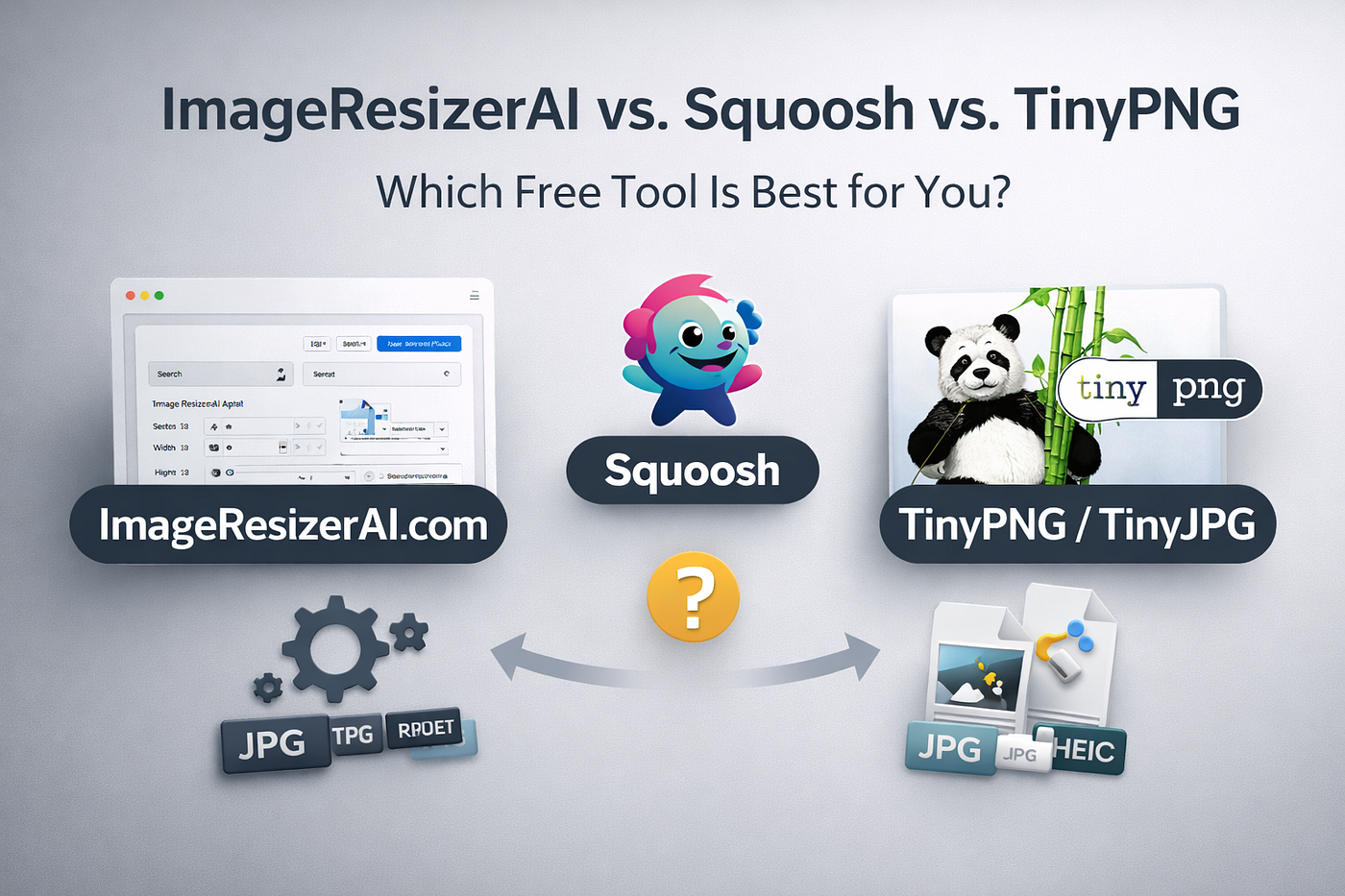
Through regular use, three tools kept coming up again and again: **ImageResizerAI.com, Squoosh, and TinyPNG**. Each of them is free and browser-based, but they serve slightly different purposes. After using all three in real-world situations, here’s what I’ve learned.
My Experience with ImageResizerAI.com
When I needed a single tool that could handle multiple tasks — resizing, compressing, converting formats, and processing images in bulk — ImageResizerAI.com proved to be the most convenient option. I often use it when working with clients who need images adjusted to specific file sizes, especially for government or corporate portals that have strict upload limits.
What Stood Out
- Resize by Dimensions: Helpful for preparing images for websites and social media while maintaining the correct aspect ratio.
- Compress to Exact KB: A lifesaver when dealing with forms that require images under a specific size, such as 20KB or 50KB.
- Batch Processing: Saves a significant amount of time when handling multiple product or portfolio images.
- HEIC to JPG Conversion: Particularly useful when transferring photos from an iPhone to a Windows system.
- Privacy-Focused: Since the processing happens in the browser, there’s no concern about uploading sensitive images.
- No Sign-Up Required: Quick and easy to use without any barriers.
Best For
Professionals, students, marketers, and business owners looking for an all-in-one solution for everyday image optimization.
My Experience with Squoosh
Whenever I needed more control over compression settings, especially while optimizing images for website performance, Squoosh became my go-to tool. Developed by Google, it offers a level of precision that’s ideal for users who like to fine-tune their results.
What I Liked
- Wide Format Support: Includes modern formats such as AVIF, WebP, and JPEG XL.
- Real-Time Preview: The side-by-side comparison makes it easy to judge quality before downloading.
- Manual Compression Controls: Great for experimenting with different quality levels.
- Client-Side Processing: Ensures privacy and fast performance.
Limitations
- No Exact KB Targeting: Reaching a specific file size requires trial and error.
- Single Image Processing: Not ideal when working with large batches of images.
Best For
Developers and designers who want precise control over image quality and compression settings.
My Experience with TinyPNG / TinyJPG
For projects involving PNG-heavy assets like logos and UI elements, TinyPNG has consistently delivered reliable results. Its simplicity makes it a convenient choice when I need quick compression without adjusting multiple settings.
What I Appreciated
- Excellent PNG Compression: Particularly effective for icons and interface graphics.
- Batch Uploads: Allows compression of up to 20 images at a time for free.
- Simple Interface: Easy to use with minimal effort.
- Good JPG Support: Suitable for general image compression.
Considerations
- Server-Side Processing: Images are uploaded to Tinify’s servers, which may not be ideal for privacy-sensitive projects.
- No HEIC Conversion: Requires an additional tool for iPhone photos.
- No Exact KB Resizing: Not suitable for strict file size requirements.
Best For
Developers and designers optimizing static website assets.
Which Tool Should You Use?
Based on my day-to-day experience, the right tool depends on what you’re trying to accomplish:

Final Thoughts
All three tools — ImageResizerAI.com, Squoosh, and TinyPNG — are reliable and serve important purposes. In my experience, ImageResizerAI.com stands out for everyday tasks because it combines resizing, compression, format conversion, and batch processing in one place. Squoosh excels when precise control is needed, while TinyPNG remains a strong choice for optimizing PNG assets.
Understanding the strengths of each tool can save time, streamline your workflow, and improve the quality of your digital content. Once you start paying attention to image optimization, it quickly becomes a habit that enhances efficiency in any professional setting.
메타데이터
- post_id
- 3c1a6473b71f
- slug
- imageresizerai-vs-squoosh-vs-tinypng-which-free-tool-is-best-for-you-3c1a6473b71f
- url
- https://medium.com/@imageresizerai/imageresizerai-vs-squoosh-vs-tinypng-which-free-tool-is-best-for-you-3c1a6473b71f
- canonical_url
- https://medium.com/@imageresizerai/imageresizerai-vs-squoosh-vs-tinypng-which-free-tool-is-best-for-you-3c1a6473b71f
- author_url
- https://medium.com/@imageresizerai
- status
- ok
- fetched_at
- 2026-06-09 15:37:30