When Activity Becomes the Problem
Why busy systems often lose direction
When Activity Becomes the Problem
Why busy systems often lose direction

Activity is useful when it reveals. It becomes dangerous when it conceals.
Sometimes activity is not progress.
It is avoidance with momentum.
That is difficult to see from the inside, because activity feels useful.
It creates movement. It creates evidence. It gives you something to point to at the end of the day.
You posted. You replied. You improved something. You launched another idea. You added another task. You kept going.
So it feels like the system is working.
But a system can be active and still be unstable.
A person can be busy and still be directionless. A team can produce more and still understand less. A business can move faster and still lose its shape.
That is where activity becomes dangerous.
Not because work is bad.
But because movement can hide structural weakness surprisingly well.
In the previous part, we looked at the difference between effort and signal.
Not all work creates direction. Not all output creates learning. Not all activity reveals what should happen next.
That was the first layer.
But there is a deeper problem.
Once people cannot clearly read signal, they often compensate with more activity.
They don’t slow down to interpret.
They speed up to escape the discomfort of not knowing.
More posting. More building. More testing. More optimizing. More starting. More fixing.
And because effort feels responsible, it rarely looks like avoidance.
But often, that is exactly what it is.
A way to avoid the harder question:
What is actually unstable here?
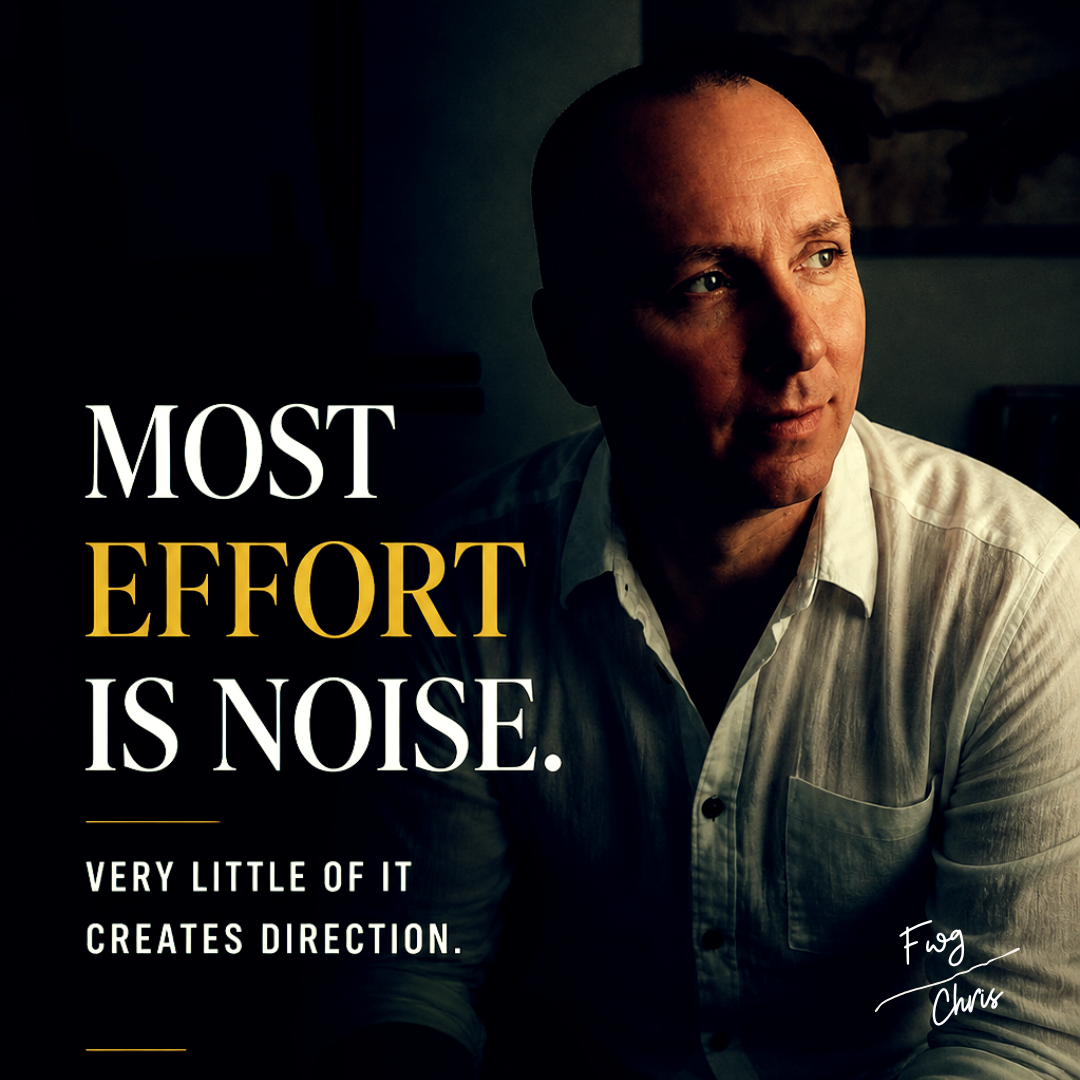
Most people do not increase activity because they have found direction.
They increase activity because they have lost it.
This is one of the quiet patterns in system building.
When clarity is missing, movement becomes emotionally useful.
It reduces anxiety. It creates a sense of control. It makes uncertainty feel productive. It turns confusion into a to-do list.
That is why “doing more” can feel so convincing.
It gives the mind relief before the system has actually improved.
But relief is not resolution.
A full calendar does not mean the system is healthy. A long task list does not mean the direction is clear. A high output week does not mean the work is compounding.
Sometimes it only means the instability has become more active.
The illusion starts when the system looks alive
There is motion everywhere.
New ideas. New experiments. New content. New offers. New improvements. New tools. New priorities.
But underneath, the same questions remain unanswered.
What is actually working? What should be repeated? What should be removed? What is creating signal? What is only creating noise?
If those questions stay unclear, activity does not solve the problem.
It covers it.
And the more active the system becomes, the harder it is to see what is actually happening.
Because noise also scales.
Not just output. Not just opportunity. Noise.
A busy system can still be directionless
This is true for people, teams, businesses, and creative work.
You can be publishing every day and still not know what your audience understands.
You can be improving your workflow and still not know what outcome it serves.
You can be adding tools and still not know what decision they are supposed to support.
You can be optimizing small details while avoiding the central constraint.
You can be moving constantly while the structure underneath remains weak.
That is the trap.
Activity can make a weak system feel strong.
For a while.
Until complexity increases. Until energy drops. Until the number of moving parts becomes too high. Until the system starts requiring constant force just to stay alive.
That is usually when people think they need more discipline.
But the problem is not discipline.
The problem is load.
The system isn’t collapsing from lack of effort. It’s collapsing under too much unfiltered movement.
This matters because the solution changes.
If the problem is lack of effort, the answer is simple:
Do more.
But if the problem is structural overload, doing more makes the system worse.
More projects create more switching. More platforms create more fragmentation. More ideas create more unfinished loops. More optimization creates more decision fatigue. More output creates more data you cannot interpret.
At some point, the system is not failing because it is empty.
It is failing because it is overcrowded.
Too many inputs. Too many directions. Too many unresolved decisions. Too many things trying to become important at the same time.
That kind of system does not need motivation.
It needs subtraction.
This is one of the hardest shifts to make
Because subtraction feels irresponsible when you are anxious.
Doing less can feel like falling behind. Removing things can feel like losing opportunity. Narrowing focus can feel like becoming smaller.
So people keep adding.
Another channel. Another offer. Another strategy. Another improvement. Another piece of content. Another system on top of the system.
But complexity is not the same as depth.
And more movement is not the same as more maturity.
A stronger system is not always the one that does the most.
Often, it is the one that knows what not to carry.
AI makes this problem more visible — and more dangerous
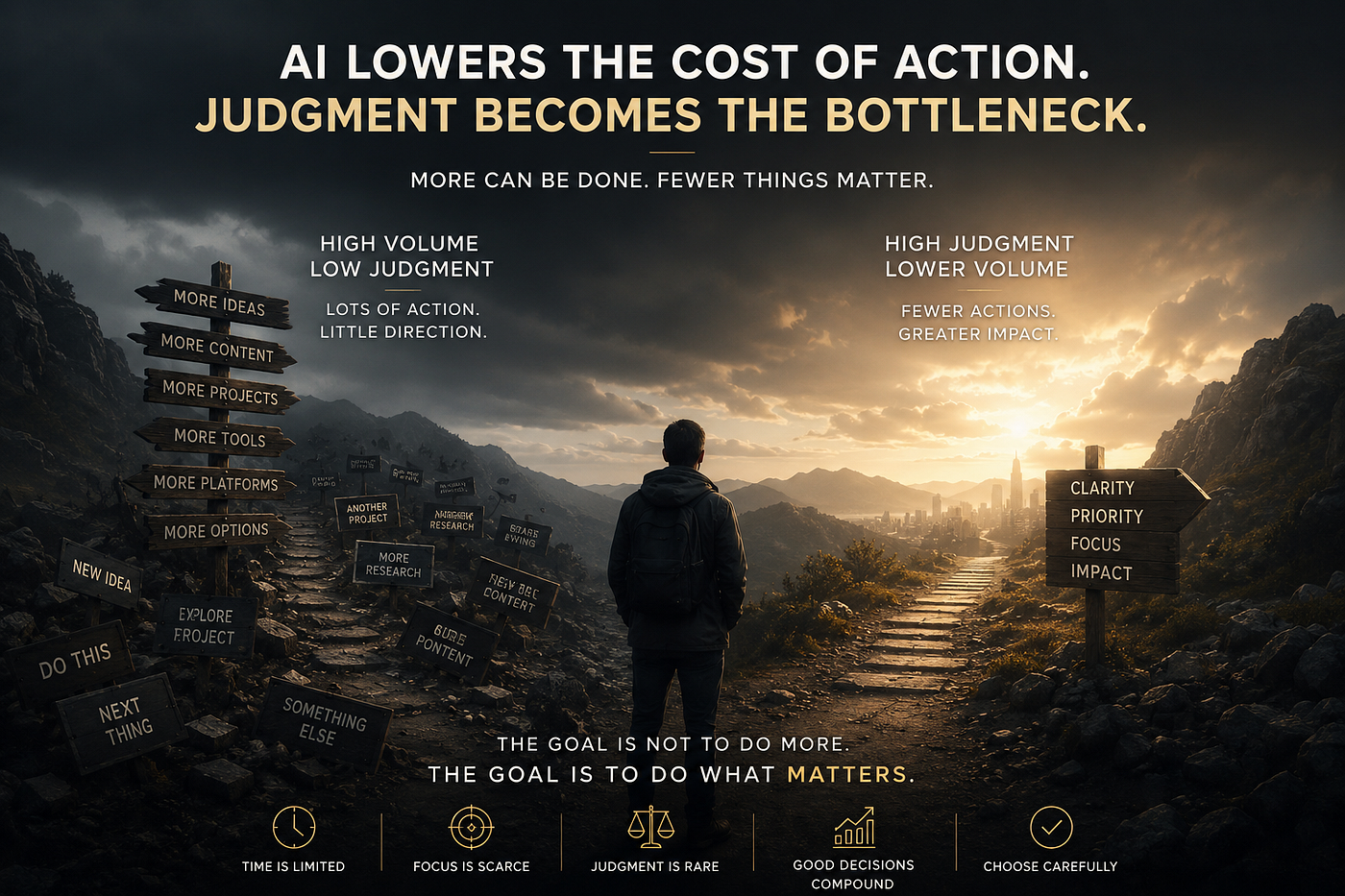
Before AI, output had natural limits.
Time limited you. Skill limited you. Energy limited you. Production cost limited you.
Those limits were frustrating, but they also created friction.
And sometimes friction forced judgment.
You had to choose what mattered because you could not do everything.
Now AI removes much of that friction.
You can generate more ideas. More drafts. More variations. More content. More experiments. More workflows.
That can be useful.
But only if the system knows how to filter.
Without judgment, AI does not create clarity.
It creates volume.
And volume inside an unstable system does not become leverage.
It becomes noise at scale.
This is why AI can make weak systems feel productive while making them harder to understand.
It gives the system more movement before the system has more direction.
That is not acceleration.
That is amplification.
And amplification is only useful when the signal is clear.
The question is not whether activity matters
It does.
Nothing becomes visible without action. No signal appears without contact with reality. No system improves without movement.
The problem begins when activity becomes the default response to every form of uncertainty.
Unclear direction?
Do more.
Weak signal?
Do more.
Scattered focus?
Do more.
Noisy results?
Do more.
Too many open loops?
Do more.
But doing more cannot fix a system that has lost the ability to filter.
At that point, the work is not to increase movement.
The work is to reduce unnecessary movement.
This is the shift of Part 7
From:
How can I do more?
To:
What movement is no longer helping?
From:
What else should I add?
To:
What is making the system harder to read?
From:
How do I stay active?
To:
What should stop so signal can become visible?
That is a different kind of productivity.
Quieter. Sharper. Less reactive.
It does not chase the feeling of progress.
It protects the conditions that make real progress visible.
A calm system is not a slow system
This is important.
Calm does not mean passive. Calm does not mean small. Calm does not mean inactive.
A calm system can move quickly.
But it does not move randomly.
It has filters. It has constraints. It has a way to decide what gets attention and what does not.
It does not treat every idea as a priority. It does not treat every reaction as signal. It does not treat every opportunity as direction.
That is what makes it calm.
Not the absence of movement.
The presence of selection.
So the practical work is simple, but not easy
Look at the system honestly.
Where is activity replacing clarity?
Where are you doing more because you are unsure what matters?
Where has output become a way to avoid interpretation?
Where are too many things moving at once?
Where is the system producing work faster than it can understand the work?
Those questions reveal the real pressure points.
Not the tasks.
The load.
Because often the next level is not created by adding more.
It is created by removing what makes the system unreadable.
Part 6 asked a necessary question:
What is actually producing signal?
Part 7 asks the next one:
What activity is preventing signal from being seen?
That is where the series now turns.
Because once activity becomes the problem, simplicity becomes the next solution.
This leads directly into Part 8:
Simple Systems Create Consistent Results
Not because simple systems are less ambitious.
But because simple systems are easier to read, easier to repeat, and easier to trust.
And when a system becomes easier to read, it becomes easier to improve.
Most systems do not need more movement.
They need less unnecessary movement.
They need fewer open loops. Fewer false priorities. Fewer signals buried under noise. Fewer actions performed only to reduce anxiety.
Activity is useful when it reveals.
It becomes dangerous when it conceals.
Strong systems are not defined by how much they can produce.
They are defined by how much unnecessary movement they can remove.
—
If this resonates:
Start here: → View the full Season 3 hub
Previous: → *Not All Effort Produces Signal*
Next: → Simple Systems Create Consistent Results
This series is not about more output.
It is about building systems that stay readable under pressure.
Calm systems don’t chase growth. They make growth inevitable.
— FreedomWayGlobal

↓ Continue the system
If this resonated, don’t stop here.
This is part of a bigger system, not just an idea.
→ Start here: build your first calm system ***https://start.freedomwayglobal.com***
Start simple. Build calm. Let the system carry the work.
— FreedomWayGlobal
메타데이터
- post_id
- 3c2e6a8d7ee7
- slug
- when-activity-becomes-the-problem-3c2e6a8d7ee7
- url
- https://medium.com/freedomwayglobal/when-activity-becomes-the-problem-3c2e6a8d7ee7
- canonical_url
- https://medium.com/freedomwayglobal/when-activity-becomes-the-problem-3c2e6a8d7ee7
- author_url
- https://medium.com/@freedomwayglobal1978
- status
- ok
- fetched_at
- 2026-06-13 07:35:29