Laozi, Zhuangzi, and the Question of Metaphysics: A Naturalistic Reading of Early Daoism
Recently, I read an insightful article by Nicole Bea Pastoukoff that summarizes the work of the contemporary philosopher Ge Ling Shang…
Laozi, Zhuangzi, and the Question of Metaphysics: A Naturalistic Reading of Early Daoism

Recently, I read an insightful article by Nicole Bea Pastoukoff that summarizes the work of the contemporary philosopher Ge Ling Shang, particularly his book Liberation as Affirmation. Shang is one of the leading contemporary interpreters of Zhuangzi, and in this work he argues that Zhuangzi transformed Laozi’s concept of wu (無, Non-being) into a thoroughly anti-metaphysical philosophy. According to his interpretation, Laozi still understood Dao as the metaphysical origin of reality, whereas Zhuangzi dismantled every attempt to treat Dao — or even Non-being itself — as an ultimate metaphysical ground.
There is much in Shang’s work that I admire. His discussion of Zhuangzi’s concept of wuwu (無無), his critique of conceptual reification, and his comparison with Nagarjuna’s philosophy of emptiness are all illuminating. Nevertheless, I believe the contrast he draws between Laozi and Zhuangzi is considerably sharper than the texts themselves warrant.
My own reading is that both Laozi and Zhuangzi belong to the same broad philosophical movement: the naturalistic and anti-essentialist current of the Axial Age. Rather than standing in opposition, they represent different stages in the development of a shared philosophical vision.
The Axial Age and the Rise of Naturalism
One of the defining characteristics of the Axial Age was a gradual movement away from mythological and religious explanations of the world toward philosophical and naturalistic inquiry.
In Greece, thinkers increasingly sought natural rather than mythological explanations for the cosmos. In India, the Buddha explained suffering through Dependent Origination rather than through divine intervention. In China, the Dao De Jing and the Zhuangzi likewise shifted attention away from Heaven as a supernatural ruler and toward the spontaneous patterns of nature itself.
This does not mean these traditions were materialistic in the modern sense. Rather, they sought to understand reality without appealing to creator gods, supernatural agencies, or revealed authority. Their concern was with the way things naturally arise, interact, and transform.
Seen in this historical context, both Laozi and Zhuangzi belong to the same intellectual revolution.
Is Laozi Really a Metaphysician?
The central disagreement concerns Laozi himself.
Shang argues that Laozi still treats Dao as the metaphysical origin of all things, while Zhuangzi later rejects this conception. Certainly, the Dao De Jing contains cosmological language. It speaks of Dao as the “Mother of the ten thousand things” and says that “Dao gives birth to One.”
But cosmological language does not necessarily imply metaphysics.
Ancient philosophical texts often employ cosmological imagery to illuminate human experience rather than to provide a literal theory of cosmic creation. To read every cosmological metaphor as an ontological doctrine risks imposing categories that belong more to later philosophical systems than to the poetic style of the Dao De Jing itself.
More importantly, Laozi repeatedly undermines any substantialist reading.
Chapter 2 famously declares:
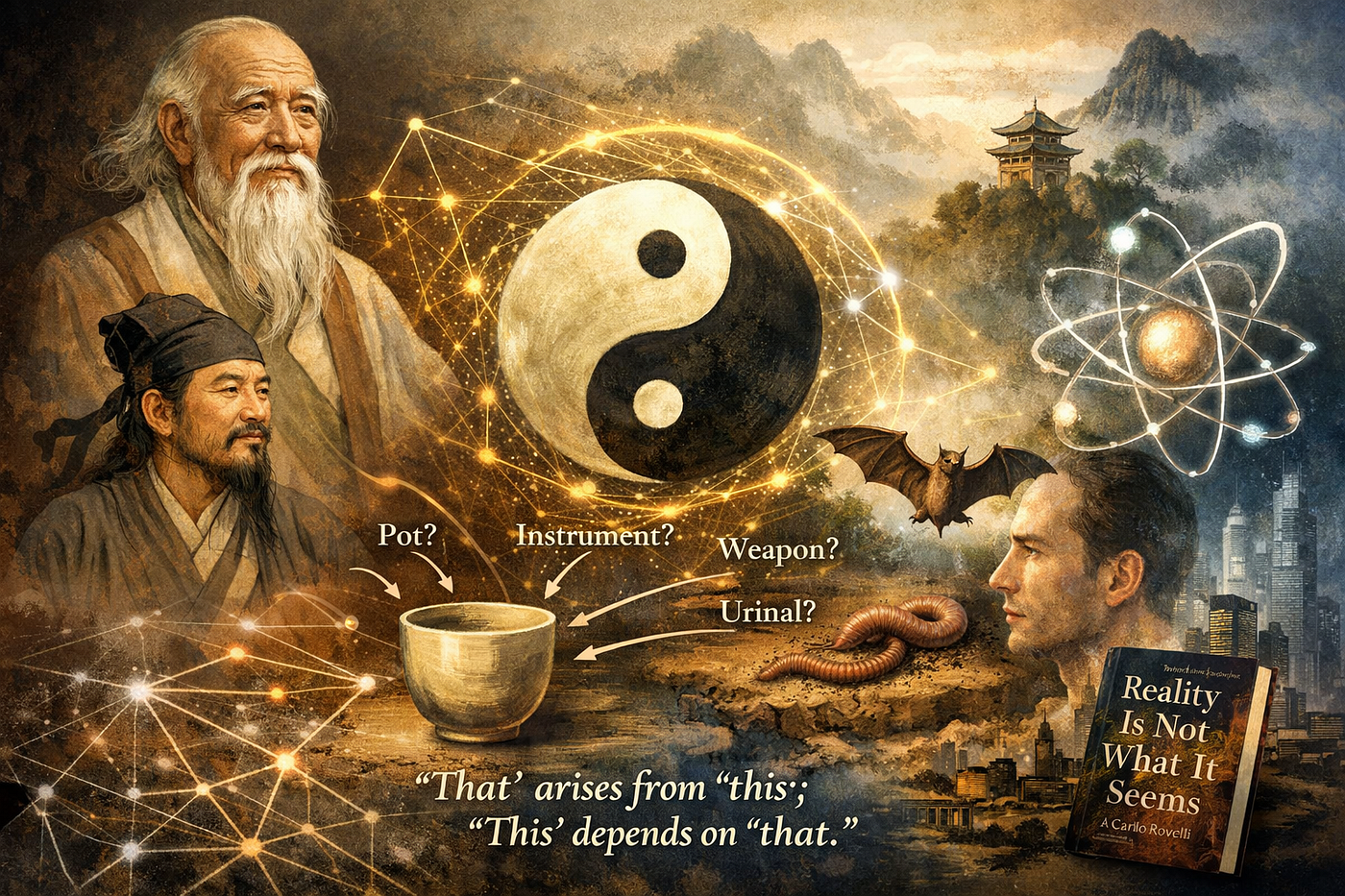
有無相生 Being and non-being give rise to one another.
This single sentence is profoundly significant.
A metaphysical system generally seeks an ultimate foundation — one principle from which everything else derives. Laozi does precisely the opposite. Being does not arise independently from Non-being, nor does Non-being exist independently from Being. The two arise together. Each depends upon the other for its very meaning.
The same logic governs Yin and Yang, long and short, high and low, difficult and easy, before and after.
Reality is fundamentally relational. Nothing possesses independent or intrinsic existence. That is not metaphysical substantialism. It is anti-essentialism.
Wang Bi and the Metaphysical Turn
Part of the confusion arises because later interpreters developed Laozi’s thought in new directions.
Among the most influential was Wang Bi.
Wang Bi’s philosophy of gui wu (貴無, “valuing Non-being”) transformed wu into the ontological ground of all beings. His interpretation became enormously influential throughout the Xuanxue tradition.
But Wang Bi should not simply be identified with Laozi. His work is both a commentary and a creative philosophical reconstruction. Like many great commentators throughout history, he interpreted the Dao De Jing through the philosophical concerns of his own age.
It is therefore important to distinguish the poetic insights of the Dao De Jing from later metaphysical interpretations. Ironically, the philosophical target of Zhuangzi’s criticism may lie closer to Wang Bi’s ontology than to Laozi’s own thought.
Cosmology Does Not Necessarily Mean Metaphysics
A further point follows naturally from this discussion.
The cosmological language of the Dao De Jing need not be read literally as a theory of cosmic origins.
When Chapter 42 says,
“Dao gives birth to One. One gives birth to Two. Two gives birth to Three. Three gives birth to the ten thousand things.”
many readers assume it describes the creation of the universe.
But another interpretation is possible. The passage may describe the evolution of human cognition rather than the birth of the cosmos.
Human experience begins as an undivided field. Our minds naturally distinguish, categorize, and conceptualize. One becomes Two. Two becomes the countless distinctions that constitute the “ten thousand things” of ordinary experience.
In this sense, the text is describing differentiation rather than creation.
An analogy may help. Consider numbers. Did early human beings discover the number “one” somewhere in nature, or did they invent numerical concepts as symbolic tools for organizing experience? Philosophers continue to debate this question. Likewise, “One” in the Dao De Jing need not refer to a metaphysical entity. It may symbolize the first conceptual differentiation through which the human mind begins to organize reality.
Read in this way, the Dao De Jing becomes less a work of speculative metaphysics than a profound reflection on perception, language, and human cognition.
Wuwu and the Completion of Laozi’s Insight
One of Shang’s most interesting contributions is his discussion of wuwu (無無), “No-Nonbeing.” He argues that Zhuangzi refuses to allow even Non-being to become a metaphysical absolute.
I find this interpretation extremely persuasive. Where I differ is in seeing this not as a rejection of Laozi but as the natural continuation of Laozi’s own dialectic.
If Being and Non-being already mutually arise, then neither possesses independent reality. Zhuangzi simply carries this insight one step further.
Even wu must not be reified.
In this sense, wuwu is less a philosophical revolution than a safeguard against misunderstanding Laozi himself.
The issue is not whether Being or Non-being is ultimately real. The issue is our tendency to transform useful concepts into independently existing realities.
Laozi, Zhuangzi, Nagarjuna, and Dependent Origination
This also explains why comparisons with Nagarjuna are so fruitful. Nagarjuna’s doctrine of śūnyatā (emptiness) is frequently misunderstood as replacing Being with Emptiness.
But Nagarjuna explicitly rejects such a reading. Emptiness itself is empty. To reify emptiness is to misunderstand it.
Likewise, Zhuangzi refuses to transform Non-being into another ultimate substance.
The common target is conceptual reification.
The parallels with early Buddhism extend even further.
The Buddha’s teaching of Dependent Origination holds that phenomena arise only through causes, conditions, and relationships. Nothing exists independently. Nothing possesses intrinsic essence.
Laozi’s statement that “Being and non-being give rise to one another” expresses a remarkably similar relational insight.
Although these traditions developed independently and should never be conflated, they converge in rejecting substantialism and affirming relationality.
Laozi’s relational complementarity, Zhuangzi’s wuwu, the Buddha’s Dependent Origination, and Nagarjuna’s emptiness all point in the same philosophical direction: reality is constituted by relationships rather than independent substances.
Dao as Natural Process
The Dao De Jing can therefore be read as a philosophy of process rather than substance.
Dao is not a creator God. It is not an invisible substance. It is not a transcendent being standing behind the world.
Rather, Dao names the spontaneous (ziran), self-organizing processes of nature itself.
This interpretation fits remarkably well within the broader ethos of the Axial Age. Like the Buddha, Laozi turns our attention away from supernatural explanations and toward understanding the natural order of things.
Zhuangzi deepens this project by exposing the subtle ways in which our conceptual thinking obscures that natural order.
Continuity Rather Than Rupture
For these reasons, I believe the discontinuity between Laozi and Zhuangzi is often overstated.
Both philosophers reject rigid conceptual frameworks.
Both emphasize spontaneity (ziran).
Both criticize attachment to fixed viewpoints.
Both understand reality in relational rather than substantial terms.
Both can be understood as naturalists.
Zhuangzi undoubtedly radicalizes these themes, pushing them to their logical conclusion through the concept of wuwu. But this is better understood as the maturation of Laozi’s philosophy than as its rejection.
The real philosophical divide may therefore lie not between Laozi and Zhuangzi, but between both of them and later metaphysical interpretations that transformed Dao into an ontological absolute.
Seen in this light, Laozi and Zhuangzi stand together as two of the greatest naturalistic philosophers of the Axial Age. Their common project was not to discover a hidden substance behind reality, but to free us from the conceptual habits that prevent us from seeing reality as the dynamic, relational, and self-organizing process that it already is.
Shang’s work remains a valuable contribution because it reminds us of Zhuangzi’s uncompromising critique of conceptual reification. My only reservation is that this critique need not be understood as a rejection of Laozi. On the contrary, it may represent the fullest flowering of philosophical seeds that Laozi had already planted centuries earlier.
메타데이터
- post_id
- 3c3f85b72fef
- slug
- laozi-zhuangzi-and-the-question-of-metaphysics-a-naturalistic-reading-of-early-daoism-3c3f85b72fef
- url
- https://medium.com/@kleong54/laozi-zhuangzi-and-the-question-of-metaphysics-a-naturalistic-reading-of-early-daoism-3c3f85b72fef
- canonical_url
- https://medium.com/@kleong54/laozi-zhuangzi-and-the-question-of-metaphysics-a-naturalistic-reading-of-early-daoism-3c3f85b72fef
- author_url
- https://medium.com/@kleong54
- status
- ok
- fetched_at
- 2026-07-15 20:09:32