Without hashing, the digital world would be an open door for cybercriminals.
Every time you log into a website, your password is never actually stored anywhere on the server, at least, not in the form you typed it…
Without hashing, the digital world would be an open door for cybercriminals.
Every time you log into a website, your password is never actually stored anywhere on the server, at least, not in the form you typed it. Every time you download a large file, there’s a way to confirm that not a single byte was altered or corrupted in transit. Every time your data moves through a blockchain, its history is provably tamper evident.
Hashing
Hashing is the process of taking an input of any size, a single word, a password, an image, or an entire multi-gigabyte file and running it through a mathematical function called a hash function. This function converts the input into a fixed-length string of characters known as a hash value, hash code, or digest. The key idea is that no matter how large or small the original input is, the resulting hash is always the same length.
For example, hashing the word “hello” and hashing an entire novel with the SHA-256 algorithm will both produce a 256-bit (64 hexadecimal character)output.
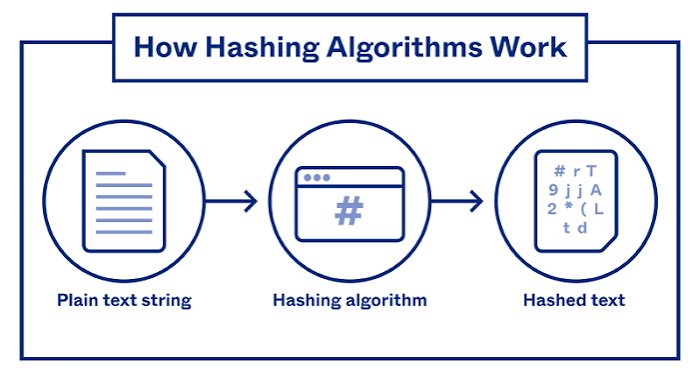
Unlike encryption, hashing is a one-way process. Encrypted data can be decrypted back to its original form using a key. Hashed data cannot be reversed back into its original input, there is no “unhash” operation. This one-directional nature is precisely what makes hashing so valuable for security. Hash is therefore irreversible.
Core Concepts and Properties of a Hash Function
Not every function that shrinks or transforms data qualifies as a good hash function. Cryptographically secure hash functions are built around six defining properties:
l. Deterministic: The same input will always, every single time, produce the exact same hash output. “password123” hashed today produces the identical digest as it will next year.
2. Fixed Output Size: Regardless of input length, one character or one terabyte, the digest length stays constant (e.g. always 256 bits for SHA-256). 3. Fast to Compute: Generating a hash from an input should be computationally quick and efficient, even for large files.
4. Pre-image Resistance (One-Way): Given only a hash output, it should be computationally infeasible to figure out what input produced it. This is the property that makes hashing irreversible.
5. Avalanche Effect: A tiny change to the input even flipping a single character’s case should produce a drastically different, completely unrecognizable output.
6. Collision Resistance: It should be extremely improbable for two different inputs to ever produce the same hash output. When this does happen, it’s called a hash collision, and it undermines trust in the function
Hashing for Fast Lookups
Beyond security, hashing is also a foundational tool in everyday programming. Hash tables use a hash function to convert a key (like a name or word) directly into the exact memory location where its value is stored. This means looking up data doesn’t require scanning through a list item by item, the hash function points straight to the right location, giving average-case constant time lookups, written as O(1).

Common Hashing Algorithms
Over the years, several hashing algorithms have been developed to solve different security and data integrity challenges. Some algorithms were designed for speed, while others focus on providing stronger cryptographic security. Today, algorithms like SHA-256, bcrypt, and Argon2 are widely trusted, whereas older algorithms such as MD5 and SHA-1 are considered outdated for security-sensitive applications.
MD5 (Message Digest 5)
MD5 generates a 128-bit hash value and was once one of the most widely used hashing algorithms. Due to its speed, it is still useful for file integrity checks, checksum verification, and duplicate file detection. However, researchers have demonstrated collision attacks against MD5, making it unsuitable for storing passwords or protecting sensitive information.
SHA-1 (Secure Hash Algorithm 1)
SHA-1 produces a 160-bit hash and was introduced as a more secure replacement for MD5. It was widely used in digital certificates, digital signatures, and is still used internally by Git to identify objects and commits. Despite these historical uses, practical collision attacks have made SHA-1 insecure for modern cryptographic applications.
SHA-256 (Secure Hash Algorithm 256)
SHA-256 is part of the SHA-2 family and produces a 256-bit hash value. It is currently one of the most trusted and widely adopted hashing algorithms because it provides strong security while remaining efficient. SHA-256 is used in blockchain technology, SSL/TLS certificates, digital signatures, API authentication, and data integrity verification. It is the preferred choice whenever secure, general-purpose hashing is required.
SHA-3
SHA-3 is the newest member of the Secure Hash Algorithm family. Unlike SHA-2, it is built on a completely different cryptographic design called Keccak, making it resistant to different classes of attacks. SHA-3 is increasingly being adopted in government systems, modern cryptographic applications, and security-critical software.
bcrypt
Unlike MD5 and SHA algorithms, bcrypt is specifically designed for password hashing rather than general-purpose hashing. It automatically generates a unique salt for every password and intentionally performs hashing slowly, making brute-force and dictionary attacks significantly more difficult. As a result, bcrypt has become one of the most popular algorithms for storing user passwords securely.
scrypt
scrypt is another password hashing algorithm that improves security by requiring a large amount of memory during computation. This memory-hard design makes attacks using GPUs and specialized hardware much more expensive. It is commonly used in authentication systems, password databases, and cryptocurrency applications.
Argon2
Argon2 is considered the modern standard for password hashing and was the winner of the Password Hashing Competition (PHC). It offers configurable memory usage, processing time, and parallelism, making it highly resistant to modern cracking techniques. Because of its excellent balance of security and flexibility, OWASP recommends Argon2 as the best choice for securely storing passwords in new applications.
What Happens Without Hashing
In today’s technology-driven world, cyberattacks and data breaches have become increasingly common, making data security a top priority for every organization. If sensitive information, especially user passwords is stored in plain text instead of being hashed, a single database breach can expose every user’s credentials instantly. Hackers do not need to crack or decrypt anything, they can simply read the passwords and use them to access accounts. Since many people reuse the same password across multiple platforms, attackers often launch credential stuffing attacks, allowing them to gain unauthorized access to email accounts, social media profiles, online banking, and other services using the same stolen credentials.
The risks are not limited to external hackers. Storing plaintext passwords also means that anyone with database access, such as employees, contractors, or administrators, can view users’ actual passwords, increasing the chances of insider misuse or accidental data exposure. Additionally, without hashing, systems cannot easily verify whether files or transmitted data have been altered, making it easier for attackers to tamper with information without being detected. This weak security approach can also lead to violations of data protection regulations such as GDPR and PCI-DSS, resulting in legal penalties, financial losses, and a significant loss of customer trust.
Hashing addresses these challenges by transforming sensitive data into a fixed-length, irreversible value before it is stored. Even if attackers manage to steal a hashed database, they cannot directly read the original passwords, making unauthorized access significantly more difficult. This is why secure hashing algorithms, combined with techniques like salting, have become a fundamental requirement in modern cybersecurity and are essential for protecting user data against today’s evolving cyber threats.
Hashing is one of the quiet, foundational tools that modern computing depends on. It doesn’t encrypt data so it can be unlocked later it fingerprints data so its authenticity and integrity can be verified without ever exposing the original content. From protecting your password the moment you sign up for a new account, to keeping blockchain transactions tamper-evident, to helping software look up massive datasets in an instant, hashing quietly secures and organizes far more of daily digital life than most people realize
메타데이터
- post_id
- 3c5e606d982a
- slug
- without-hashing-the-digital-world-would-be-an-open-door-for-cybercriminals-3c5e606d982a
- url
- https://medium.com/@temporyemail123321/without-hashing-the-digital-world-would-be-an-open-door-for-cybercriminals-3c5e606d982a
- canonical_url
- https://medium.com/@temporyemail123321/without-hashing-the-digital-world-would-be-an-open-door-for-cybercriminals-3c5e606d982a
- author_url
- https://medium.com/@temporyemail123321
- status
- ok
- fetched_at
- 2026-07-25 06:43:36



