Welcome To El Niño
A warm ocean meets a world already breaking on four fronts at once — and the next two years are where they collide
Welcome To El Niño
A warm ocean meets a world already breaking on four fronts at once — and the next two years are where they collide
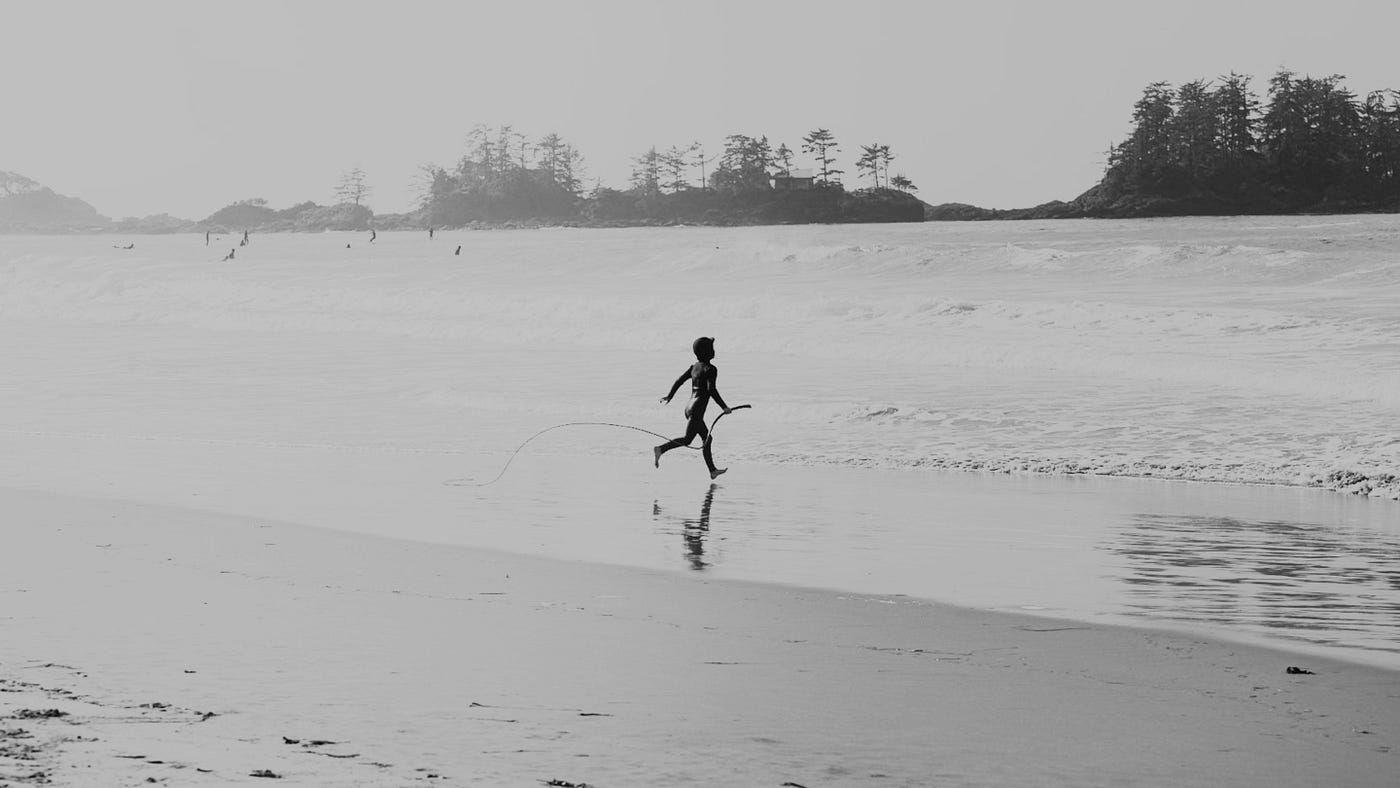
Welcome To El Niño (photo by author)
Every few years, a stretch of the Pacific Ocean the size of a continent runs a fever. The warm water changes where the rain falls, and because the whole sky is connected, that change travels: a flood in Peru, a drought in Australia, a failed harvest in many countries on different corners of the map.
Welcome to El Niño.
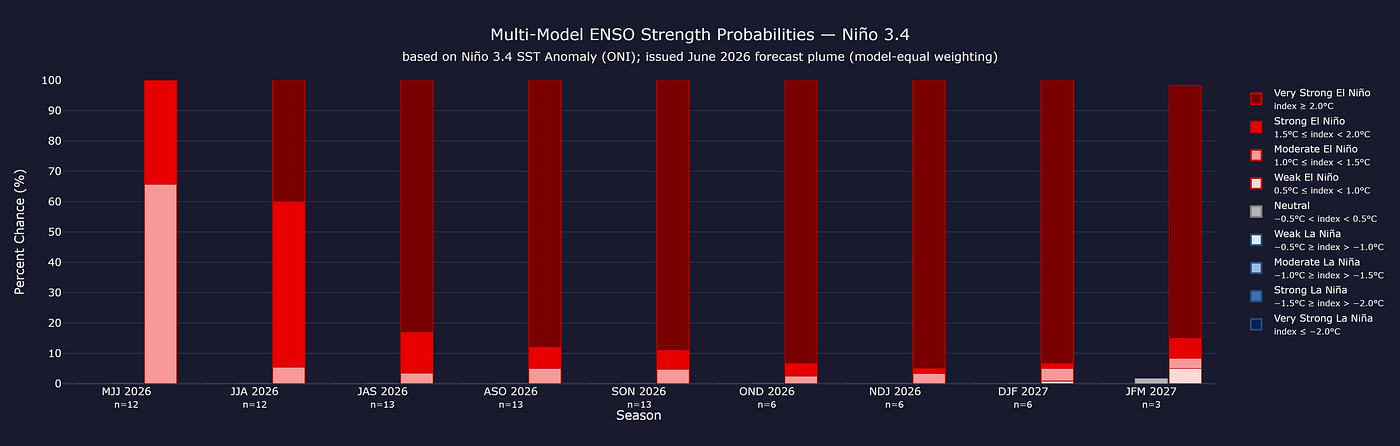
El Niño is here (Source)
And this one looks massive, to the point it could become one of the strongest ever measured. The last time the Pacific ran this hot, back in 1877, crops failed across India, China, and Brazil at the same time, and tens of millions of people starved while the ships kept carrying their grain abroad for sale.
I’m not telling you that to scare you. I’m telling you because of how this thing moves.
El Niño doesn’t hit like a storm you can see coming up the street. It warms the ocean first. The warm ocean shifts the wind. The wind bends the rain. The bent rain wrecks or spares a harvest. The harvest sets the price. And the price, finally, reaches your grocery aisle, eight or ten months after the ocean first warmed, by which point almost nobody connects the heat to the bill.
That delay is the whole problem. By the time you feel it, the cause looks like old news.
So I want to walk you through what’s coming while the line between cause and effect is still easy to see. Five things this El Niño sets in motion. The ocean doesn’t create any of them. Each one was already there, wound up tight, and the Pacific is just the thumb that presses down.
1. It All Starts With The Taps
You probably heard the war in Iran explained with words (and excuses) like uranium, sanctions, the clerics, the oil reserves, the strikes that shut down the Strait of Hormuz. All of that happened. None of it explains why the country was already on fire before a single bomb dropped.
Iran had gone five years without enough rain, a drought directly linked to a warming planet. Tehran, a city of ten million, got within weeks of its reservoirs running dry. When rain finally came, the ground was so parched it behaved like concrete, and the water slid off into floods instead of soaking in. People had spent decades being told the wells and the dams would hold. They didn’t. And in December, anger over empty taps put people on the streets in every province of the country. The government answered with bullets and shut off the internet.
[embed]
Thousands died. The bombs came afterward, into a place the drought had already cracked open.
The story sounds like a war that happened to break out in a thirsty country, when what really happened is that the thirst became the war. And Iran isn’t the exception here. It’s the latest entry in the oldest fight humans have.
People have killed each other over water for as long as there have been cities. The first war we have a written record of, around 4,500 years ago, was two Mesopotamian city-states fighting over irrigation canals on the Tigris, in the same stretch of land that’s now Iraq. Today the Pacific Institute keeps a running tally of water conflicts, and the most recent count was the worst on record, with more than 300 fresh incidents of violence tied to water in a single year.
[embed]
Most of them trace back to the same setup: a river that several countries need, and not enough of it to go around. Turkey, Syria, and Iraq have spent sixty years at a low boil over who gets the Tigris and Euphrates, with Turkey’s dams upstream deciding how much reaches the farms downstream. India and Pakistan, two countries with nuclear weapons pointed at each other, have a decades-old treaty splitting the Indus that gets shakier every time the rivers run low. Egypt has called the Nile a matter of life and death since the time of the pharaohs, because almost every drop it drinks falls as rain in another country first.
And that last one just boiled over. In September 2025, Ethiopia switched on the Grand Ethiopian Renaissance Dam, the biggest hydroelectric dam in Africa, built across the Blue Nile, the branch that supplies most of the river’s water. It did this with no agreement in place over how the dam gets run in a dry year. For Ethiopia, a country of 110 million where most people still lack reliable electricity, the dam is a lifeline. For Egypt, which pulls almost all its fresh water from that same river and has no backup, a dam controlled by someone upstream is a hand resting on the country’s throat. Cairo calls it an existential threat. There is still no deal, the talks keep collapsing, and now whoever runs that dam holds the tap for two nations at once.
This is the world a strong El Niño walks into. A planet already laced with rivers that countries are willing to fight over, and a hot Pacific that’s about to make every one of those rivers run lower at the same moment. The drought doesn’t invent the conflict. It loads the gun that history already cocked.
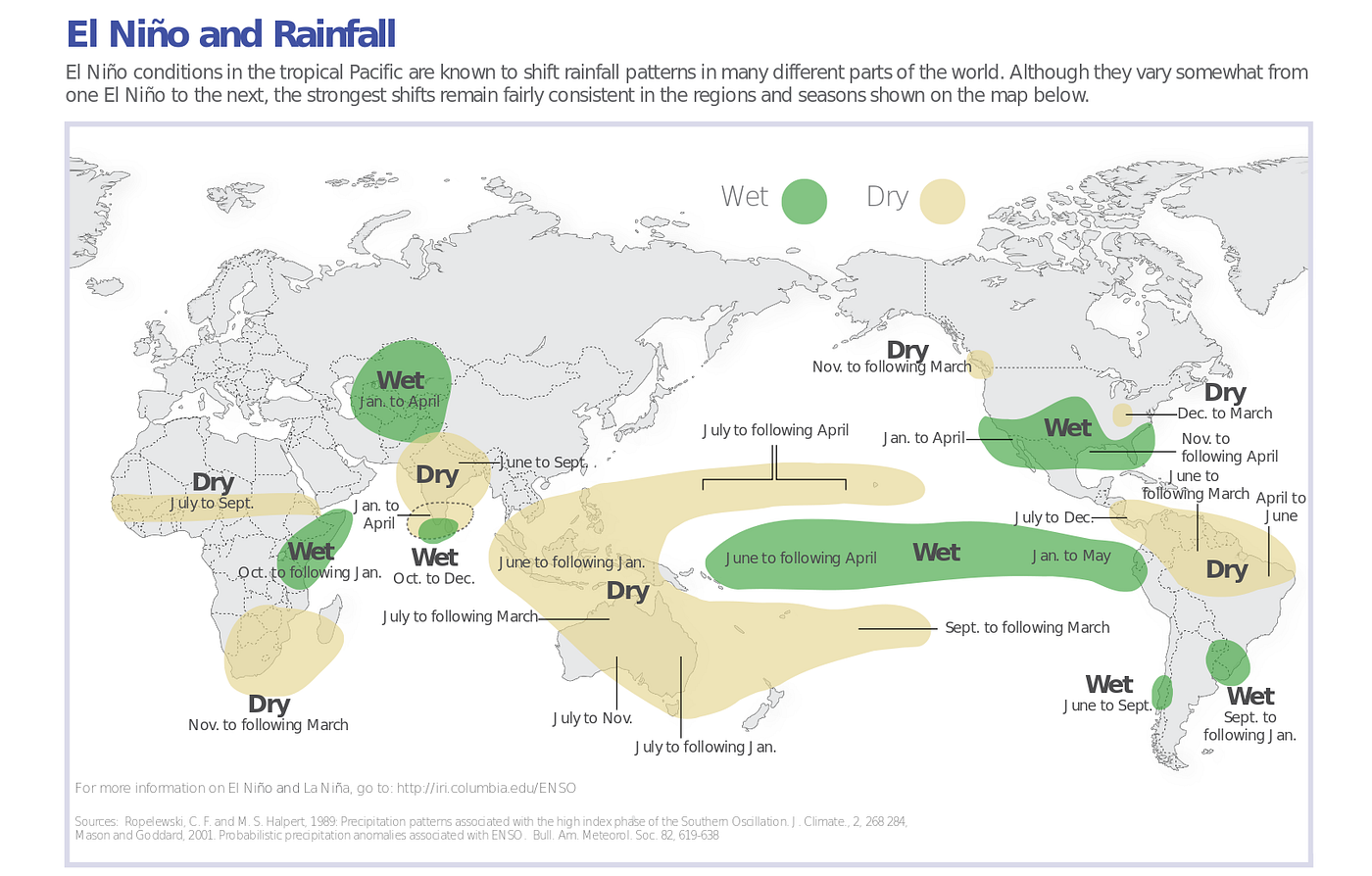
When the Pacific runs this hot, it tends to choke the rain off over Australia, Indonesia, and southern Asia, and it dries out chunks of southern Africa too. The last El Niño, in 2024, wasn’t even a strong one, and it still handed southern Africa its worst hunger in a generation: twenty-seven million people short of food, five countries declaring emergencies. This one is forecast to hit harder, and it arrives on a planet where, before the first crop fails, more than 300 million people already don’t have enough to eat.
Look back at the Horn of Africa, where that Nile fight is already bleeding into another one. Ethiopia and Eritrea, two countries that fought a war into the hundreds of thousands of dead twenty-five years ago, are circling each other again. Ethiopia has no coastline and now calls getting one a matter of survival, even floating the idea of taking an Eritrean port by force. Eritrea has called up its military. The official story is about ports and old grievances, the same way Iran’s was about uranium. Underneath it is a region that has used up every bit of cushion a bad year used to land on, where dead livestock and dried fields and families on the move aren’t a sad sidebar anymore but the actual ground the fight is happening on.
El Niño won’t start these wars. It just takes away the last thing keeping them from starting.
2. The Borders Slam Shut
When the food runs out, people leave. It’s the oldest thing we humans have done, older than money, older than countries.
The World Bank ran the numbers and found that climate pressure alone could push 216 million people to leave their homes by 2050, and that’s just people moving inside their own countries, leaving land that can no longer feed them, heading toward places that only want to keep them out.
El Niño moves that timeline up. A year of dead harvests across the Sahel and southern Africa, Middle East, southern Asia, and Central America doesn’t wait for 2050. It pushes families toward cities, and cities toward borders, in the same year and a half the food prices climb.
And the countries on the other side of those borders have already built their entire politics on a promise to turn them away. This isn’t one country’s quirk. It’s a planet-wide reflex, and the names are easy to list.
In the US, the whole MAGA machine already runs: mass deportations, the wall, the doubled flights of deportees that President Bukele of El Salvador now jails in a mega-prison built for the purpose. Across Latin America the same wave keeps winning, from Bukele to Argentina’s Javier Milei, as the whole region tilts right harder than at any point in two decades.
In Europe, far-right anti-immigration parties are now topping the polls in Germany, France, and Britain at the same time, a first in modern history: Alice Weidel’s AfD, Marine Le Pen’s National Rally, Nigel Farage’s Reform UK, with Giorgia Meloni already governing Italy and Geert Wilders the biggest force in the Netherlands.
On the other side of the world, Australia has spent more than a decade turning asylum boats around at sea and shipping the people who get through to camps on remote Pacific islands, a regime so popular that both major parties now defend it. Europe is studying the Australian model right now, looking to ship its own asylum seekers offshore.
Source
None of these leaders built the walls for the climate migrant. They built it for the last wave of arrivals, the Syrians and Afghans and Central Americans of the last decade. But it’s standing there ready for exactly the surge a hot ocean is about to produce.
The drought makes the migrant. The migrant feeds a politics that was already starving for one. And once that politics is fed, it has every reason to keep the real cause off the table, because pointing at what dried the soil would mean pointing at the fuel its own donors are selling.
That loop scares me more than any single drought. Climate stress doesn’t show up as a clean emergency that brings out the best in people. It shows up as gasoline on whatever was already burning, useful for the people who swear the weather is changing absolutely nothing.
3. Defund The Forecast And Fund The Moon
First: NOAA, the agency that saw this El Niño coming and warned everyone, is the same agency the US government tried to take apart. The budget the administration put forward would have shut down NOAA’s research arm, killed the office that makes weather forecasts more accurate, and switched off climate satellites that are already up in orbit doing their job. NASA’s science budget faced a cut of nearly half, with a White House statement waving most of its Earth-watching work away as “climate scam programs.”
Second: the one big thing that budget protected was the most beautiful distraction in human history, also known as sending astronauts back to the Moon and building a base up there, under an order titled “Ensuring American Space Superiority.”
Source: NOAA
So the government switching off the satellites that tell a farmer when the rain is coming is spending the money instead on a flag planted on a rock where it never rains at all.
Denial only works at a distance. It survives as long as the heat is happening to someone else, somewhere else, on the news. A monster El Niño stacked on top of the hottest stretch humans have ever lived through closes that distance fast. When 2027 turns out to be the hottest year ever recorded, when the grocery bill climbs for the second year running, when the drought finally reaches the supermarket of a country that thought it was safe, calling the whole thing a hoax stops working.
The first thing people do under stress is look for someone closer to blame than an oil executive. But a hungry person is a hard sell for a hoax. And the people who spent years being told the heat was a lie are going to remember, once it’s in their own kitchen, exactly who told them.
4. The Money That Walks Away
Once a place becomes known for failed crops and floods and unrest, the money that used to flow there starts backing away. Think of it like a neighborhood that floods every year: eventually the insurance company either jacks up the price until nobody can afford it or refuses to cover you at all.
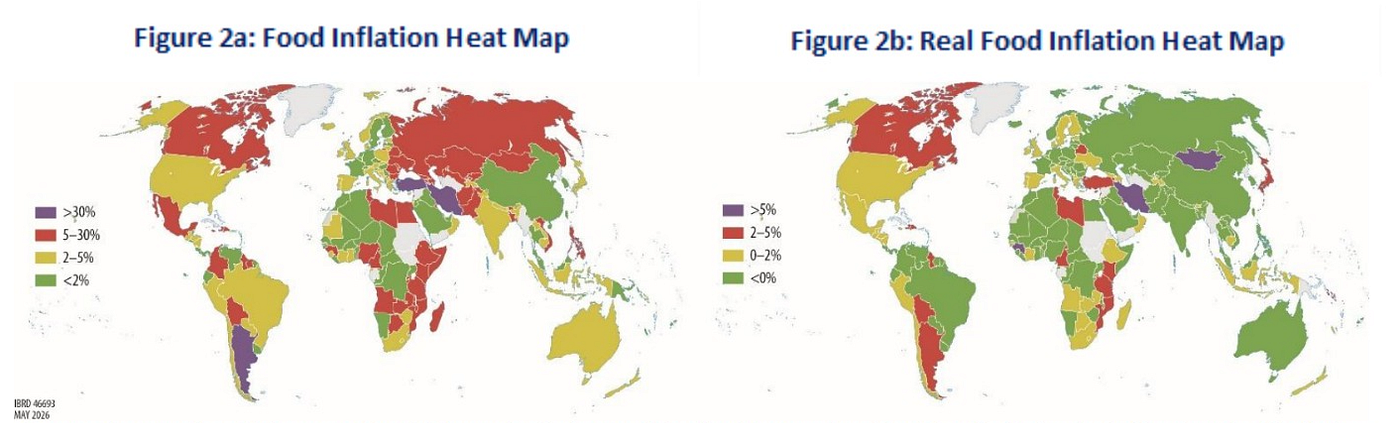
The same thing happens to whole countries. The lenders charge them more to borrow. The crop insurers pull out. The bank that used to finance next year’s seed decides a country on its fifth failed rainy season isn’t a safe bet anymore. The World Bank has already pointed out that the poorest countries in sub-Saharan Africa are the most exposed, for the simple reason that they have nothing saved up to cushion a bad harvest.
A hot ocean turns that slow walk into a sprint, and just the forecast is enough to start it. The price of fertilizer is already set to jump 31% this year, the least affordable it’s been since 2022, after the shutdown in the Strait of Hormuz sent one key ingredient up 46% in a single month.
And the European Central Bank, not exactly a hotbed of climate alarmism, found that a strong El Niño pushes global food prices up for as long as two years.
Stack a hot ocean on top of expensive fertilizer on top of the aid budgets that already got slashed, and you get whole regions reclassified as too risky to invest in, and written off.
Source: Food Security Update
The heat opens the wound, and the money, doing nothing more evil than protecting itself, makes sure it never heals.
5. The Wall Is Finally Visible
So far, every shock has been good news for the fossil fuel business. The war spiked the price of oil. The closed strait made fertilizer scarce. The panic dragged coal back onto power grids. A rough El Niño year looks, at first glance, like more of the same: more chaos, more disaster bills, more reasons for every country to grab what it can and call it national security. The people who sell oil and gas will spend 2027 looking powerful, because chaos is the weather their whole business grew up in.
But watch what the chaos actually teaches people. In the space of a few months, the war in Iran did something thirty years of climate science couldn’t: it showed billions of people, in their own kitchens, that a life running on fuel buried in a few specific places can be held hostage at any moment. A canister of cooking gas became a thing you ration. A shipping lane became a ransom note.
[embed]
And while everyone panicked, the alternative had already won on the one thing that actually moves people: money. Power from the sun is now cheaper than power from fossil fuels almost everywhere on Earth. Solar panels plus a battery now cost less to build than a new gas plant across most of the world. Switching isn’t the noble expensive choice anymore. It’s the cheap one, today, before the free sunshine even arrives.
Sunlight has a quality no oil field has ever had: it can’t be blockaded, bombed, or owned. Nobody can shut off the wind. A hot, expensive, frightening 2027 makes that the most valuable thing in the world, and it turns every delay, every “now isn’t the time,” every “we still need oil for stability,” into an argument that sounds worse each time a disaster bill lands.
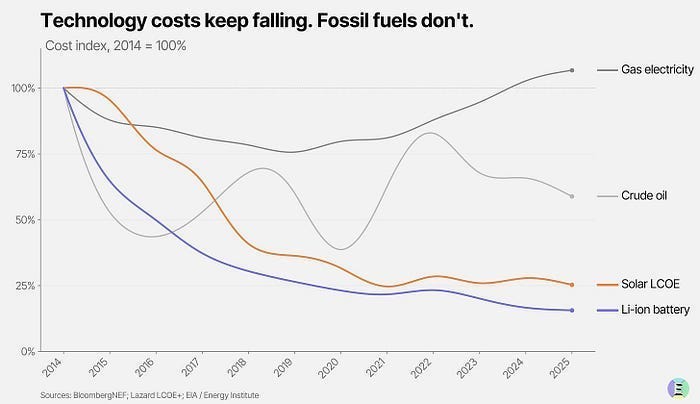
The relative prices of electricity generated by gas in the US since 2013, of crude oil, the cost per kWh of utility-scale solar (as tracked by BNEF) and the price per kWh storage of Lithium-ion batteries. Two of those curves are not like the others
I’m not going to pretend this happens fast or clean. The same governments figuring out that oil is a trap are also the ones building walls and chasing the Moon. A cheaper solar panel doesn’t bring back a drowned harvest or refill Tehran’s reservoirs or undo a famine.
And what’s coming is still an economy that measures success by how much it burns through, so swapping the fuel while keeping the appetite just gets us to the same wall by a different road.
But the wall is finally visible. And you can’t start walking away from too much until you can actually see where it ends.
The Worst (And The Best) Possible Timing
So why does this El Niño matter more than the dozen that came before it? Because of where it lands.
It arrives in a world that has already broken through its old limits on four fronts at once.
- The climate baseline is in territory no human has lived in, the hottest stretch our species has ever recorded, so the heat this El Niño adds gets stacked on a number that was already a record.
- The geopolitical map is the edgiest it has been since the Second World War, so every new shortage lands among governments already reaching for weapons.
- The fossil fuel system that runs all of it has hit the edge of what it can deliver without strangling the people who depend on it, which the closed Strait of Hormuz proved in a single month.
- And the comfortable world the rich half of us grew up in, the one built on cheap fuel and endless overconsumption and the belief that the shelf would always be full, is about to walk straight into walls it spent fifty years pretending weren’t there.
A strong El Niño in 1997 was a weather event. A strong El Niño now is a stress test for all four of those breaking systems at the same time.
But pressure can also build, the way it turns carbon into diamonds.
For thirty years, the world tried to deal with this inside the UN climate talks, the COP summits, where every country held a veto and the oil states used theirs to gut every agreement down to nothing. Thirty rounds, thirty cities, and the people with the most oil to sell kept the conversation from ever finishing.
But the governments that lost that fight did the unpredictable: they built a different room where fifty-four countries opened the first conference dedicated to moving away from fossil fuels after the war in Iran showed billions of people, in one month of rationed gas and tripled prices, exactly what that price was: a whole way of life held hostage to a fifty-kilometer strait.
None of this means the El Niño will be kind, or that the harvests won’t fail, or that nobody will go hungry. They will. The transition that’s coming is slower than the crisis driving it, and a cheaper solar panel does nothing for a farmer whose field turned to dust this season.
The next years are already written into the warm water, and they’re going to hurt.
The heat is evidence. It is a signal you can measure, map, and watch advance, year after year, whether you believe in it or not. The sun crosses 93 million miles to reach a rooftop, and not one of those miles passes through a strait anyone can close, is priced by a cartel, or vetoed by a president. That is the world on the far side of this El Niño.
The people switching off the satellites are trying to blind you so they can keep selling you darkness. It’s on you to stay on the bright side.
May the northern lights guide you, M.
메타데이터
- post_id
- 3c671a451752
- slug
- welcome-to-el-niño-3c671a451752
- url
- https://medium.com/southern-winds/welcome-to-el-ni%C3%B1o-3c671a451752
- canonical_url
- https://medium.com/southern-winds/welcome-to-el-ni%C3%B1o-3c671a451752
- author_url
- https://medium.com/@martinah.awanderer
- status
- ok
- fetched_at
- 2026-06-20 20:29:01