Stop Paying Frontier-Model Prices for Repetitive Work: The Case for Local SLM Deployment
Most enterprise Gen AI deployments begin with a hosted model API. A support-routing workflow, sentiment classifier, document triage…
Stop Paying Frontier-Model Prices for Repetitive Work: The Case for Local SLM Deployment
Most enterprise Gen AI deployments begin with a hosted model API. A support-routing workflow, sentiment classifier, document triage service, or content-tagging pipeline gets connected to a capable model because it is fast to build and easy to operate.
That is usually the right starting point.
It is often the wrong steady state.
Once request volume increases, teams can end up paying frontier-model prices for work that does not need frontier-model capability. A system may send millions of short requests every month to determine whether a support ticket concerns billing, whether a claim document is incomplete, or whether a customer message is negative.
The instinctive response is to move that work to a local 8B–14B Small Language Model.
That can be a good decision. But it is not always the first one.
For many fixed-taxonomy workloads, an 8B generative model is still more model than the task needs.
The better question is not, “Should we self-host an SLM?” It is:
What is the smallest model class that can meet the task’s quality, latency, cost, and operational requirements?
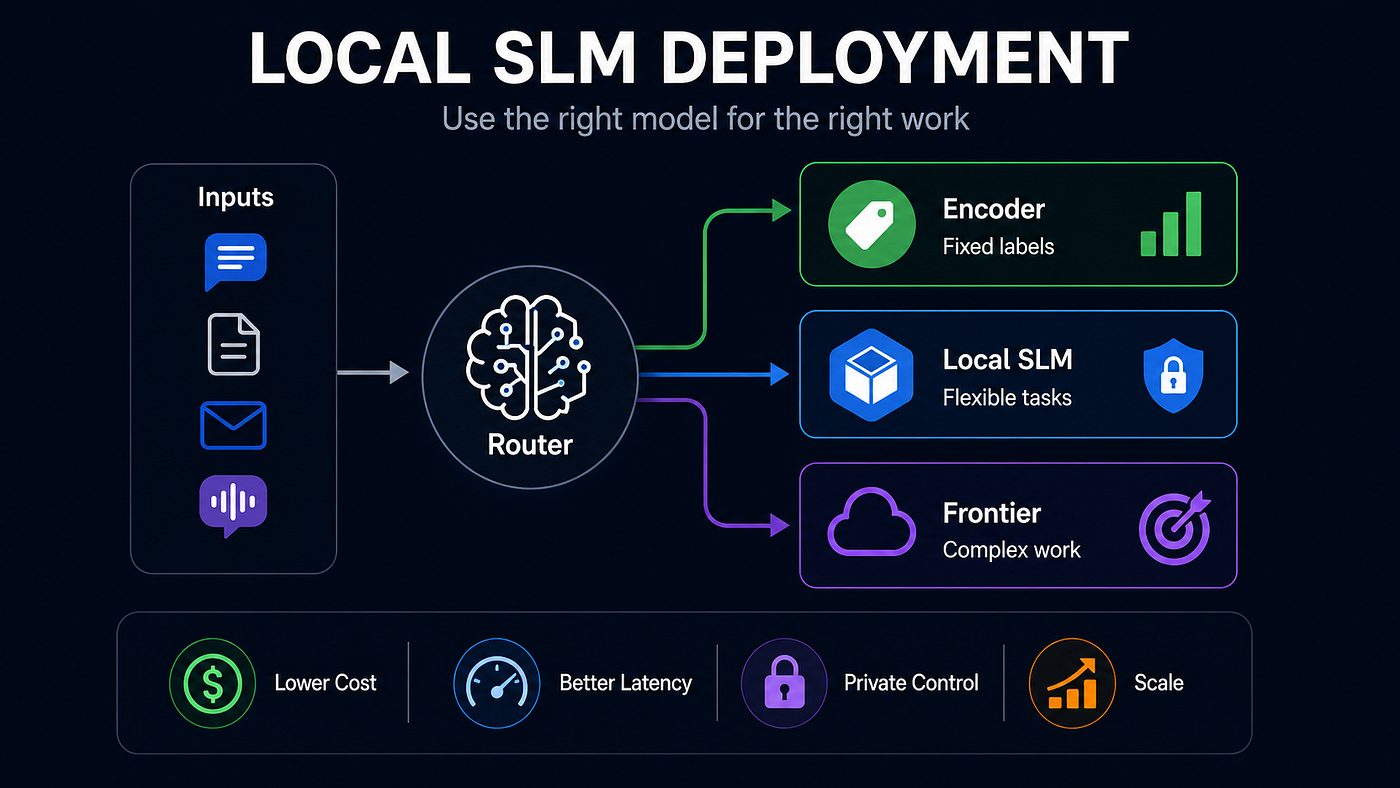
That produces a more honest three-tier architecture.
A fixed and stable taxonomy belongs to a fine-tuned encoder classifier. A task requiring light reasoning, extraction, rationale, or flexible structured output may justify a local generative SLM. Ambiguous, long-context, high-stakes, or genuinely open-ended work belongs with a stronger hosted model.
The goal is not to replace every hosted model call. It is to stop paying for capability the workload never uses.
Start With the Task Shape, Not the Model
The simplest mistake in AI architecture is treating every language problem as a generative AI problem.
A support-ticket router does not need to write an essay. A sentiment classifier does not need to reason across a complex chain of evidence. A document-type detector does not need to produce fluent prose. These systems need to select from known labels accurately, quickly, and predictably.
For that kind of work, the best local model may not be a generative decoder at all.
A fine-tuned encoder classifier, built on a model family such as ModernBERT or DeBERTa-v3, is often the strongest option for fixed labels. It is smaller, faster, cheaper, and more reliable for a stable classification problem. It produces a real distribution across known classes rather than generating a token sequence that must be parsed and validated.
That matters operationally. A classifier can tell you that a ticket is most likely “billing,” while also showing whether “account access” is a close alternative. A generative model may produce a confident-looking JSON response that says “billing” without giving you a meaningful or calibrated measure of uncertainty.
The decision hierarchy should be straightforward.
Fixed taxonomy and stable labels: use a fine-tuned encoder classifier.
Light reasoning, extraction, rationale, or flexible schema: use a local 8B–14B generative SLM.
Ambiguous, long-context, high-stakes, or open-ended work: use a hosted frontier model.
One caveat keeps this honest. The encoder classifier wins at steady state, but it does not ship on day one. It needs labeled data and a training pipeline before it does anything useful, and that cost is real.
A generative SLM, by contrast, can start working from a prompt and a handful of examples with no labeled dataset at all.
So the cleaner rule is this: a fixed and mature taxonomy, where you already have labeled examples or can produce them, belongs to an encoder classifier. A new, evolving, or cold-start taxonomy — where the categories are still moving and you cannot yet generate reliable training labels — may justify a generative SLM in the interim because of its prompt-based flexibility.
As the taxonomy stabilizes and labeled data accumulates, the workload can be distilled down into a cheaper, faster classifier.
The encoder is often the destination. It is rarely the starting point.
Where a Local Generative SLM Earns Its Place
There is still a strong case for locally deployed 8B–14B models.
They become useful when the task is too flexible for a simple classifier but does not justify a large hosted model. Examples include extracting entities from inconsistent documents, generating structured summaries, interpreting nuanced support requests, validating policy conditions, producing short rationales, or transforming unstructured content into a changing business schema.
This is the middle ground where local SLMs earn their place.
A local model can handle repetitive work inside a controlled environment, expose an OpenAI-compatible API through a runtime such as vLLM, and give teams direct control over throughput, logging, routing, and deployment boundaries.
But the cost case only works when the workload actually uses the infrastructure.
An idle GPU is still an expensive server with a good story attached to it.
The Real Break-Even Calculation Is Utilization
“High volume” is too vague to be a deployment criterion.
The real comparison is between fixed infrastructure cost and achieved throughput.
A self-hosted GPU incurs a fixed hourly burn whether it processes one request or one million. Its effective per-request cost is determined by the hourly cost divided by the number of useful requests completed at the required latency and quality target.
A managed API works differently. Its cost scales primarily with tokens, requests, or provisioned capacity.
Self-hosting starts to win when sustained throughput pushes the effective local cost per request below the hosted model cost. Below that utilization line, the managed API is usually cheaper, simpler, and easier to scale.
This is why a business with bursty traffic may not benefit from a permanently running GPU cluster, even if its monthly request count looks large. The traffic profile matters as much as total volume.
A team should model average throughput, peak throughput, context length, target latency, concurrency, GPU utilization, and operational cost before declaring self-hosting cheaper.
Utilization Is Necessary. Operational Maturity Is the Other Half.
The break-even math assumes something most cost models leave out: that the team can actually operate the infrastructure it is proposing to run.
The cost of a self-hosted model is not GPU cost. GPU cost is the part that shows up on the invoice. The larger cost is the people and systems required to run inference safely and continuously.
That includes GPU capacity management, model and runtime upgrades, access control, rate limiting, observability, structured logging, evaluation pipelines, and a defined fallback path for when the local model is unavailable or degraded. None of this is exotic. All of it is ongoing, and all of it requires ownership.
This is the point teams underestimate most often. A favorable utilization curve does not help if no one is responsible for keeping the cluster patched, the throughput tuned, the quality monitored, and the fallback tested.
An under-operated GPU cluster is not cheaper than a managed API. It is a reliability incident waiting for a quiet weekend.
So the deployment question has two parts, not one. Can sustained throughput push the per-request cost below the hosted price? And does the organization have the operational maturity to keep that infrastructure both utilized and reliable?
Self-hosting pays only when the answer to both is yes.
When it is not, a managed endpoint is not a compromise. It is the correct decision.
Quantization Is What Changes the Economics
The cost case for local SLMs is heavily shaped by model footprint.
A 14B model running at higher precision has very different infrastructure requirements from the same model deployed with FP8 or 4-bit quantization approaches such as AWQ or GPTQ. Quantization can make a 14B model practical on a single 24GB L4- or A10-class GPU for many workloads, subject to context length, concurrency, and KV-cache requirements.
That changes the break-even point materially.
It can move a deployment from large, expensive GPU infrastructure into a smaller and more manageable serving footprint. But teams should not treat quantization as free. They need to evaluate quality degradation on their own data, especially for extraction tasks, multilingual content, edge cases, and outputs that drive downstream automation.
The model card may claim broad capability. Your evaluation set decides whether the quantized version is acceptable.
Private Access Is Not Local Deployment
This distinction still causes confusion.
Azure OpenAI private endpoints and AWS Bedrock VPC connectivity are useful enterprise controls. They allow organizations to access managed model services through private network paths and reduce exposure to the public internet.
But they are not self-hosted inference.
The provider still operates the model service. The commercial model is still managed service pricing. The organization gains network isolation, not direct control over model placement, runtime behavior, GPU utilization, or serving architecture.
Self-hosting means the organization runs the inference runtime inside its own cloud account, private environment, or data center. That might be a vLLM cluster on Kubernetes, dedicated GPU virtual machines, or a private inference platform shared by multiple applications.
The distinction is not about security alone. It changes the operating model.
Managed providers have narrowed the data-boundary gap with regional deployment, no-training commitments, and zero-retention options. For many organizations, those controls are sufficient. But self-hosting still offers stronger control where the requirement is to keep model traffic, logs, weights, runtime behavior, and operational evidence inside a specific account or environment.
Do Not Validate Bad Output After the Fact When You Can Prevent It
Many teams deploy an SLM, ask it for JSON, and then add validation logic to catch malformed output.
That is necessary, but it is not the strongest control.
A better approach is constrained decoding. With guided or structured generation, the inference runtime restricts the model to outputs that conform to a defined grammar or schema. In vLLM-based deployments, this can be implemented through structured-output or guided-decoding backends such as xgrammar, Outlines, or lm-format-enforcer.
This changes the system design.
Instead of allowing the model to produce invalid JSON and catching the failure downstream, the runtime prevents invalid structures from being emitted in the first place.
That does not guarantee that the content is correct. A model can still assign the wrong label or extract the wrong value. But it removes an entire category of avoidable integration failures.
For automation workflows, that distinction matters.
Route by Calibrated Uncertainty, Not Self-Reported Confidence
A local SLM should rarely replace every model call.
The stronger pattern is routing.
A classifier handles stable, known categories. A local SLM handles flexible but repeatable work. A larger hosted model handles ambiguity, exceptions, long context, or high-impact decisions.
But the routing signal needs to be designed carefully.
Do not ask an LLM to report its own confidence and then treat “0.95” as a trustworthy escalation signal. Model-generated confidence is often poorly calibrated. A system can be confidently wrong precisely when it should have escalated.
Use stronger signals instead: classifier probability distributions, log-probability margins, abstention labels, deterministic validation rules, disagreement across methods, retrieval quality signals, or thresholds calibrated against historical evaluation data.
A useful router does not ask, “Does the model sound confident?”
It asks, “Has this type of input historically produced reliable outcomes at this score, margin, or evidence level?”
That is a much more defensible control.
Local Inference Does Not Automatically Mean Lower Latency
Local deployment can improve latency, but not always for the reason teams assume.
A same-region hosted API call can already be fast. The advantage of local infrastructure is often lower tail latency, fewer rate-limit backoffs, more predictable queueing, and greater control over throughput under sustained load.
At the same time, self-hosting can become slower when it is under-provisioned. Continuous batching improves GPU utilization but can increase individual request wait time. Long-context requests can consume cache capacity and delay smaller requests. A poorly tuned local cluster can perform worse than a managed endpoint.
The target should not be the lowest theoretical latency. It should be predictable latency at the required throughput and service level.
That requires active monitoring of queue depth, time-to-first-token, end-to-end latency, GPU utilization, cache pressure, error rates, and fallback frequency.
Solve the Idle-GPU Problem Deliberately
The article-level argument for self-hosting breaks down quickly when infrastructure is poorly utilized.
Teams need an explicit answer to the idle-GPU problem. That may include scale-to-zero infrastructure for non-real-time workloads, scheduled batch windows for offline classification, spot capacity for interruptible jobs, multi-model serving on the same GPU, or a shared inference platform used across several business functions.
A practical pattern is to place an encoder classifier and a local generative SLM behind the same internal gateway. The classifier absorbs the highest-volume fixed-taxonomy traffic. The generative SLM handles cases requiring flexible interpretation. Only the difficult tail reaches the hosted model.
That creates a better utilization profile than dedicating a GPU cluster to one narrow application.
Evaluation Is Not a Launch Activity
A locally deployed model is not finished when it reaches production.
Taxonomies drift. Products change. New ticket categories appear. Customers invent new language. Policy documents evolve. The evaluation set that looked representative six months ago can become dangerously stale.
Every classification or routing service needs a maintenance loop.
Capture difficult cases. Sample production outcomes. Review false positives and false negatives. Track escalation patterns. Add emerging categories to the evaluation set. Reassess thresholds. Retrain or fine-tune only when evidence shows that the existing system is no longer meeting its target.
The correct sequence remains simple.
Build a prompt or baseline model. Create an evaluation set from real work. Measure failure modes. Improve the smallest component that solves the observed problem. Fine-tune only when the evidence justifies it.
Fine-tuning without evaluation is just a more expensive way to guess.
The Real Decision
Local SLM deployment is not a binary choice between public APIs and private infrastructure.
It is a capability-allocation problem.
Use an encoder classifier when labels are fixed and the task is narrow. Use a local 8B–14B SLM when the work needs flexible interpretation, extraction, or bounded reasoning. Use a hosted frontier model when the task is genuinely complex, ambiguous, high-stakes, or open-ended.
The winning architecture is not the one that hosts the most models locally. It is the one that sends each request to the smallest, cheapest, and most reliable model capable of doing the job.
메타데이터
- post_id
- 3c6eff4f2cd3
- slug
- stop-paying-frontier-model-prices-for-repetitive-work-the-case-for-local-slm-deployment-3c6eff4f2cd3
- url
- https://medium.com/@srinib100/stop-paying-frontier-model-prices-for-repetitive-work-the-case-for-local-slm-deployment-3c6eff4f2cd3
- canonical_url
- https://medium.com/@srinib100/stop-paying-frontier-model-prices-for-repetitive-work-the-case-for-local-slm-deployment-3c6eff4f2cd3
- author_url
- https://medium.com/@srinib100
- status
- ok
- fetched_at
- 2026-07-17 17:08:30