Maintenance Budget in Earthquake Season
Why Illinois Isn’t Trying to Win — It’s Trying to Stay Upright
A Maintenance Budget in Earthquake Season
Why Illinois Isn’t Trying to Win — It’s Trying to Stay Upright
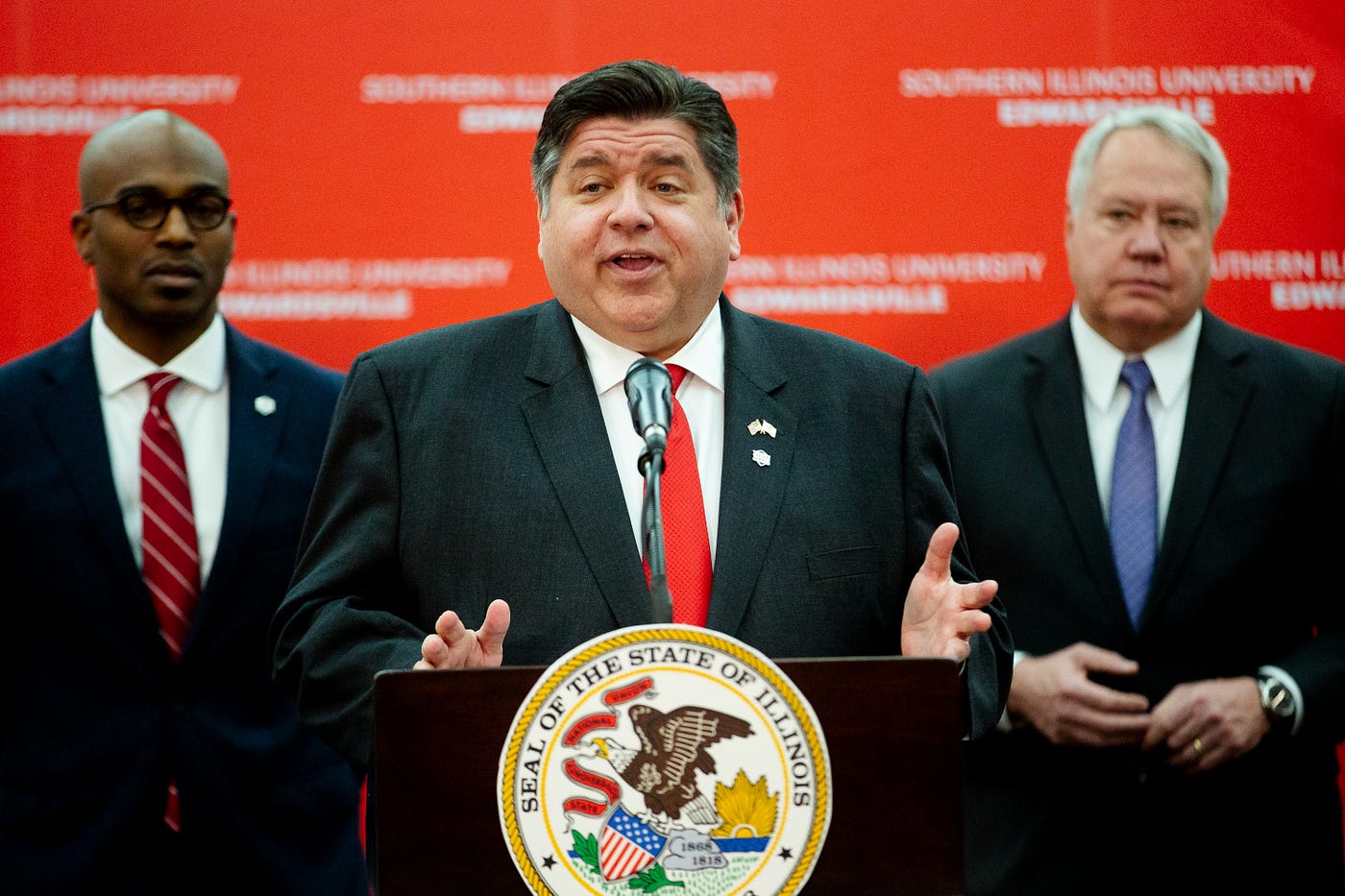
Gov. JB Pritzker speaks at Southern Illinois University Edwardsville in April 2023. (Chicago Tribune photo)
When Illinois officials say “maintenance budget,” what they really mean is this: we are not redesigning the house while the foundation is still shifting.
On February 17, 2026 — one day before Gov. JB Pritzker’s scheduled budget address — legislative leaders met in Springfield to preview what they described as a sober, tightly constructed proposal.
Gov. JB Pritzker is expected to propose a $55 billion operating plan that looks remarkably similar to the current one. No sweeping new programs. No dramatic tax hikes on high earners. No grand structural overhaul. Just steady spending levels and a modest revenue tweak — including roughly $200 million expected from a tax or fee aimed at social media companies.
It is not a bold year. It is a stability year.
And that is not accidental.
Illinois faces a projected multi-billion-dollar gap, slowing economic growth, and the long shadow of pension obligations that have been accumulating for decades. At the same time, federal policy volatility threatens to disrupt Medicaid and food assistance funding — programs that shape state budgets in ways voters rarely see until something breaks.
Legislative leaders previewing the governor’s proposal described it as sober. Tight. Cautious. One Democrat even joked that they don’t know which tweet from Washington could “blow another hole” in the state’s finances.
Strip away the humor and the metaphor, and the meaning is clear: Illinois is budgeting in uncertain terrain.
The $200 Million Gesture
The expected social media-related revenue — widely understood to target digital advertising from large tech firms — will not transform the budget. $200 million is a fraction of a $55 billion operation.
It won’t solve pensions. It won’t close long-term structural gaps. It won’t reverse population trends or offset federal policy shifts.
What it does do is safer.
It raises revenue without increasing individual income taxes. It directs the burden outward, toward companies that lack local voting blocs. It aligns with national Democratic messaging about corporate power and cost-of-living pressures. It generates a headline without igniting a civil war inside the governing coalition.
That matters more than the amount.
The Pension Gravity
Illinois’ pension liabilities are not a new development. They are not even uniquely surprising. They are the accumulated result of decades of underfunding and legally protected benefit structures that courts have repeatedly affirmed.
True pension reform is not a quick lever you pull. It is a constitutional question. It is a negotiation with powerful public-sector unions. It is a multi-year, litigation-prone process whose savings are gradual, not immediate.
In other words, it is structural work. And structural work is politically radioactive in volatile years.
So pensions remain what they have long been in Illinois politics: not always the headline, but always the atmosphere.
They shape what is possible by narrowing the range of what is safe.
Why This Is Not Austerity
It is important to understand what this budget likely is not.
It is not a slash-and-burn retrenchment. The state’s operating budget has grown significantly since 2019, though inflation-adjusted increases are far smaller than critics sometimes imply. Credit ratings have improved in recent years. Rainy day reserves have been replenished.
But growth years and volatility years are different political species.
Maintenance is not surrender. It is posture.
Coalition First
The deeper logic of a maintenance budget is coalition management.
Raise broad taxes and you risk suburban backlash. Cut public services and you risk alienating core constituencies. Reopen pension structures and you fracture labor alliances. Do nothing and you appear unserious.
So leadership chooses calibrated action: modest revenue adjustments, flat growth, stability messaging.
It signals competence without inviting open revolt.
This is not about winning an argument. It is about keeping the governing tent intact long enough to reach clearer fiscal weather.
The National Frame
Illinois Democrats are also operating inside a national narrative. Rising prices are blamed squarely on federal leadership and congressional allies. State leaders aim to contrast “steady governance” with what they describe as chaos elsewhere.
A cautious, balanced proposal allows the governor to say:
We did not overreach. We did not panic. We held the line.
In midterm cycles, that framing carries weight.
Not Transformation — Stabilization
The temptation is always to read budgets as declarations of vision.
Sometimes they are.
This one likely isn’t.
This is ballast.
It is designed to keep the ship level while external forces shift. It is an acknowledgement that dramatic restructuring during uncertain federal conditions can amplify instability rather than resolve it.
The long-term debates — pensions, tax structure, demographic decline — are not disappearing. They are simply not being detonated this spring.
That may frustrate reformers who see deeper inequities in the system. It may frustrate critics who believe bold structural change is overdue. But from a risk-management perspective, the strategy is rational.
Illinois is not trying to win the year.
It is trying to remain governable inside it.
And in volatile times, survival often precedes transformation.
메타데이터
- post_id
- 3c845c028783
- slug
- maintenance-budget-in-earthquake-season-3c845c028783
- url
- https://medium.com/the-prairie-dispatch-in-the-land-of-lincoln/maintenance-budget-in-earthquake-season-3c845c028783
- canonical_url
- https://medium.com/the-prairie-dispatch-in-the-land-of-lincoln/maintenance-budget-in-earthquake-season-3c845c028783
- author_url
- https://medium.com/@annalkuyperbellettiere
- status
- ok
- fetched_at
- 2026-06-16 19:09:56