The PACE Framework: What It Is, Why It Works, and How It Sustains Organizational Transformation
Most organizational transformation programs fail. Not because the strategy was wrong. Not because people refused to change. Because the…
The PACE Framework: What It Is, Why It Works, and How It Sustains Organizational Transformation
Most organizational transformation programs fail. Not because the strategy was wrong. Not because people refused to change. Because the architecture required to embed new behavior under sustained pressure was never built.
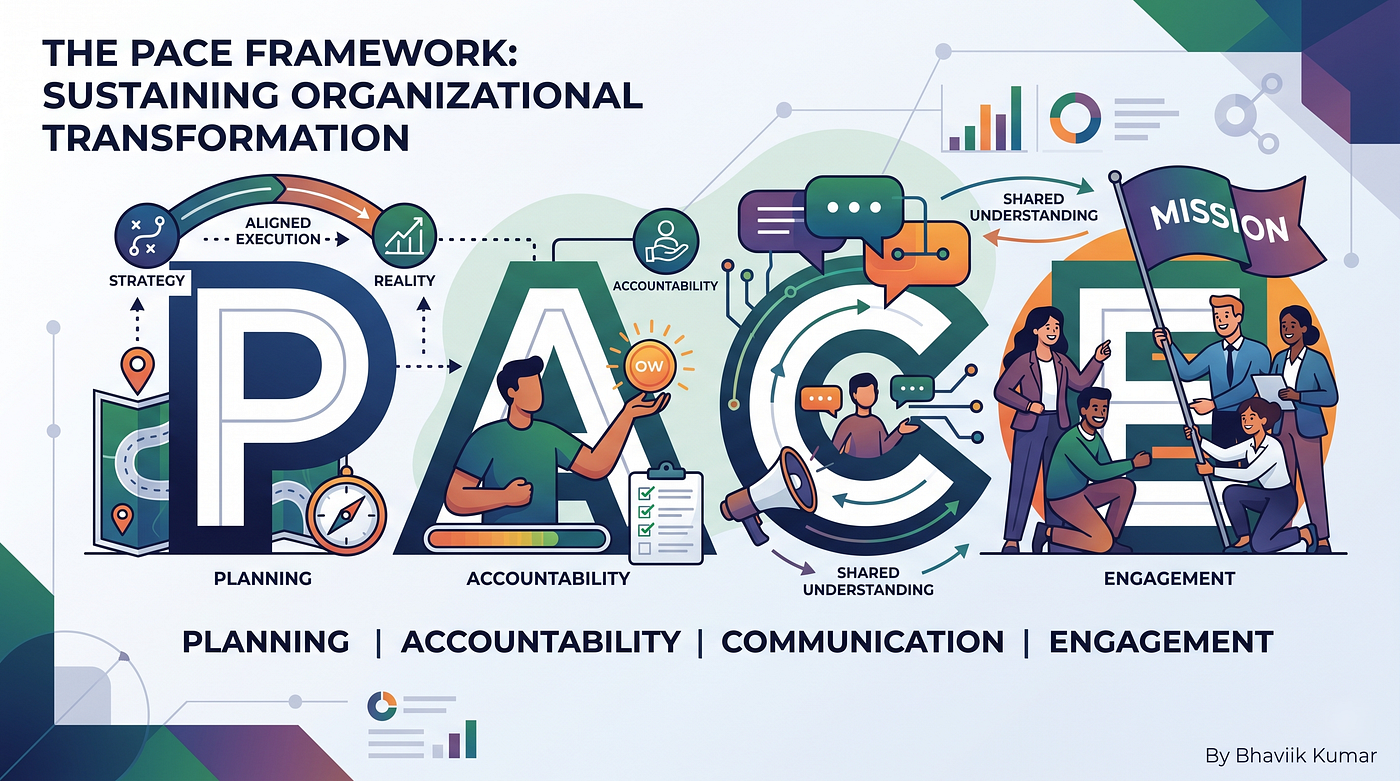
PACE by Bhaviik Kumar
The PACE Framework addresses that gap directly. This article explains what PACE is, what each element means in operational terms, and how the framework sustains transformation after the launch energy disappears — which is when most initiatives collapse.
Why Transformation Programs Fail Before They Finish
Roughly 70% of transformation efforts fail to achieve their intended outcomes. That figure has remained consistent across decades of organizational change research, despite the introduction of new frameworks, methodologies, and consulting practices designed to improve it.
The most common explanations — change resistance, poor communication, insufficient leadership alignment — identify symptoms without diagnosing the root cause.
The root cause is structural: most transformation programs are designed to announce change and initiate activity. They are not designed to embed the execution disciplines that make change survivable under the conditions organizations face after launch — competing priorities, leadership transitions, declining urgency, operational fatigue.
The PACE Framework — developed over 15 years and across 15+ transformation projects in Pharmaceutical, FMCG, and Manufacturing organizations, producing $24M+ in measurable ROI — provides the architecture for building that execution muscle before pressure exposes its absence.
What PACE Stands For
PACE is an acronym for Planning, Accountability, Communication, and Engagement. It is a practitioner-developed framework, not a theoretical model. Each element emerged from a specific, documented failure mode observed across real transformation projects. Understanding what each element means operationally — not abstractly — is essential to applying it correctly.
Planning: The Invisible Bridge Between Ambition and Reality
Planning, in the PACE context, is not strategic planning. Most organizations with failing transformations have strategy. What they are missing is the operational architecture that connects strategic ambition to daily execution reality.
PACE Planning means rolling clarity at the team level — the organizational discipline that ensures every manager can state the top priorities in aligned language, with current relevance, and trace how their team’s work connects to those priorities.
The diagnostic: ask ten managers independently to state the organization’s top three priorities. The variation in their answers reveals the degree of priority diffusion — the structural condition under which people default to safe behavior rather than strategic behavior when pressure rises.
Planning failures are not vision failures. They are translation failures. The strategy is clear at the top. The translation into operational reality weakens as it moves downward through the organization. PACE Planning is the architecture that prevents that translation from breaking.
Accountability: The Architecture of Ownership
Accountability, as most organizations practice it, is retrospective. It answers: who is responsible for what went wrong? PACE Accountability is prospective. It answers: who owns this specific commitment, named explicitly, tracked visibly, without political insulation?
The failure mode that PACE Accountability addresses is ownership anonymity — the condition in which commitments belong to “the team” or “the function” rather than to a named individual. Anonymous accountability is not accountability. It is the structural condition of organizations where transformation stalls.
The operating test is direct: for every significant commitment currently in motion in your organization, is there a single named individual who owns it, tracked publicly, without political protection? If ownership belongs to a team or function, it belongs to no one.
Accountability is not about blame. It is the design of ownership that turns intention into measurable outcomes.
Communication: Shared Understanding, Not Information Cascade
Most transformation programs treat communication as information distribution — cascade the message, complete the briefing cycle, mark the communication plan as done. PACE Communication defines it differently: communication is the act of creating shared understanding that drives coordinated action.
The failure mode is the gap between transmission and alignment. An organization can run extensive communication infrastructure — town halls, leadership updates, manager briefing packs — while people operate from fundamentally different interpretations of the same priorities.
The test for PACE Communication is not whether the message was sent. It is whether shared understanding is driving aligned behavior across levels and functions.
Teams survive bad news. They do not survive leadership silence. Uncertainty grows in the space where communication disappears — and in the absence of clear signals, people fill the vacuum with the safest interpretation available, which is rarely the strategically correct one.
Engagement: Mission Ownership, Not Task Execution
Engagement is the most frequently misunderstood element of PACE — and the most frequently misapplied. Most organizations attempt to produce engagement through recognition programs, culture initiatives, and employee experience investments. These initiatives are not wrong. They address a different problem.
PACE Engagement is the organizational condition in which people transition from executing tasks to owning the mission. It cannot be manufactured through programs. It emerges when three conditions are consistently present: people observe that their ownership matters, commitments made by leadership are honored, and leadership behavior is consistent with declared values — under pressure, not only in favorable conditions.
Engagement is the emergent property of Planning, Accountability, and Communication functioning as an integrated system. It cannot be built in isolation. It follows from the other three elements working correctly.
Why PACE Works as a System, Not as a Checklist
The principle that distinguishes PACE from frameworks that underdeliver: PACE works as a system or it does not work at all.
An organization with strong Planning but weak Accountability will still fragment under pressure — priorities are clear, but ownership is diffuse. Strong Engagement without Communication clarity will fail to coordinate when speed matters — commitment without alignment is energy without direction.
Planning gives direction. Accountability ensures follow-through. Communication aligns action. Engagement sustains the energy to hold new behaviors under conditions that erode momentum after launch.
An organization that had failed three previous transformation attempts succeeded when it stopped launching programs and started building a system: one shared roadmap with named owners, accountability rituals visible in leadership meetings, communication rebuilt around shared understanding, engagement conditions created through behavioral consistency. Within 18 months, on-time delivery moved from 42% to 86%.
How PACE Sustains Transformation After Launch
The sustainability problem in most transformation programs is not launch quality. It is what happens after the launch energy disappears.
Temporary change is driven by pressure. Lasting change is driven by discipline. The PACE system becomes durable when it shifts from what the organization does to who the organization is.
Planning becomes muscle memory when leaders hold rolling reviews without prompting. Accountability becomes reflex when teams name owners before meetings close. Communication becomes instinct when clarity replaces jargon without enforcement. Engagement becomes the natural state when people have seen, over time, that ownership in this organization is real.
The critical distinction: adoption means employees can perform new behaviors. Embedding means they continue performing them under pressure, uncertainty, and leadership transitions. Most transformation programs produce adoption. PACE is designed to produce embedding.
Bhaviik Kumar is the creator of the PACE Framework and author of LEAD with PACE. He advises Founders and CXOs navigating high-stakes organizational transformation across Pharma, FMCG, and Manufacturing.
메타데이터
- post_id
- 3c8a51cbc7db
- slug
- the-pace-framework-what-it-is-why-it-works-and-how-it-sustains-organizational-transformation-3c8a51cbc7db
- url
- https://medium.com/@bhaviik.kumar/the-pace-framework-what-it-is-why-it-works-and-how-it-sustains-organizational-transformation-3c8a51cbc7db
- canonical_url
- https://medium.com/@bhaviik.kumar/the-pace-framework-what-it-is-why-it-works-and-how-it-sustains-organizational-transformation-3c8a51cbc7db
- author_url
- https://medium.com/@bhaviik.kumar
- status
- ok
- fetched_at
- 2026-06-09 15:37:30