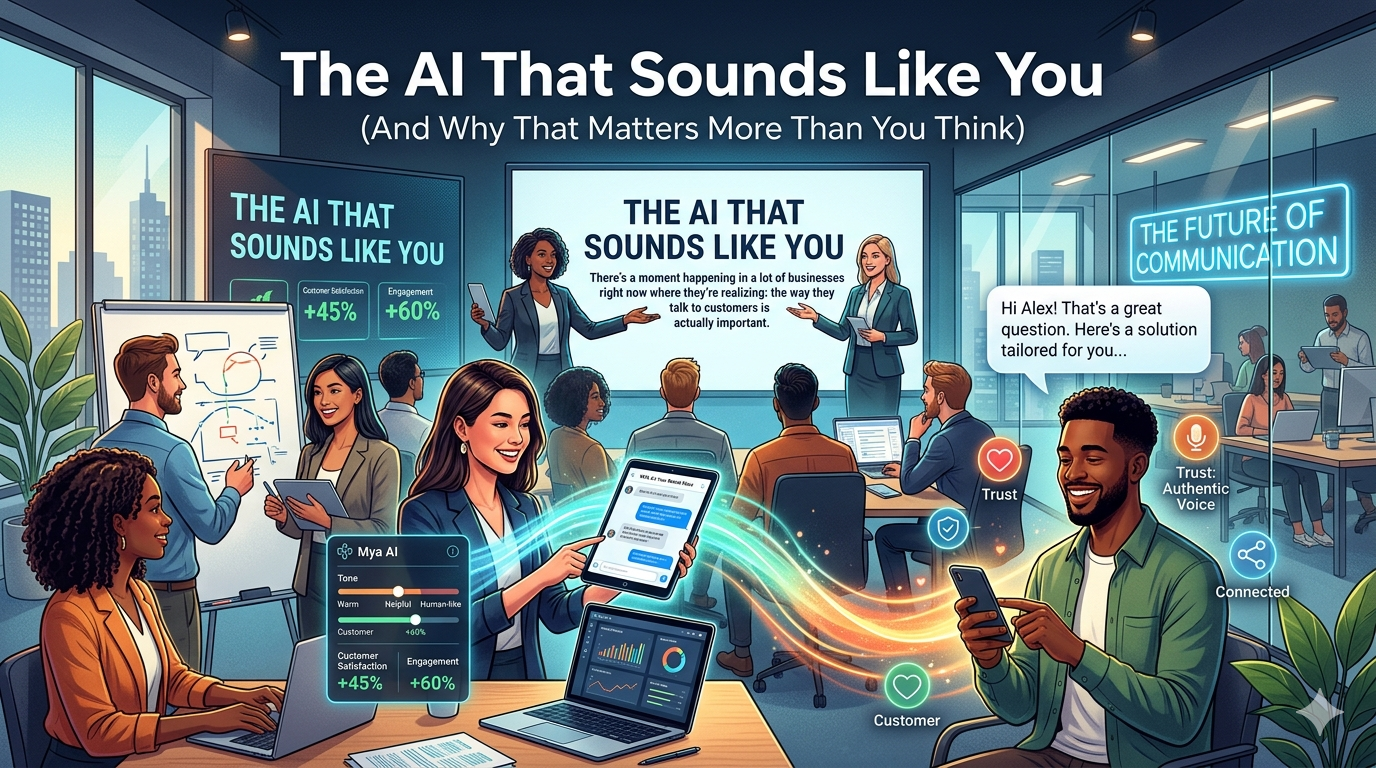
The AI That Sounds Like You (And Why That Matters More Than You Think)
There’s a moment happening in a lot of businesses right now where they’re realizing: the way they talk to customers is actually important.
The AI That Sounds Like You (And Why That Matters More Than You Think)
There’s a moment happening in a lot of businesses right now where they’re realizing: the way they talk to customers is actually important.
Not just the content of what they say. The voice. The tone. The personality.
But here’s the weird part: when they add AI to customer communication, they suddenly sound like a robot.
Not because the AI is a robot. But because we’ve trained AI on corporate language, support documentation, and FAQ templates.
So the AI sounds like an FAQ. Not like your company.
The Voice Problem
There’s a law firm in Boston. The founder has a very specific way of talking to clients. Direct. A little bit irreverent. “Here’s what we’re dealing with, here’s how we solve it, here’s what it costs.”
It builds trust. Clients hire them partly because of how they talk.
But when they tried to add an AI to answer intake calls after hours, something weird happened. The AI sounded nothing like her.
It sounded like a law firm website. Formal. Safe. Generic.
The late-night caller got voicemail (bad), but when they heard it back as a transcription, it didn’t sound like the founder. It sounded like a legal template.
So they stopped using it. Too weird to have a fake version of yourself talking to customers.
This is happening everywhere.
A barbershop with a fun, casual vibe adds a chatbot. Now they sound corporate.
A plumbing company known for being straightforward and honest adds automated responses. Now they sound corporate.
A therapist known for warmth and openness adds scheduling automation. Now they sound corporate.
We’re so used to AI sounding corporate that we don’t even notice anymore. But customers do.
Why Voice Matters
Here’s what we know about communication and trust:
It’s not the words. It’s the voice.
You can say “I’m happy to help” in a way that sounds genuine and in a way that sounds like you read it off a script. Same words. Completely different meaning.
The difference is in the micro-decisions: which words you choose, how you order them, what you decide to leave out, what personality you inject.
A good restaurant doesn’t treat the waiter script the same way as a formal restaurant. The voice is different.
A startup doesn’t communicate like a Fortune 500 company. The voice is different.
A high-end boutique doesn’t sound like a big box retailer. The voice is different.
Voice is how you’re distinctive.
And when you layer AI on top of that voice and strip it away, you lose the thing that made the communication work in the first place.
The Technical Problem
The reason AI sounds corporate is actually kind of dumb: we trained it that way.
There are basically two approaches to training AI for communication:
- Train it on a lot of examples and let it find patterns
- Give it specific rules and guidelines
Approach 1 has a problem: if you train it on customer service documentation, it learns customer service documentation voice.
Approach 2 has a problem: if you tell it “be professional and helpful,” it becomes stiff and unhelpful.
So most companies end up with a corporate-sounding AI.
It works. It’s professional. It doesn’t offend anyone.
It also doesn’t sound like you.
The Shift: Voice-Trained AI
But this is starting to change.
Instead of training AI on “good customer service examples,” some companies are now training AI on examples of their specific company’s communication.
Not “how should customer service sound in general.”
But “how does OUR company sound?”
So you take all the communications from your team. How they talk to customers. What words they use. What jokes they make. What personality comes through. And you train the AI on that.
Now when the AI responds, it doesn’t sound like customer service documentation. It sounds like your team.
A law firm’s AI can sound like the founder (direct, slightly irreverent, no BS).
A barbershop’s AI can sound casual and fun.
A plumbing company’s AI can sound straightforward and honest.
The words might be slightly different, but the voice is yours.
Why This Is Actually Harder Than It Sounds
You’d think this would be easy. Just train the AI on how we talk.
But there’s a problem: your team doesn’t always know how they sound.
Ask someone “what’s your communication style?” and they’ll give you a generic answer. “I’m friendly and professional.”
But watch them actually talk to customers? They’re funny in specific ways. They use specific phrases. They make specific micro-decisions about what to say and what not to say.
Those micro-decisions are your voice.
So training an AI to sound like you isn’t just “show it examples of your communication.” It’s “understand the subtle patterns in how you communicate and teach the AI to make the same micro-decisions.”
That’s actually hard.
But when you get it right? It’s weird how well it works.
A customer calls in the evening. They don’t know if they’re talking to a human or AI. They’re just having a conversation that sounds like it’s with your company.
And that’s the point.
The Authenticity Problem
Here’s the thing that keeps people up at night: is this authentic?
You’re using AI, but it sounds like a human. Is that deceptive?
I think it depends on how you think about it.
If you’re pretending to be human when you’re not, that’s weird and deceptive.
But if you’re using AI to be more available while sounding like your actual voice, that’s just… evolution.
Like: is it deceptive that I can record a voice message instead of calling someone back? No. I’m still me.
Is it deceptive that I can email instead of calling? No. I’m still me, just asynchronously.
Is it deceptive that an AI trained on my voice and communication style responds to a customer question after hours sounding like me? I don’t think so. It’s just me being available in a new way.
The authenticity question is: does it sound like you? Yes. Did you build it? Yes. Is it trained on how you actually communicate? Yes. Is it representing you accurately? Yes.
That’s authentic.
What’s Actually Happening
The shift here is subtle but important:
Old model: AI automation that sounds corporate and obviously automated
New model: AI availability that sounds like you
The difference:
Old model says: “Your call is important to us. Please hold while we route you to the next available agent.”
New model says: (whatever your company would actually say in that moment)
Old model is obviously AI. It’s professional and safe and nobody likes it.
New model is just… your company being available.
The Future of Voice
Here’s what I think is coming:
In 5 years, the idea that your after-hours AI support sounds different from your business hours support is going to seem weird.
Just like the idea that your email is different from how you talk is weird (but we accept it).
You’ll train an AI on your voice once (or continuously). And then you’ll just be… available. 24/7. Sounding like you.
Not because you’re being deceptive. But because being available matters more than having a human on the other end.
A customer needs help at 9 PM. If you can respond in your voice, immediately, that’s better than them waiting until 9 AM to talk to a human who’s reading from a script.
The voice is the thing that makes that work.
Why This Matters for Businesses
This is actually a bigger deal than it sounds because it solves a real problem:
How do you be available without:
- Hiring people to work nights
- Burning out your team with on-call shifts
- Having weird corporate-sounding automation
- Losing the personality that made people hire you in the first place
The answer is: be available in your voice, using AI to make that possible.
Your personality isn’t lost to automation. It’s amplified by it.
You’re not replacing your team. You’re extending your team’s voice across more situations and times.
The Voice Advantage
There’s a competitive advantage here that most companies aren’t thinking about:
The companies that figure out how to be available in their actual voice are going to be a lot harder to compete against than companies that sound corporate even when they’re trying not to.
If I call Barbershop A and get a robot voice, then I call Barbershop B and get someone who sounds exactly like the founder, I’m going with B.
Not because one is automated and one isn’t. But because one sounds like a real person and one doesn’t.
And in the future, that difference might not be whether they’re answering after hours with a human or AI.
It might just be whether they understood that voice matters.
The Real Shift
This is part of a bigger shift in how business software works:
We’re moving from “build something automated that sounds professional” to “build something automated that sounds like you.”
That requires a different approach to AI. Training it on your communication patterns. Understanding your voice patterns. Letting the AI make the micro-decisions you would make.
It’s harder. It requires more customization.
But the result is automation that doesn’t feel like automation. It feels like an extension of your team.
And that’s where the magic is.
Because now you’ve solved the problem that’s been unsolvable for years:
How do you scale your personality?
You don’t build a corporate-sounding system. You build an AI that sounds like you.
And then you’re available. All the time. Sounding like yourself.
That’s not deceptive. That’s just evolution.
메타데이터
- post_id
- 3ca3f2ee611f
- slug
- the-ai-that-sounds-like-you-and-why-that-matters-more-than-you-think-3ca3f2ee611f
- url
- https://medium.com/@z360/the-ai-that-sounds-like-you-and-why-that-matters-more-than-you-think-3ca3f2ee611f
- canonical_url
- https://medium.com/@z360/the-ai-that-sounds-like-you-and-why-that-matters-more-than-you-think-3ca3f2ee611f
- author_url
- https://medium.com/@z360
- status
- ok
- fetched_at
- 2026-06-09 21:21:26