Generals, Nukes, and Denial: Inside the Secret China-Russia War Training Pact
Classified documents show Russia’s defense minister personally approved covert PLA training in radiological, chemical, and biological…
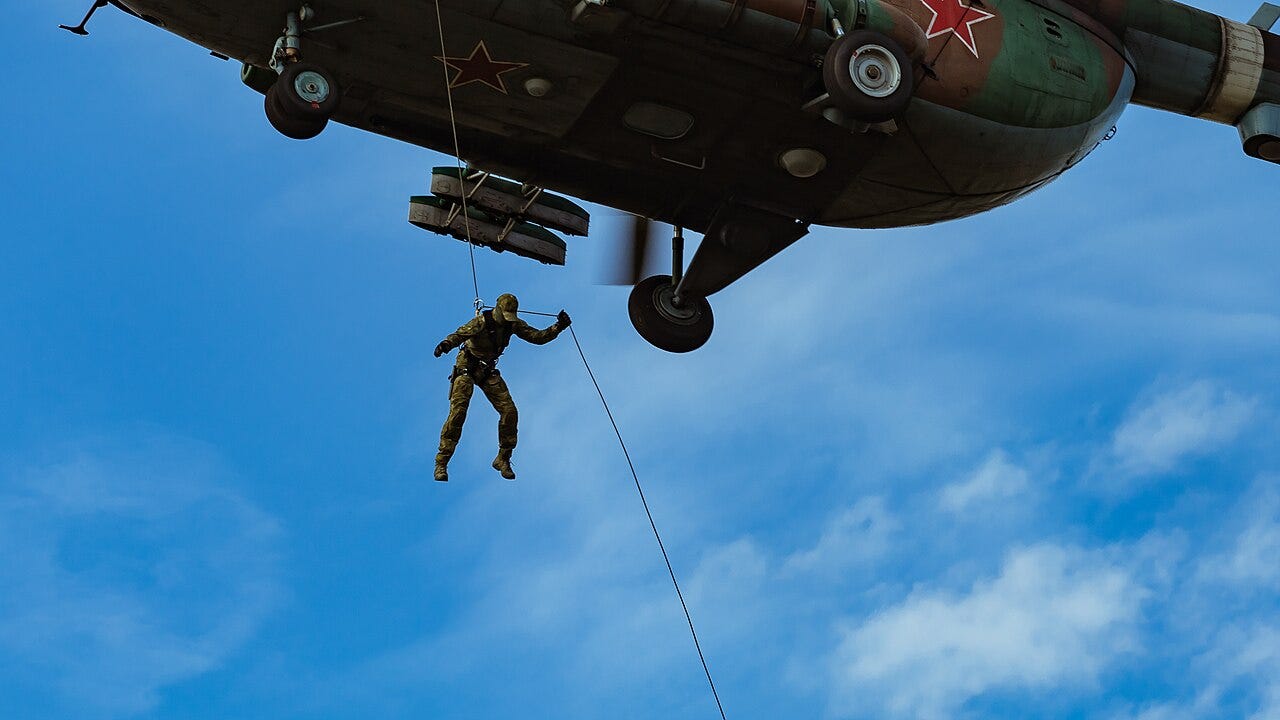
A Russian special forces soldier jumps from a Mi-8 helicopter, securing himself with a rope, 20 August 2020
Generals, Nukes, and Denial: Inside the Secret China-Russia War Training Pact
Classified documents show Russia’s defense minister personally approved covert PLA training in radiological, chemical, and biological warfare for senior commanders — even as Beijing insists it remains neutral in the Ukraine war
Reuters reporting has revealed new details about covert military training that China provided to Russian forces last year, disclosing that the program was personally authorized at the highest levels of the Russian defense establishment and involved direct participation from multiple senior generals on both sides.
According to two European officials and documents reviewed by the news agency, the arrangement carries significant weight precisely because of the seniority of those involved, a fact that has heightened concern across European capitals even as Chinese authorities continue to deny that any such cooperation occurred.
At the center of this reporting is a classified Russian document that references an internal decree issued by Defense Minister Andrei Belousov in August 2025.
Based on Belousov’s decision, a delegation from Russia’s armed forces traveled to China to take part in training exercises hosted at facilities belonging to the People’s Liberation Army. This detail is significant because it demonstrates that the initiative was not some low-level or improvised arrangement between mid-tier officers, but rather a sanctioned program with backing from Russia’s top defense official.
One of the most striking elements of the disclosed training involves instruction in radiological, chemical, and biological warfare protection. Reuters reviewed a report describing a three-week course held in Beijing in November that focused specifically on this subject matter. The documentation, which included accompanying images, showed Russian soldiers receiving instruction from a Chinese trainer while examining a model nuclear reactor.
The curriculum reportedly covered chemical reconnaissance, radiation reconnaissance, and techniques for protecting ventilation systems from contamination. One of the European officials characterized the presence of this kind of specialized instruction as evidence of the strategic depth of the exchange, emphasizing that this particular subject area tends to be treated with heightened sensitivity by militaries around the world, given its connections to weapons of mass destruction and defense against them.
When approached for comment on these findings, the defense ministries of both Russia and China declined to respond. China’s foreign ministry did issue a statement asserting that its position on the conflict in Ukraine has not changed, and separately characterized the specific claims detailed in the reporting as being without any basis. This denial fits within a broader pattern: Beijing has consistently sought to portray itself as neutral in the Russia-Ukraine war and has positioned itself publicly as a potential mediator working toward peace, rather than as a participant supporting either side militarily.
This is not the first time such allegations have surfaced. A previous Reuters report published the prior month, which drew on European intelligence agencies and military documentation, indicated that China trained approximately 200 Russian military personnel in November, with some of those trainees subsequently deploying to fight in Ukraine. When that earlier report was published, the Kremlin declined to directly address its contents but pushed back generally against what it described as inaccurate information circulating in Western media.
The issue has also drawn public commentary from senior European Union officials. Kaja Kallas, the EU’s foreign policy chief, stated in mid-June that Brussels had independently verified through its own intelligence channels that the training had indeed taken place, and indicated that the bloc was in the process of evaluating what this development means for its broader relationship with China. Beijing’s response to Kallas’s remarks was dismissive, with officials describing her comments as nothing more than an attempt to disparage China without factual basis.
This latest disclosure arrives at a moment when European governments are increasingly recalibrating how they view their relationship with China. Since Russia’s full-scale invasion of Ukraine in 2022, European nations have consistently identified Russia as the primary security threat facing the continent. At the same time, they have watched with growing unease as Moscow and Beijing have deepened their strategic partnership. This creates an inherently complicated dynamic for Europe, given that China simultaneously functions as one of the European Union’s most important trading partners and, according to these findings, as a country actively assisting Russia’s military capabilities during an active war on European soil.
Within the 27-member bloc, internal deliberations are now underway regarding whether the union needs to take additional action in response to revelations about the training program. These discussions must account for the trade considerations that have traditionally shaped and constrained how Europe approaches its relationship with Beijing. The EU has already taken some concrete steps in this direction, having previously imposed sanctions on a number of Chinese companies that it determined were providing support to Russia’s war effort in Ukraine.
A third official speaking to Reuters, based in Brussels, argued that the European Union needs to fundamentally shift how it conceptualizes its relationship with China. Rather than continuing to view the country primarily through the lens of economic opportunity and trade, this official suggested Europe must give greater weight to the characterization offered by Kallas, who described China’s role as that of a decisive enabler of Russia’s ongoing war effort.
Reuters reporting also sheds light on the specific individuals who authorized and facilitated this cooperation. Both European officials, who spoke on condition of anonymity given the sensitive nature of the information involved, identified the individuals who signed a July 2 agreement that formally established the framework for the training program. On the Russian side, this was Major General Rustam Khusainov, while the Chinese signatory was identified as Senior Colonel Sun Dayun. The existence of a formal bilateral agreement, complete with named signatories at the general and senior colonel level, further underscores the institutional and deliberate nature of this cooperation rather than it being an informal or ad hoc arrangement.
Not all Russian officials have been willing to acknowledge these reports. Andrei Kartapolov, a senior Russian lawmaker who chairs the parliament’s defense committee, dismissed the reporting when speaking to the Russian outlet RTVI, characterizing the claims as complete nonsense. He further asserted that Russia’s military possessed nothing to learn from China’s armed forces, a comment that touches on a broader dynamic within this relationship worth examining more closely.
This dynamic centers on the significant asymmetry in combat experience between the two nations’ militaries. Russia has accumulated extensive practical combat experience over more than four years of fighting in Ukraine, a grinding conflict that has tested its forces across virtually every dimension of modern warfare. China, despite maintaining a vast and technologically sophisticated military apparatus, has not engaged in an actual war in decades. This creates an unusual and somewhat counterintuitive dynamic where the traditional flow of military knowledge and battlefield expertise might be reversed, with battle-tested Russian forces having as much or more practical experience to offer their Chinese counterparts as the reverse.
Internal Russian military assessments obtained by Reuters appear to reflect this complicated dynamic. Reports evaluating the training acknowledged both strengths and weaknesses in what China offered. One assessment specifically addressing training conducted in Nanjing offered praise for the quality of Chinese military equipment, the sophistication of simulators used during instruction, and the strong theoretical knowledge demonstrated by Chinese instructors. At the same time, this same assessment explicitly noted China’s lack of actual combat experience, suggesting Russian participants recognized the gap between theoretical proficiency and the practical, hard-won lessons of actual warfare.
Additional documentation reviewed by Reuters names specific individuals who took part in these exchanges, going well beyond the two signatories of the formal agreement. One Russian military document catalogued every participant across all the training courses conducted under this program, including detailed information about senior officers involved. This documentation provided each individual’s rank, date of birth, military affiliation, and level of security clearance, representing a remarkably granular official record of Russian personnel who participated in the Chinese-hosted training.
Among the most senior figures identified was Colonel General Rustam Muradov, who serves as deputy commander-in-chief of Russia’s land forces and who led the overall Russian delegation according to both the personnel list and a separate military document examined by Reuters. On the Chinese side, Major General Li Jinsun was named as having taken part in the opening ceremony for one of the training courses. Li holds the position of head of the PLA’s Military Academy of Radiological, Chemical and Biological Defence, a detail that reinforces the significance of the specialized warfare training components described elsewhere in the documentation. Additionally, Russian Major General Vitaly Gerasimov was identified as having participated in a training course conducted in the Chinese city of Bengbu, further illustrating the geographic breadth of the training program across multiple Chinese military facilities and its involvement of multiple high-ranking Russian commanders beyond just Muradov.
Sources:
메타데이터
- post_id
- 3cb04f8409b7
- slug
- generals-nukes-and-denial-inside-the-secret-china-russia-war-training-pact-3cb04f8409b7
- url
- https://medium.com/the-geopolitics-report/generals-nukes-and-denial-inside-the-secret-china-russia-war-training-pact-3cb04f8409b7
- canonical_url
- https://medium.com/the-geopolitics-report/generals-nukes-and-denial-inside-the-secret-china-russia-war-training-pact-3cb04f8409b7
- author_url
- https://medium.com/@v.langston.journalist
- status
- ok
- fetched_at
- 2026-07-09 01:49:10