QMS (Quality Management System): Importance, Challenges, and How Techy Pharma Helps Pharma…
Quality Management System (QMS): The Backbone of Pharma Quality and Compliance
QMS (Quality Management System): Importance, Challenges, and How Techy Pharma Helps Pharma Companies
Quality Management System (QMS): The Backbone of Pharma Quality and Compliance
In the pharmaceutical industry, quality is not just a target — it is a responsibility. Every product, process, and record must meet strict standards to ensure patient safety, regulatory compliance, and operational consistency. This is where a **Quality Management System (QMS)** becomes essential.
A strong QMS helps pharma companies manage quality across the entire product lifecycle, from development and manufacturing to documentation, audits, and continuous improvement. Without a structured QMS, organizations risk deviations, compliance failures, production delays, and costly regulatory issues.
For pharma and life sciences companies, a digital, well-designed QMS is no longer optional. It is a strategic necessity.
What is a Quality Management System (QMS)?
A Quality Management System (QMS) is a structured framework of policies, processes, procedures, and responsibilities used to ensure that products and services consistently meet quality standards.
In pharma, a QMS supports:
- Regulatory compliance
- Product consistency
- Risk management
- Documentation control
- Investigation of deviations
- Corrective and Preventive Action (CAPA)
- Audit preparedness
- Continuous improvement
A QMS is not limited to one department. It connects quality assurance, production, regulatory, validation, supply chain, and management into one coordinated system.
Why QMS is Important in Pharma
Pharmaceutical companies operate in a highly regulated environment. A minor quality issue can impact product safety, patient trust, and business continuity. A strong QMS helps organizations build a culture of quality and control.
Key benefits of QMS in pharma:
1. Regulatory compliance A QMS helps companies follow industry expectations such as GMP, FDA requirements, and other global regulatory standards.
2. Better product quality Standardized processes reduce variation and improve consistency in manufacturing and operations.
3. Faster issue resolution Deviations, complaints, and non-conformances can be tracked and resolved systematically.
4. Improved documentation control A QMS ensures the right version of documents is used, approved, and retained properly.
5. Audit readiness When records are organized and traceable, inspections and audits become smoother.
6. Continuous improvement A QMS encourages learning from errors and improving systems over time.
Core Components of an Effective QMS
A pharma QMS usually includes several critical modules and processes. These are the most important areas every organization should manage well.
1. Document Control
Document control ensures that SOPs, policies, forms, and work instructions are approved, versioned, and distributed correctly. It prevents confusion caused by outdated documents.
2. Deviation Management
Deviations occur when a process does not follow the approved method. A strong QMS records deviations, investigates root causes, and ensures corrective actions are implemented.
3. CAPA Management
CAPA stands for Corrective and Preventive Action. It addresses current issues and prevents recurrence in the future. This is one of the most important parts of quality improvement.
4. Change Control
Any change in process, equipment, software, or documentation must be reviewed and approved to avoid quality risks.
5. Risk Management
Risk-based thinking helps companies identify quality risks early and take preventive measures before they become major issues.
6. Audit Management
A QMS should support both internal and external audits by maintaining evidence, findings, responses, and follow-up actions.
7. Training Management
Employees must be trained on SOPs, compliance requirements, and process updates. Training records should be tracked and linked to job responsibilities.
8. Complaint Management
Customer complaints should be recorded, investigated, and resolved in a timely manner to maintain product confidence and regulatory alignment.
9. Supplier Quality Management
Raw material and vendor quality directly affect final product quality. Supplier performance must be monitored and controlled.
10. Management Review
Leadership should regularly review quality performance indicators, open issues, and improvement opportunities.
Common Challenges in QMS Implementation
Even though QMS is essential, many pharma companies struggle with implementation and maintenance. Here are the most common challenges.
1. Manual and paper-based processes
Many organizations still depend on spreadsheets, email approvals, and physical documents. This creates delays, errors, and poor traceability.
2. Poor document version control
Using the wrong SOP version can lead to mistakes, non-compliance, and repeated deviations.
3. Weak deviation and CAPA tracking
When investigations are not properly tracked, issues remain unresolved and recur again and again.
4. Slow approval workflows
Manual approvals can delay production, release, training, and change implementation.
5. Lack of real-time visibility
Quality teams often cannot see the status of open issues, overdue tasks, or audit findings in real time.
6. Inconsistent training management
Employees may not always receive the latest training before process changes are implemented.
7. Audit preparation stress
When records are scattered, audit preparation becomes time-consuming and stressful.
8. Data integrity risks
Disconnected systems and manual entry increase the risk of missing, inaccurate, or inconsistent records.
9. Difficult cross-functional coordination
Quality involves many departments. If the process is not centralized, communication gaps can create delays.
10. Limited continuous improvement
Some companies focus only on compliance and ignore trend analysis, process improvement, and root cause learning.
How Techy Pharma Can Solve QMS Challenges
This is where Techy Pharma can create real value. Pharma companies need more than just quality processes — they need a system that is efficient, compliant, and easy to manage.
Techy Pharma can help organizations modernize their QMS with digital solutions that reduce manual work and improve control.
1. Centralized digital QMS platform
Techy Pharma can provide a single system to manage documents, deviations, CAPA, audits, training, and change control in one place.
This helps eliminate scattered records and improves process visibility.
2. Automated workflows
Approval routing, escalation, notifications, and task assignments can be automated to reduce delays and improve accountability.
3. Strong document control
A digital document system ensures version control, approval history, controlled distribution, and quick retrieval during audits.
4. Efficient deviation and CAPA tracking
Techy Pharma can help teams record incidents, assign investigations, analyze root causes, and monitor CAPA completion.
5. Audit-ready record keeping
A well-structured digital QMS creates traceable records that make inspections and internal audits much easier.
6. Training linkage
Techy Pharma can connect training records with SOP changes so employees are trained on the latest approved procedures.
7. Real-time dashboards
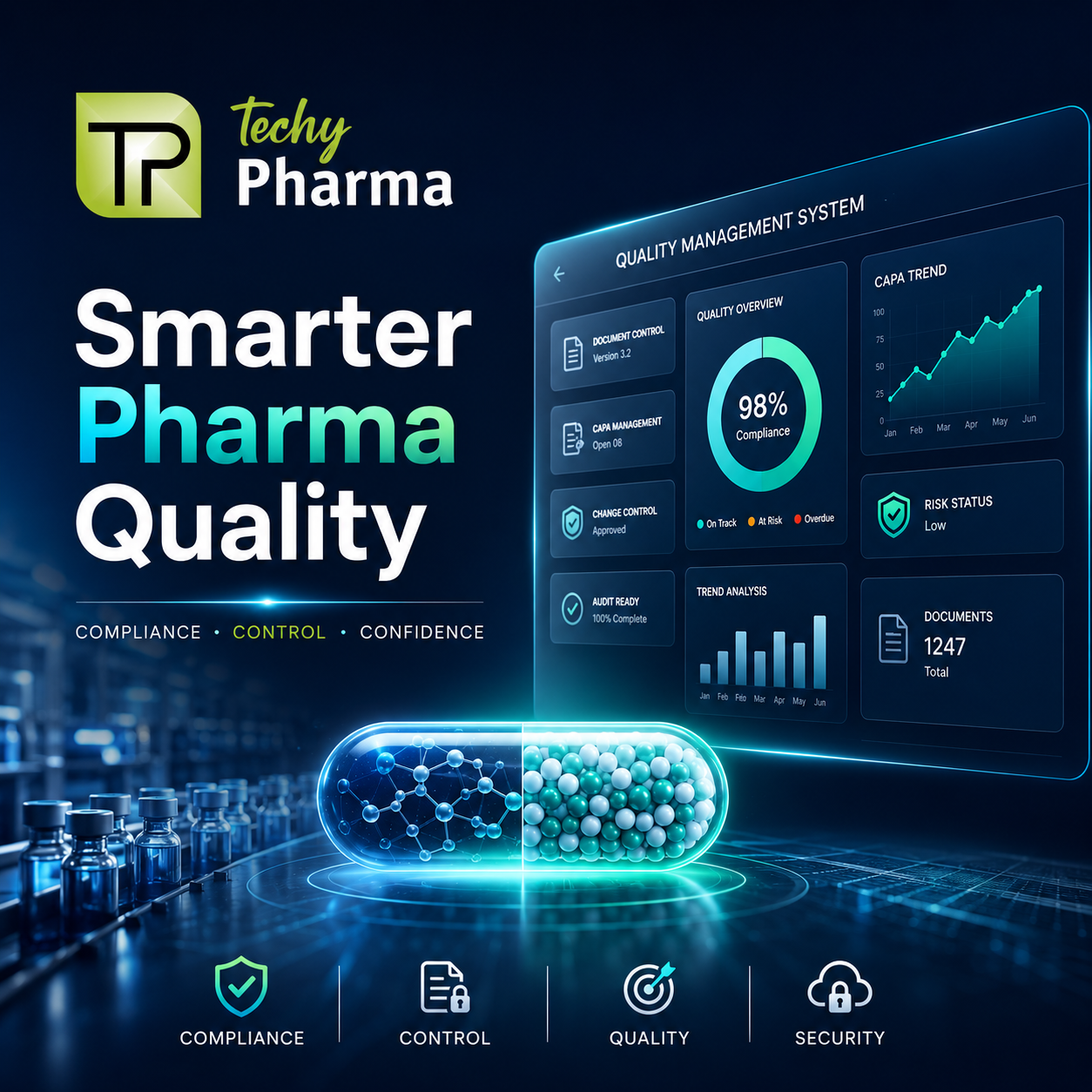
Management can get instant visibility into open issues, overdue actions, and quality trends through dashboards and reports.
8. Better compliance support
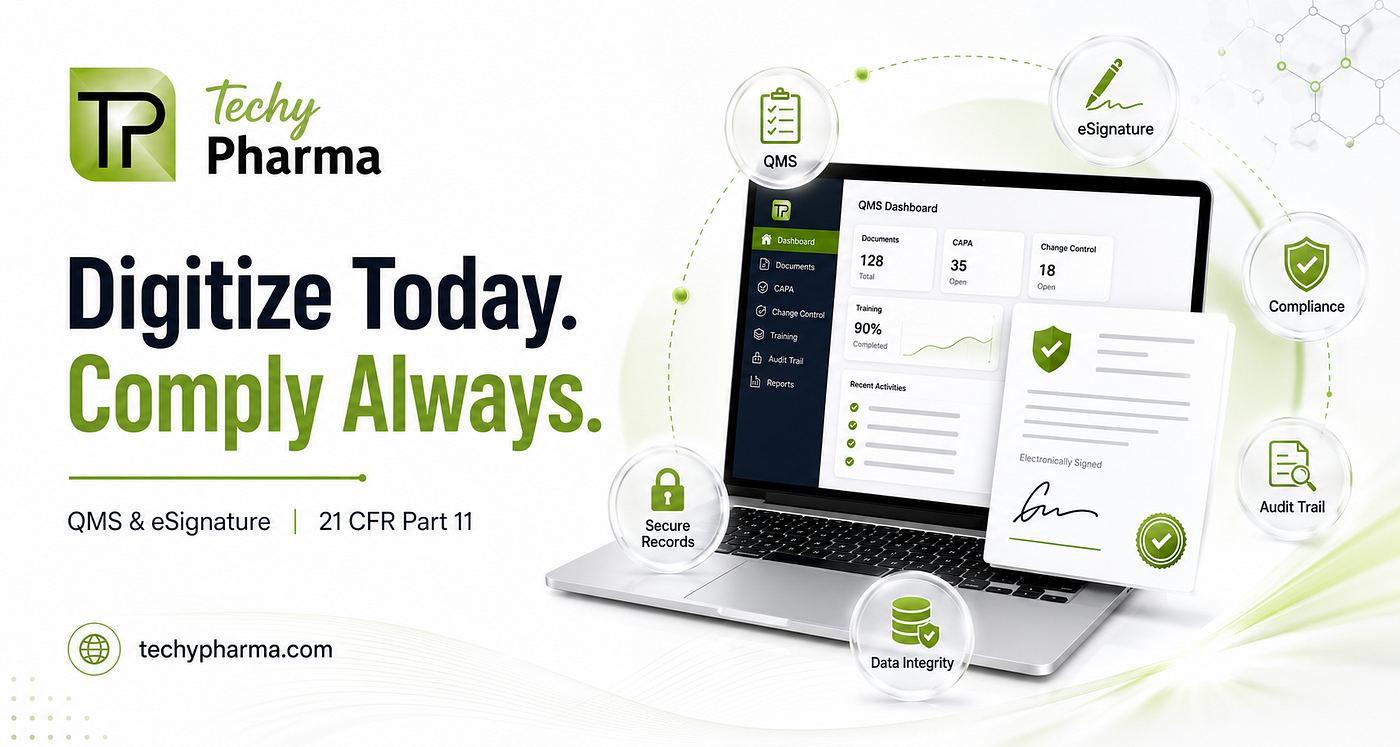
A modern QMS can support data integrity, controlled access, e-signatures, and traceability, which are critical for regulated industries.
9. Scalable for growing organizations
As pharma companies expand, a digital QMS can scale across departments, sites, and teams without losing control.
10. Continuous improvement insights
Trend analysis and recurring issue tracking help organizations identify weak points and improve quality performance over time.
What a Modern Pharma QMS Should Deliver
A strong QMS should not only help with compliance. It should also improve business performance.
A modern pharma QMS should provide:
- Faster approvals
- Better traceability
- Reduced manual effort
- Lower compliance risk
- Improved team collaboration
- Faster audit preparation
- Clear quality metrics
- Better process consistency
- More confident decision-making
For pharma and CROs, this means fewer quality bottlenecks and more focus on innovation, operations, and growth.
Best Practices for Building a Strong QMS
To make a QMS effective, companies should follow these best practices:
Standardize processes
Use clear SOPs and consistent workflows across departments.
Digitize quality records
Reduce paper dependency and use secure digital systems for record keeping.
Train employees regularly
Quality culture starts with awareness and responsibility at every level.
Track everything
Every deviation, change, and CAPA should be traceable from start to finish.
Review trends
Use quality data to identify recurring issues and improve long-term performance.
Involve leadership
Management support is critical for successful QMS adoption.
Focus on usability
The system should be simple enough for teams to use daily without friction.
Why QMS is a Business Advantage
Many companies think of QMS only as a compliance requirement. In reality, it is also a business advantage.
A well-designed QMS can help companies:
- Reduce waste
- Save time
- Improve product consistency
- Strengthen customer trust
- Reduce audit risk
- Increase operational efficiency
- Support long-term growth
In the pharmaceutical industry, quality is directly linked to reputation. Companies that build strong quality systems are better positioned to compete and scale.
How Techy Pharma Supports Quality-Driven Growth
Techy Pharma can help pharma companies move from fragmented quality processes to a more streamlined and controlled environment.
By offering software solutions designed for regulated operations, Techy Pharma can support:
- Digital quality workflows
- Document and change control
- Deviation and CAPA management
- Audit readiness
- Compliance-focused operations
- Better visibility across quality functions
The goal is not only to manage quality, but to make quality easier to execute every day.
Conclusion
A Quality Management System (QMS) is the foundation of quality, compliance, and operational excellence in the pharmaceutical industry. From document control and CAPA to audits and risk management, every part of a pharma organization depends on an effective QMS.
However, manual systems often create delays, errors, and compliance risks. That is why digital transformation is so important. With the right platform, pharma companies can improve traceability, reduce workload, and stay inspection-ready.
Techy Pharma can help organizations build a smarter, more reliable QMS that supports compliance, efficiency, and continuous improvement.
FAQs
What is QMS in pharma?
QMS in pharma is a structured system that manages quality processes, compliance, documentation, investigations, and continuous improvement.
Why is QMS important in pharmaceuticals?
It helps ensure product quality, patient safety, regulatory compliance, and process consistency.
What are the main components of QMS?
Key components include document control, CAPA, deviation management, change control, audits, training, complaint handling, and risk management.
How can Techy Pharma help with QMS?
Techy Pharma can provide digital solutions that streamline quality workflows, improve compliance, and reduce manual effort.
More Information: https://techypharma.com/resources/blog/quality-management-system-qms-in-pharma-benefits-challenges-digital-solutions/
메타데이터
- post_id
- 3cbe8cc9f0a6
- slug
- qms-quality-management-system-importance-challenges-and-how-techy-pharma-helps-pharma-3cbe8cc9f0a6
- url
- https://medium.com/@bd_56967/qms-quality-management-system-importance-challenges-and-how-techy-pharma-helps-pharma-3cbe8cc9f0a6
- canonical_url
- https://medium.com/@bd_56967/qms-quality-management-system-importance-challenges-and-how-techy-pharma-helps-pharma-3cbe8cc9f0a6
- author_url
- https://medium.com/@bd_56967
- status
- ok
- fetched_at
- 2026-06-09 15:37:30