Bridging the Gap: Why We Should Stop Choosing Between Model Cascading and Speculative Decoding
In the world of LLM inference optimization, two heavyweights have long dominated the conversation: Model Cascading and Speculative…
Bridging the Gap: Why We Should Stop Choosing Between Model Cascading and Speculative Decoding
In the world of LLM inference optimization, two heavyweights have long dominated the conversation: Model Cascading and Speculative Decoding.
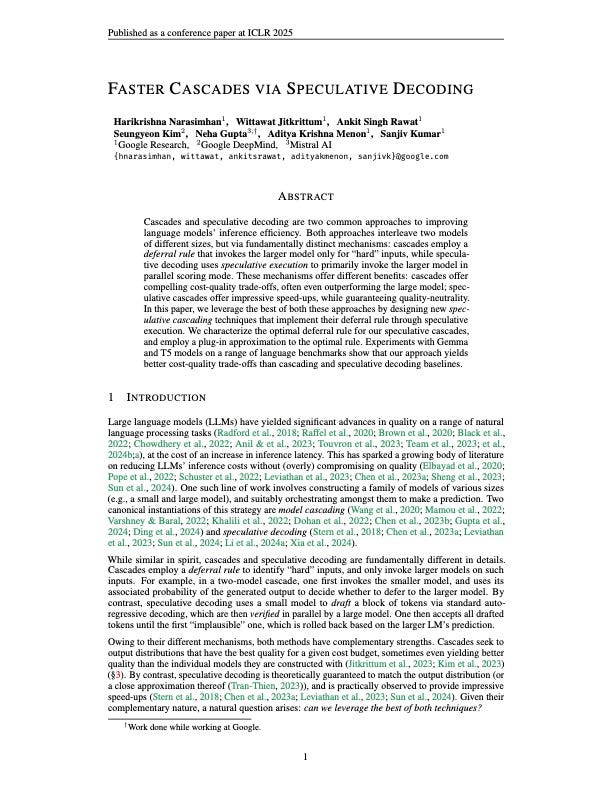
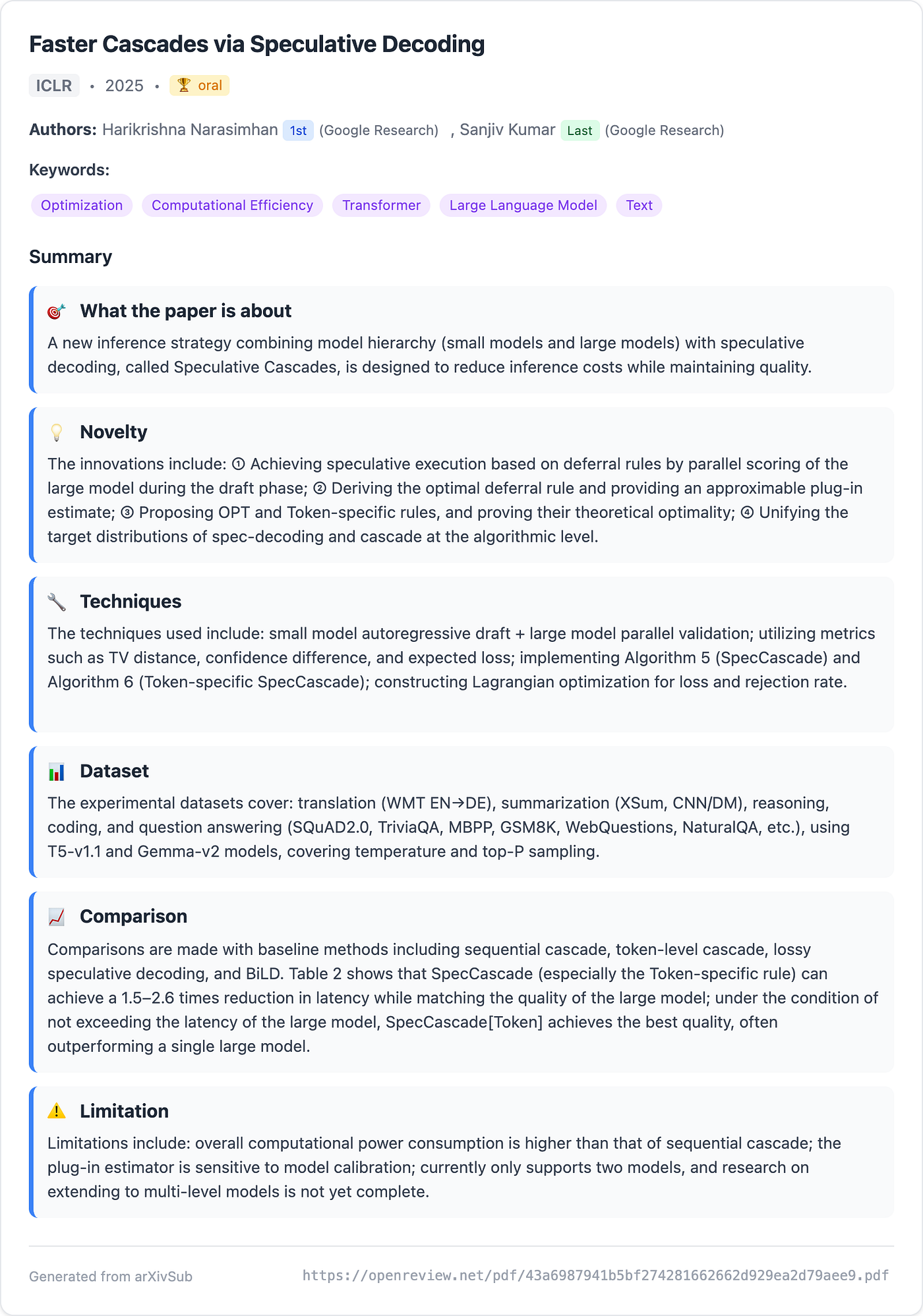
On one hand, Cascading is the king of budget management. It allows us to play a balancing act between quality and cost by routing simpler queries to a “small” model ($q$) and reserving the “big” model ($p$) for the heavy lifting. On the other hand, Speculative Decoding is the undisputed speed demon; it accelerates generation by letting a small model draft tokens while the big model verifies them in parallel, all without altering the final output distribution.
Despite their strengths, these two paths have largely remained parallel. Cascading is great at “smart routing” but lacks parallel efficiency; Speculative Decoding is fast but doesn’t naturally navigate the quality-cost trade-off.
The million-dollar question is: Can we merge them into a single framework?
The Unified Vision
A recent paper proposes exactly that. The goal is to combine the “clever decision-making” of Cascading with the “parallel verification” speed of Speculative Decoding.
To understand how they fuse, let’s look at how they traditionally differ:
- Traditional Cascading: Operates like a binary classifier. It looks at the small model’s confidence (using metrics like max probability or entropy) and decides: “Do I trust $q$ enough to stop here, or do I need to call $p$?” It’s a step-by-step handoff.
- Speculative Decoding: Operates like a draft-and-review system. The small model $q$ drafts a block of tokens, and the big model $p$ scores them all at once, deciding which to keep and which to roll back.
The breakthrough here lies in a unified mathematical perspective. If you can express the final output at any given position as a joint distribution $\pi(q_t, p_t)$, you can implement it using a generalized Speculative Decoding process.
In this view, the “Cascade” is just a specific mixture distribution:
$$\pi(v) = (1-\delta) \cdot q_t(v) + \delta \cdot p_t(v)$$
In traditional cascading, $\delta$ is simply a 0 or 1 decision based on a heuristic.
From “Wait and See” to “Parallel Validation”
The shift is subtle but powerful. Instead of the old sequence — Run $q \rightarrow$ Check confidence $\rightarrow$ Decide whether to run $p$ — the new flow becomes: Run $q \rightarrow$ $p$ performs parallel scoring $\rightarrow$ Accept/Reject based on $\pi$.
By doing this, we use the big model’s actual distribution to better calculate the delegation factor ($\delta$), similar to how methods like Diff or OPT operate, but within a much more efficient execution loop.
Optimizing for the Real World
In a standard cascade, we usually aim to minimize a simple objective: the expected loss of staying with the small model versus the cost of switching to the big one.
However, when you introduce Speculative Decoding, “cost” isn’t a constant anymore. It becomes a variable tied to the rejection rate. The paper re-frames the “optimal deferral” (when to hand off to the big model) as a constrained optimization problem:
- Minimize Loss: Ensure the generated distribution stays as close to the ground truth as possible.
- Budget Constraint: Keep the total “rollback” overhead within a predefined limit.
The paper even dives into a token-specific deferral mechanism, allowing the system to decide whether to delegate to the big model on a per-token basis rather than just per-sequence.
The Bottom Line
The results of this “SpecCascade” approach are clear. Whether you are looking for the lowest latency at a fixed quality bar or the highest quality within a fixed latency budget, this hybrid approach outperforms both traditional cascading and “lossy” speculative decoding.
By breaking down the wall between routing and drafting, we’re finally getting the best of both worlds: a system that is as smart as a cascade and as fast as a speculator.
| Find papers faster on arXivSub with AI summary (CVPR/ICCV/ICML/ICLR/NeurIPS/AAAI/MICCAI)
메타데이터
- post_id
- 3cc2fd2e0c37
- slug
- bridging-the-gap-why-we-should-stop-choosing-between-model-cascading-and-speculative-decoding-3cc2fd2e0c37
- url
- https://medium.com/@zljdanceholic/bridging-the-gap-why-we-should-stop-choosing-between-model-cascading-and-speculative-decoding-3cc2fd2e0c37
- canonical_url
- https://medium.com/@zljdanceholic/bridging-the-gap-why-we-should-stop-choosing-between-model-cascading-and-speculative-decoding-3cc2fd2e0c37
- author_url
- https://medium.com/@zljdanceholic
- status
- ok
- fetched_at
- 2026-06-09 15:37:30