Rethinking Motivation
or what I’ve learned from the “Drive” book by Daniel H. Pink
Rethinking Motivation
or what I’ve learned from the “Drive” book by Daniel H. Pink
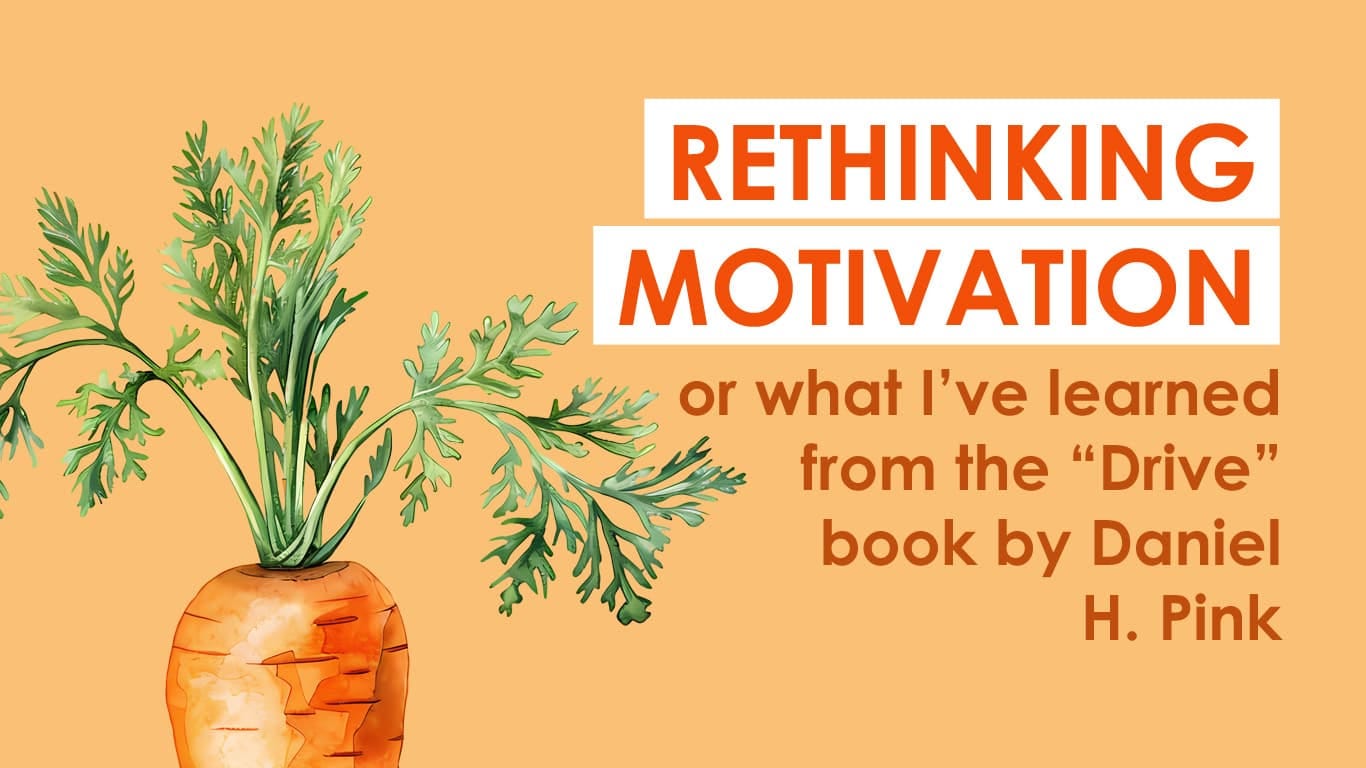
the cover is made by the author — Felix Davidenko
How often do you think about what motivates you to work? What motivates you to get up in the morning and do what you get paid for? And how often do you think an employer thinks about what motivates their employees to do their job? I’m sure that you think about your motives literally every day, but the employer most often doesn’t think about your motives at all. His job is to pay you a salary, and he thinks that this is enough of a motivator for you to give 100% every day. Why this attitude is outdated and ineffective, as well as how to really motivate people, Daniel Pink tells in his book “Drive”.
This article is not a verbatim retelling of all the chapters of the book but is a subjective overview of the key points that I highlighted in the margins of the book while reading it.
About the author
Daniel H. Pink is an American author and speaker known for his work on business, motivation, and human behavior. Born in 1964, Pink has a background in law, earning a degree from Yale Law School, though he chose to pursue a career in writing and public speaking instead of practicing law. He has written several bestselling books, including “Drive”, which focuses on how human motivation functions in the modern world. Pink’s work often challenges conventional thinking about work, education, and business. He is also a frequent motivational speaker and has given multiple TED Talks.
Rethinking motivation
The main idea of this book is that the traditional motivation system based on external rewards and punishments (such as money, promotions, or fear of failure) is outdated and ineffective, especially for complex, creative tasks. Instead, the author argues that true motivation comes from intrinsic factors: the desire for autonomy (the freedom to control our own work), mastery (the drive to improve and become better at something meaningful), and purpose (the sense that our work contributes to something larger than ourselves). These intrinsic motivators are more powerful and lead to higher performance and satisfaction in the modern world.
Motivation 1.0 was the basic biological drive for survival — seeking food, safety, and reproduction. As society advanced, Motivation 2.0 emerged, based on the reward-and-punishment system, which dominated the workplace and educational systems in the industrial era. Pink refers to this as an extrinsic motivator model, one that assumes humans are primarily driven by the desire for external rewards (money, status, approval) or the fear of punishment.
However, in modern contexts where creativity, problem-solving, and innovation are key, Motivation 2.0 is increasingly inadequate. Pink points out that rewards and punishments can actually dampen creativity, encourage short-term thinking, and promote unethical behavior. He provides numerous studies and examples demonstrating how extrinsic rewards narrow focus and are only effective for routine tasks, not for complex, cognitive ones.
Motivation 3.0 recognizes that humans have a natural desire to learn, create, and improve the world around them. Pink argues that this internal drive is essential for modern-day success. The three pillars of this new operating system are autonomy, mastery, and purpose. Pink asserts that these intrinsic motivators are far more powerful than external ones in encouraging high performance and personal satisfaction.
How does it work in real life
One powerful example from this book that illustrates the principles of autonomy, mastery, and purpose is the case of Atlassian, a software company. Atlassian introduced what they called “FedEx Days” (now known as ShipIt Days), where employees were given 24 hours of complete autonomy to work on any problem or project they chose, as long as they delivered a prototype or result by the end of the day.
This experiment led to breakthroughs and innovations that the company hadn’t anticipated. Because employees were given autonomy to choose their own projects and methods, they were more engaged and motivated. They pursued mastery by diving deep into problems they were passionate about, and they felt a sense of purpose in delivering something valuable to the company by the end of the 24-hour period.
This illustrates how creating an environment with autonomy (freedom to choose their tasks), mastery (the challenge of solving important problems), and purpose (the drive to deliver meaningful results) can lead to higher levels of creativity and productivity, ultimately helping both individuals and the company succeed.
Three pieces of advice
- Create time for autonomy. Schedule time each day where you have complete control over what you do, how you do it, and when you do it. This could be setting aside an hour to work on personal projects, experiment with new ideas, or improve skills in an area you care about. Autonomy fosters creativity and engagement.
- Focus on mastery through deliberate practice. Pick a skill or area you want to improve and commit to deliberate practice. Set specific goals for improvement and break them into manageable tasks. Embrace challenges, seek feedback, and understand that mastery is a long-term pursuit. The continuous desire to improve will keep you motivated.
- Align your tasks with purpose. Connect your daily activities to a larger goal or purpose. Reflect on how your work or personal projects contribute to something meaningful, whether it’s helping others, improving yourself, or contributing to a broader mission. When you feel your efforts matter, it boosts long-term motivation and satisfaction.
Conclusion
So, what I’ve learned from the “Drive” book is that old models of motivation, based on external rewards and punishments, no longer work in our modern world. Pink’s Motivation 3.0, centered on autonomy, mastery, and purpose, offers a framework for more effective and fulfilling work. By understanding what truly motivates us, individuals, organizations, and educators can unlock higher levels of creativity, productivity, and satisfaction.
In summary, “Drive” challenges us to rethink how we motivate ourselves and others. It provides a roadmap for creating environments that encourage intrinsic motivation, leading to better outcomes and more meaningful lives. The key to success, Pink suggests, lies in tapping into our innate human desires to direct our own lives, improve our skills, and work toward a greater purpose.
Author — Felix Davidenko
Join me on LinkedIn
메타데이터
- post_id
- 3cc596cafd2a
- slug
- rethinking-motivation-3cc596cafd2a
- url
- https://medium.com/@felixdavidenko/rethinking-motivation-3cc596cafd2a
- canonical_url
- https://medium.com/@felixdavidenko/rethinking-motivation-3cc596cafd2a
- author_url
- https://medium.com/@felixdavidenko
- status
- ok
- fetched_at
- 2026-07-29 01:50:13