Is It Good English ? Yes, It’s.
The Linguistic Reason Behind Contraction Restrictions
Is It Good English ? Yes, It’s.
The Linguistic Reason Behind Contraction Restrictions
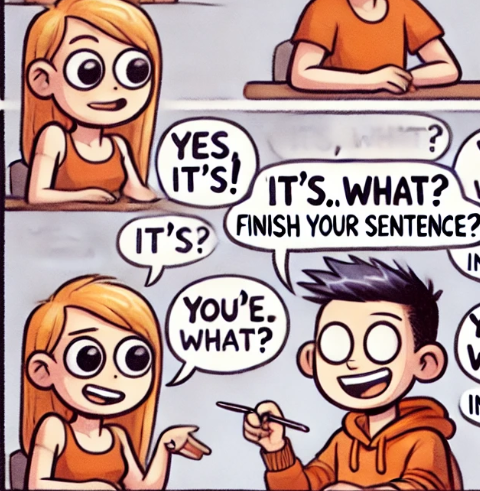
Have you ever noticed that you can end a sentence with isn’t or aren’t, but not with it’s or I’m?
✔ Yes, it is. → Yes, it is! ✔ No, it is not. → No, it isn’t! ✘ Yes, it’s. → (Unacceptable in English)
This restriction is not just a convention — it is a syntactic necessity. Contractions like it’s and I’m cannot function as standalone responses because they are structurally incomplete.
Contractions Are Not Fully Functional Verbs
English allows auxiliary verbs (is, am, are) to stand alone when the rest of the sentence is omitted through ellipsis:
✔ Are you coming? → Yes, I am! ✔ Do you like it? → Yes, I do!
This works because am and is are fully functional verbs, and their complements can be omitted when the meaning is clear. However, I’m and it’s behave differently because they are fused contractions of a pronoun (I, it) and a verb (am, is), making them syntactically incomplete without a complement:
✔ I’m happy. → Yes, I am. (Ellipsis allows “I am happy” to be understood.) ✘ Yes, I’m. (Unacceptable because I’m is an incomplete contraction — it must be followed by a complement)
✔ It’s cold. → Yes, it is. (Ellipsis allows “it is cold” to be implied.) ✘ Yes, it’s. (Unacceptable because it’s needs a complement.)
The issue is that in standard English, subject-verb contractions require a following element to complete the sentence. Unlike is and am, which can function independently, it’s and I’m do not have the grammatical flexibility to stand alone.
Why Negation Changes the Rules
Negative contractions (isn’t, aren’t, wasn’t, weren’t) behave differently because negation adds enough meaning to make the sentence complete.
✔ Is it raining? → No, it isn’t. (Negation allows “It isn’t raining” to be understood.) ✔ Are you coming? → No, I’m not. (Negation makes “I’m not coming” a valid response.)
In contrast, it’s and I’m lack the necessary semantic weight to stand alone:
✘ Is it raining? → Yes, it’s. (Incomplete: “It’s what?” remains unresolved.) ✘ Are you hungry? → Yes, I’m. (Unacceptable: I’m must be followed by a complement.)
Negative contractions work because the negation itself provides enough semantic completion, whereas simple contractions do not.
Why This Is a Syntactic Necessity, Not Just Convention
This restriction is not just a stylistic rule; it is a fundamental aspect of English syntax:
- Ellipsis only works with full auxiliary verbs, not contractions.
- Subject-verb contractions require a complement — they do not behave like standalone auxiliary verbs.
- Negation makes a contraction syntactically and semantically complete, but affirmative contractions do not have this feature.
Some languages (e.g.: Spanish) allow pronoun omission (pro-drop languages), making similar contractions grammatically possible. But in English, subject-auxiliary contractions are always incomplete without something following them.
The Exception: Colloquial Speech
Some dialects and informal speech patterns override these rules, though they remain ungrammatical in standard English. You might hear:
- You ready? → Yeah, I’m. (Non-standard but sometimes used in casual speech.)
However, this remains uncommon and sounds unnatural in formal English.
This quirk of English grammar boils down to syntax: affirmative contractions require a complement, while negatives do not. That’s why you can say No, it isn’t, but never Yes, it’s.
©Antoine Decressac — 2025.

메타데이터
- post_id
- 3cc69412338f
- slug
- is-it-good-english-yes-its-3cc69412338f
- url
- https://medium.com/knowlobby/is-it-good-english-yes-its-3cc69412338f
- canonical_url
- https://medium.com/knowlobby/is-it-good-english-yes-its-3cc69412338f
- author_url
- https://medium.com/@adecressac
- status
- ok
- fetched_at
- 2026-07-31 18:08:18