The VIP Room Paradox: How to Stop Getting “Viral But Broke” on Medium
Stop getting 10,000 views for a $2 payout. Learn how to reverse-engineer the Medium algorithm to capture high-value paying members and…
The VIP Room Paradox: How to Stop Getting “Viral But Broke” on Medium
Stop getting 10,000 views for a $2 payout. Learn how to reverse-engineer the Medium algorithm to capture high-value paying members and build real income.
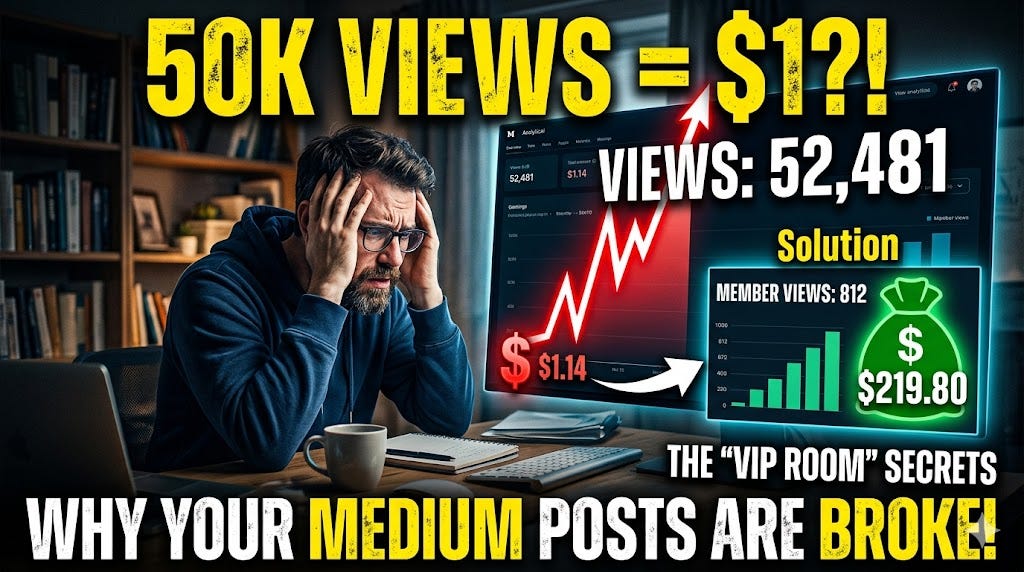
You spent days researching, writing, and polishing your article. You hit publish. Suddenly, the traffic spikes. Your analytics dashboard shows 10,000 views, then 20,000. You are refreshing the page, watching the numbers climb, imagining the payout.
Then, the monthly earnings report arrives. Your reward for 20,000 views? $2.14.
If this has happened to you, you are not alone. Thousands of expert writers abandon Medium every month because they feel cheated by the system. But the platform isn’t cheating you. You are just playing the wrong game. You are optimizing for eyeballs, but Medium only pays for a very specific type of attention.
Here is how to stop getting “viral but broke” and start capturing the readers who actually pay your bills.
1.0 The Broken Math of the Medium Algorithm
The biggest trap on Medium is external virality.
When your article gets shared on Reddit, Twitter, or Google Discover, you get a massive flood of traffic. But here is the hard truth: Medium is a closed ecosystem. The platform does not run ads. It makes money solely from monthly subscription fees paid by Medium Members. Therefore, they only pay you when a paying member reads your work.
When 50,000 free users read your article, Medium makes zero dollars, which means you make zero dollars.
“Think of Medium like a high-end casino. External traffic is just people looking through the windows from the street. They don’t make the casino money, so the casino doesn’t pay you. You only get paid when you pull the high-rollers — the paying members — into the VIP room to sit at your table.”
To actually earn money, you must completely shift your goal. You have to stop asking, “How do I get more views?” and start asking, “How do I trap high-value member attention?”
2.0 Reverse-Engineering the “Boost” Trigger
If you want to reach paying members, you need the algorithm to push your story to their customized homepages. This process is heavily influenced by human curators called “Boost Nominators.”
Why Tags Are Dead
Writers used to stuff their articles with generic tags like #Technology, #Writing, or #LifeLessons. Today, those broad categories are completely saturated with AI-generated filler. Nominators ignore them.
The Micro-Niche Strategy
Instead of broad tags, target the micro-niches that human curators actively monitor. If you are writing about coding, don’t use #Programming. Use #ReactServerComponents or #DatabaseArchitecture. You are signaling to the system that your content is for deep experts, not casual scrollers.
The 30-Second Paywall Hook
Medium pays based on “read time,” but there is a catch. When a paying member clicks your article, the algorithm watches closely to see if they stay past the first 30 seconds. If they bounce, your article is buried.
To trigger the “deep read” multiplier, you must structure your introduction to drop the reader directly into the middle of the problem. Skip the long, winding background information. State the exact pain point in the first sentence, and promise the data-backed solution by the third.
3.0 The Contrarian Opinion: Stop Submitting to Big Publications
Mainstream advice always says the same thing: If you want to make money on Medium, you must submit your drafts to massive publications with hundreds of thousands of followers.
This is an illusion of reach, and it is actively hurting your long-term income.
When a reader follows a massive publication, that publication controls the distribution. The reader connects with the publication’s brand, not yours. Worse, you do not get to capture that reader’s email address.
“Large publications rent you their audience for a day. Building your own micro-publication allows you to own your audience for a lifetime.”
The Pivot
Start your own micro-publication on Medium. Yes, you will lose the initial, vanity-metric spike in views. But every person who subscribes to your publication is a high-intent reader. You keep 100% of that long-term, compounding member list. Over time, publishing to 500 of your own dedicated members will pay infinitely more than publishing to 50,000 strangers in someone else’s magazine.
4.0 The Real-World Telemetry: Member Views vs. Free Views
Let’s look at hard data to prove why targeting members is the only math that matters. Here is a real-world breakdown of two articles written by the same author in the same month.
- Article A: A broad opinion piece about the future of tech. It went viral on an external forum.
- Views: 12,000
- Traffic Source: 98% External
- Total Payout: $1.14
- Article B: A highly technical, hyper-specific breakdown of a software migration problem.
- Views: 800
- Traffic Source: 90% Internal Medium Members
- Total Payout: $312.50
The Data Teardown
Why did Article B win? Because it used entity-dense language. It didn’t just use keywords; it used the specific jargon, tool names, and structural concepts that only a working professional would understand. The Medium algorithm recognized this high-signal text and served it directly to members who had a history of reading deep, technical content.
5.0 Building the “Earnings Moat”
Once you get a paying member onto your page, you cannot let them leave. You need to build an earnings moat that traps their attention and compounds your read time.
The Internal Linking Web
Never leave a reader at a dead end. Instead of linking out to external sites, aggressively link your new articles to your past high-earning articles. Create a closed-loop trap. When a paying member finishes one article, the exact solution to their next logical question should be a link to another one of your stories.
The LLM Discovery Pivot
Search engines are changing. People are now using AI tools like ChatGPT or Perplexity to find answers. You want these AI engines to cite your Medium article as the primary source. To do this, format your H2 and H3 headers as direct, highly specific questions, immediately followed by a clear, factual answer. This makes your content highly discoverable to AI, which then drives premium, high-intent readers straight to your page.
Your Final Action Protocol
Before you write your next post, do this to fix the ones you already have:
- Audit: Find an old Medium article that has high external views but low earnings.
- Rewrite: Change the headline and the first paragraph to speak directly to a high-level expert, cutting out all beginner-level fluff.
- Relink: Add three internal links to your other deep-dive articles.
Stop writing for the internet. Start writing for the VIP room.
메타데이터
- post_id
- 3cca323be5ed
- slug
- the-vip-room-paradox-how-to-stop-getting-viral-but-broke-on-medium-3cca323be5ed
- url
- https://medium.com/@nanthakumar18122000/the-vip-room-paradox-how-to-stop-getting-viral-but-broke-on-medium-3cca323be5ed
- canonical_url
- https://medium.com/@nanthakumar18122000/the-vip-room-paradox-how-to-stop-getting-viral-but-broke-on-medium-3cca323be5ed
- author_url
- https://medium.com/@nanthakumar18122000
- status
- ok
- fetched_at
- 2026-08-06 12:15:19