The Context Window Crisis: Why Standard Tokenizers Fail Web3 Security
Web3 security is fundamentally broken at the parsing layer. We expect large language models to catch reentrancy attacks before blocks…
The Context Window Crisis: Why Standard Tokenizers Fail Web3 Security
Web3 security is fundamentally broken at the parsing layer. We expect large language models to catch reentrancy attacks before blocks finalize. They usually fail. They fail because neural networks do not read Solidity. They read matrices of numbers. Every time an auditor feeds a smart contract into a standard AI model, they bleed context window capacity.
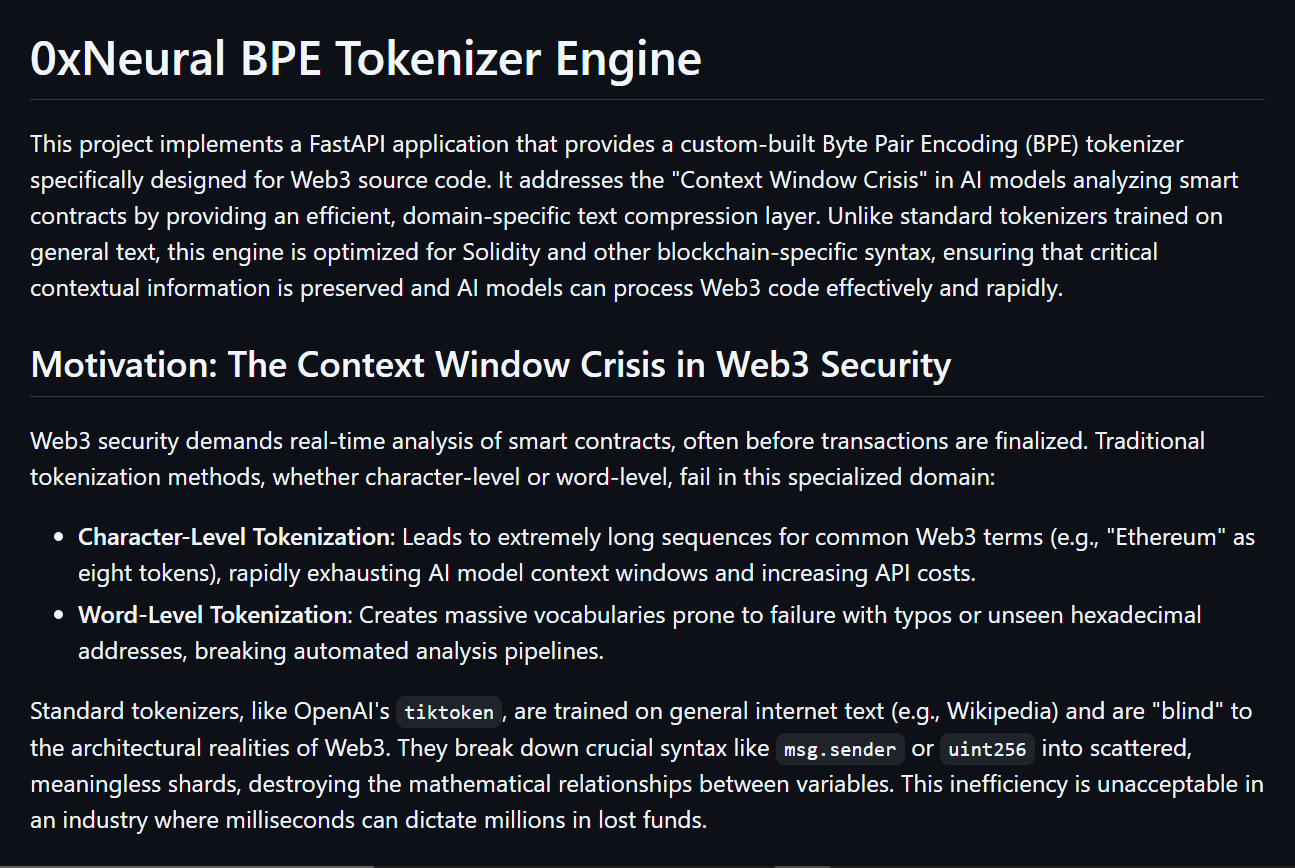
The standard infrastructure is reactive. By the time a malicious transaction executes on the Ethereum mainnet, the capital is already gone. Real security requires analyzing the mempool. It requires flagging anomalous logic in milliseconds before validators commit the block. You cannot achieve this latency if your data pipeline chokes on the text compression layer. Standard tokenizers treat blockchain syntax as alien text. They break down a simple msg.sender or uint256 into scattered, meaningless shards. This destroys the mathematical relationship between the variables. In an industry where milliseconds dictate millions in lost funds, this inefficiency is entirely unacceptable.
It is 11PM in Cotonou, Benin. I am staring at the limitations of basic text compression. I am looking at the raw memory overhead of feeding smart contracts into an AI pipeline. The “Goldilocks” dilemma of natural language processing is mathematically flawed when applied to decentralized finance.
Character-level tokenization forces an AI to process the word “Ethereum” as eight distinct tokens. When you scale this to a 500-line decentralized application, it rapidly exhausts the model memory. It maximizes API costs. Word-level tokenization creates a massive dictionary of hundreds of thousands of words. It crashes the moment it encounters a typo. It fails completely when it scans an unseen hexadecimal wallet address. A single out-of-vocabulary error breaks the entire automated pipeline.
The industry relies on sub-word tokenization. Specifically, it uses Byte-Pair Encoding. The algorithm is sound. The training data is the problem.
Most developers simply import the OpenAI tiktoken library. I refused the black box.
Standard tokenizers train on general internet text. They optimize for Wikipedia articles and conversational English. They are completely blind to the architectural realities of Web3. Relying on them to parse a smart contract is an engineering flaw. I stripped away the frameworks. I dropped PyTorch and TensorFlow. I bypassed the pre-built Hugging Face wrappers. I built the text compression algorithm entirely from scratch in pure Python.
The rigorous preparation from ALX’s Data Science program taught me a critical lesson. You must understand the raw mechanics beneath the libraries. You cannot fix a memory leak in an abstraction. I needed a tokenizer that understood Web3 natively.
I acquired 9.8 million characters of deployed smart contracts from decentralized applications. Loading ten million characters into active memory presents an immediate bottleneck. Python handles strings inefficiently. Converting this mass of text into a workable list of integers requires strict memory management. A poorly optimized iteration loop easily crashes a local kernel when computing frequency stats across millions of adjacent byte pairs.
I initiated the engine with the absolute baseline. The vocabulary started with 256 standard UTF-8 raw bytes. The algorithm scanned the sequence of integers. It counted the frequency of every adjacent pair. It found the most common pair, assigned a new unique integer ID, and merged the pair throughout the entire text.
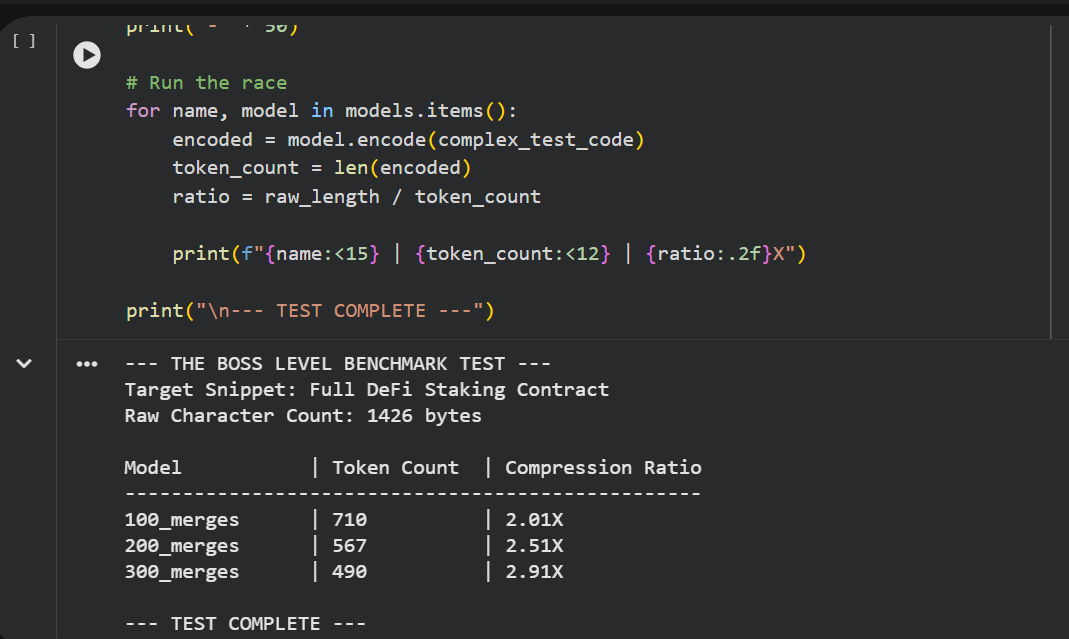
I forced the algorithm to discover the underlying mathematical structure of Web3 natively. I ran the engine for 100 merges, then 200 merges, and finally pushed the limits to 300 merges. The algorithm did not know what Solidity was. It simply followed the calculus of frequency. It naturally discovered that the characters u, i, n, t, 2, 5, 6 frequently appear together. It merged them. It learned that syntax like function and address are atomic concepts.
The deployment functions dictate the actual business value. The encode method takes fresh, unseen human text and compresses it using the exact learned merge rules in strict chronological order. The decode method translates the generated integers back into human-readable bytes. This process is perfectly mathematically reversible.
The benchmarks validate the architecture.
I ran a stress test against a heavily optimized, wordy DeFi staking contract spanning 1426 bytes. A standard tokenizer bleeds context parsing the brackets alone. My custom 300-merge model compressed the raw text down to 490 tokens. It achieved a 2.91X compression ratio. I tested a simple transfer function. The 300-merge model reduced 54 characters into just 11 tokens, delivering a 2.79X ratio.
I pushed the model against out-of-distribution data. I fed it an unseen NFT list contract utilizing OpenZeppelin inheritance and base64 SVG encoding. The model maintained strict structural integrity. It delivered a solid 1.87X compression ratio on alien logic. By compressing the tokens, I effectively tripled the context window of any AI model reading these contracts. I tripled the speed at which a neural network can ingest vulnerability data.
This build is not an academic exercise. It is the foundational layer for my Web3 security architecture. I am building pipelines that monitor real-time Ethereum mempool traffic. By passing the mempool data through this custom BPE tokenizer, I compress the traffic instantly. I feed dense, highly optimized integers into a custom neural network.
You cannot secure decentralized systems using tools built for chat applications. Real security demands infrastructure built specifically for the environment it protects. Develop your own data stacks. Control your own pipelines. Build the math yourself.
Explore the raw math, pure-Python architecture, and benchmark data here: https://github.com/Ogezi-Emmanuel/BPE-Tokenizer
메타데이터
- post_id
- 3cd82dfd2c1c
- slug
- the-context-window-crisis-why-standard-tokenizers-fail-web3-security-3cd82dfd2c1c
- url
- https://medium.com/@Emmysunday/the-context-window-crisis-why-standard-tokenizers-fail-web3-security-3cd82dfd2c1c
- canonical_url
- https://medium.com/@Emmysunday/the-context-window-crisis-why-standard-tokenizers-fail-web3-security-3cd82dfd2c1c
- author_url
- https://medium.com/@Emmysunday
- status
- ok
- fetched_at
- 2026-06-09 15:37:30