Holding Dollars Is A Losing Bet
There’s a question I keep coming back to, and I don’t think enough people are asking it seriously: What is your cash actually doing?
Holding Dollars Is A Losing Bet
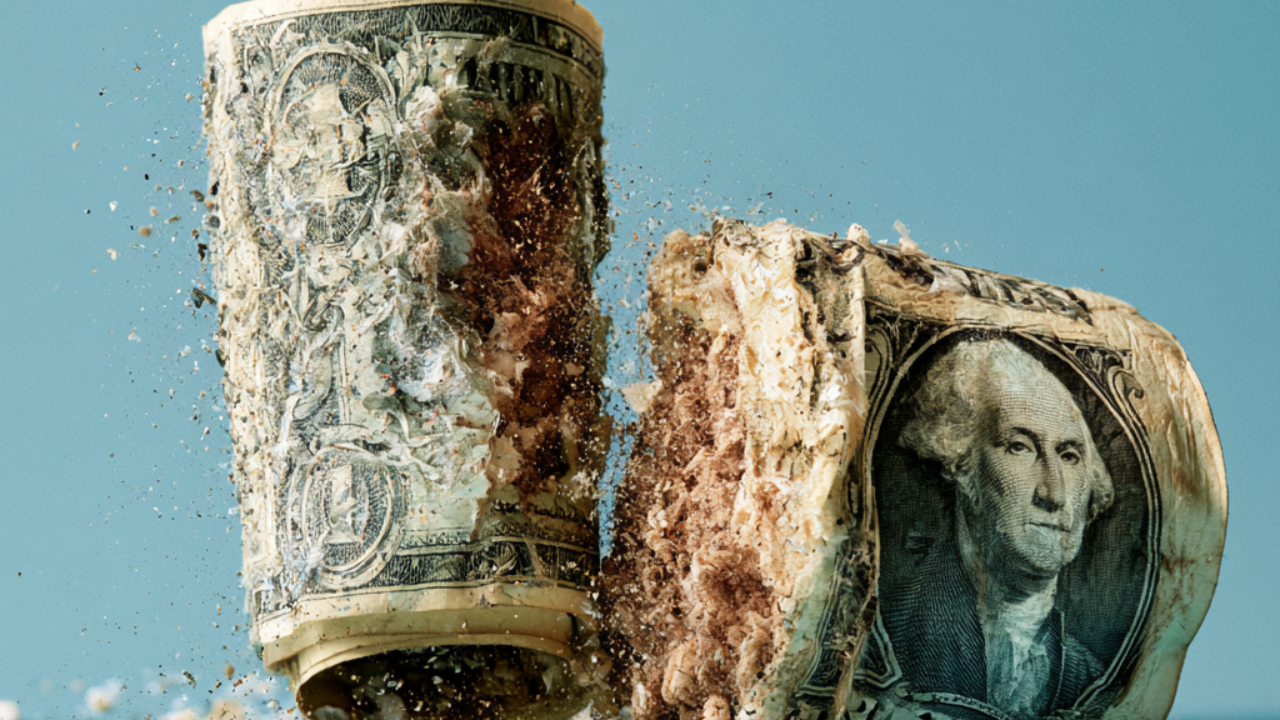
There’s a question I keep coming back to, and I don’t think enough people are asking it seriously: What is your cash actually doing?
Not what is available to do. Not what you could do with it. What is it doing right now, sitting in that savings account earning 0.01% while the price of your groceries climbs every single month?
The answer, if you’re honest about it, is losing.
I know that sounds dramatic. Cash feels safe. It’s liquid. You can see the number in your account. It doesn’t fluctuate like stocks. You’re not checking it nervously every morning. But the stability you see on screen is an optical illusion. The number stays the same. The purchasing power of that number quietly shrinks, year after year, with no alarm bells and no visible damage until you notice that a tank of gas costs what a week of groceries used to.
That’s inflation. And it’s not a once-in-a-while thing. It’s structural. It’s baked into how modern fiat money systems work.
The Inflation Tax Nobody Talks About
Let’s be direct about what inflation is. It’s not just prices going up. It’s a hidden tax on savers.
When the government needs to spend money it doesn’t have, one tool available to central banks is creating more of it. More dollars chasing roughly the same amount of goods means each dollar buys a little less. The people holding dollars take the hit. The people who borrowed or spent early get a relative benefit, because they’re paying back debts in cheaper future dollars. This isn’t a conspiracy theory — it’s a pretty well-understood mechanism that economists across the political spectrum acknowledge, even when they disagree about the consequences.
The Federal Reserve has a stated inflation target of 2% per year. Think about that for a second. The official, publicly stated goal is for your money to be worth 2% less every year. At 2%, the purchasing power of a dollar is cut roughly in half over 35 years. At 4%, you’re at half in about 18 years. At 7%, which the U.S. actually hit in 2021 and 2022, you’re looking at a halving in 10 years.
Most savings accounts, even good high-yield ones, don’t keep up. And after taxes on interest income, you’re almost certainly running negative in real terms during any serious inflationary period. You’re not saving. You’re slowly giving it away.
The people who understand this tend to stop treating cash as a store of value and start treating it as a medium of exchange — something you hold briefly while moving between assets, not something you park for decades and expect to maintain its worth. That’s a fundamentally different relationship with money, and it changes everything about how you think about financial protection.
When Inflation Goes Berserk
Normal inflation is a slow leak. You can live with it for years before you really feel it. But history keeps showing us what happens when the slow leak becomes a burst pipe.
Hyperinflation is a different animal entirely. It’s not 7% per year — it’s 7% per week, or per day, or per hour. It happens when confidence in a currency collapses faster than the supply can be managed, and once it starts, it can spiral in ways that are genuinely hard to comprehend from the outside.
The Weimar Republic in Germany in 1923 is the textbook case. At its worst, prices were doubling every few days. Workers were paid twice daily so they could spend their wages before they lost value. People famously burned currency for heat because it was cheaper than wood. A wheelbarrow of cash to buy a loaf of bread — that image stuck in the collective memory for a reason.
But Weimar isn’t ancient history as a concept. Zimbabwe went through it in 2008, with inflation peaking at numbers so large they became almost meaningless — the central bank eventually issued a 100-trillion-dollar note that couldn’t buy a bus ticket. Venezuela has been struggling through a version of it for over a decade, with ordinary Venezuelans watching their savings vanish and scrambling for any asset that could hold value.
You might reasonably say: That can’t happen here. The U.S. dollar is the world’s reserve currency. There are structural protections. Maybe. Probably. But “probably won’t happen” is cold comfort when we’re talking about savings you might depend on for the rest of your life. And even short of full hyperinflation, the 2021–2022 inflation cycle in the U.S. wiped out years of real purchasing power gains for people who held cash and did nothing. That wasn’t fringe. That was mainstream.
The pattern in every single hyperinflationary episode is the same: people who held hard assets survived in much better shape than people who held currency. Every time. Without exception.
Gold: The 5,000-Year Hedge
Gold has a reputation problem among a certain type of investor. It doesn’t pay dividends. It doesn’t grow earnings. You can’t build a discounted cash flow model on it. Buffett famously said it’s “inert” — it just sits there.
All of that is true. And it completely misses the point of what gold is for.
Gold isn’t a growth asset. It’s a monetary preservation asset. It’s what you hold when you want purchasing power to survive across decades, government changes, currency reforms, and economic crises. The reason it’s been used for this purpose for roughly five thousand years isn’t tradition or sentiment — it’s that it works. Gold has no counterparty risk. No government can print more of it. No central bank can debase it. It doesn’t go to zero because a company had a bad quarter.
When you look at what an ounce of gold could buy throughout history, the number is remarkably stable in real terms. An ounce of gold in ancient Rome could buy a fine toga and sandals. Today, it buys a reasonably nice suit. The commodity it tracked best, over thousands of years, is human productive capacity. That’s not magic. That’s a naturally scarce asset that people in various cultures have consistently agreed holds value.
In dollar-denominated terms over the last century, the dollar has lost more than 97% of its value against gold. An ounce of gold in 1920 cost about $20. Today it costs over $2,000. The dollar didn’t hold value against gold. Gold held value against the dollar. The math is not subtle.
During inflation cycles specifically, gold tends to do what it’s supposed to do. It’s not perfectly correlated with every inflationary period — sometimes it moves early, sometimes late — but over multi-year inflationary regimes, it has a solid track record of preserving purchasing power while cash holders take losses. That’s the job. It does the job.
Silver: The Underrated Sibling
If gold is the anchor, silver is the workhorse. It gets talked about less, but there are good reasons to pay attention to it, especially for people who aren’t starting with a large capital base.
First, the practical reality: a one-ounce silver coin costs around $28- $ 35 in the current market. A gold coin runs over $2,000. For someone building a physical hard-asset position from scratch, silver is simply more accessible. You can accumulate meaningful quantities without needing considerable upfront capital.
Second, silver has an industrial demand that gold largely doesn’t. Solar panels, electronics, electric vehicles, medical equipment — silver is embedded in the modern industrial economy in ways that create a floor of demand separate from its monetary role. That twofold nature means it can behave differently from gold and can outperform during industrial expansion cycles. It also means it’s more volatile, which is a two-edged sword — but for people with a long time horizon, that volatility can work in your favor if you’re accumulating steadily.
The gold-to-silver ratio — how many ounces of silver it takes to buy one ounce of gold — has historically averaged around 50–60. For much of the last decade, it has run at 80, 90, even over 100 at points. Some analysts who track this closely see silver as historically cheap relative to gold. Others think the changes in industrial supply have permanently repriced the relationship. I’m not going to tell you who’s right, but if you’re interested in precious metals, at least understanding the ratio and its history gives you a framework for thinking about relative value.
Actually Doing It: Physical vs. Paper
One thing worth being clear about: not all “gold and silver exposure” is the same thing.
ETFs like GLD or SLV give you price exposure to precious metals without actually holding them. They’re easy to buy and sell, they work fine for most investors, and they’re much more practical for large sums than taking physical delivery. But they do introduce counterparty risk. If you hold GLD, you hold a claim on gold. There’s a difference between holding the claim and holding the gold. In a serious financial crisis — which is exactly the scenario where you most want the hedge to work — the distinction can matter.
Physical gold and silver mean you actually have the metal. It has its own complications: storage, insurance, and the liquidity friction of selling. But it has no counterparty. Nobody can freeze it, and it doesn’t require a functioning financial system to retain value.
A practical approach for most people is some mix of both: physical holdings for serious long-term protection, and ETFs for the portion you might want to move more nimbly. Holding a few months’ worth of physical silver coins in a home safe, plus some GLD or a gold IRA for the larger allocation, isn’t paranoid — it’s just not putting all your eggs in one basket, which we were supposed to know already.
The Point Isn’t to Get Rich
I want to end on something that I think gets lost in a lot of precious metals conversations, because it tends to attract people with strong opinions who can sometimes make it sound like a sure path to wealth.
Gold and silver aren’t get-rich schemes. They’re not-get-poor schemes. They’re what you hold so that decades of savings and work don’t get quietly eaten by financial policy decisions you had no voice in. They’re the part of your financial life that exists outside the system — the portion that doesn’t depend on a government, a bank, or a corporation to honor a claim.
The dollar is useful. It’s how you transact, pay bills, and buy groceries. Nobody is saying to bury cash in the backyard. But treating it as the primary place to store wealth over long time horizons, when its entire design includes a feature that makes it worth less over time, is a bet you’re not making consciously. It’s a bet you’re making by default.
If you want to make that default bet on purpose, fine. But at least make it on purpose.
메타데이터
- post_id
- 3cdda0d0d2f6
- slug
- holding-dollars-is-a-losing-bet-3cdda0d0d2f6
- url
- https://medium.com/@travisthomas97701/holding-dollars-is-a-losing-bet-3cdda0d0d2f6
- canonical_url
- https://medium.com/@travisthomas97701/holding-dollars-is-a-losing-bet-3cdda0d0d2f6
- author_url
- https://medium.com/@travisthomas97701
- status
- ok
- fetched_at
- 2026-07-09 10:05:04