The Mandela Effect: Why Do Millions of People Have the Same False Memory?
If I asked you what year Nelson Mandela died, you might say, “The 1980s, when he was still in prison.”
The Mandela Effect: Why Do Millions of People Have the Same False Memory?
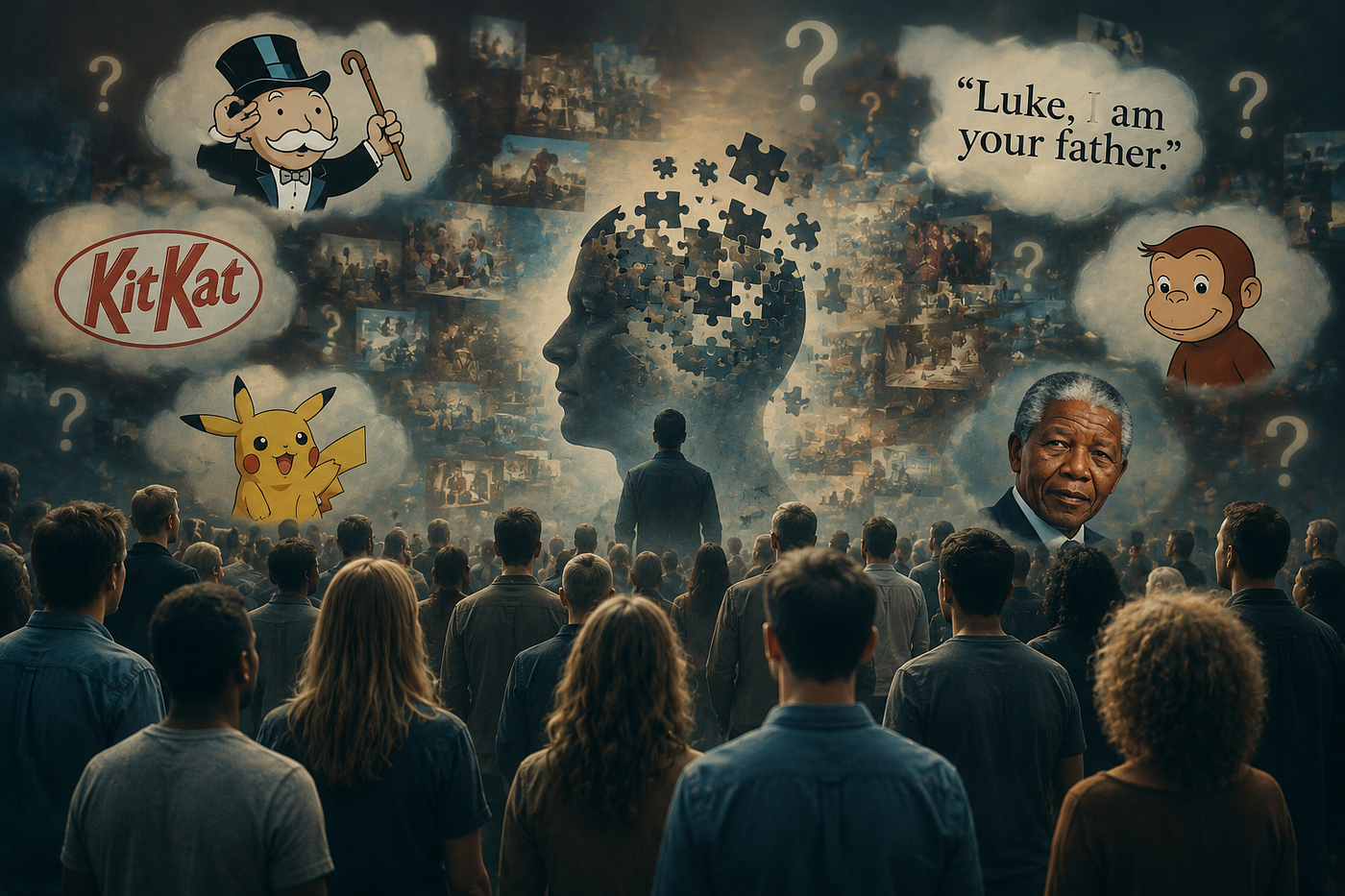
If I asked you what year Nelson Mandela died, you might say, “The 1980s, when he was still in prison.”
But that’s the wrong answer.
Mandela died in 2013, after years of freedom, political activism, and even presidency of South Africa.
What’s more interesting is that you’re not alone. Millions of people around the world have the same false memory, and some even claim to have watched his funeral on television.
How is it possible that so many people have the same memory of an event that never happened?
This amazing phenomenon is called the Mandela Effect; one of the most mysterious memory errors that challenges the boundaries between reality, memory, and perception.
What is the Mandela Effect?
The Mandela Effect occurs when a large number of people remember an event, name, image, or sentence in a similar but incorrect way.
The important thing is that people are not lying. They truly believe that their memory is correct.
For this reason, the Mandela Effect has attracted the attention of cognitive psychologists, neuroscientists, and even philosophers of the mind for years.
Where did the name come from?
In 2009, researcher Fiona Broome noticed that many people believed that Nelson Mandela had died in prison in the 1980s.
When she brought this up with others, she was surprised to find that many had exactly the same memories; some even remembered details such as news reports or funerals.
Even though none of these events had ever happened.
Since then, the phenomenon has become known as the Mandela Effect.
Real-life examples of the Mandela Effect
- The famous Monopoly penguin logo
Ask people what the Monopoly character looks like.
Many will confidently say:
“He has a monocle.”
But the truth is that this character never had a monocle.
- “Luke, I am your father.”
One of the most famous lines in movie history.
Most people are sure that in the movie Star Wars, Darth Vader said:
“Luke, I am your father.”
But the real sentence is:
“No, I am your father.”
The name “Luke” is not in that sentence at all.
- KitKat brand logo
Many are sure that the KitKat logo has a hyphen between the two words.
That is:
Kit-Kat
But in fact, the official logo has been written as:
KitKat
For years.
- Curious George
Most people think he has a tail.
But if you look at the original images, you’ll notice that this adorable monkey never had a tail.
- Pikachu
Many people think that the end of Pikachu’s tail is black.
But in the original anime and game, his tail never had a black tip.
Does this mean that reality has changed?
There are many interesting and sometimes bizarre theories about the Mandela Effect on the Internet.
Some say:
• Parallel universes have overlapped.
• We have entered another timeline.
• Reality has changed.
These ideas are fascinating and have a special place in science fiction, but so far no credible scientific evidence has supported them.
From the perspective of psychology and neuroscience, there are simpler and more documented explanations.
What do psychologists explain?
Memory does not work like a film camera.
Every time we recall a memory, the brain reconstructs it.
In this process, different pieces of information are combined:
• Real experience
• Mental images
• What we have heard from others
• News
• Movies
• Expectations
• Previous beliefs
Sometimes these pieces fit together so naturally that the brain creates a completely new but very believable story.
Why do millions of people make exactly the same mistake?
This is the most important question in the story.
If everyone’s memory is different, why are the mistakes similar?
Psychologists offer several reasons.
- The brain loves patterns.
The human mind is always looking to complete incomplete information.
If an image is a little vague, the brain completes it with something that seems “more logical.”
- Shared Culture
Movies, advertisements, jokes, and the media allow millions of people to receive the same information.
If a misquote is repeated thousands of times, it gradually becomes registered as truth in the collective memory.
- Memory reconstruction
Every time we define a memory, we reconstruct it.
In this reconstruction, new details may enter the memory.
For this reason, memories change over time.
Is the Mandela effect dangerous?
In most cases, no.
But the phenomenon has important implications.
If millions of people can misremember a logo or a sentence, is it possible that witnesses to an event can also be wrong?
The answer is yes.
For this reason, research has shown that eyewitness testimony, while valuable, is not always accurate and can be influenced by reconstructed memory.
Social Media and the Mandela Effect
Today, our memories are more influenced by the Internet than ever before.
A edited image, a misquoted quote, or a viral video can be viewed millions of times.
After a while, many people no longer remember where they learned this information; they are only sure that “it’s always been that way.”
In this way, social media can contribute to the formation of false collective memories, although they are not the only cause of this phenomenon.
Can the Mandela Effect be prevented?
Absolutely not.
Because it is the result of a natural feature of the brain.
But you can reduce its likelihood:
• Don’t trust your memory too much.
• Check reliable sources before discussing a “definite memory.”
• Distinguish between what you have seen and what you have heard from others.
• Just because millions of people believe something doesn’t mean it’s true.
Closing Remarks
Mandela’s work is less about the fallibility of memory than it is about the wonder of the human mind.
Our brains didn’t evolve to accurately record the past; they were designed to construct a coherent narrative of the world. Sometimes this narrative is so compelling that not just one person, but millions of people, take it for granted.
Perhaps, then, the real question is not “How accurate is my memory?” but rather:
If my mind can reconstruct the past so skillfully, how many other beliefs do I accept in my daily life with the same confidence, but without any real basis?
Perhaps the answer to this question will not only change the way we look at memory; it will also change the way we judge reality, others, and even ourselves.
메타데이터
- post_id
- 3ceba11f31e8
- slug
- the-mandela-effect-why-do-millions-of-people-have-the-same-false-memory-3ceba11f31e8
- url
- https://medium.com/@amraan.changwani/the-mandela-effect-why-do-millions-of-people-have-the-same-false-memory-3ceba11f31e8
- canonical_url
- https://medium.com/@amraan.changwani/the-mandela-effect-why-do-millions-of-people-have-the-same-false-memory-3ceba11f31e8
- author_url
- https://medium.com/@amraan.changwani
- status
- ok
- fetched_at
- 2026-08-17 06:10:16