🔥Understanding MiniMax Sparse Attention
Introduction
🔥Understanding MiniMax Sparse Attention
Photo by Riccardo Annandale on Unsplash
Introduction
Large Language Models are rapidly shifting from short, single-turn conversations into long-horizon agentic workflows that span over hundreds of interleaved reasoning and action steps, such as writing and deploying production code, navigating the open web, orchestrating diverse tools, and producing structured documents.
For Non-Members: Read here!
Context Length Challenge
But the challenge remains, the ultra-long contexts these tasks demand impose severe compute and memory bottlenecks on both training and inference, with quadratic-cost softmax attention being the primary culprit, further amplified by the latency and throughput constraints of production-scale deployment.
Thus, making the Context length a critical scaling dimension for LLMs, where we trade off model quality against efficiency.
A few approaches are being pushed to overcome the context length bottleneck, including
- A hybrid architecture to replace a subset of softmax attention layers with efficient alternatives, such as linear attention or sliding window attention.
- Sparsify softmax attention to break the computational bottleneck.
Among these approaches, the latest one is MSA (MiniMax Sparse Attention), which we’ll explore in this blog.
MiniMax Sparse Attention
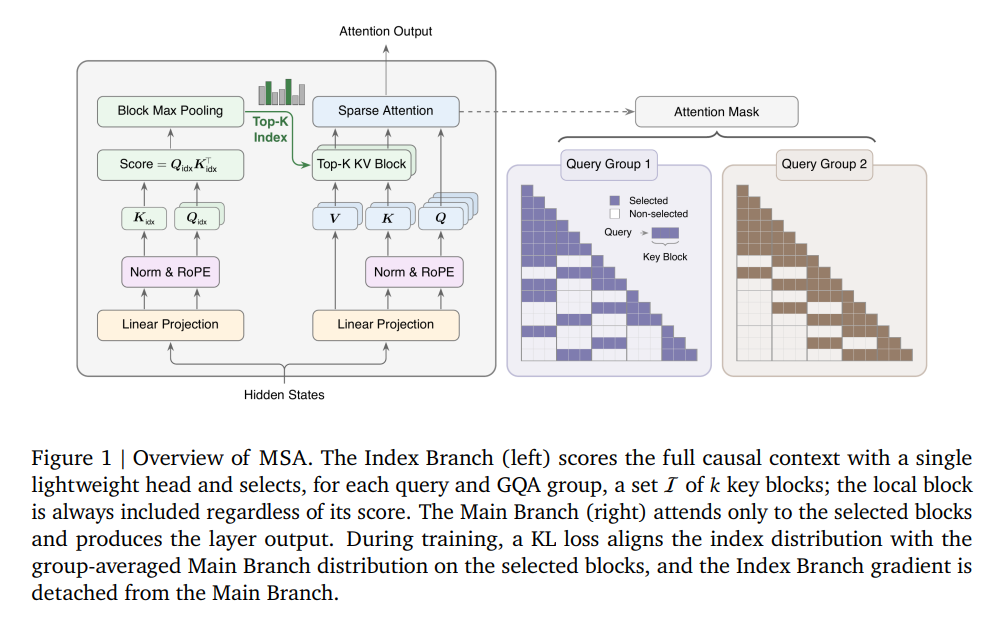
The key idea behind MiniMax Sparse Attention (MSA) is to overcome the quadratic computational cost of traditional softmax attention in long-context models by using a two-branch, blockwise sparse architecture co-designed for efficient GPU execution.
Here, instead of attending to every token in a million-token sequence, MSA uses a lightweight indexer to select only the most relevant subset for processing dynamically.
MSA Technicals
1. Two-Branch Architecture
MSA factors the attention process into two distinct stages:
- Index Branch: It is an ultra-lightweight module that scores causally visible key-value blocks. For each Grouped Query Attention (GQA) group, it selects a Top−k subset of blocks to attend to. It introduces only two small projection matrices to the standard GQA setup.
- Main Branch: This branch performs the actual softmax attention, but it is restricted solely to the causally visible tokens within the blocks chosen by the Index Branch.
2. Blockwise and Group-Specific Selection
- Efficiency through Blocks: To efficiently utilize the GPUs, MSA operates at block granularity (e.g., 128 tokens) rather than individual tokens. This reduces routing overhead and makes memory access more regular for GPU matrix operations.
- GQA-Based Sharing: Selection results are shared within each GQA group. While different groups can attend to different long-range stripes of data, all query heads within the same group share the same selected key-value blocks, balancing flexibility with efficiency.
3. Stable and Scalable Training
Because Top−k selection is non-differentiable, MSA uses several mechanisms to train the indexer:
- KL Alignment Loss: The indexer is trained using an auxiliary loss that forces its scores to match the actual attention distribution of the Main Branch.
- Indexer Warmup: Training begins with a brief full-attention phase to give the indexer a meaningful initialization and stabilize its selections before it takes control of routing.
- Forced Local Block: To prevent the model from ignoring immediate context, the local block containing the current query is always included in the selection, regardless of its score.
4. Algorithmic and Hardware Co-Design
A significant part of the MSA’s key idea is that theoretical compute savings are translated into real-world speed via specialized GPU kernels:
- Exp-free Selection: The indexer ranks blocks directly using raw scores, bypassing expensive softmax calculations during the selection phase.
- KV-Outer Iteration: The main attention kernel uses a KV-outer iteration order to maximize the arithmetic intensity on the GPU, which is particularly effective for block-granular access patterns.
By combining these elements, MSA can reduce per-token attention compute by 28.4x at a 1M context length while maintaining the performance parity with standard GQA models.
Experiment
MiniMax Sparse Attention (MSA) design is validated by testing it on a 109B-parameter Mixture of Experts (MoE) model trained on a 3T-token budget of text, image, and video data.
The experiments focus on two primary training routes compared against a Full-Attention GQA baseline:
- MSA-PT (Pre-trained): A model trained from scratch with MSA, including a 40B-token indexer warmup period.
- MSA-CPT (Continued Pre-training): A model that begins with a pre-trained Full-Attention checkpoint, replaces the attention layer with MSA, and continues training for 400B tokens.

Key Results
Training Stability: The training curves (LM loss and gradient norms) for native sparse pre-training (MSA-PT) were nearly identical to the full-attention baseline, indicating that MSA does not introduce optimization degradation or instability.
Conversion Efficiency: For the MSA-CPT model, the indexer warmup stage rapidly reduced KL loss, and the model maintained high “selection recall,” effectively retrieving the same important blocks that dense attention would have prioritized.
Performance Parity: Both sparse models remained competitive with the Full-Attention baseline across general reasoning, math, code, and multimodal benchmarks. MSA-PT specifically showed strengths in math and long-context retrieval, while MSA-CPT proved to be a practical route for converting existing dense checkpoints with minimal loss.
Long-Context Capability: Even with a highly restricted budget of only 2,048 key-value tokens per query, the models preserved long-context abilities on benchmarks like RULER and HELMET.
Efficiency Gains: At a 1M context length, MSA reduced per-token attention compute by 28.4x. This translated into actual wall-clock speedups of 14.2x for prefilling and 7.6x for decoding.


Wrapping it up
MiniMax Sparse Attention (MSA) is a highly efficient, minimal, and scalable blockwise sparse attention mechanism that effectively addresses the quadratic cost of traditional attention for ultra-long contexts.
Key takeaways include:
- Architectural Efficiency: MSA successfully attaches a lightweight Index Branch to a standard Grouped-Query Attention (GQA) layer, allowing each group to independently select relevant key-value blocks for processing.
- Performance Parity: Validated on a 109B-parameter MoE model, MSA preserves the capabilities of full-attention GQA across general reasoning, multimodal, and agent-oriented benchmarks.
- Significant Speedups: At a 1M context length, MSA reduces per-token attention compute by 28.4x. This theoretical reduction translates to real-world wall-clock speedups of 14.2x for prefilling and 7.6x for decoding on H800 GPUs.
- Seamless Integration: The design supports both training from scratch and the near-lossless conversion of existing pretrained GQA checkpoints.
Future Directions: The authors aim to further close the long-context retrieval gap through refined training and richer indexing, while also extending the selector-only design to reinforcement learning and agentic workflows where long-context costs are most restrictive.
Digital Products
ML Interview Book: Crack Your Next ML Interview with Machine Learning Interview Playbook
Productivity Tool: ***Social Media Time Tracker: Take Back Your Time, a tool that annoys you when you log in to social media sites. Chrome Extension.***
Connect with the author
LinkedIn | YouTube | Threads | Twitter | Instagram | Facebook
Reference
메타데이터
- post_id
- 3cec44d86339
- slug
- understanding-minimax-sparse-attention-3cec44d86339
- url
- https://medium.com/mlworks/understanding-minimax-sparse-attention-3cec44d86339
- canonical_url
- https://medium.com/mlworks/understanding-minimax-sparse-attention-3cec44d86339
- author_url
- https://medium.com/@mayur-ds
- status
- ok
- fetched_at
- 2026-06-22 08:06:21