“The US-China Stock Market Clash: Is Decoupling Finally Real?
Explore the untold story of sanctions, supply chains, and the silent war for financial supremacy.
“The US-China Stock Market Clash: Is Decoupling Finally Real?
Explore the untold story of sanctions, supply chains, and the silent war for financial supremacy.

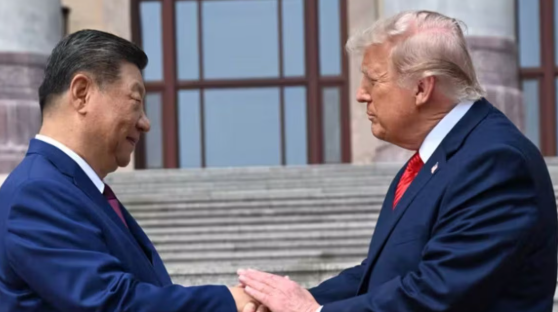
Image used from tbsnews
If you’ve been following global finance even loosely, you’ve probably noticed something feels different lately. Not just the usual noise of tariffs and political tensions something structural is shifting. And I’ve been watching it unfold with a mix of fascination and genuine concern, because what China is doing right now is not what most people think it is. It’s not missiles.
It’s not sanctions. It’s something far more calculated and in some ways, far more dangerous for the long-term dominance of the US financial system.
Let me walk you through what’s actually happening, why it matters, and what I think comes next.
Despite Trump’s Visit to Beijing, the Underlying Reality Hasn’t Changed
Let’s start here, because I think a lot of people got distracted by the optics.
There were handshakes. There were grand ballroom moments. There were photo ops that suggested some kind of thawing between Washington and Beijing. But if you look past all of that and listen carefully to what Western policymakers are actually saying, the strategy hasn’t budged even slightly.
Anthony Blinken made it about as plain as you can. The Western plan is to unite allied economies Europe, Japan, South Korea, India, Australia, Canada and use that collective weight to contain China and slow its rise. The idea is simple: the US alone represents about 25% of world GDP.
But with those allies lined up together, that number jumps to 50–60%. That’s a much harder wall for China to push through.
So the smiles and handshakes? Diplomatic theatre. The underlying posture is the same as it’s been for years. And China knows it.
China Responding Not With Sanctions, Not With Missiles
Here’s what I find genuinely fascinating about how China is playing this. They’re not responding the way Western governments typically respond with loud proclamations, export bans, or aggressive military posturing. They’re responding with financial precision.
The trade numbers already tell part of the story. China’s trade surplus with the US has already dropped by 31% that’s roughly $93 billion less flowing through bilateral trade. Both sides are reducing their exposure to each other. But China has now moved to the next phase, and this one hits closer to home for American markets. They’re going after the flow of Chinese retail money into US stocks and bonds.
This is the real decoupling. Not some economic theory. Not a think-tank scenario paper. It’s happening right now, in real time, and the moves are far more drastic than most Western financial media is letting on.
China Has Cracked Down Hard on Brokerages
Here’s the part that I think most people haven’t fully absorbed yet.
Beijing has gone after the brokerages that were helping Chinese mainland money flow into US markets. And we’re not talking about a light-touch regulatory slap. The fines being handed out are running into the tens to hundreds of millions of dollars per institution. But the fines aren’t even the most significant part.
Two additional punishments have been imposed that go much further. First, all Chinese mainland accounts with these brokers must be closed within two years. Every single position in US stocks will have to be liquidated. Forced selling. Mandatory unwinding. Call it what you want the result is the same. Chinese money in American equities is getting pulled out.
Second and this is the part that really shocked me Beijing is confiscating the profits investors made through these accounts. Clawing back gains from people who were just trying to grow their savings. That is a serious, draconian message. It’s Beijing telling its own citizens: we do not want Chinese money in American assets, full stop.
Beijing Is Sending a Message to Everyone
The logic here is actually pretty straightforward once you see it clearly.
To buy US stocks or bonds, you first have to buy dollars. Every yuan converted to dollars is Chinese currency being moved into the US financial system. Beijing doesn’t want that. They want the yuan to stay strong. They want domestic capital cycling inside China’s own markets, growing China’s own financial ecosystem. And this strategy is already working in measurable ways.
Chinese bonds have posted over 1% in gains even as Western bonds have been falling. Domestic investors who stayed at home have been getting rewarded for it.
Meanwhile, the yuan has hit a three-year high up 3% year to date against the dollar. That doesn’t happen by accident. A stronger yuan makes Chinese assets more attractive to both domestic and global investors, which draws more capital in. It’s a deliberate loop, carefully engineered.
The Closed Loop System Beijing Is Building
What Beijing is actually constructing is an elegant closed-loop financial system. Any Chinese money that goes overseas must flow through official government channels. Any investment in Hong Kong or elsewhere must be structured so that returns flow back to China in yuan. The pathway for ordinary Chinese middle-class savers to quietly open a global brokerage account and park their savings in the S&P 500? That door is being sealed shut.
And think about what that means for the US Treasury market. Treasury Secretary Bessant needs to borrow nearly $900 billion over the next five months. That is an enormous amount of debt issuance in a very compressed time frame.
He needs buyers not casual buyers, but structural buyers who show up to every auction regardless of yield, regardless of geopolitical tension, regardless of what inflation is doing.
Chinese retail money was part of that buyer base. Now it isn’t. And without that consistent bid, the already-dangerous trajectory of US Treasury yields climbing higher becomes even more difficult to manage. Every basis point of yield that rises adds billions of dollars to the annual debt burden.
China Is Using the Iran War to Attack the Dollar at Its Foundation
But cutting off retail investment flows into US markets is only one part of what China is doing. The other part goes much deeper all the way down to the foundation of the entire post-war dollar system.
Analysts have been calling this the “golden window” for the Chinese yuan. And it centers on one scenario: oil. Specifically, the Strait of Hormuz and the possibility that Iran demands oil transiting through it be settled in yuan, not dollars. If that happens at scale, the petrodollar system which has been the bedrock of dollar dominance since the 1970s is effectively over.
We’re already seeing early movement in that direction. The value of transactions settled through China’s CIPS payment system surged dramatically in March.
The single-day peak in April hit 1.2 trillion yuan across 42,000 transactions in a single day. Countries around the world watched what happened to Russian assets after 2022, and they’re watching sanctions now being applied to Iran, and they’re quietly looking for payment systems that Washington cannot turn off. China’s system is filling that gap.
The most dollar-dependent trade on Earth energy is starting to migrate toward a Chinese payment infrastructure. That’s not a small shift.
Washington’s Response Is Stablecoins And That’s a Problem
Washington knows this is happening. And their answer, at least partly, is stablecoins. The plan which Bessant has been building toward for at least a year is to create a $3.7 trillion stablecoin market by 2030. The logic is that stablecoin issuers have to hold dollars as reserves, which creates a new structural buyer base for US debt.
I understand the logic. But I’m skeptical, and here’s why.
Petrodollar demand was structural in the truest sense. Countries that need oil have to buy it every single day. That creates constant, reliable, inescapable demand for dollars. Stablecoin demand is nothing like that. It’s speculative. It’s fickle. It can evaporate overnight when risk sentiment turns. You can’t replace 50 years of petrodollar recycling with a cryptocurrency instrument and call it a solution.
Meanwhile, Iran’s state media has confirmed that the Strait of Hormuz remains very much under Iranian control. More oil trade is migrating to yuan settlement with every passing week. The window for defending the petrodollar is closing faster than Washington is moving.

Image used from economist
China’s Gold Clearing System in Hong Kong Changes Everything
Here’s the part of the story that I think ties everything together and it’s the part most people haven’t heard about yet.
Not every country wants to hold Chinese stocks. Not every central bank or sovereign wealth fund trusts the yuan enough to park large reserves in it. Beijing knows this. There’s still a trust deficit that even China cannot overcome in a year or five years.
So, they need something else. Something neutral. Something the entire world already accepts as a store of value, completely outside of the existing dollar-dominated financial system.
That something is gold.
China is launching a gold clearing system in Hong Kong this July. And this is genuinely groundbreaking. Right now, the overwhelming majority of the world’s physical gold trading is settled through London and the New York COMEX system. That infrastructure gives the West enormous influence over how gold is priced and in what currency it’s bought and sold. Beijing wants to break that.
Global physical gold trading runs at roughly $100 billion a day through those two systems. China wants a meaningful slice of that, and they’re building the infrastructure to capture it including unallocated accounts for faster, more scalable trading so investors can buy and sell gold without physically moving bars. Hong Kong is also expanding its gold storage capacity to 2,000 tons to back all of this up.
China’s Own Gold Accumulation Tells You How Seriously They Take This
If you want to understand how committed China is to this gold strategy, just look at their buying behavior. Official holdings have been growing for 18 consecutive months without a single pause. They now officially hold over 9% of total reserves in gold. But and this is important China is widely known to underreport its gold holdings. They buy through the central bank, through state-owned entities, and reportedly through military channels as well. The real number is almost certainly much higher than what they admit to.
If you control the gold clearing system and you hold more gold than anyone else knows about, you are positioning yourself to be the dominant financial power in a world that is slowly moving away from dollar-based infrastructure.
That’s not an accident. That’s a decade-long strategy reaching its conclusion phase right now.
Washington Created the Opportunity China Is Exploiting
Here’s my honest take, and it’s not entirely comfortable to say.
China didn’t cause this. Washington did.
The excessive money printing since 2020 created the inflation that eroded trust in the dollar. The weaponization of SWIFT and the freezing of Russian central bank assets sent a clear message to every country on Earth: if you’re on the wrong side of Washington, your reserves can be seized.
The Iran conflict is creating an energy shock that’s frustrating governments globally. Every one of these decisions opened a door that China has very skillfully walked through.
China didn’t create these crises. They just positioned themselves patiently and deliberately to benefit from every single one of them.
I find it hard to argue that Beijing has played this badly. Whether you agree with their system of government or not, their financial strategy over the past decade has been remarkably coherent. While Washington has been reactive, China has been playing a long game. And right now, that long game is starting to pay off in ways that will be very difficult for the US to reverse quickly.
The shift happening right now is real, it’s structural, and it’s moving faster than most of the financial press is acknowledging. Whether Beijing fully cuts off all retail investment flows to the US, whether Hong Kong’s gold clearing system successfully challenges London and COMEX these are genuinely open questions. But the direction of travel is clear.
Pay attention to what China does next, not what Western politicians say about it. The gap between the narrative and the reality is where the real story always lives. Stay curious, keep watching the numbers, and don’t let the diplomatic theatre distract you from the underlying shifts that are already well underway.
메타데이터
- post_id
- 3cee0943a2d4
- slug
- the-us-china-stock-market-clash-is-decoupling-finally-real-3cee0943a2d4
- url
- https://medium.com/geopolitics-beyond/the-us-china-stock-market-clash-is-decoupling-finally-real-3cee0943a2d4
- canonical_url
- https://medium.com/geopolitics-beyond/the-us-china-stock-market-clash-is-decoupling-finally-real-3cee0943a2d4
- author_url
- https://medium.com/@quotesnjokes07
- status
- ok
- fetched_at
- 2026-06-09 15:37:30