DeepSpeed is Revolutionizing LLM Training
Non-members can read for free
DeepSpeed is Revolutionizing LLM Training
***Non-members can read for free***
Training massive Large Language Models (LLMs) used to be a significant bottleneck in AI development: painfully slow, prohibitively expensive, and requiring resources beyond the reach of most researchers. But, a powerful open-source library named DeepSpeed has fundamentally changed the landscape, making it easier and faster to train and fine-tune models that were once considered unfeasible.
DeepSpeed, developed by Microsoft, has emerged as the crucial engineering backbone powering many state-of-the-art LLMs today. It provides the system-level optimizations necessary for massive training runs, abstracting away the immense complexity of distributed machine learning.
The Core Engine: ZeRO (Zero Redundancy Optimizer)
The heart of DeepSpeed’s magic lies in a groundbreaking technology called the Zero Redundancy Optimizer (ZeRO).
Traditional distributed training methods duplicate model states (optimizer states, gradients, and parameters) across every GPU, which rapidly consumes available memory and limits model size. ZeRO solves this challenge by intelligently partitioning these states across different GPUs.
This smart partitioning removes memory redundancy, effectively allowing developers to train models that far exceed the memory limits of a single graphics processing unit.
Why DeepSpeed Matters for Modern AI
DeepSpeed isn’t just a minor tweak; it represents a comprehensive toolkit for next-generation AI development. Here’s a closer look at its transformative features:
1. Unmatched Scaling Capabilities
With ZeRO at its core, DeepSpeed provides robust memory optimization that makes training models with trillions of parameters a reality. It democratizes the ability to work with frontier models, moving massive-scale AI from hypothetical to practical.
2. Dramatic Speed Improvements
DeepSpeed isn’t just about size; it’s about speed. Through advanced kernel optimizations and various parallelism techniques, the library can deliver up to 10x faster training throughput compared to native PyTorch distributed training methods.
3. Comprehensive 3D Parallelism
DeepSpeed incorporates a sophisticated 3D parallelism strategy:
- Data Parallelism: Distributing data batches across devices.
- Tensor Parallelism: Splitting individual tensor operations across devices.
- Pipeline Parallelism: Breaking the model layers into stages handled by different devices.
This multi-dimensional approach ensures optimal resource utilization for the largest possible models.
4. Optimized Inference for Deployment
The benefits of DeepSpeed extend beyond training. It includes powerful inference optimizations that significantly reduce latency and memory usage when serving these large LLMs in production environments, a critical factor for deploying real-world AI applications efficiently.
Seamless Integration and Open Source Commitment
Perhaps one of the most compelling features of DeepSpeed is its ease of use. It works seamlessly with the popular PyTorch framework and slots directly into existing training loops with minimal code changes.
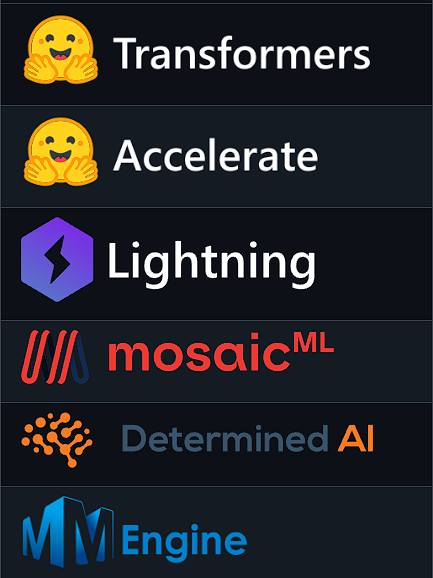
DeepSpeed integrated with several different popular open-source DL frameworks
DeepSpeed handles the heavy lifting of distributed engineering complexity, allowing AI researchers and engineers to focus on model architecture and innovation rather than system constraints.
Best of all, it is open source. This commitment ensures continuous community improvement and broad accessibility to the tools needed to push the boundaries of AI research and application.
DeepSpeed Installation Requirements
Before you supercharge your AI training with DeepSpeed, ensure your environment meets these necessary prerequisites:
Software Requirements
- PyTorch: PyTorch must be installed before installing DeepSpeed. For full feature support and compatibility, the developers recommend using a version of PyTorch that is
>= 1.9, ideally the latest stable release. - Compilers: A CUDA or ROCm compiler (such as
nvccorhipcc) is required to compile the necessary C++/CUDA/HIP extensions.
Hardware (GPU) Requirements
While DeepSpeed might work on other hardware configurations, it is most extensively developed and tested on specific GPU architectures.
- NVIDIA: Pascal, Volta, Ampere, and Hopper architectures are the primary focus of development and testing.
- AMD: MI100 and MI200 GPUs are officially supported and tested.
Conclusion
In conclusion, DeepSpeed has effectively removed many of the historical barriers to training cutting-edge AI, shifting the focus from managing system constraints back to advancing machine learning research itself. By intelligently managing memory and optimizing speed through innovations like ZeRO and 3D parallelism, this open-source library allows researchers and developers to build larger, faster, and more capable LLMs using existing PyTorch infrastructure. With the right hardware and software prerequisites in place, integrating DeepSpeed is a straightforward path to unlocking hyperscale capabilities and accelerating the next wave of AI innovation.
References
[1] https://www.microsoft.com/en-us/research/project/deepspeed/
메타데이터
- post_id
- 3cf7b3a7fbe8
- slug
- deepspeed-is-revolutionizing-llm-training-3cf7b3a7fbe8
- url
- https://pub.towardsai.net/deepspeed-is-revolutionizing-llm-training-3cf7b3a7fbe8
- canonical_url
- https://pub.towardsai.net/deepspeed-is-revolutionizing-llm-training-3cf7b3a7fbe8
- author_url
- https://medium.com/@ml-point
- status
- ok
- fetched_at
- 2026-07-13 06:23:13