Weathering the Storm: Why Climate Change Hits Outdoor Tomatoes Harder Than Greenhouse Crops
If you’ve walked through your shamba or garden recently, you might have noticed that growing outdoor tomatoes feels more like a gamble than…
Weathering the Storm: Why Climate Change Hits Outdoor Tomatoes Harder Than Greenhouse Crops
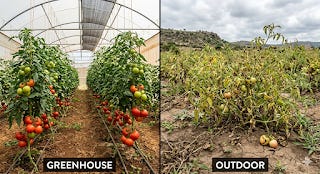
If you’ve walked through your shamba or garden recently, you might have noticed that growing outdoor tomatoes feels more like a gamble than it used to. One season you’re dealing with unexpected, scorching heatwaves; the next, a sudden deluge of unseasonal rainfall floods your acreage.
While tomatoes are inherently sun-loving plants, the increasing unpredictability caused by climate change is shifting the rules of agriculture. If you are growing tomatoes in the open air, your crop is on the front lines of this environmental shift. Meanwhile, greenhouse farmers are experiencing a very different reality.
Here is a deep dive into why climate change is disproportionately affecting outdoor tomato production, and why protected environments are winning the battle.
1. Temperature Extremes and the Pollination Crisis
Tomatoes may love the warmth, but they have a strict thermal comfort zone when it comes to reproduction. To successfully set fruit, tomatoes generally require daytime temperatures below 32°C and nighttime temperatures between 13°C and 21°C.
- The Outdoor Reality: Climate change has led to a spike in erratic heatwaves. When outdoor temperatures breach that 32°C threshold-or if nights remain suffocatingly hot-the pollen grains inside the tomato blossoms become sterile. The flowers dry up and drop off the vine without ever producing a single fruit, a devastating phenomenon known as blossom drop.
- The Greenhouse Advantage: In a greenhouse, a farmer isn’t entirely at the mercy of the midday sun. Through the strategic use of shade nets, roof vents, evaporative cooling fans, or simple misting systems, greenhouse growers can artificially shave several degrees off the internal temperature, keeping the plants safely within their optimal breeding zone.
2. Erratic Rainfall: The Enemy of Fruit Quality
Climate change doesn’t just mean things are getting hotter; it has completely disrupted traditional rainfall patterns. We now see prolonged dry spells followed by sudden, intense downpours.
- The Outdoor Reality: This rapid oscillation between bone-dry soil and waterlogged roots is catastrophic for outdoor tomatoes. When a thirsty, heat-stressed plant suddenly absorbs a massive influx of water from an unexpected heavy rain, the interior of the fruit expands faster than the outer skin can stretch. The result? Fruit cracking and splitting, which exposes the crop to rot and ruins its market value. Furthermore, alternating moisture levels prevent the plant from absorbing calcium properly, leading to the dreaded blossom end rot (where the bottom of the tomato turns black and leathery).
- The Greenhouse Advantage: Greenhouse cultivation completely eliminates rain variability. Water is delivered precisely and consistently via drip irrigation networks. Because the root zone experiences a steady, predictable moisture level, greenhouse tomatoes rarely suffer from the expansion shocks that split outdoor crops open.
3. Shifting Pest Dynamics and Disease Pressure
As global temperatures climb, the behavior, geographic range, and lifecycles of destructive agricultural pests are changing rapidly.
- The Outdoor Reality: Warmer winters and longer summers mean that pests like whiteflies, spider mites, thrips, and the notorious leafminer ( Tuta absoluta) no longer die off or go dormant. Instead, they multiply faster, producing more generations per season. Outdoor crops are entirely exposed to these migrating swarms. Additionally, unseasonal, humid rainfall creates the perfect breeding ground for fungal disasters like Early Blight and Late Blight, which can wipe out an entire open-field crop in a matter of days.
- The Greenhouse Advantage: A greenhouse acts as a physical fortress. Insect-proof netting on vents keeps flying pests out, dramatically reducing the need for heavy chemical spray regimens. Furthermore, because rain is kept off the foliage inside a greenhouse, the leaves stay dry, significantly lowering the humidity levels required for fungal spores to germinate and spread.
4. Soil Degradation and Nutrient Leaching
The health of your tomato crop starts directly in the dirt. Intense weather directly degrades the topsoil that outdoor farmers rely on.
- The Outdoor Reality: Flash flooding caused by severe weather events physically washes away fertile topsoil and leaches vital, water-soluble nutrients (like nitrogen and potassium) deep into the earth, far below where tomato roots can reach. Outdoor farmers are forced to constantly reapply fertilizers, increasing production costs in an unstable market.
- The Greenhouse Advantage: Greenhouse soil is highly managed and protected from erosion. Many modern greenhouse operations even use soil-less media (like coco peat or pumice) fed by precise fertigation systems. The nutrients go directly to the roots without any risk of being washed away by a storm.
Summary: A Tale of Two Microclimates
The Way Forward
Does this mean outdoor tomato farming is dead? Absolutely not. But it does mean open-field farmers must adapt. If you are growing outdoors in this changing climate, incorporating strategies like heavy mulching to preserve soil moisture, installing temporary shade cloth during peak summer months, and selecting heat-tolerant, disease-resistant hybrid seed varieties are no longer optional-they are essential for survival.
Originally published at https://kbelfu.blogspot.com.
메타데이터
- post_id
- 3cf99de7cd70
- slug
- weathering-the-storm-why-climate-change-hits-outdoor-tomatoes-harder-than-greenhouse-crops-3cf99de7cd70
- url
- https://medium.com/@kbelfu/weathering-the-storm-why-climate-change-hits-outdoor-tomatoes-harder-than-greenhouse-crops-3cf99de7cd70
- canonical_url
- https://medium.com/@kbelfu/weathering-the-storm-why-climate-change-hits-outdoor-tomatoes-harder-than-greenhouse-crops-3cf99de7cd70
- author_url
- https://medium.com/@kbelfu
- status
- ok
- fetched_at
- 2026-06-11 12:34:08